


18,99 €
Mehr erfahren.
- Herausgeber: John Wiley & Sons
- Kategorie: Fachliteratur
- Sprache: Englisch
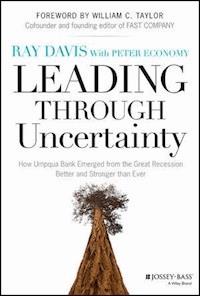
From the CEO of Umpqua Bank, the essential leadership practices that allowed the West Coast's largest independent community bank to emerge from the economic crisis even stronger than before In this follow-up to the successful Leading for Growth, Umpqua Bank CEO Ray Davis shares the tactics and strategies that have allowed Umpqua to grow and succeed in the toughest economic environment. The results are clear: despite years of economic uncertainty, Umpqua has continued its upward trajectory--expanding from five locations in 1994 to more than 200 today. Davis's approach can help leaders recalibrate their approaches, no matter what the industry or market upheaval they face. In Leading Through Uncertainty, Davis shares a concise set of smart, actionable leadership practices that leaders can use to navigate their businesses and teams through difficult times. These include focusing on honesty and transparency, motivating and inspiring employees, building an outstanding corporate reputation, paying attention to details, and more. By showing leaders how to maintain a clear value proposition and strong leadership, Leading Through Uncertainty will help any company secure a lasting foothold in any economy.
Sie lesen das E-Book in den Legimi-Apps auf:
Seitenzahl: 271
Veröffentlichungsjahr: 2013
Ähnliche


















Contents
Foreword
Introduction: The Great Uncertainty
Part 1: Leading Yourself
Chapter 1: The New Normal
A World in Flux
Change the Game
Be Agile—You Can’t Stand Still
Relentless Progress is the Key
Deal with It
Chapter 2: The Truth, Nothing But the Truth
Why I Tell the Truth
Being Truthful with Yourself
Chapter 3: Problems and the Healing Process
The State of Denial
Timing is Everything
Encourage Your People to Step Up
Chapter 4: Control and Uncertainty
Managing the Risk Element
Worry About What You Can Control
Two Aspects of A Leader’s Job: Controllable Results and Uncertainty
Black and White: Making Decisions Easy
Do Your Best, Get Input, and Remember—It’s Just a Number!
Chapter 5: Exercise Your Intuition
Intuition and Customer Relations
Listen and Act
Know When to Act
When You Trust Your Intuition, Opportunities Follow
Regular Practice Will Strengthen Your Intuition
Part 2: Leading Your Organization
Chapter 6: Be Really Good at the Basics
Company Standards and Ethics
Core Values of the Leadership Team
Believe in Yourself
Chapter 7: The Value of a Value Proposition
Price is a Death Spiral
Living Your Value Proposition
Creating Your Value Proposition
Communicating Your Value Proposition
Nurturing Your Value Proposition
Chapter 8: Be Available
Keep Your Organization Flat
Be Available to Everyone: Associates, Customers, Suppliers, and the Public
How Else Can You Lead in Difficult Times?
Be Confident; Be Real
Chapter 9: Motivate and Inspire
Sincerity, Trust, and Passion
The Value of People in Uncertain Times
The Value of Team Players
An Infrastructure for Motivating Our People
Chapter 10: Leverage Your Assets
Leveraging Technology
Businesses are More Efficient Because They Have to Be to Survive
Learn to Make 1 + 1 = 4
Part 3: Leading the Way
Chapter 11: Reputation Counts
Occupy Umpqua
No Chipped Paint
Ripples on a Pond
Chapter 12: Create Buzz (But Manage Crisis)
In Today’s Noisy World, Buzz is Critical
Rumors Start Fast (and Bad News Spreads Faster)
You are Best at Delivering Your Message
Corny is (Very) Good
Power of the Unexpected
Chapter 13: Build Momentum
Know When to Hit the Gas, and When to Slow Down
With Uncertain Times Come Great Opportunities
Bring in Incremental Resources to Build Momentum
Chapter 14: Practice Incremental Evolution
Sustaining a Competitive Gap
Study Industries Outside Your Own
Easier to Do in Good Times Than in Bad
Conclusion: Lead On
Acknowledgments
About the Authors
More from Wiley
Index
Design concept by Gearbox
Cover photograph by Vito Palmisano | Getty
Copyright © 2014 by Ray Davis. All rights reserved.
Published by Jossey-Bass
A Wiley Imprint
One Montgomery Street, Suite 1200, San Francisco, CA 94104-4594—www.josseybass.com
No part of this publication may be reproduced, stored in a retrieval system, or transmitted in any form or by any means, electronic, mechanical, photocopying, recording, scanning, or otherwise, except as permitted under Section 107 or 108 of the 1976 United States Copyright Act, without either the prior written permission of the publisher, or authorization through payment of the appropriate per-copy fee to the Copyright Clearance Center, Inc., 222 Rosewood Drive, Danvers, MA 01923, 978-750-8400, fax 978-646-8600, or on the Web at www.copyright.com. Requests to the publisher for permission should be addressed to the Permissions Department, John Wiley & Sons, Inc., 111 River Street, Hoboken, NJ 07030, 201-748-6011, fax 201-748-6008, or online at www.wiley.com/go/permissions.
Limit of Liability/Disclaimer of Warranty: While the publisher and author have used their best efforts in preparing this book, they make no representations or warranties with respect to the accuracy or completeness of the contents of this book and specifically disclaim any implied warranties of merchantability or fitness for a particular purpose. No warranty may be created or extended by sales representatives or written sales materials. The advice and strategies contained herein may not be suitable for your situation. You should consult with a professional where appropriate. Neither the publisher nor author shall be liable for any loss of profit or any other commercial damages, including but not limited to special, incidental, consequential, or other damages. Readers should be aware that Internet Web sites offered as citations and/or sources for further information may have changed or disappeared between the time this was written and when it is read.
Jossey-Bass books and products are available through most bookstores. To contact Jossey-Bass directly call our Customer Care Department within the U.S. at 800-956-7739, outside the U.S. at 317-572-3986, or fax 317-572-4002.
Wiley publishes in a variety of print and electronic formats and by print-on-demand. Some material included with standard print versions of this book may not be included in e-books or in print-on-demand. If this book refers to media such as a CD or DVD that is not included in the version you purchased, you may download this material at http://booksupport.wiley.com. For more information about Wiley products, visit www.wiley.com.
Library of Congress Cataloging-in-Publication Data
Davis, Ray, date
Leading through uncertainty : how Umpqua Bank emerged from the Great Recession better and stronger than ever / Raymond P. Davis.—First edition.
pages cm
Includes index.
ISBN 978-1-118-73302-8 (hardback)—ISBN 978-1-118-78257-6 (pdf)—ISBN 978-1-118-78260-6 (epub)
1. Umpqua Bank. 2. Community banks—Oregon—Portland—Management. 3. Banks and banking—Oregon—Portland—Management. 4. Leadership. I. Title.
HG2613.P84U473 2014
332.1'609797—dc23
2013027869
For the associates of Umpqua Bank.
You lead, you motivate, and you inspire.
Foreword
More than a century ago, Theodore Roosevelt offered a definition of success that has stood the test of time. “Far and away the best prize that life offers,” he said, “is the chance to work hard at work worth doing.” By that definition, Ray Davis is one of the most successful business leaders I have ever met. He and his colleagues at Umpqua Bank have worked harder, smarter, and with more passion and authenticity than the leadership of any other bank I know—and, to be honest, just about any organization in any field that I know. And their work is certainly worth doing—building a company, a brand, a presence in the marketplace that stands out from the crowd and stands for something special.
Leading Through Uncertainty is Ray’s second effort to share with the world (with all his trademark modesty) what he and his colleagues have learned during their incredible twenty-year journey of innovation, service, and exceptional financial performance. His first book, Leading for Growth, was published in March 2007, when the banking business, and the world economy as a whole, were riding high and enjoying the tailwinds of housing booms and fast-paced growth. His new book appears at a very different moment in the economy and in the psychology that animates leaders and shapes their outlook. Most companies in most industries, and certainly in the banking industry, are operating in the face of fierce headwinds—the hangover from the worst financial collapse since the Great Depression, frustratingly slow growth in the real economy, a hard-to-shake sense of distrust between customers and the companies with which they do business.
And yet the Ray Davis you will encounter in these pages, the Umpqua Bank that he and his writing colleague, Peter Economy, bring to life, is every bit as confident, every bit as passionate, every bit as daring as was the case during the height of the boom. That’s because even as the world changes—as the Internet and social media reinvent the technologies of banking, as financial trends and government policies reshape the environment of banking—Ray and his colleagues have remained true to their values, their belief system, their distinctive point of view about what their company could be and the role it could play in their customers’ lives.
In a book filled with powerful insights, pragmatic takeaways, and colorful stories, this to me is Ray’s ultimate lesson, and one that applies in good times and tough times. He understands, as few other CEOs do, that we are living today through the Age of Disruption. You can’t do big things anymore, as a company or a leader, if you are content with doing things a little better than everybody else, or a little differently from how you did them in the past. In an era of hypercompetition and nonstop dislocation, the only way to stand out from the crowd is to stand for something special. Originality has become the acid test of every company’s strategy.
The term I like to use is strategy as advocacy—and Ray and his colleagues are persuasive advocates for their approach to strategy. They understand that the most successful companies don’t just offer competitive products and services. They champion compelling ideas—ideas that shape the competitive landscape of their field, ideas that reshape the sense of what’s possible for customers, for colleagues, for investors. As I look at companies that are winning big in difficult circumstances, I see that a richly defined values proposition beats a dollars-and-cents value proposition every time.
To be sure, no one will mistake Umpqua Bank for one of the financial services juggernauts headquartered in New York or Hong Kong, and no one will mistake Ray himself for a Master of the Universe or a Titan of Finance. And that’s the beauty of this book. Ray’s insights and messages are worth reckoning with not because of the size of his bank’s balance sheet (although all those billions of dollars of assets are beginning to add up), but because of the power of his ideas and their relevance to many leaders running companies in many different industries.
For a long time, we lived in a world where the strong took from the weak. If you had the most established brand, the widest global reach, the deepest pockets, you won almost automatically. That world is over. The new logic of success is that the smart take from the strong. The most successful companies I have gotten to know don’t just try to outcompete their rivals. They aspire to redefine the terms of competition in their field by embracing one-of-a-kind ideas in a world filled with me-too, copycat thinking. In Ray’s memorable words, these companies “find the revolution before the revolution finds them.”
Ideas truly matter. But there’s a second core message to Ray’s book, a second defining principle of his approach to leadership, that it’s important to underscore. It’s a lesson I’ve learned and relearned during this long economic crisis—and even though it’s a simple lesson, it’s one that’s all too easy to overlook. Yes, the most successful leaders and companies think differently from everyone else. But they also care more than everybody else—about customers, about colleagues, about how the organization conducts itself in a world with endless opportunities to cut corners and compromise on values. You can’t be special, distinctive, compelling in the marketplace unless you create something special, distinctive, compelling in the workplace. Your strategy is your culture; your culture is your strategy. That’s why the most effective leaders serve an agenda larger than themselves and create organizations where everyone shares a common cause.
This, to me, is what ultimately makes Ray Davis and Umpqua Bank so special. Ray is a CEO, and Umpqua is a company of more than twenty-five hundred people who care deeply about the impact they’re having, the legacy they’re leaving, the difference they’re making in the lives of their customers and communities. It is also, by the way, what makes this book so special. Ray obviously cares enough about what he and his colleagues have built to share the lessons they’ve learned, the successes they’ve enjoyed, and the mistakes they’ve made with an audience of leaders who are working hard inside their own companies on work worth doing.
Thanks to Ray for sharing his insights, and good luck to all of you benefiting from it as you pursue, in the words of Theodore Roosevelt, “the best prize that life offers.”
William C. Taylor
cofounder and founding editor of Fast Company and author of Practically Radical
Introduction: The Great Uncertainty
Much of the world is stuck in the economic doldrums, a place where there is precious little breeze to push the weathervane in any particular direction. Is the economy headed toward growth and prosperity, or is an even bigger recession just around the corner? Will this be the year that unemployment rates finally return to manageable levels, or are the increasing ranks of people who have dropped out of the job market entirely going to be a heavy anchor that keeps our economy from moving forward? Is there an inflationary (or deflationary) spiral in our not-too-distant future?
When will things get back to normal? Will they ever get back to normal?
I call this time in history the Great Uncertainty, and it’s the place where we find ourselves today. No one really knows with any degree of confidence where our economy is headed and whether the general business environment will be better or worse in the coming months or years. I personally believe that the uncomfortable new normal of uncertainty we find ourselves in today is a long-term reality that business leaders will be forced to deal with for at least the next five years. To succeed, we as leaders cannot afford to complain about the uncertainty out there—in our economy, our markets, our government representatives and regulators, our customers, our people. We must instead find ways to deal with this new normal, and to profit, even during the Great Uncertainty.
We must be leaders. We must lead.
My first book, Leading for Growth, was published in late 2007, before the 2007 financial crisis had taken hold of the economy. While I was writing that book, the U.S. economy was strong and growing, the housing market was seen by many as indestructible (or at least indefatigable), and consumer confidence was as high as it had ever been. Leading for Growth was written to offer a fresh look at how leaders could steer their companies to long-term success. That book offered tools and techniques that could be embraced by all people who found themselves in a leadership role. Leading for Growth didn’t take an MBA to understand or put into practice. It was a down-to-earth reminder of the basic leadership tenets that have proven year after year to be effective in leading a company for growth.
Throughout the book, I provided examples of how leaders have put these skills to work within their companies. As the CEO of Umpqua Holdings Corporation, the holding company for Umpqua Bank, a regional community bank headquartered in Portland, Oregon, I was also able to relate specific stories of how Umpqua benefited from many of these leadership principles. Although I often used Umpqua Bank to demonstrate how we applied these practices, Leading for Growth was written for all leaders in all industries, and I heard from many executives both inside and outside the banking industry who put them to work.
As we look back to the period leading up to the onset of the Great Recession, the effects of which still negatively affect the world today, who would have thought that our economy would fall as far as it did? Who would have thought that the housing market would drop as fast as it did and affect so many Americans so dramatically? Who would have thought that our problems would become contagious and affect the economy throughout the rest of the world?
Few people imagined just how bad things would get or how long it would take to recover. However, one thing was certain throughout: effective leadership during difficult times is not only needed; it is required.
Leading Through Uncertainty addresses just that: the importance of leadership within organizations competing during challenging and uncertain times—and also through times of growth. Let’s face it: effective leadership is motivating, and it can and should be the energy that propels a company through inevitable waves of change. Poor leadership can lead to disaster and has sunk more than a few companies and governments alike.
In Leading for Growth I wrote, “There is no Door Number 3.” I meant that leaders have to be willing to address, accept, and welcome change instead of fighting it, ignoring it, or simply hoping it will go away. Change happens, and trying to stay the same isn’t practical: it’s too costly and is an impossible proposition. I believe that this still applies for leaders. You have to be ready and able to adapt to rapid changes during times of great difficulty and uncertainty—and also during times of great innovation or growth. It also means that when things get tough, a leader can either choose Door Number One (meaning, suck it up and do what you know you need to do—lead), or choose Door Number Two (meaning, get the hell out of the way!). There is no Door Number Three.
Although Umpqua wasn’t immune to economic turmoil, we were disciplined and proactive, and that approach served us well. We identified potential challenges early and took action immediately—before most other companies had even acknowledged that the economy was in trouble. Although our bold response wasn’t popular on Wall Street at the time, it positioned the bank as one of the most stable in the industry.
Throughout, we remained focused on both navigating the recession and our long-term growth strategy. Despite the challenging economic environment, that strategy never wavered. We remained focused on building a different kind of bank—one that combines the sophisticated products and expertise of a big bank with the service and local engagement of a community bank. This allowed us to remain opportunistic in ways that advanced our growth. During this time, we completed four transactions assisted by the Federal Deposit Insurance Corporation (FDIC), adding significantly to our geographic reach while protecting the financial health of communities in Nevada and Washington State.
And we were able to act quickly when we saw the economic storm beginning to calm, expanding our company in ways that would build for the future. We added wealth management, international banking, and capital markets divisions; expanded our commercial teams in key markets; and built new stores to complement those acquired through the FDIC deals.
As a result, Umpqua’s balance sheet today is even stronger than it was when the financial crisis began. And we’ve continued to grow, nearly doubling in size since 2007, from 120 to more than 200 stores and from $7 billion to $12 billion in assets.
* * *
Over the past several years, I’ve learned firsthand the power of strong leadership. In this book, I outline qualities that leaders need to motivate and inspire their people in times of change, both to protect their businesses when market conditions are difficult and to build confidence and momentum in times of positive change.
Leading Through Uncertainty reminds leaders to:
Remember that the truth will set them free.
Remain agile in the face of uncertainty and change.
Keep their heads out of the sand when problems arise.
Understand the value of intuition and why it’s important for their people to exercise theirs.
Motivate and inspire their people in order to build successful companies.
Recognize the need for momentum and the value of leverage.
Build a company culture that reinforces a meaningful value proposition.
Problems don’t normally evaporate without leadership, and by understanding and practicing basic leadership principles, leaders can successfully navigate their companies through even the roughest water. Like Leading for Growth, this book is a conversation on leadership rather than a how-to manual. In my first book, I wrote about the nature of change and how it encourages us to think of leadership in a new way. As we slowly leave the Great Recession further behind and work our way through the Great Uncertainty, this book takes those who understand the challenges of leadership during difficult times and urges them to practice their skills and apply them for the benefit of their people, their customers, their organizations, and their communities.
Leading Through Uncertainty is divided into three parts: Leading Yourself, Leading Your Organization, and Leading Your Industry. Each part explores an essential aspect of leadership practice. You can’t be a truly effective leader without becoming proficient in each of these areas of leadership practice.
Part 1, “Leading Yourself,” is about how a leader has to get comfortable within his or her own skin in order to lead others effectively. In other words, how confident are you, the leader, in yourself? It shouldn’t be difficult, but unfortunately all too often it’s painful for leaders to be truthful with both themselves and with fellow workers. We frequently read stories in the news about leaders who are obviously avoiding the truth, timing an announcement, or trying to soften the blow to others when full disclosure is the best course of action for their people and organizations. Believe me: being truthful will absolutely set you free. By being forthright and transparent, you will gain respect and credibility from others, while reinforcing your own leadership ability. In addition to exploring the value of being truthful and the energizing impact it can have on organizations, the chapters in Part 1 consider:
How accepting the fact that the new normal isn’t normal at all can help get leaders past the “hesitation machine” and propel them to seek out changes that are fast approaching
Why leaders should worry only about the issues that they and their people can control, yet be ready to deal with the uncertainty that’s all around us
The negative impact that discounting the impact of intangibles like intuition can have on an organization
Part 2, “Leading Your Organization,” takes the personal leadership skills of the leader outward, to the company and the organization. The chapters in this part explore how important the perception of the leader and the company within the organization may be, while recognizing how that perception others have can become truth. The strong leader will never discount this fact. This part explores a number of topics:
The value of being really good at executing the basic underlying fundamentals of a business.
The creation of a meaningful value proposition, which can set you apart from your competition and propel your company forward.
What being available to all of your many different stakeholders can mean to the organization and the influence this has on sustaining a company in times of great turbulence and uncertainty.
The simple fact that leaders can’t lead if they can’t motivate and inspire their people. There are many ways to accomplish this, and it is a leader’s job to figure out what approaches are most effective.
How, even in difficult times, a leader must have the vision to know when to leverage up a company’s assets.
The first two parts of this book aim to prepare leaders to accomplish great things for themselves and for their people. The chapters in Part 3, “Leading the Way,” offer strong fundamental strategies that can lead to progressive advances within your company, propelling it to the top of its industry.
As I wrote in Leading for Growth, all businesspeople have a common mission: to get clients and customers to shop with them. All business leaders are hard at work trying to discover the recipe for the secret sauce that will differentiate their company or business from their competition. It’s a simple fact that we’re all trying to accomplish this and that it’s an all-consuming job. The four chapters in this part address:
How a company’s reputation is one of its greatest—and most vulnerable—assets. If it’s not tended to properly, even the best reputation can erode and cause serious issues for the organization.
How to take a company’s value proposition and inspire others to turbocharge it, while constantly evolving to keep your company fresh and its competitive gap alive.
Knowing when to pull back and when to start building momentum for the future.
How to differentiate your business from others that are selling the same products or services.
Leading Through Uncertainty is a practical book of commonsense advice that will help leaders in any business and any industry sustain their company through uncertain economic times. This isn’t a book of science or formulas, and it’s not a book about obscure management practices. This is a book about leadership, pure and simple, from the perspective of someone who has successfully guided a company through great challenges. Above all, this is a book of common sense that I hope will resonate with readers and bring to life those essential leadership skills that we all need to be reminded of from time to time.
I have no doubt that there will be many booms and busts in the decades to come; it’s a natural part of the global economy, and history is full of both. However, regardless of which direction the winds of economic change eventually blow, the truth is that there is no certainty in either calm or tumultuous waters. If you are a leader, you must be prepared to lead through uncertainty. If you can’t or won’t lead, then step aside and make room for someone who will, because there is still no Door Number Three.
Part 1
Leading Yourself
Control is not leadership; management is not leadership; leadership is leadership. If you seek to lead, invest at least 50 percent of your time in leading yourself—your own purpose, ethics, principles, motivation, conduct. Invest at least 20 percent leading those with authority over you and 15 percent leading your peers.
—Dee Hock, founder and CEO emeritus, Visa
Before you can lead others, you first need to learn how to lead yourself. Leading yourself will help you hone the skills you’ll need to lead others, while building the confidence that infuses good leaders and builds the confidence of those they lead. Part 1 considers a number of topics related to self-leadership, including getting your arms around today’s headlines, the importance of telling the truth, dealing with problems, understanding what you can and cannot control, and exercising your intuition.
Chapter 1
The New Normal
Destiny is not a matter of chance; it is a matter of choice. It is not a thing to be waited for, it is a thing to be achieved.
—William Jennings Bryan
The effects of the global financial crisis continue to affect our economy: growth and unemployment rates haven’t yet stabilized, and change is constant and faster than ever before. We’re in the new normal—a time when there is no normal. Now more than ever before, leaders must be looking over the horizon to the next revolution—before it overtakes their businesses and their customers along with it.
Since my book Leading for Growth was published in 2007, the world has been through an economic tsunami that has wrought incredible damage. Although Umpqua Bank, a regional community bank headquartered in Portland, Oregon, has done well in these uncertain times, other companies—and the citizens of many countries—haven’t been so lucky. The economic recovery that followed the 2007–2009 recession has been particularly weak due to many factors, including a stubbornly high unemployment rate, the impact of European fiscal disasters, and the ineffectiveness of Congress to address the major issues facing the United States, to name just a few. The impact of the recession, coupled with a slow and uncertain recovery, has left many families and businesses bruised and battered, resulting in an American public that for good reason is worried about the future.
We’re stuck in a kind of economic no-man’s-land where anything can and just might happen. Is a double-dip recession waiting for us a few months down the road? Maybe. It’s not out of the question. A boom driven by a sudden surge in consumer demand? Sure. It’s a possibility if consumer confidence begins to rise. Even the things that we have long taken for granted—fully stocked grocery stores, lights that work when you flip the switch, and water that flows from the tap when you turn it on—may soon be at risk according to experts who point out that the infrastructure of post–World War II America is wearing out.1
Of course, this new normal isn’t all negative. Out of this economic trial by fire, we’re seeing great creativity and innovation in technology and business, which is resulting in remarkable new products and services that are produced more efficiently than ever before. Entrepreneurs are starting up new businesses at a high rate. According to the Kauffman Foundation in Kansas City, Missouri, more than 500,000 new business owners were minted in the United States each month in 2013.2
Nevertheless, the uncertainty of the times we’re in—and can expect to be in for many years into the future—creates anxiety and fear, and this anxiety and fear drive the decisions that we make. Let’s face it: When we are scared, confused, and worried about our prospects, we all have a tendency to do nothing and hope the storm passes over us without too much damage, or we overreact impulsively—sometimes exacerbating the bad situation we are already experiencing.
We business leaders are no different from the people we lead. We often feel compelled to take action in difficult or uncertain times. Sometimes we do this to make a difference when we see a clear path to our goals, and sometimes we do this just to let people know that we’re awake at the wheel. Business leaders are human, and we often find ourselves in situations where our fellow associates are looking for and expecting us to remain calm and deliberate—and we overreact. In the heat of the battle, it’s natural for leaders to overreact to the conditions in which they find themselves instead of staying calm and acting only when necessary. The old saying “It’s better to do something than to do nothing” isn’t always the best advice to follow. In fact, in many cases, doing something for the sake of appearing busy—or what has been described as “firing for effect”—can get you and your company into even deeper trouble than if you had instead done nothing.
I have to wonder whether Netflix’s decision in 2011 to split its business into two—creating one company, Qwikster, that would handle its legacy DVD rental business and another company, retaining the original Netflix name, that would be responsible for the online video streaming business—was an overreaction to fast-changing and uncertain market conditions. The net result for Netflix’s loyal customers was twofold. First, the price they would pay for their Netflix subscriptions would double overnight, from a minimum of $7.99 a month to $15.98 a month. In addition, those same customers would also have to deal with two companies to get the same services they were getting from the original Netflix. This led to a virtual riot among Netflix customers that aggressively built momentum through newly popular social media channels, with 16 percent reporting soon after the decision went public that they would cancel their subscriptions.
The result? The price of shares of Netflix stock sunk 57 percent in just two months, and the plan was scuttled by company founder Reed Hastings before it went into effect. Said Hastings at the time, “There is a difference between moving quickly—which Netflix has done very well for years—and moving too fast, which is what we did in this case.”3
The dilemma we often find ourselves in during uncertain times is made more complicated by the simple fact that it’s almost impossible to remain the same. It has long been said that there are only two things we can count on in life: taxes and death. We need to add one more certainty to that short list: change. But unlike the other two, change can be exciting, positive, and rewarding.
It’s interesting to watch how people react to the simple expression “We are going to make changes,” or “If we are going to improve, we need to change,” or any of the many other ways of saying the same thing. I’m sure there are many psychologists and physiologists who would point out that we are genetically programmed at an early age to fear and worry about change. Indeed, according to experts in organization change, more than 70 percent of all organization change efforts fail, and failed change is the number 1 reason that business leaders get fired.4 Much of the blame for these failures can be traced to the resistance to change that seems to be genetically wired into many of us. I often wonder why this is so when change can be so inspiring. If you don’t believe change can be beautiful, just watch your children grow.




