


61,99 €
Mehr erfahren.
- Herausgeber: John Wiley & Sons
- Kategorie: Fachliteratur
- Sprache: Englisch
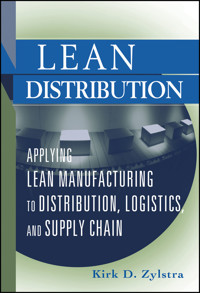
"Kirk Zylstra's focus on the customer is a fresh approach to lean. Companies that can bear the burden of variability will develop a strategic advantage in today's volatile market." --Travis Jarrell Institute of Industrial Engineers Program Committee Chair "Lean Distribution is a comprehensive yet concise work with clear leanings. Kirk's experience across a range of industries brings a unique understanding of common opportunities and solutions available to optimize distribution processes. Lean techniques, typically effective in manufacturing processes, are applied in the downstream supply chain in a practical and productive manner that will offer something to any business distributing tangible goods." --F. Jeff Duncan Jr. VP, CIO, and Director of Technology Louisiana Pacific Corp. "Lean Distribution has robustly captured the revolution occurring in today's increasingly competitive and global supply chain. Eliminating losses through lean manufacturing and lean distribution initiatives will become even more critical enablers to organizations developing cost-advantaged supply chains." --Rick McDonald Director of Manufacturing The Clorox Company
Sie lesen das E-Book in den Legimi-Apps auf:
Seitenzahl: 334
Veröffentlichungsjahr: 2005
Ähnliche



















Contents
Preface
Acknowledgments
Chapter 1: Taking the Lean Approach
The Lean Change in Distribution
The RFID Change Dilemma
The Forecast Barrier
The Balancing Act
Business and Operational Plans
Forecast Accuracy
Another Approach
The Traffic Analogy
Improving Distribution Operations
Lean Paradigm Shifts
Book Approach and Contents
Lean Distribution Framework
Lean Distribution Transformation
Role of Information Technology
Applications for Lean Distribution
Summary
Chapter 2: Distribution Challenges
Customer Directions
Global Sourcing
Cost Reduction
Lean Streamlining
New Challenges?
Functional Silos
Summary
Chapter 3: Optimizing Distribution
Distribution Sports Franchise Analogy
Optimizing Distribution
Technology Infrastructure
Lowering Production/Sourcing Costs
Improving Inventory Management
Maximizing Asset Utilization
Technology Directions
Summary
Chapter 4: IT Transforms Distribution Processes
Distribution Business Processes
ERP Transformation
Summary
Chapter 5: Lean Operating Capabilities
The Lean Approach
Managing Uncertainty with Lean
Lean and DRP: Collaboration
Lean-Enabled Collaboration
Summary
Chapter 6: Customer Service Policy
Customer Service Policy
Segmentation
Service Strategies
Summary
Chapter 7: Buffer Strategy
Buffer Strategy
Determine Service Strategies
Service Distinctions
Summary
Chapter 8: Replenishment Cycles
The Pipeline Approach
Replenishment Time
Delivered Cost
Summary
Chapter 9: Pull Approach
Pull Trigger
Replenishment Orders
Inventory Targets
Buffer Management
Summary
Chapter 10: Conclusion
The Simplicity Challenge
Planning Transformation
Lean Distribution Benefits
Selling the Lean Distribution Vision
Implementing Lean Distribution
Index
Copyright © 2006 by John Wiley & Sons, Inc. All rights reserved.
Figures © 2006 Kirk E. Zylstra.
Published by John Wiley & Sons, Inc., Hoboken, New Jersey.
Published simultaneously in Canada.
No part of this publication may be reproduced, stored in a retrieval system, or transmitted in any form or by any means, electronic, mechanical, photocopying, recording, scanning, or otherwise, except as permitted under Section 107 or 108 of the 1976 United States Copyright Act, without either the prior written permission of the publisher or authorization through payment of the appropriate per-copy fee to the Copyright Clearance Center, Inc., 222 Rosewood Drive, Danvers, MA 01923, 978-750-8400, fax 978-646-8600, or on the Web at www.copyright.com. Requests to the publisher for permission should be addressed to the Permissions Department, John Wiley & Sons, Inc., 111 River Street, Hoboken, NJ 07030, 201-748-6011, fax 201-748-6008, or online at http://www.wiley.com/go/permissions.
Limit of Liability/Disclaimer of Warranty: While the publisher and author have used their best efforts in preparing this book, they make no representations or warranties with respect to the accuracy or completeness of the contents of this book and specifically disclaim any implied warranties of merchantability or fitness for a particular purpose. No warranty may be created or extended by sales representatives or written sales materials. The advice and strategies contained herein may not be suitable for your situation. You should consult with a professional where appropriate. Neither the publisher nor author shall be liable for any loss of profit or any other commercial damages, including but not limited to special, incidental, consequential, or other damages.
For general information on our other products and services, or technical support, please contact our Customer Care Department within the United States at 800-762-2974, outside the United States at 317-572-3993 or fax 317-572-4002.
Wiley also publishes its books in a variety of electronic formats. Some content that appears in print may not be available in electronic books.
For more information about Wiley products, visit our Web site at http://www.wiley.com.
Library of Congress Cataloging-in-Publication Data
Zylstra, Kirk D.
Lean distribution : applying lean manufacturing to distribution, logistics, and supply chain / Kirk D. Zylstra.
p. cm.
Includes index.
ISBN-13: 978-0-471-74075-9 (cloth)
ISBN-10: 0-471-74075-6 (cloth)
1. Business logistics—Management. 2. Physical distribution of goods—Management I. Title.
HD38.5.Z95 2006
658.7'88—dc22
2005015356
To my clients, with whom I learn so much, and my consulting colleagues, who help me see what I have yet to learn
Preface
The distribution function shoulders responsibility for successful customer service while continually being under pressure to reduce costs and inventory. It can be an awesome responsibility that only gets more difficult and complicated as the supply chain spans the globe. For products moved across great distances, say for ones sourced from China into the North American market, supply chains become “long,” making distribution more difficult than for products sourced or produced locally.
The “long” supply chain is here to stay as global sourcing has taken firm hold. Despite the long distances, time zones, and other hurdles involved, distribution is under pressure to reduce costs and inventory. There is a substantial amount of cost and inventory in Distribution, so it is a natural target for profitability improvement efforts. Any reduction in freight expense appears to go directly to improved profit, which encourages an ongoing emphasis to reduce freight costs.
Longer supply chains require more accurate forecasts to plan. Commitments must be made to suppliers or plants for long supply chains much farther into the future than for ones right next door. These long commitments require customer order forecasts farther into the future. But forecasts may not be sufficiently accurate to maintain a stable plan causing continual changes and updates. With the plan always in flux, it may be difficult to see how costs can be kept low.
For my clients, the forecast limitation to cost reduction came to light only through rigorous assessment of the overall product flow. Mapping and assessing product flow from source through internal manufacturing (if applicable) to distribution and finally to customers provided this new view. Assessments highlighted many of the policies that inhibited improvement due to the focus on cost reduction and forecast-based planning. By addressing the underling policies, it became clear that forecasts are essential for overall and long-term planning, but that short-term execution required a different approach.
To break the forecast- and cost-driven approaches, Lean techniques were employed. Practices such as Pull replenishment showed dramatic benefits to improve service and maintain low inventories and costs. This seemed counterintuitive at first, but as the total product flows were modeled and changed, the benefits became clear. The problem all along was not just forecast accuracy, but all variability. Using Lean helped compartmentalize and reduce variability such that replenishment was easier and planning more effective. We came to call this transformation as taking a Lean approach to Distribution.
This book, Lean Distribution, is based on these successful Lean implementations I had the privilege to lead. The primary driver for these implementations was addressing today’s challenges in customer service and distribution. This book provides a composite of the issues and drivers leading to the design for a Lean approach that simultaneously reduces costs and inventory while improving service. In this way, the Lean Distribution approach has been market tested and proven to deliver results by leveraging the Lean concepts of Pull, kanban, cycle time reduction, and buffer against variation.
Each client takes a different path on the Lean journey and develops a unique design, but typically addresses similar issues and challenges along the way. Lean Distribution provides a comprehensive framework for you to take this journey and design your own Lean approach. Each step is methodical and provides a link to both the last step and the ultimate goals for distribution. The transformation is driven by key distribution metrics such as order fill rates, warehouse costs, and inventory levels, to name just a few.
The Lean Distribution framework provides a comprehensive and cross-industry guide to the Lean journey. It starts with the business trends and drivers leading to the need for new approaches in distribution and then uses customer service expectations to initiate the Lean design. Readers may skim over some of the trends they already understand well, but covering all is important to ensure that perspectives are well understood prior to designing the Lean solution. For the typical company, these trends enable the entire executive team and organization to gain a common understanding of distribution challenges and solutions by seeing the perspectives and issues from all sides.
Viewing all sides of current distribution paradigms exposes the implications and limitations of forecasts to improve service and profitability. Forecasts and the planning processes to improve distribution have been improved as information technology matured, but cannot further improve results due to the inaccuracy of sales order forecasting. Forecast-based plans have added tremendous value to business growth, profitability, and customer service, but have reached the limit of their underling accuracy. Forecast accuracy is limited by the pace of change and variation in sales, which are the new fundamental characteristics of markets. Forecasting algorithms and customer collaboration techniques may be seen as the “answer” to forecast inaccuracy, but are in conflict with the needs of customers to be flexible and respond as their customers or markets change.
Closely following and responding to customer demand enables companies to succeed without the buildup or dearth of inventory in distribution. Whenever inventory swings too high or too low, distribution costs increase. Usually these swings are caused by forecasts that have gone awry. Consider the difference in Dell Computer’s approach to the market: Produce to demand and do not stock finished goods internally or at retailers. Inventory swings are stabilized rather than magnified going back to internal operations and suppliers.
I assume that you have some understanding of Lean concepts and practices such as Pull, kaizen, lot size reduction, and their relationship with lead time reduction. Many excellent books can provide the background, approach, and practices for Lean so this book does not repeat these themes. Lean books provide an excellent foundation for the transformation, but do not provide effective solutions to the transportation and customer demand variation that are such key factors in distribution. Taking Lean into a distribution environment requires a customer service-based approach that builds change around total cost minimization rather than the more traditional Lean approach: value stream mapping and using kaizen to improve each area of the process.
The Lean Distribution approach is described using a number of analogies. Each analogy is meant to describe how and why Lean provides a solution to fairly knotty problems. Terms are defined when introduced and described in the relationship to distribution. You should be able to follow along with the framework and solution approach, but you may not fully appreciate what should occur in the plant or at your suppliers to enable these distribution changes. At least you will see the distribution transformation, which should whet your appetite to understand more about Lean.
Lean Distribution may be read differently across the organization. Some executives may benefit most by just reading Chapter 1 to gain perspectives on the reasons to change. Other executives may also read the chapters associated with their functional responsibilities, such as customer service. Managers and professionals who are in the day-to-day operational processes may read the entire book with emphasis on sections most pertinent to their responsibilities. Project managers and leaders may take particular notes across all sections to best relate to each portion of their team and management group.
Implementing the Lean Distribution approach is enabled by addressing key paradigms in customer service and distribution to “pave the way” for change. For example, with customer service policies, these paradigms are critical elements for daily decision making and must be aligned with the Lean transformation. New capabilities may be discovered to serve customers better; in other cases policy will be aligned with capabilities and customer needs. The critical point is that paradigm shifts are essential to success in both the long term and across the organization.
A Lean journey can be a wonderful learning experience related to both Lean and how the organization really operates. In many cases assumptions have been made and built into the fabric of the organization and business processes without being fully challenged. A Lean transformation brings these assumptions to light and designs processes according to how growth, profits, and customer service can be optimized. It is a journey of discovery and adventure that leads to an aligned organization, relevant metrics, and enhanced results.
Kirk D. Zylstra
Redmond, Washington
April 2005
Acknowledgments
Many ideas and contributions were necessary to develop and successfully implement the Lean Distribution approach. Lean takes a different view than the typical Distribution model and requires a dedication to analyze and see the forest for the trees. Because the typical distribution approach chases cost savings for each transaction, organizations struggle to manage total costs and customer service. The Lean Distribution approach starts with the total and then works back to how individual transactions are processed requiring a more thorough viewpoint. Taking this view from the total to the detail required the dedication and contribution of many clients and co-workers of mine.
I am grateful for the opportunity to work with two wonderful clients in particular who have challenged and embraced these ideas and in so doing improved the approach and results. Especially, Fred Beightol and James Handley who stood with our team as their organizations embraced the shift from the current mindsets. These can be perilous journeys fraught with anxiety and doubt, but they held true to the new perspectives that we developed and tested. As these journeys unfolded, both Fred and Jim have become friends and colleagues in the pursuit of operating excellence and the demand-driven enterprise. Their contributions and encouragement have been critical to my enthusiasm to take on this book project to spread Lean practices further across the world of Distribution.
A number of consulting colleagues contributed to both my success and ability to develop the Lean Distribution approach. The teams for both of these clients, as well as many others, were instrumental in transforming ideas into successful implementations. The dedication and enthusiasm of these many bright colleagues helped take on the difficult task of enterprise change against the odds of current performance measures, limited financial systems, and organizational dynamics.
The quality and completeness of Lean Distribution was greatly enhanced by the contributions of my reviewers and confidants. I appreciate the efforts and insights brought by Patricia Bailey, Hank Barr, Fred Beightol, William Dettmer, James Handley, Michael Miksis, and Raffiq Rajabali. Each uniquely contributed to the contents and approach for the book. They endured reading the entire draft manuscript at a point that certainly took a certain amount of diligence to complete.
My Dad, Bud Ruby, has provided invaluable insights and guidance for my career over these many years. His successful business leadership in the apparel industry has been an inspiration to me during this writing and all through my career. He has also brought practical context and ideas, such as perspective on one of the earliest implementations of Vendor Managed Inventory (VMI) I have encountered. I am grateful to have had his influence, encouragement, and support all along the way.
Last, I am grateful for the support from my family to make the transition from Big 4 consulting partner to author, University of Washington Business School faculty member, and independent consultant. I wanted to write this book for several years now, and retiring from a full time consulting partner role was necessary to see it through. I have spent an enormous amount of time thinking and creating Lean Distribution. I could not have completed the book without making this transition, which opened up my time to reflect on past consulting successes and the approaches that succeed in changing the perspectives of others. My wife Mariann, son Alex, and daughter Ashton have supported my difficult transition with grace and humor. Their insights many times were refreshing and helpful as they commented on my ideas. They understood the quirks of my writing time and this lifestyle change. It has been a wild ride at times and I am sure they are glad my first book is behind me.
Chapter 1
Taking the Lean Approach
Lean Distribution breaks the forecast accuracy barrier to improving customer service and profit with flawless execution of simplified operating processes
Competition is growing at an ever-increasing rate, and price tends to be the main battleground. Finding the lowest-cost source or manufacturing location has been the strategy with sourcing from China, the preeminent destination. Low cost sourcing is creating and extending supply chains across the globe making distributing products more challenging than ever. There is just no room for error when planning and moving products across complex, global supply chains.
Lesen Sie weiter in der vollständigen Ausgabe!
Lesen Sie weiter in der vollständigen Ausgabe!
Lesen Sie weiter in der vollständigen Ausgabe!
Lesen Sie weiter in der vollständigen Ausgabe!
Lesen Sie weiter in der vollständigen Ausgabe!
Lesen Sie weiter in der vollständigen Ausgabe!
Lesen Sie weiter in der vollständigen Ausgabe!
Lesen Sie weiter in der vollständigen Ausgabe!
Lesen Sie weiter in der vollständigen Ausgabe!
Lesen Sie weiter in der vollständigen Ausgabe!




