


Erhalten Sie Zugang zu diesem und mehr als 300000 Büchern ab EUR 5,99 monatlich.
- Herausgeber: Romano Guerra Editora
- Kategorie: Geisteswissenschaft
- Serie: Latin America: Thoughts
- Sprache: Englisch
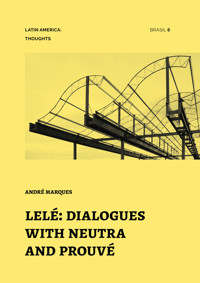
The sixth book of "Latin America: Thoughts" collection, with foreword by Abilio Guerra and afterword by Paulo Bruna, brings André Marques' research on the work of architect João Filgueiras Lima, Lelé, in its aspects of technology and interaction with the environment. The author also establishes relationships between Lelé's design strategies with those of the French builder Jean Prouvé and the Austrian architect Richard Neutra.
Sie lesen das E-Book in den Legimi-Apps auf:
Seitenzahl: 190
Veröffentlichungsjahr: 2020
Das E-Book (TTS) können Sie hören im Abo „Legimi Premium” in Legimi-Apps auf:
Ähnliche




















LATIN AMERICA: THOUGHTS
Romano Guerra Editora
Nhamerica Plataform
MANAGEMENT COORDINATION
Abilio Guerra, Fernando Luiz Lara and Silvana Romano Santos
LELÉ: DIALOGUES WITH NEUTRA AND PROUVÉ
André Marques
Brasil 6
FOREWORD
Abilio Guerra
AFTERWORD
Paulo Bruna
EDITORIAL STAFF
Abilio Guerra and Fernanda Critelli
TRANSLATION
Thomas Leirner Goldenstein and Fernanda Critelli
TRANSLATION REVIEW
Fernanda Critelli, Fernando Luiz Lara and Felipe Rodrigues
GRAPHIC DESIGN
Maria Claudia Levy e Ana Luiza David (Goma Oficina)
FORMATTING
Fernanda Critelli
E-BOOK FORMATTING
Natalli Tami Kussunoki
foreword how a thesis is written
abilio guerra
the monk and the hippie: architecture and society
architecture and industry: dialoguing with jean prouvé
architecture and environment: dialoguing with richard neutra
chosen designs
afterword observations as they were conclusions
paulo bruna
bibliography
foreword
how a thesis is written
abilio guerra
a new book is always a reason to celebrate. in times when culture is under strict siege, it becomes a motive for reflection. the book we present hereby – ‘lelé: dialogues with neutra and prouvé,’ by andré marques – results from a master’s thesis research1 developed at fau mackenzie.2 it was up to me the privilege to participate in its confection officially as supervisor and, in practice, as an enthusiastic interlocutor
about the theme. João Filgueiras Lima’s imaginary dialogues with Richard Neutra and Jean Prouvé are a reflection of backstage debates between researcher and supervisor, as it is also a reflection of varied mediations: Textual discussion with other researchers, frequent dialogue with the architect (and object of study), casual chitchat with colleagues, and passionate debate with the professors during the qualification exam.
I argue here how tangled are individual and collective spectrums enrolled in an authorial work. Few years later, I put myself a similar challenge when reviewing Eduardo Ferroni’s master’s thesis on architect Salvador Candia.3 The ambition was to relate the thesis with the academic production taken at Brazilian graduate programs in the field of architecture and urbanism. I highlighted at that moment that the critic review process occurred after the 1990s, when dissertations and thesis opened space for new characters – specially the foreign architects living in Brazil that were so relevant in São Paulo, Rio de Janeiro and other capital cities. They were also relevant for new interpretations – particularly a new look over Brazilian architects whose work escapes from the traditional formula that privileges native architecture’s national character.4
On the list of architects studied by academic researches there are not only the most famous first modern generation – Flávio de Carvalho, Oscar Niemeyer, Affonso Eduardo Reidy, Vilanova Artigas, Rino Levi, Oswaldo Bratke, Lúcio Costa, Jorge Machado Moreira, Irmãos Roberto –, but also many who stand out next, like Attilio Correa Lima, Francisco Bolonha, Alcides da Rocha Miranda, Severiano Porto, Paulo Mendes da Rocha, Pedro Paulo de Melo Saraiva, Abrahão Sanovicz, Carlos Millán, Eduardo Kneese de Mello, David Libeskind, Flávio Império, Sérgio Ferro, Rodrigo Lefrève, among others. Even some active professionals become object of monographs – that is the case of Eduardo de Almeida and of the tandem Marcelo Ferraz and Francisco Fanucci.
As I did not know all sources, in the broad range of academic scholarships that I worked on up to that moment there is none on João Filgueiras Lima, architect whose work was already widely known after the monographic book edited by Giancarlo Latorraca in 2000.5 By forgetting about the architect, at least four master’s thesis already developed in important graduate programs stayed out of the inventory: The ones of Elane Ribeiro Peixoto, developed in 1996 at FAU USP;6 Gislene Passos Ribeiro, 2004 at FAU Mackenzie;7 Jorge Isaac Perén Montero, 2006 at EESC USP;8 and Eduardo Westphal, 2007 at FA UFRGS.9
This omission would be unlikely if I had written the review the following year. In 2009, Museu da Casa Brasileira – MCB’s technical director Giancarlo Latorraca invited the publishing company Romano Guerra Editora to edit two publications related to Lelé: A catalog for the exhibition that would be held by the museum in the following year, from July 20 to September 19, 2010; and a book written by the architect himself, where he narrated his architectonic and urbanistic experience in the health field. The catalog, however, was published without our participation10 and launched during the exhibition, while the book edition took longer than we had foreseen and it was finalized by RG only in 2012.11
My relatively superficial and scarce knowledge on Lelé’s work would change completely after meeting André Marques during FAU Mackenzie’s graduate admission exam. In that occasion, the applicant already manifested his intention to develop a master research on João Filgueiras Lima’s work, and demonstrated general and specific knowledge that called my attention. After being approved, we met two times in Lelé’s exhibition at MCB – at random in the first time; and the second, scheduled, when we saw and discussed together the exhibit and, also, we sealed the deal for supervision.12
After that, data and information exponentially expanded, once I got more familiar with Lelé’s designs during the book edition, at the sime time André provided me an infinite number of information on the architect’s works and personal trajectory.13 Unlimited curiosity and non-stop disposition, the ideal combination for a fruitful investigation: To cover the available bibliography on the architect, to visit the discussed works, to interview the architect whenever possible, to study his designs, to redraw his sketches… It would not be exaggerated to say that, in some level, André Marques mimicked the character himself. He even started to wear a blue Maoist jacket, so common in Lelé’s clothing, in order to discover the symbolism that the gesture expressed.14
The monographic works missing from my review came to my knowledge through André Marques. Beyond the four theses already discussed, another two academic texts developed at FAU USP were discovered by the researcher: The master’s thesis of Cristina Câncio Trigo, 2009;15 and the doctoral dissertation of Ana Gabriella Lima Guimarães, 2010.16 Apart from the others, this first one focus its interests on the built work (of which they did a panorama), the later highlights Lelé’s connections with international architecture, when she “establishes benchmarks and/or similarities between Lelé’s works and the designs of high-tech architects such as Norman Foster, Nicholas Grimshaw, Michael Hopkins, and Renzo Piano, among others.”17 This dissertation was inspiring due its discussion on the relation between Lelé’s work and serially produced architecture – one of the binomials explained by André Marques, alongside the environmental preoccupation.
However, a few master thesis escaped from the researcher and his supervisor’s attention: The one of Ana Gabriella Lima Guimarães herself, presented in 2003 at School of Engineering at São Carlos under Hugo Segawa’s supervision,18 and the one of Adalberto Vilela, supervised by experienced Sylvia Ficher and presented in January 2012 at FAU UNB.19 These researches would have been extremely useful, because they link Lelé’s designs to Richard Neutra’s work and line of thought,20 especially the environmental preoccupation – one of the binomials explained by André Marques, alongside the lightweight industrialization proposed by Prouvé. Lastly, I highlight the absence of Mariele Lukiantchuki’s thesis presented in 2010 at EESC USP, that would also have been useful to Marques’ argument once it discusses on Sarah Hospital, one of the four projects analyzed in the last chapter.21
It is also worth to recall that Neutra’s experience in Puerto Rico, later published in the book Architecture of Social Concern in Regions of Mild Climate,22 had an impact on Brazil, a matter already discussed by Claudia Loreiro and Luiz Amorin in their 2002 paper.23 And that the wide and diffuse interest over this book among Brazilian architects was highlighted by Adriana Irigoyen24 and Patrícia Pimenta Azevedo Ribeiro25 in their doctoral dissertations developed at FAU USP in 2005 and 2007, respectively. From 2011 on, I myself started to supervise the researches developed by Fernanda Critelli on the Austrian architect’s trips to Latin America and his relation with several Latin American countries, especially with Brazilian architecture. This research developed into three monographs at the levels of scientific initiation (2012), master (2015) and PhD (2020),26 plus a paper present at Enanparq Natal 2012 seminar,27 all of them raising questions, approaches and bibliographies that were imbedded in André Marques’ work. Lastly, Lelé himself, in various occasions, had revealed his interest on Neutra’s works, as one can see, for example, in the testimony he gave to Cynara Menezes in 2004.28
This set of information will allow André Marques to delineate what he calls “bioclimatic strategies,” that is, fundamentally, João Filgueiras Lima’s constant search for an efficient passive ventilation in order to inflate air in his buildings; always prioritizing the force of nature instead of technology. The passage in which Marques relates the natural ventilation strategies of primitive or vernacular architecture with the reinterpretations proposed both by Lelé and Norman Foster is insightful. Through different paths, both architects came to very similar solutions for dry and hot weather. For the Sarah Kubitschek Salvador Hospital (1991), the Brazilian architect canalized wind into technical tunnels alongside the building, where the air is cooled down and filtered thanks to fountains strategic located on reflection pools (solution that he will once again use at Sarah Fortaleza Hospital, 1992). On the other hand, Foster will accurately study passive strategies both of Middle East traditional cities and desert tribes to design a wind capture tower with inner water splashes for cooling down the air that ventilates Masdar City (2007-2014), built in Abu Dhabi desert.29
André Marques’ accuracy reveals itself in the discussion about the built works, with faithful description of the technical-constructive aspects and focused on real performance of the analyzed building. Thus, Abadiânia Transitory School (1982-1984) is presented to us with all its spatial and constructive qualities, but also with its environmental aspects’ flaws and limitations – the small natural lightening and ventilation sheds do not function properly. The researcher’s close attention identified in Lelé the constant preoccupation with performance, an action thought like an experimental laboratory based on “recurrence and improvement.” Therefore, the architect will experiment the same element in various projects, always improving it in light of the detected problems. In sum, to repeat and to improve are his design principles. The shed’s ever growing size that one can observe in his series of designs is understood as an evolution conquered with the constant adjustment of technical elements. According to André Marques, this process has an impact on Lelé’s work and line of thought: The search for an environmental adequate architecture that can be built with modular coordination and serial repetition.
Curiously, Richard Neutra and Jean Prouvé both travelled to Brazil in 1959 to attend the Extraordinary International AICA Congress, which discussed the theme New City: Synthesis of the Arts in São Paulo, Rio de Janeiro and Brasília.30The Brazilian future capital city (at that time still under construction) would later become the stage of João Filgueiras Lima’s relevant performance. There he became responsible for the construction of the University City’s buildings, especially the Science Central Institute – known as “Minhocão” and designed by Oscar Niemeyer –, and the Colina – housing buildings for the professors, designed by Lelé himself and built using precast elements.
If the relation with Richard Neutra is clearer and well documented, the one with Jean Prouvé is more conceptual and diffuse. During the first part of the research, the French architect showed in a highlighted position, but he was not yet the protagonist that he eventually became in the final version. In the “Rationalization and Efficiency” subchapter, a foreseen part of the second chapter on industrialization, there were some quotations extracted from Prouvé’s writings and accompanied by a note to the readers: “This part is under development.”31 What was initially a potential idea gained support and encouragement from the architects and professors Rafael Perrone (FAU Mackenzie) and Paulo Bruna (FAU USP), both juries of the qualification exam. The extensive use of folded metallic sheets and the manual assembly brought Lelé and Prouvé even closer among the most important architects working with metal industrialization. This was the theme discussed in February 3, 2012, that induced chapters 2 and 3 personalization: The association between the French architect’s industrialization and the Austrian architect’s environmental concern.
On November 9, 2012, at 3pm, in the same João Calvino buildng, with the same jury from the qualification exam, André Marques’ thesis was approved with distinction and recommended for publication. Chapter 1 had the same title “Architectural Culture and Society (the Monk/the Hippie)” and very little modifications. It registers Lelé’s academic and intellectual formation, his elective preferences and affinities, and his relations (especially with Oscar Niemeyer, his mentor). Chapter 2 “Architecture and Industry (the Industrial Designer)” became “Architecture and Industry (Construction) – Dialoguing with Jean Prouvé”; and the chapter “Architecture and Environment (the Ecologist)” became “Architecture and Environment (Ambience) – Dialoguing with Richard Neutra.” Both aspects highlighted from João Filgueiras Lima’s work (construction and ambience) articulate themselves in a less schematic way.32 The bigger transformation occurred in the commented designs: Originally six, divided in two groups placed after chapters 2 and 3, they were reduced to four more expressive ones (Abadiânia Transitory School, Salvador City Hall, Salvador Sarah Hospital, and Roberto Pinho Residence) – it were out Mais Day-care Center and Darcy Ribeiro Memorial –, this time condensed in a fourth chapter, originally non-existent. This way, each design’s interpretation is based on the two proposed concepts. Now the discourse is finalized with the analysis and has as a background the architect’s professional history, his predilections and idiosyncrasies. The last transformation occurred in the book’s chosen title, synthesized and more symbolic – Lelé: Dialogues with Neutra and Prouvé.
In this publication, which I really like, I highlight two of the author’s accomplishments, in which one can verify that, in the evolution of a research, some elements develop themselves and gain new status while others are permanent since the beginning. The first is the work on every sketch and drawing, taking to the next level the empathy with the work of the studied architect. The redrawing was present here and there in the previous versions, but in this publication the option is radicalized and, except from Celso Brando’s cover photo, Lelé’s picture taken by André Marques and Nelson Kon’s photos opening the chapters, all the illustrations were made by André Marques. This radical iconographic transformation changes the book completely when compared with the thesis. The second accomplishment is the accurate list of factories assembled by Lelé throughout the decades, an element absence even from the architect’s own books. This little but extremely important detail is present since the qualification essay, stayed until the actual thesis and, now, it will be published in this book.33 The only change occurs in the last mentioned institution: Brazilian Habitat Institute – IBH (2010-2014), settled in Salvador. In the first two versions, it appeared only the year of its creation while, for the book, it was also included the year of Lelé’s factory closure. The enterprise’s head and muscles, the architect passed away in May 21, 2014, same year that his institute closes its activities.
An academic work is part of a collective construction. The same way it benefits itself from several prior researches, André Marques’ thesis became one of the referential interpretations on João Filgueiras Lima’s work. It is an important reference to academic researches developed the following years in high-quality universities. Such as: Michel Hoog Chaui do Vale’s thesis presented at FAU USP in 2016, supervised by Maria Cristina da Silva Leme;34 and the doctoral dissertations of Aristóteles de Siqueira Campos Cantalice II, presented at UFPE in 2018 under the supervision of Fernando Diniz Moreira;35 of Sérgio Kopinski Ekerman, presented at UFBA in 2018 under the supervision of Naia Alban Suarez and Nivaldo Vieira de Andrade Junior;36 and Adalberto Vilela, presented at Swiss Federal Institute of Technology of Zurich in 2018 under the supervision of Laurent Stalder.37 André Marques’ thesis is also quoted in papers published at magazines and seminar’s annals38 and it is required reading in a UFBA class taught by professors José Fernando Minho and Ceila Cardoso.39 I believe it won’t be necessary further arguments to justify this publication!
NOTES
1. André Felipe Rocha Marques, “A Obra de João Filgueiras Lima, Lelé: Projeto, Técnica e Racionalização.”
2. Graduate Program in Architecture and Urbanism, School of Architecture and Urbanism, Mackenzie Presbyterian University. Program: “Architecture and Urbanism Design;” field of research: “Modern and Contemporary Architecture: Representation and Intervention;” research project: “Modern and Contemporary Architecture: Metodology, research and Broadcast;” supervisor Abilio Guerra.
3. Eduardo Rocha Ferroni, “Aproximações Sobre a Obra de Salvador Candia.”
4. Abilio Guerra, “Monografia Sobre Salvador Candia e a Necessidade de um Diálogo Acadêmico.”
5. Giancarlo Latorraca, ed., João Filgueiras Lima, Lelé.
6. Elane Ribeiro Peixoto, “Lelé: O Arquiteto João da Gama Filgueiras Lima.”
7. Gislene Passos Ribeiro, “Conforto Ambiental e Sustentabilidade do Edifício na Obra de João Filgueiras Lima (Lelé).”
8. Jorge Isaac Perén Montero, “Ventilação e Iluminação Naturais na Obra de João Filgueiras Lima, Lelé: Estudo dos Hospitais da Rede Sarah Kubitschek – Fortaleza e Rio de Janeiro.” The Architecture and Urbanism Department of the School of Engineering at São Carlos, University of São Paulo campus at countryside, became independent with the creation of Architecture and Urbanism Institute – IAU USP São Carlos in December 14, 2010.
9. Eduardo Westphal, “A Linguagem da Arquitetura Hospitalar de João Filgueiras Lima.”
10. Max Risselada and Giancarlo Latorraca, A Arquitetura de Lelé: Fábrica e Invenção.
11. João Filgueiras Lima, Arquitetura. Uma Experiência na Área de Saúde.
12. This relationship had immediate fruits, once the researcher’s visit to two Ribeirão Preto Communitarian Support Base (both designed by Lelé) resulted in a small paper published the next month: André Marques, “BACS Ribeirão Preto. Obras do Arquiteto João Filgueiras Lima, Lelé.” Later, another visit results in a small essay on Salvador City Hall, also published prior to the thesis presentation: André Marques, “Sede Transitória da Prefeitura de Salvador. Aspectos da Racionalização e Contexto Histórico.”
13. This process resulted in a paper originally published in Italy at an issue dedicated to the architect: Abilio Guerra and André Marques, “João Filgueiras Lima, Ecologia e Razionalità / João Filgueiras Lima, Ecology and Rationality.”
14. About the Maoist jacket, the Zhongshan suit, and the personal relation between the author and Lelé, see: André Marques, “Lembranças de Meu Último Encontro com Lelé.”
15. Cristina Câncio Trigo, “Pré-Fabricados em Argamassa Armada: Material, Técnica e Desenho de Componentes Desenvolvidos por Lelé.”
16. Ana Gabriella Lima Guimarães, “A Obra de João Filgueiras Lima no Contexto da Cultura Arquitetônica Contemporânea.”
17. Marques, “A Obra de João Filgueiras Lima, Lelé,” 64.
18. Ana Gabriella Lima Guimarães, “João Filgueiras Lima: O Último dos Modernistas.”
19. Adalberto Vilela, “A Casa na Obra de João Filgueiras Lima, Lelé.”
20. Relation that was also mentioned in Eduardo Westphal’s thesis.
21. Marieli Azoia Lukiantchuki, “A Evolução das Estratégias de Conforto Térmico e Ventilação Natural na Obra de João Filgueiras Lima, Lelé: Hospitais Sarah de Salvador e do Rio de Janeiro.”
22. Richard Neutra, Architecture of Social Concern in Regions of Mild Climate.
23. Claudia Loureiro and Luiz Amorim, “Por uma Arquitetura Social: a Influência de Richard Neutra em Prédios Escolares no Brasil.”
24. Adriana Marta Irigoyen de Touceda, “Da Califórnia a São Paulo.”
25. Patrícia Pimenta Azevedo Ribeiro, “Teoria e Prática: A Obra do Arquiteto Richard Neutra.”
26. Fernanda Critelli, “Richard Neutra no Brasil;” Critelli, “Richard Neutra e o Brasil;” Critelli, “Richard Neutra: Conexões Latino-Americanas.”
27. Paper present at II Encontro da Associação Nacional de Pesquisa e Pós-graduação em Arquitetura e Urbanismo – Enanparq, Natal, September 18 to 21, 2012. Later published as: Abilio Guerra and Fernanda Critelli, “Richard Neutra e o Brasil.”
28. Lelé comments: “And there was also Richard Neutra with an exquisite proposition in terms of finishing mixed of steel and concrete. He used metallic structure just like me.” João Filgueiras Lima, O Que É Ser Arquiteto: Memórias Profissionais de Lelé (João Filgueiras Lima); em Depoimento a Cynara Menezes, 34.
29. This similarity between Lelé’s and Foster’s designs noticed by André Marques reminds me an unusual and illustrative fact. During Lelé’s book edition, we received at the publisher the visit of an important architect of Foster and Partners. When she passed by a computer that had a Sarah Hospital design on screen, she automatically stopped and looked. She immediately noticed the connections between Brazilian and British architects’ line of thought and said: “This is a very clever design.”
30. Maria da Silveira Lobo and Roberto Segre, eds., Congresso Internacional Extraordinário de Críticos de Arte. Cidade Nova: Síntese das Artes.
31. André Felipe Rocha Marques, “A Obra de João Filgueiras Lima, Lelé: Projeto, Técnica e Racionalização” (Qualification Exam), 44-46.
32. “When thinking about the conceptual pair art and science, or technology and nature, it may seem we speak of opposite things. It is possible to find, however, in João Filgueiras Lima’s work, these two aspects coexisting to their fullest capacities.” Marques, “A Obra de João Filgueiras Lima, Lelé,” 168.
33. See page 64-65 of this book.
34. Michel Hoog Chaui do Vale, “João Filgueiras Lima (Lelé): Arquitetura Pública e Urbanismo em Salvador (1979-81 e 1986-88).”
35. Aristóteles de Siqueira Campos Cantalice II, “Descomplicando a Tectônica: Três Arquitetos e uma Abordagem.”
36. Sérgio Kopinski Ekerman, “Tecnologia e Transformação: Pré-Fabricação para Reestruturação de Bairros Populares e Assistência Técnica à Autoconstrução.”
37. Adalberto Vilela, “Architecture without Applause. The Manufactured Work of João Filgueiras Lima, Lelé.“
38. I mention three papers as examples: Elza Luli Miyasaka, Michele C. B. Ferrari-Caixeta and Marcio Minto-Fabrício, “Arquitectura e Industrialización de la Construcción en la Obra de João Filgueiras Lima – Lelé;” Daniel Juracy Mellado Paz, “Um Sonho de Unidade: João Filgueiras Lima e sua Gesamtkunstwerk;” Rodrigo Oliveira Sena and Sergio Kopinski Ekerman, “O Centro Histórico de Salvador como Laboratório: O Restauro do Plano Piloto da Ladeira da Misericórdia. Teorias e Práticas de Intervenção no Moderno.”
39. “ARQB43 – Temas Especiais em Projetos de Arquitetura, Urbanismo e Paisagismo. Relatos de um Aprendizado: Sobre a Arquitetura de Lelé (Plano de Ensino).” Professors José Fernando Minho and Ceila Cardoso <https://bit.ly/32PKbUp>.
the monk and the hippie
architecture and society
João Filgueiras Lima, Lelé. Photo André Marques




