


9,99 €
Mehr erfahren.
- Herausgeber: 50Minutes.com
- Kategorie: Sachliteratur, Reportagen, Biografien
- Serie: Art & Literature
- Sprache: Englisch
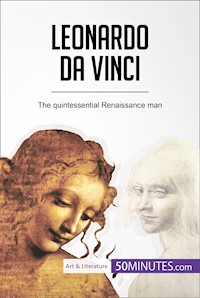
Keen to learn but short on time? Find out everything you need to know about the life and work of Leonardo da Vinci in just 50 minutes with this straightforward and engaging guide!
Leonardo da Vinci was an artist, inventor and engineer who was renowned as one of the leading figures of the Italian Renaissance. During his lifetime he attracted the attention of a variety of wealthy patrons who commissioned him both to make unique art pieces and to carry out tasks in other fields, such as reinforcing city fortifications. His most famous works are
The Last Supper and the
Mona Lisa, the latter of which was the subject of centuries of speculation regarding the subject of the portrait. He also developed innovative new painting techniques such as
sfumato, pyramidal composition and atmospheric perspective, all of which influenced the emergence of new artistic styles in the following centuries.
In this book, you will learn about:
• The artistic and historical context of 15th-century Italy
• Da Vinci’s main works, including his famous masterpiece the
Mona Lisa
• His influence on future generations of artists, scientists and inventors
ABOUT 50MINUTES.COM | Art & Literature
The Art & Literature series from the 50Minutes collection aims to introduce readers to the figures and movements that have shaped our culture over the centuries. Our guides are written by experts in their field and each feature a full biography, an introduction to the relevant social, political and historical context, and a thorough discussion and analysis of the key works of each artist, writer or movement, making them the ideal starting point for busy readers looking for a quick way to broaden their cultural horizons.
Das E-Book können Sie in Legimi-Apps oder einer beliebigen App lesen, die das folgende Format unterstützen:
Seitenzahl: 41
Veröffentlichungsjahr: 2018
Ähnliche











LEONARDO DA VINCI
Name: Leonardo di ser Piero da Vinci.Born: 15 April 1452 in Vinci, Tuscany (Italy).Died: 2 May 1519 in Clos Lucé, near Amboise (France).Context: the Italian Renaissance.Notable works:Annunciation (1472-1475)Adoration of the Magi (1481-1482)Virgin of the Rocks (1483-1486)The Last Supper (1494-1498)Mona Lisa (1503-1505)The Virgin and Child with St.Anne (c. 1510)Although many famous polymaths were active during the Italian Renaissance, Leonardo da Vinci stands above the rest due to the sheer quantity of disciplines he worked in and mastered over the course of his life, including painting, sculpture, architecture, hydraulics, optics, mathematics, botany, military engineering, anatomy and physics. He was a true genius, and produced stunning artwork, incredible sketches and all kinds of inventions, some of which were so ahead of his time that they were never actually built until the modern era. He kept track of his work in notebooks which numbered over 7000 pages in total, although many of them have been lost over the years and the remainder have been scattered across the world.
Da Vinci travelled a great deal over the course of his life, particularly in northern and central Italy and in France, which allowed him to meet many of the most influential figures of the era: the Italian artists Donato Bramante (1444-1514), Sandro Botticelli (1445-1510), Domenico Ghirlandaio (1449-1494), Michelangelo (1475-1564) and Raphael (1483-1520); the writer Niccolò Machiavelli (1469-1527); Pope Leo X (1475-1521); the ruler of Florence, Lorenzo de’ Medici (1449-1492); the Duke of Milan, Ludovico Sforza (1452-1508); the Italian nobleman Cesare Borgia (1475-1507); and the French King Francis I (1494-1547).
His work had such a tremendous influence on the society he lived in that there is a clear distinction between the periods “before” and “after” da Vinci in the fields of art and engineering. This is particularly true of the field of painting, as da Vinci is credited with developing a number of new techniques, such as sfumato and atmospheric perspective. But even though da Vinci was the driving force behind artistic innovation in the late 15th and early 16th centuries, he also encountered a number of difficulties: he never enjoyed an easy relationship with any of his artistic patrons, who even included the French King Francis I, as he was generally unable to strike a balance between complying with their demands and fulfilling his own artistic vision. This is undoubtedly the reason why so many of his works are unfinished and remain shrouded in a degree of mystery.
CONTEXT
THE ITALIAN RENAISSANCE
The Renaissance began in the Italian city of Florence in the mid-15th century, and spread across the rest of Europe over the course of the 16th century. This tremendously influential movement was born from the study of ancient Greek and Latin texts, which led to the rediscovery of many artistic and cultural principles dating from antiquity. Its aims were to revive these traditions and restore learning and knowledge to a more prominent position within society. The great thinkers of the era also began placing greater emphasis on the inherent value of humanity, particularly through the idea that human beings could improve themselves by gaining knowledge. As such, it was a time of research and discovery, which led to innovation in a wide range of scientific and artistic fields. For example, the new theories on perspective and proportions that were developed by sculptors and architects had a tremendous influence on artistic techniques.
Artists also began to receive a great deal more recognition for their work: they began signing their artwork with their names and were no longer considered mere artisans. Furthermore, they began drawing inspiration from different sources, notably from ancient Greek and Roman mythology, and secular works such as portraits, nudes and mythological allegories became much more popular. Italian nobles also realised that art could be used as a tool to glorify themselves or their cities, and patronage became a much more common practice. This meant that artists received more commissions, which in turn bolstered their reputations.
DID YOU KNOW?
Unlike other great thinkers of his time, da Vinci did not base his work on classical principles, and even admitted that he was unfamiliar with them in his writings. On the contrary, his painting style was primarily influenced by his own worldview, which was based on his life experience and scientific experiments. In a way, it could be said that he did not believe anything unless he had seen it with his own eyes.
THE REPUBLIC OF FLORENCE
Italy did not become a unified country until 1870, and was made up of a variety of city-states in the 15th




