


5,49 €
Mehr erfahren.
- Herausgeber: Quick Reads
- Kategorie: Religion und Spiritualität
- Sprache: Englisch
Discover the extraordinary life of Leonardo da Vinci…
Leonardo da Vinci stands as one of history’s most fascinating figures, a Renaissance genius whose curiosity and creativity knew no bounds. From his unparalleled artistic achievements to his groundbreaking contributions in science and engineering, Leonardo’s legacy continues to inspire centuries after his time. This biography delves into the many facets of his remarkable life, exploring not only his iconic masterpieces but also his relentless pursuit of knowledge.
From his early years in the Tuscan countryside to his time in Florence under the mentorship of Andrea del Verrocchio, Leonardo’s journey toward greatness began early. His mastery of techniques like sfumato and chiaroscuro would later give the world timeless works such as *The Last Supper* and *Mona Lisa*. Beyond art, his anatomical studies and inventive designs showcased his interdisciplinary brilliance, blending science with art in unprecedented ways.
Discover a plethora of topics such as:
* Leonardo’s Early Life and Influences
* Techniques and Iconic Artworks
* Scientific Inquiry and Anatomical Studies
* Groundbreaking Inventions and Designs
* His Last Years and Enduring Legacy
And much more...!
If you want a concise and informative book on Leonardo da Vinci, scroll up and click the "Buy now" button for instant access!
Das E-Book können Sie in Legimi-Apps oder einer beliebigen App lesen, die das folgende Format unterstützen:
Veröffentlichungsjahr: 2024
Ähnliche






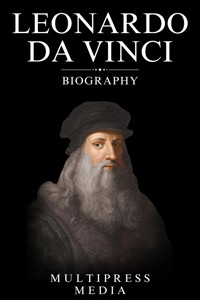
LEONARDO DA VINCI
Biography
By
MultiPress Media
Important Legal Information:
Except as provided by United States of America copyright law, this book or any part of it may not be reproduced in any form, stored in any retrieval system, or distributed in any format by any means, whether electronic, mechanical, photocopy, recording, or otherwise, without the publisher’s written permission.
Disclaimer:
This book’s contents are solely for educational and informative purposes. We take no responsibility for any impacts or outcomes that may occur as a result of using this content. Despite making every attempt to offer accurate and sufficient information, the author accepts no responsibility for its correctness, usage, or abuse.
Copyright © 2024 by MultiPress Media.
All Rights Reserved.
Table of Contents
Introduction
Chapter 1: The Early Years of Genius
Chapter 2: The Renaissance Context
Chapter 3: Master of Art
Chapter 4: Scientific Inquiry and Anatomical Studies
Chapter 5: Inventions and Engineering
Chapter 6: The Last Years in France
Chapter 7: Legacy in Art and Science
Chapter 8: The Quest for Knowledge
Chapter 9: Leonardo’s Influence on Modern Innovation
Chapter 10: The Mystique of the Man
Chapter 11: The Da Vinci Code: Myths and Misconceptions
Chapter 12: Leonardo’s Enduring Legacy
Conclusion
Introduction
Leonardo da Vinci, often hailed as the quintessential Renaissance man, embodies the spirit of curiosity and innovation that defined an era. Born in 1452 in the small Tuscan town of Vinci, he emerged as one of history's most influential figures, transcending the boundaries of art, science, and philosophy. His extraordinary range of interests and talents—encompassing painting, anatomy, engineering, and botany—has not only left an indelible mark on the cultural landscape of the West but also established him as a beacon of human potential and creativity.
Throughout his life, Leonardo navigated a complex web of relationships and influences, collaborating with luminaries such as the Medici family in Florence and King Francis I in France. These interactions not only provided him with patronage but also challenged and inspired him, pushing the boundaries of his artistic and intellectual endeavors. His masterpieces, including "The Last Supper" and "Mona Lisa," are celebrated not only for their technical prowess but also for their profound exploration of human emotion and experience.
Key moments in Leonardo's life, such as his early apprenticeship under Andrea del Verrocchio and his later years in the French court, serve as pivotal chapters in understanding his evolution as an artist and thinker. Each phase of his journey is marked by a relentless pursuit of knowledge, evidenced by his extensive notebooks filled with sketches and observations that reveal the depth of his curiosity and intellect.
Chapter 1: The Early Years of Genius
Leonardo da Vinci was born on April 15, 1452, in the small town of Vinci, situated amidst the rolling hills of Tuscany. This idyllic landscape, characterized by its fertile fields and vibrant colors, would not only serve as a backdrop for his early years but also profoundly influence his later work. As the illegitimate son of a wealthy notary, Piero da Vinci, and a peasant girl named Caterina, Leonardo's early life was marked by a juxtaposition of privilege and the challenges associated with his birth. Raised in his father's household, he had access to education and resources that many of his peers lacked. His father, recognizing his son’s potential, ensured that Leonardo received an upbringing rich in the arts and humanities.
Growing up in the Tuscan countryside instilled in him a deep appreciation for nature. The lush landscapes and varied flora and fauna would later inform his meticulous studies of plants, animals, and human anatomy. The local environment was not merely a setting; it was a source of inspiration that shaped Leonardo’s perception of the world. His childhood explorations of the hills and valleys around Vinci sparked an insatiable curiosity that would define his lifelong quest for knowledge.
In 1466, at the age of 14, Leonardo began his formal apprenticeship in Florence, a vibrant hub of Renaissance culture and creativity. He joined the workshop of the esteemed painter and sculptor Andrea del Verrocchio, who was renowned for his skill and innovative techniques. This pivotal experience marked the beginning of Leonardo's transformation from a curious boy into a skilled artist. In Verrocchio’s workshop, Leonardo was exposed to a rich array of artistic disciplines, from painting and sculpture to metalwork and woodworking. This diverse training would be instrumental in shaping his multifaceted approach to art and science.
Under Verrocchio’s tutelage, Leonardo honed his technical skills and began to develop his unique style. Notably, Verrocchio's influence can be seen in Leonardo's early works, such as the “Baptism of Christ,” painted around 1472. In this collaborative piece, Leonardo contributed the angel holding Christ's robe, a figure that showcases his emerging talent. The grace and fluidity of the angel’s pose, along with the subtle play of light and shadow, reveal the hallmark characteristics of Leonardo's burgeoning style. While he learned from his master, it is crucial to note that Leonardo was not merely an imitator; he absorbed and expanded upon Verrocchio’s teachings, integrating his observations into a more profound understanding of artistic representation.
As he continued his apprenticeship, Leonardo's quest for knowledge extended beyond mere technique. He was driven by a desire to understand the principles underlying the natural world. This insatiable curiosity led him to explore anatomy, engineering, and perspective, subjects that would later become central to his body of work. His studies were not confined to the canvas; rather, they encompassed a holistic understanding of the interconnectedness of various disciplines.




