


5,49 €
Mehr erfahren.
- Herausgeber: Quick Reads
- Kategorie: Geisteswissenschaft
- Sprache: Englisch
Discover the fascinating history of Ancient Rome…
Ancient Rome stands as one of the most influential civilizations in history, shaping the political, cultural, and architectural landscapes of the modern world. From its legendary founding to the height of the Empire and its eventual decline, the story of Rome is filled with remarkable achievements, pivotal conflicts, and enduring legacies. *The Ancient Rome: An Interesting History From Beginning to End* offers a comprehensive look at the events and individuals that defined this incredible civilization.
In this book, you will explore:
* The founding myths of Romulus and Remus and their significance in Roman identity.
* The political rise and expansion of the Roman Republic, including key military conquests.
* Daily life in Rome, from family dynamics and religious practices to the impact of slavery.
* The transition from Republic to Empire, with a focus on Julius Caesar and Augustus.
* The decline and fall of the Western Roman Empire, examining the causes and consequences.
And much more...!
If you want a concise and engaging history of Ancient Rome, filled with intriguing insights and historical context, simply scroll up and click the "Buy now" button for instant access!
Das E-Book können Sie in Legimi-Apps oder einer beliebigen App lesen, die das folgende Format unterstützen:
Veröffentlichungsjahr: 2024
Ähnliche















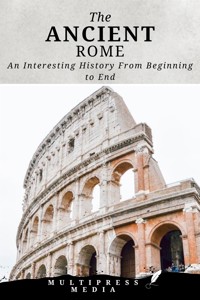
THE ANCIENT ROME
An Interesting History From Beginning to End
By
MultiPress Media
Important Legal Information:
Except as provided by United States of America copyright law, this book or any part of it may not be reproduced in any form, stored in any retrieval system, or distributed in any format by any means, whether electronic, mechanical, photocopy, recording, or otherwise, without the publisher's written permission.
Disclaimer:
This book's contents are solely for educational and informative purposes. We take no responsibility for any impacts or outcomes that may occur as a result of using this content. Despite making every attempt to offer accurate and sufficient information, the author accepts no responsibility for its correctness, usage, or abuse.
Copyright © 2024 by MultiPress Media.
All Rights Reserved.
Table of Contents
Introduction
Chapter 1: The Founding Myths and Early Society
Chapter 2: The Roman Republic: Rise and Expansion
Chapter 3: Culture and Daily Life in Rome
Chapter 4: The Arts and Literature of Ancient Rome
Chapter 5: The Roman Economy and Trade Networks
Chapter 6: Politics and Power: The Transition from Republic to Empire
Chapter 7: Governance and Administration of the Empire
Chapter 8: Religion and Philosophy in Roman Society
Chapter 9: The Military and Warfare in Rome
Chapter 10: The Crisis of the Third Century
Chapter 11: The Decline and Fall of the Western Roman Empire
Chapter 12: The Legacy of Ancient Rome
Conclusion
Introduction
The Ancient Rome, a civilization that spanned over a millennium, represents a pivotal chapter in human history, marked by remarkable achievements and profound complexities. As one of the most influential cultures in the Western world, Rome's legacy permeates modern governance, law, engineering, and the arts, shaping the foundations of contemporary society. From its humble beginnings as a small settlement along the Tiber River to its ascent as a sprawling empire that encompassed vast territories across Europe, North Africa, and the Near East, the story of Ancient Rome is one of ambition, power, and cultural evolution.
At the heart of this narrative are the key figures who not only influenced the course of Roman history but also embodied the spirit of their time. Leaders such as Julius Caesar, whose rise and fall encapsulated the tensions between ambition and republicanism, and Augustus, the first emperor, whose reign marked the transition from Republic to Empire, serve as focal points in understanding the political intricacies of the era. Equally significant are the voices of the common people, the patricians and plebeians whose lives were shaped by the decisions of their leaders, and the various religious and philosophical figures who questioned and defined the moral fabric of Roman society.
Critical moments, such as the Punic Wars that established Roman dominance over the Mediterranean, the internal strife of the late Republic, and the eventual decline of the Western Empire, illustrate the dynamic interplay of conflict and culture that characterized Ancient Rome. Each chapter in this book will delve into these themes, exploring the multifaceted dimensions of Roman life, from military strategies and economic structures to the arts and religious transformations.
As we embark on this exploration, it is essential to recognize that the story of Ancient Rome is not merely one of political and military conquests. It is also a rich tapestry woven with the threads of social change, cultural exchange, and the enduring quest for identity. This introduction sets the stage for a deeper examination of the complexities of Ancient Rome, inviting readers to engage with its history through a lens that highlights both its triumphs and its tribulations. In the chapters that follow, we will uncover the layers of this ancient civilization, providing a comprehensive understanding of its enduring impact on the world we inhabit today.
Chapter 1: The Founding Myths and Early Society
The founding myths of Rome, particularly the legendary tale of Romulus and Remus, are crucial to understanding the cultural identity of ancient Romans. According to tradition, Romulus and Remus were the twin sons of Rhea Silvia, a vestal virgin, and Mars, the god of war. Their story begins in 753 BCE, when they were abandoned as infants and left to die along the banks of the Tiber River. However, fate intervened in the form of a she-wolf, who nursed them until a shepherd named Faustulus discovered and raised them. This myth serves as a cornerstone of Roman identity, symbolizing not only the city’s origins but also the virtues of resilience and strength that the Romans valued.
Romulus eventually killed Remus in a dispute over where to establish their new city, leading to the founding of Rome itself. This violent fratricide underscores a recurring theme in Roman history: the intertwining of conflict and creation. The tale of Romulus's ascension as the first king of Rome highlights the Romans' embrace of martial valor and authority, as he was said to have established many of the city’s foundational institutions, including its early political structures and the sanctity of its religious practices. The celebration of these myths was not merely for entertainment; they served as moral lessons that reinforced the values that Romans held dear—strength, loyalty, and the importance of the city-state.




