


5,49 €
Mehr erfahren.
- Herausgeber: Quick Reads
- Kategorie: Geisteswissenschaft
- Sprache: Englisch
Discover the captivating history of Babylon...
Once a small settlement along the Euphrates, Babylon grew into one of the most influential civilizations of the ancient world. This city, with its rich tapestry of culture, law, and mythology, has left an indelible mark on human history. At the heart of this remarkable journey lies the story of a civilization that not only shaped the course of its era but also continues to echo through time.
In this enlightening exploration, we delve into the foundational elements that made Babylon a beacon of human achievement. From King Hammurabi’s revolutionary code of laws to the legendary Hanging Gardens, we uncover the pivotal moments that defined this ancient metropolis. We also examine the religious practices that intertwined with daily life, the significance of the Tower of Babel, and Babylon's lasting contributions to science and mathematics.
Discover a plethora of topics such as:
* The Birth of a Civilization
* Hammurabi and the Code of Laws
* Nebuchadnezzar II: The Golden Age of Babylon
* Daily Life in Babylon
* The Babylonian Captivity and Its Impact
* Babylon Rediscovered: Archaeology and Modern Interpretations
And much more...!
So if you want a concise and informative book on Babylon, simply scroll up and click the "Buy now" button for instant access!
Das E-Book können Sie in Legimi-Apps oder einer beliebigen App lesen, die das folgende Format unterstützen:
Veröffentlichungsjahr: 2024
Ähnliche
















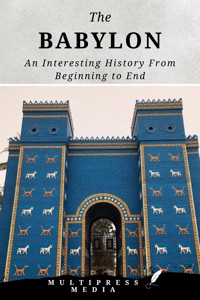
THE BABYLON
An Interesting History From Beginning to End
By
MultiPress Media
Important Legal Information:
Except as provided by United States of America copyright law, this book or any part of it may not be reproduced in any form, stored in any retrieval system, or distributed in any format by any means, whether electronic, mechanical, photocopy, recording, or otherwise, without the publisher's written permission.
Disclaimer:
This book's contents are solely for educational and informative purposes. We take no responsibility for any impacts or outcomes that may occur as a result of using this content. Despite making every attempt to offer accurate and sufficient information, the author accepts no responsibility for its correctness, usage, or abuse.
Copyright © 2024 by MultiPress Media.
All Rights Reserved.
Table of Contents
Introduction
Chapter 1: The Birth of a Civilization
Chapter 2: Hammurabi and the Code of Laws
Chapter 3: Religion and the Gods of Babylon
Chapter 4: The Tower of Babel: Fact, Myth, and Legacy
Chapter 5: Nebuchadnezzar II: The Golden Age of Babylon
Chapter 6: Daily Life in Babylon
Chapter 7: Babylon’s Contributions to Science and Mathematics
Chapter 8: Conflict and Conquest: The Fall of Babylon
Chapter 9: The Babylonian Captivity and Its Impact
Chapter 10: The Legacy of Babylon in Later Civilizations
Chapter 11: Babylon Rediscovered: Archaeology and Modern Interpretations
Chapter 12: Babylon’s Place in Popular Culture and Modern Imagination
Conclusion
Introduction
Babylon stands as one of the most iconic civilizations of the ancient world, a city whose name evokes grandeur, power, and mystery. Situated along the fertile banks of the Euphrates River, Babylon rose from humble beginnings to become the political and cultural epicenter of Mesopotamia, a land where empires were born, flourished, and fell. At its zenith, Babylon was a beacon of architectural, legal, and intellectual achievement, a place where rulers sought to leave their indelible mark on history, and where the gods were thought to wield influence over the destiny of mankind.
The city first gained prominence under King Hammurabi in the 18th century BCE, whose reign ushered in a new era of unification and governance. Hammurabi's most enduring legacy, the Code of Hammurabi, is one of the earliest and most comprehensive sets of laws in recorded history. This legal code not only established Babylon as a model for governance but also reflected the complex social hierarchy and justice system of the time. Babylonian law would serve as a foundation for future legal systems, both in the ancient world and beyond.
However, it was Nebuchadnezzar II, reigning in the 6th century BCE, who would transform Babylon into a symbol of imperial might and cultural sophistication. Nebuchadnezzar's reign marked the zenith of Babylon's power, as the city expanded its territorial control and influence over much of the ancient Near East. Under his rule, Babylon became a marvel of urban design, with towering ziggurats, opulent palaces, and the famed Hanging Gardens—one of the Seven Wonders of the Ancient World. His military conquests, notably the siege and destruction of Jerusalem, also marked a significant chapter in the history of the region and played a central role in the Jewish experience of exile, an event that would later resonate deeply in biblical traditions.
Yet, Babylon’s significance transcends the reigns of these mighty rulers. Its contributions to science, mathematics, and astronomy left a legacy that shaped the intellectual traditions of the ancient world. Babylonian scholars, through their development of cuneiform writing and advanced understanding of mathematics and time, laid the groundwork for future civilizations, including the Greeks and Islamic scholars, who would further develop these fields.
The city’s fall to Cyrus the Great of Persia in 539 BCE marked the end of its dominance, but not the end of its influence. Babylon continued to play a vital role under Persian rule and later empires, serving as a symbol of cultural and religious complexity. The biblical story of the Tower of Babel, for instance, reflects the city's pivotal place in both myth and reality, underscoring its importance as a point of connection—and division—among different peoples and languages.
This book embarks on a journey through the vast historical, cultural, and religious tapestry of Babylon. It delves into the city’s foundational myths, its rise to power under iconic rulers, and its lasting impact on the civilizations that followed. Each chapter will uncover a different layer of Babylon’s multifaceted story, from its contributions to law and architecture to its role in shaping the spiritual and intellectual life of the ancient world. In doing so, it aims to provide a comprehensive understanding of why Babylon remains one of history’s most enduring and intriguing civilizations.
Chapter 1: The Birth of a Civilization
Settlements along the Euphrates and Tigris rivers were the lifeblood of the earliest Mesopotamian civilizations, and it was here, amidst fertile plains and strategic waterways, that Babylon’s story began. The region, often referred to as the “Cradle of Civilization,” saw the emergence of small agricultural communities as early as 6000 BCE. These villages, reliant on the rich soil deposited by the rivers, gradually expanded, evolving into complex urban centers that would define the early phases of Mesopotamian society. By the late 4th millennium BCE, cities like Uruk and Eridu had grown into powerful hubs of trade, culture, and governance, setting a precedent for Babylon’s eventual rise.
The geographical advantages of the region were key to its development. The Euphrates and Tigris rivers not only provided a steady source of irrigation for crops but also served as vital transportation routes that linked the scattered settlements. As agricultural surplus increased, so too did the capacity for trade, which in turn spurred the growth of urban settlements. It was in this environment that the earliest foundations of Babylon were laid, though the city itself would not emerge as a dominant power until much later.




