


5,49 €
Mehr erfahren.
- Herausgeber: Quick Reads
- Kategorie: Geisteswissenschaft
- Sprache: Englisch
Discover the fascinating world of the Sumerians...
The architects of civilization who emerged in the heart of ancient Mesopotamia. Known for their remarkable innovations, the Sumerians established the first city-states, such as Ur and Uruk, transforming agriculture through advanced irrigation techniques and shaping society along the vital Tigris and Euphrates rivers.
Explore the unique power dynamics of Sumer, where governor-priests held significant authority, and delve into the legendary tales of Gilgamesh, a ruler whose quest for immortality reflects the core values of Sumerian culture. Uncover the intricate pantheon of gods, including Anu and Enlil, and learn how religion permeated daily life through temples and ziggurats.
Trace the revolutionary development of cuneiform writing, a groundbreaking system that preserved Sumerian law, literature, and governance. From trade networks that connected distant lands to the artistic legacies etched in stone and clay, the Sumerians' influence resonates throughout history.
Discover a plethora of topics such as:
* The Rise of Sumer
* Kings and Priests
* The Epic of Gilgamesh
* Sumerian Religion and Mythology
* The Invention of Cuneiform
* The Role of Women in Sumerian Society
And much more...!
So if you're ready to dive into the origins of civilization, scroll up and click the "Buy now" button for instant access!
Das E-Book können Sie in Legimi-Apps oder einer beliebigen App lesen, die das folgende Format unterstützen:
Veröffentlichungsjahr: 2024
Ähnliche
















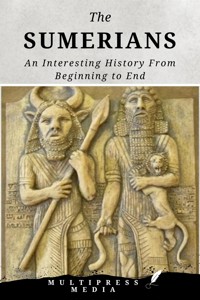
THE SUMERIANS
An Interesting History From Beginning to End
By
MultiPress Media
Important Legal Information:
Except as provided by United States of America copyright law, this book or any part of it may not be reproduced in any form, stored in any retrieval system, or distributed in any format by any means, whether electronic, mechanical, photocopy, recording, or otherwise, without the publisher's written permission.
Disclaimer:
This book's contents are solely for educational and informative purposes. We take no responsibility for any impacts or outcomes that may occur as a result of using this content. Despite making every attempt to offer accurate and sufficient information, the author accepts no responsibility for its correctness, usage, or abuse.
Copyright © 2024 by MultiPress Media.
All Rights Reserved.
Table of Contents
Introduction
Chapter 1: Dawn of Civilization – The Rise of Sumer
Chapter 2: Kings and Priests – The Power Structures of Sumer
Chapter 3: The Epic of Gilgamesh – Myth and Reality
Chapter 4: Gods Among Men – Sumerian Religion and Mythology
Chapter 5: Language and Writing – The Invention of Cuneiform
Chapter 6: The Economy of Sumer – Trade, Agriculture, and Craftsmanship
Chapter 7: Law and Society – The Sumerian Legal System
Chapter 8: The Art and Architecture of Sumer – A Legacy in Stone and Clay
Chapter 9: Conflict and Cooperation – War and Diplomacy in Sumer
Chapter 10: The Role of Women in Sumerian Society
Chapter 11: The Fall of Sumer – Decline and Assimilation
Chapter 12: Legacy of the Sumerians – Influence on the Ancient and Modern World
Conclusion
Introduction
The Sumerians stand as one of the earliest and most influential civilizations in human history. Emerging around 4500 BCE in the fertile plains of southern Mesopotamia, the Sumerians developed a complex society that would leave an indelible mark on the course of civilization. Often referred to as the "Cradle of Civilization," Sumer saw the birth of cities, writing, monumental architecture, and sophisticated governance, all of which became cornerstones of human development. Over the course of nearly two millennia, the Sumerians established a foundation that shaped not only the ancient Near East but also the trajectory of history itself.
At the heart of Sumerian civilization were its city-states, each with its own ruler, gods, and identity. Ur, Uruk, and Lagash were among the most powerful, thriving as centers of trade, religion, and political power. The rulers of these cities, such as the legendary Gilgamesh of Uruk, wielded both temporal and divine authority. Their stories—part history, part myth—echo through the ages in texts like the *Epic of Gilgamesh*, one of the oldest literary works known to humanity. The Sumerians, however, were not merely a culture of kings and priests. They were an industrious people who transformed the landscape through pioneering irrigation techniques and a sophisticated understanding of agriculture. Their innovations in technology and trade linked them to distant regions, creating one of the earliest examples of a global economy.
The creation of cuneiform, the world's first writing system, signaled another landmark achievement of Sumerian society. Initially developed for record-keeping, cuneiform evolved into a medium for preserving law, literature, and religious doctrine. The Code of Ur-Nammu, a precursor to the famous Code of Hammurabi, is one of the earliest examples of written law, reflecting the complex and structured nature of Sumerian society. In the realm of religion, the Sumerians constructed towering ziggurats as places of worship, establishing a lasting architectural legacy that would influence civilizations for centuries.
The rise of the Sumerians was not without conflict. City-states often vied for supremacy, and external threats loomed large. The Akkadian conquest under Sargon the Great in the 24th century BCE marked the beginning of Sumer's decline, yet even as political dominance shifted, the cultural achievements of Sumer endured. Their religious practices, legal systems, and technological advancements would permeate the later empires of Mesopotamia and beyond.
In the chapters that follow, we will delve deeper into the life, culture, and achievements of the Sumerians. From their complex social structures to their monumental contributions to art and writing, each aspect of their society offers a glimpse into the ingenuity and resilience of one of the world’s first great civilizations. Through a careful examination of key figures, seminal events, and groundbreaking innovations, this book seeks to offer a comprehensive understanding of the Sumerians and their enduring legacy.
Chapter 1: Dawn of Civilization – The Rise of Sumer
ABy the dawn of the 4th millennium BCE, the fertile plains of southern Mesopotamia had given rise to one of the world’s first great civilizations: Sumer. Nestled between the Tigris and Euphrates rivers, the Sumerians transformed this landscape into a series of thriving city-states. These urban centers, including Ur, Uruk, Lagash, and Eridu, became the backbone of a society marked by profound innovations in governance, agriculture, and technology. Each city-state, though distinct, shared common cultural, religious, and technological frameworks that laid the foundations for later civilizations in the region.
The city of Uruk, in particular, emerged as a focal point of early urban development. By approximately 3200 BCE, under the rule of legendary figures like Enmerkar and Lugalbanda, Uruk had grown into the largest and most influential city-state in Sumer. Its iconic white temple, dedicated to the sky god Anu, stood as a testament to the religious and political authority of its rulers. These leaders were not merely kings in the conventional sense but intermediaries between the gods and their people, a role that reinforced the divine legitimacy of their rule. Uruk's impressive ziggurats and sprawling walls, said to have been built by Gilgamesh, reflect the immense resources and labor that the Sumerians could mobilize through their burgeoning political systems.




