


5,49 €
Mehr erfahren.
- Herausgeber: Quick Reads
- Kategorie: Geisteswissenschaft
- Sprache: Englisch
**Discover the Fascinating History of the Iron Age**
The Iron Age was a pivotal period that reshaped human civilization with groundbreaking advancements and profound societal changes. "The Iron Age: A Quick Read History Full of Interesting Information" offers a compelling exploration of this transformative era, making it an engaging and accessible read for history enthusiasts and curious minds alike.
From the transition from bronze to iron, which revolutionized technology, to the vital role iron played in agriculture, craftsmanship, and warfare, this book delves into the myriad ways iron influenced ancient societies. You'll uncover the intricate social structures, economic systems, and trade networks that emerged during this time, as well as the spiritual and artistic expressions that were deeply intertwined with iron. This concise yet comprehensive guide provides a vivid overview of the Iron Age, highlighting key themes and captivating narratives that bring history to life.
Discover a plethora of topics such as:
* Transition from Bronze to Iron: Technological Advancements
* Iron Tools and Their Impact on Agriculture
* Development of Iron Weaponry and Armor
* Social Structures and Hierarchies
* Expansion of Trade Routes During the Iron Age
* Iron Age Deities and Religious Practices
And much more...!
So if you want a concise and informative book on the Iron Age, simply scroll up and click the "Buy now" button for instant access!
Das E-Book können Sie in Legimi-Apps oder einer beliebigen App lesen, die das folgende Format unterstützen:
Veröffentlichungsjahr: 2024
Ähnliche















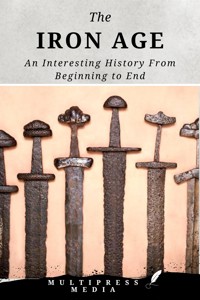
THE IRON AGE
An Interesting History From Beginning to End
By
MultiPress Media
Important Legal Information:
Except as provided by United States of America copyright law, this book or any part of it may not be reproduced in any form, stored in any retrieval system, or distributed in any format by any means, whether electronic, mechanical, photocopy, recording, or otherwise, without the publisher's written permission.
Disclaimer:
This book's contents are solely for educational and informative purposes. We take no responsibility for any impacts or outcomes that may occur as a result of using this content. Despite making every attempt to offer accurate and sufficient information, the author accepts no responsibility for its correctness, usage, or abuse.
Copyright © 2024 by MultiPress Media.
All Rights Reserved.
Table of Contents
Introduction
Chapter 1: Origins of the Iron Age
Chapter 2: The Role of Iron in Daily Life
Chapter 3: Iron in Warfare
Chapter 4: Iron Age Societies and Governance
Chapter 5: Trade and Exchange Networks
Chapter 6: Religious and Spiritual Beliefs
Chapter 7: Art and Symbolism
Chapter 8: Architectural Innovations
Chapter 9: Environmental Impact
Chapter 10: Health and Medicine
Chapter 11: Regional Variations
Chapter 12: Legacy of the Iron Age
Conclusion
Introduction
The Iron Age, which lasted from around 1200 BCE to 600 CE, was a watershed moment in human history. This time saw the transition from the Bronze Age, which was distinguished by the prevalence of bronze tools and weapons, to an age defined by mastery of ironworking skills. The discovery of iron dramatically altered cultures throughout Europe, Asia, and Africa, establishing the framework for later advances in technology, culture, and government.
The Iron Age is significant not only for its technological breakthrough in iron smelting and forging, but also for the tremendous influence these advancements had on numerous elements of daily life. Iron tools transformed agriculture, allowing for more effective land cultivation and promoting population increase. The creation of iron weaponry changed the nature of warfare, causing empires to rise and fall and transforming political landscapes. Iron also played an important role in trade, allowing for long-distance trades and cultural dissemination.
Key personalities and events from this era demonstrate the transforming potential of iron. In the Near East, the Hittites are typically credited with pioneering iron smelting technology circa 1200 BCE, establishing a precedent that would extend throughout the region. In Europe, the Celts frequently used iron, leaving a legacy of complex metalwork and fortified villages. Meanwhile, in Africa, the Nok civilization of modern-day Nigeria created magnificent terracotta statues and iron implements as early as 1000 BCE, demonstrating superior metallurgical abilities.
The growth of ironworking is likewise intricately tied to the construction of complex civilizations and political structures. The Assyrian Empire, known for its military might, used iron weapons to extend its territory and gain control over wide areas. In China, the Zhou Dynasty used iron implements to boost agricultural output, assisting in the establishment of one of the world's first bureaucratic regimes. Similarly, on the Indian subcontinent, the Maurya Empire used iron technology to improve its administrative and military capacities, resulting in economic wealth and cultural flowering.
This book takes readers on a tour through the Iron Age, exploring the various ways in which iron affected human society. From the scientific discoveries that permitted iron production to the cultural and socioeconomic transformations that followed, each chapter digs into the fascinating fabric of the Iron Age. This work seeks to give a thorough knowledge of an era that formed the groundwork for the contemporary world via the exploration of many views and compelling narrative. As we progress through the chapters, we will discover the legacy of the Iron Age, following its influence on the evolution of society and the course of human history.
Chapter 1: Origins of the Iron Age
The Iron Age signaled an important era in human history, marked by the shift from bronze to iron. This transition, which began approximately 1200 BCE, was not abrupt or uniform, but rather gradual and geographically diverse. To understand this shift, we must look at technical breakthroughs, early ironworking societies and areas, as well as archeological evidence of iron use.
Several variables influenced the shift from bronze to iron, notably the greater availability of iron ore vs the rarer tin required to manufacture bronze. For more than a millennia, bronze, a copper-tin alloy, has been the preferred material for tools and weapons. However, when trade routes were interrupted and tin supplies depleted, cultures began to explore alternatives. The Hittites, an ancient Anatolian tribe whose kingdom thrived in modern-day Turkey, are sometimes attributed with being pioneers in iron smelting. Around 1500 BCE, they invented methods for extracting iron from ore, though it was initially employed for ceremonial purposes rather than general practical usage.




