


32,99 €
Mehr erfahren.
- Herausgeber: John Wiley & Sons
- Kategorie: Fachliteratur
- Sprache: Englisch
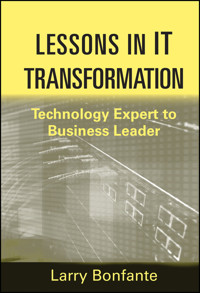
Important insights into the true purpose of IT?from a CIO's perspective Focusing on the qualities required to transform an organization through the lens of the CIO, this book provides practical advice on how to address key issues, as well as create a context for the type of leadership qualities required to broaden the CIO's impact in every aspect of the corporation. * Provides practical advice on key issues for leadership qualities * Looks at the differences between leadership and management and the need for effectiveness in both disciplines * Explores relationship management, communication skills, change management, developing human capital, sustainability, alignment, and qualities of great leaders A timely look at how the IT function can become totally aligned with the strategies and operational direction of the business enterprise, Lessons in IT Transformation reveals how CIOs can?and should?evolve from managers of utility services to business leaders who can drive revenue, value, and process redesign.
Sie lesen das E-Book in den Legimi-Apps auf:
Seitenzahl: 312
Veröffentlichungsjahr: 2011
Ähnliche



















Contents
Cover
Title Page
Copyright
Dedication
Preface
What Is a CIO?
It's Common Sense
Introduction
Chapter 1: First Things First: What Is Leadership?
Defining Leadership
Leadership versus Management
Misconceptions about Leadership
Leadership Roles
Chapter 2: That Vision Thing
Importance of Vision
Deciding Whose Vision It Is
Helping Employees Feel Ownership
Creating the Vision
Aligning Your Vision with the Vision of Your People
Inspiring Others to Share the Vision
Making the Vision Real for People
Chapter 3: It's the Business, Stupid!
The Purpose of IT
The Foolishness of Alignment
Three Questions about IT's Role in the Organization's Mission
Fiscal Management—IT Is an Investment, Not a Cost
IT as a Tool to Drive Revenue
Ways to Engage the Board
The CIO as a Business Leader, Not Technologist
Meaningful Metrics
Focus on What Matters
Managing Perception versus Reality
Chapter 4: Communication
The Importance of Communication
The Importance of Listening
Who Do I Need to Communicate With?
How Should I Communicate with Them?
How Often Should I Communicate?
The Need for Marketing
What Is Your Brand?
Leading a Volunteer Army
Communicating Tough Messages
Focusing on the Issue, Not the Person
Honesty and Transparency
Chapter 5: Relationship Management
No Man (or Woman) Is an Island
Helping Other People Succeed
Being a Team Builder
Building Credibility
The Law of WIFM—What's in it for Me?
Leading by Serving
What People Feel about You Is More Important than Reality
Chapter 6: Developing Human Capital
Leading “Persons”
Leveraging People's Unique Talents
Engaging the Whole Person
Focusing on Strengths
Recruiting/Retaining/Developing
Making Sure a Person Is Better Off for Having Had the Experience
Recognizing and Rewarding Your People's Efforts and Successes
Chapter 7: Leading the Process of Change
Change Is Uncomfortable
Selling the Need for Change
Personalizing the Need for Change
Making Change a Part of Your Culture
Building Community
Ensuring Buy-in
Breaking Change into Bite-sized Chunks
Supporting Progress along the Way
Celebrating and Communicating Progress/Success
Comparing Position versus Influence
Balancing Change with Disciplined Project Management
Developing a Culture of Innovation
Developing a Culture of Accountability
Chapter 8: Partnering for Success
Some Words Are Used Too Loosely
Creating an Empowered, Team-oriented Environment
Adjusting to the Twenty-first-century Workforce
Partnering with Your Team
Partnering with Your Clients
Partnering with Your Executive Management and Board of Directors
Sourcing—Expanding Your Team to Include Outside Partners
Networking in the Industry
Chapter 9: Developing the Qualities of a Great Leader
Being Authentic
Inspiring Others
Building Trust
Showing Humility
Having a Bias Toward Action
Leveraging Collective Wisdom
Building Personal Relationships
Influencing Others
Showing Your Humanity
Empowering the People around You
Being Receptive to Feedback
Being Likable
Being Accountable
The Most Important Characteristic of a Leader—Having Integrity
Chapter 10: Sustainability
Accomplishing Short-term Success Is Only the First Step
Individual Leaders Can Drive Short-term Success
You Need a Culture of Leadership to Ensure Long-term Viability
A Leader's Job Is Not Only Creating Success—It is Creating Other Leaders
Chapter 11: Homework and Parting Thoughts
Leadership Begins with Me!
I am IT!
Be Wary of Linda Ronstadt Disease
Seek Alignment versus Consensus
God Gave You Two Ears and One Mouth
How Do You Feel When You Are the Customer?
Leadership Is a Responsibility, Not a Privilege
You Are Either Part of the Solution or Part of the Problem—the Choice Is Yours
There Are Three Kinds of People in the World
When You Change, Your World Changes
About the Author
Index
Copyright © 2011 by Larry Bonfante. All rights reserved.
Published by John Wiley & Sons, Inc., Hoboken, New Jersey.
Published simultaneously in Canada.
No part of this publication may be reproduced, stored in a retrieval system, or transmitted in any form or by any means, electronic, mechanical, photocopying, recording, scanning, or otherwise, except as permitted under Section 107 or 108 of the 1976 United States Copyright Act, without either the prior written permission of the Publisher, or authorization through payment of the appropriate per-copy fee to the Copyright Clearance Center, Inc., 222 Rosewood Drive, Danvers, MA 01923, (978) 750-8400, fax (978) 646-8600, or on the web at www.copyright.com. Requests to the Publisher for permission should be addressed to the Permissions Department, John Wiley & Sons, Inc., 111 River Street, Hoboken, NJ 07030, (201) 748-6011, fax (201) 748-6008, or online at www.wiley.com/go/permissions.
Limit of Liability/Disclaimer of Warranty: While the publisher and author have used their best efforts in preparing this book, they make no representations or warranties with respect to the accuracy or completeness of the contents of this book and specifically disclaim any implied warranties of merchantability or fitness for a particular purpose. No warranty may be created or extended by sales representatives or written sales materials. The advice and strategies contained herein may not be suitable for your situation. You should consult with a professional where appropriate. Neither the publisher nor author shall be liable for any loss of profit or any other commercial damages, including but not limited to special, incidental, consequential, or other damages.
For general information on our other products and services or for technical support, please contact our Customer Care Department within the United States at (800) 762-2974, outside the United States at (317) 572-3993 or fax (317) 572-4002.
Wiley also publishes its books in a variety of electronic formats. Some content that appears in print may not be available in electronic books. For more information about Wiley products, visit our website at www.wiley.com.
Library of Congress Cataloging-in-Publication Data:
Bonfante, Larry
Lessons in IT transformation : technology expert to business leader / Larry Bonfante.
p. cm.
Includes index.
ISBN 978-1-118-00447-0 (cloth); 978-1-118-04447-6 (ebk); 978-1-118-04448-3 (ebk); 978-1-118-04450-6 (ebk)
1. Information technology—Management. 2. Leadership. I. Title.
HD30.2.B657 2011
004.068'4–dc22
2010053513
To the greatest teachers in my life:
My mother, Josephine, who taught me the meaning of selflessness
My grandfather, Jerome, who taught me the meaning of integrity
My wife, Denise, who taught me the meaning of strength
My daughters, Danielle and Christine, who taught me what really matters in life
Thank you for your lessons and your love.
Preface
Every generation must deal with the challenges of a constantly changing world. Although many of the issues and dynamics we face may change over time, the one variable that remains constant is the need for quality leaders to help us navigate difficult and uncharted waters. There have been countless books written on the subject of leadership. I have read many of these books and learned a great deal from the experience. While all of them were valuable, no book written by another human being can capture an individual's personal evolution as a leader. This book is meant to share my own journey to date in the hope that the lessons I have learned will be of value to other leaders. It is also written from the point of view of a CIO so that it can be of specific value to technology leaders. It is by no means meant to be the definitive tome on the topic of leadership. Many of the lessons contained within these pages are certainly reflected in other books on this topic.
What Is a CIO?
CIO is a term that means many things in various organizations. The idea of creating a position of chief information officer is about 25 years old. CIOs have historically been entrusted with operating the technology services and assets of modern organizations. However, today more than ever, the shift in focus is away from simply being a “utility provider” who keeps the lights on. The modern CIO has to be an evangelist, an innovator, a revenue producer, a consumer expert, and an executive relationship manager. These are skills that are not always naturally inborn into many IT executives who have grown up through the ranks of technology organizations. We will focus on the traits and talents that you must be able to incorporate into your portfolio if you hope to be a successful CIO in the year 2011 and beyond.
It's Common Sense
Over the years, I have noticed that the teams who win on Sunday are not the teams with the best trick plays, but rather those who block and tackle the best. Much of what is contained in this book will seem like common sense, but as a wise man once told me, common sense is not that common! It is amazing how often we don't leverage the lessons we've learned over time to improve our relationships and outcomes. This book is not intended to impress the reader with complex concepts. It is meant to help share the simple concepts that I have seen make a meaningful difference in leading successful teams.
The older I get, the more I realize that I will always be a student of leadership. I am not arrogant enough to believe that I am an expert or that I have all the answers. My desire is to continue to learn until my last day on this planet. I hope that readers will take away from my experiences some useful bits of knowledge that will help them become a better leader and help them to develop the leadership qualities in the people around them. As a person who has a great passion about the subject of leadership, writing this book has been a labor of love.
Introduction
Why should I read this book? Be honest—that's what you are really trying to figure out before you decide to invest the time and money required to read any book. There are thousands of books available on the topic of leadership. Why is this book different, and why should you care? Here are a few answers to your question.
First of all, this book is written for the IT professional as its stated audience. It focuses on the topic of leadership through the unique perspective of an IT practitioner. It is also written through the lens of an actively practicing CIO who lives the challenges of leading and managing a complex technology organization every day.
The book is also very different from many resources written for the IT community in that it focuses on what I lovingly refer to as the human side of IT leadership. Many IT executives have risen through the technical ranks and already have a great handle on leading IT projects, implementing technical solutions, and handling the day-to-day operations of a technology organization. What most CIOs or aspiring CIOs don't always have is a great deal of experience or focused education in dealing with the human elements of leading an organization that ultimately will decide whether you, as well as your organization, succeed. In this book we will focus on real, pragmatic issues that are critical for executive success. These topics include:
Helping to create a vision that your team will embraceThe real purpose of IT—driving business valueDeveloping effective communication skillsBecoming an effective relationship managerDeveloping the people on your team for maximum contributionLeading a major change effortCreating an atmosphere of partnership with your people, clients, and vendorsDeveloping the qualities of great leadersSustaining success once it's achievedThese topics are critical to executive success but are not often taught in MBA programs or easily learned on the job. I will cram nearly 30 years of lessons from the school of hard knocks into these pages in the hope that you can avoid having to invest as much time (and make as many mistakes!) as I have.
Finally, the book has two major focuses—helping the individual evolve from a technical expert to a business executive and helping his/her organization evolve from a utility service provider to a trusted business partner that drives true business value. If these are goals you hope to accomplish, then this is the right book for you at the right time.
Chapter 1
First Things First: What Is Leadership?
Before we get into the “nuts and bolts” of what is involved in transforming an IT organization, we will spend some time defining some key concepts. Specifically, we will focus on the following concepts:
Defining what I mean by leadershipComparing and contrasting leadership and managementReviewing common misperceptions regarding leadershipExamining the critical roles that a transformational leader has to playDefining Leadership
There are probably as many definitions of leadership as there are people who have an interest in the topic. Many of us have formed our thoughts and definitions based on the people in our lives from whom we have learned our lessons of leadership. For many people, the image of leadership comes along with formal power and authority. For others, it elicits a vision of eloquent orators who can inspire with their thoughts and words. Some may conjure up emotional pictures of military leaders or sports coaches who “fire up” the troops.
Lesen Sie weiter in der vollständigen Ausgabe!
Lesen Sie weiter in der vollständigen Ausgabe!
Lesen Sie weiter in der vollständigen Ausgabe!
Lesen Sie weiter in der vollständigen Ausgabe!
Lesen Sie weiter in der vollständigen Ausgabe!
Lesen Sie weiter in der vollständigen Ausgabe!
Lesen Sie weiter in der vollständigen Ausgabe!
Lesen Sie weiter in der vollständigen Ausgabe!
Lesen Sie weiter in der vollständigen Ausgabe!
Lesen Sie weiter in der vollständigen Ausgabe!
Lesen Sie weiter in der vollständigen Ausgabe!
Lesen Sie weiter in der vollständigen Ausgabe!




