


Erhalten Sie Zugang zu diesem und mehr als 300000 Büchern ab EUR 5,99 monatlich.
- Herausgeber: Pushkin Press Classics
- Kategorie: Gesellschafts- und Liebesromane
- Sprache: Englisch
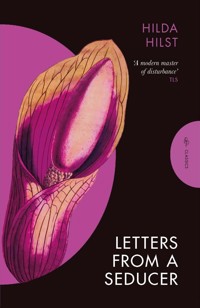
In Letters from a Seducer, Hilst describes the everyday life of Karl, a wealthy, erudite, and amoral man who seeks an answer to his incomprehension of life through sex. Karl writes and sends twenty provocative letters to Cordelia, his chaste sister. The letters' text becomes intertwined with the life of the poet Stamatius, who finds Karl's letters in the trash, as Hilst constructs an ingenious mirror play between the two that casts strange light on questions of amorality, sexuality and the spirit.Linguistically rich and endlessly playful, Letters from a Seducer is a work of perverse genius by one of Brazil's greatest modern writers.
Sie lesen das E-Book in den Legimi-Apps auf:
Seitenzahl: 145
Veröffentlichungsjahr: 2025
Das E-Book (TTS) können Sie hören im Abo „Legimi Premium” in Legimi-Apps auf:
Ähnliche

















LETTERS FROM A SEDUCER
HILDA HILST
TRANSLATED FROM THE PORTUGUESE BY JOHN KEENE
WITH AN INTRODUCT ION BY BRUNO CARVALHO
PUSHK IN PRESS CLASSICS
2
‘Like her friend and admirer Clarice Lispector, Hilst was a passionate explorer of the sacred and the profane, the pure and the obscene’
BENJAMIN MOSER
‘A joyfully wicked writer’
TLS
‘Hilst wrote with the ink of melancholy, the quill of playfulness, and, above all, a human body—a woman’s body’
VICTOR HERINGER, AUTHOR OF THE LOVE OF SINGULAR MEN
INTRODUCTION
BrunoCarvalho
Born in Jaú, a small town in the state of São Paulo, Hilda Hilst (1930-2004) went on to become one of Brazil’s most prestigious authors. Despite numerous literary prizes and steady critical acclaim, her work remains controversial among readers of Portuguese, and largely unknown in the English-speaking world. This edition of Letters from a Seducer, in John Keene’s superb translation, should leave no one indifferent. It follows TheObsceneMadameD, the first book by Hilda Hilst to be published in English, also by Nightboat Books and A Bolha Editora. In tandem, they make available to a broader public one of the twentieth century’s most provocative and versatile writers.
Hilda Hilst began to publish while still a law student at the University of São Paulo. Between 1950 and 1962, she authored seven poetry books, the last of which earned her São Paulo’s Pen Club Award. In the mid-60s, Hilda moved to a house in the outskirts of Campinas, São Paulo. Known as the “Casa do Sol” (House of the Sun), it hosted a myriad of writers and artists during Hilda’s lifetime, including the sculptor Dante Casarini, her husband of many years. The “Casa do Sol” now houses the Hilda Hilst Institute. During the late 1960s, she began to split time between the Campinas residence and the “Casa da Lua” (House of the Moon) in the Massaguaçu beach. She also expanded her literary pursuits, writing plays and prose fiction. In 1969 she received the Anchieta Theater Prize, and in 1970 published her first book of fiction. For the next iithree decades, Hilda Hilst would continue to publish both poetry and prose, while amassing prizes and seeing several of her works adapted to the stage.
Letters from a Seducer, first published in 1991, was the third in a tetralogy of what the author deemed “brilliant pornography,” or “porno-chic.” These works followed a period of intense experimentation in Brazilian literature. The country had emerged from a military dictatorship (1964-1985), and writers no longer had to contend with brutal government censorhip. The constraints of the market, however, remained. Hilda Hilst did not attempt to produce best-sellers with this series, but she was playing with the boundaries of readers’ expectations. While Letters from a Seducer is by no means conventional, it is in many ways one of Hilda Hilst’s most enjoyable and stimulating works.
The book is divided in three loosely connected parts. All of them are narrated by a male voice. In the first, recalling the libertine epistolary novel tradition, the depraved and wealthy Karl writes to his sister Cordélia. Karl’s foil, the dispossessed writer Stamatius, who goes by Tiu, pens the four short stories that comprise the second part. The last section includes seven fragments that can be read both as semi-autonomous vignettes, and in dialogue with the rest of the text. Karl and Stamatius, who refer to each other in less than amicable terms, take delight in exploring taboos: incest, pedophilia, murder, cannibalism. Most of the homosexuality focuses on man-man acts, rather than the woman-woman sex that prevails in heteronormative male porn. Much of the sex, however, revolves around male-centric ideas of female phallic fixation, and certain passages even verge on parodies of Henry Miller’s literature. iii
Hilda Hilst maintains a reputation as a difficult author, a writer’s writer. Much of her more experimental prose, including other works from her “obscene” series, can seem hermetic and impenetrable. In LettersfromaSeducer, literary references abound. Almost every page alludes to a major author: Marx, Camus, Foucault, Genet, D.H. Lawrence, Tolstoy, Joyce, Madame de Staël, Nietzsche. Critics have pointed out parallels to Kierkegaard’s DiaryofaSeducer, as well as the narrative’s metalinguistic elements. This is also a reflection about writing itself, about the limits of language and literary pursuit. Its appeal, however, is not limited to a bookish reader’s abilities to decipher intertextual puzzles. To the contrary, like most pornography, LettersfromaSeducerconcerns itself with gratification, albeit mostly not of the erotic sort. In this work, where the trappings of pleasure are so often brought to the fore, it is not difficult to find pleasure at every turn.
The opening sentence offers useful clues: “How to think about pleasure wrapped up in this crap?” Crap can refer to the body and to language. Emil Cioran’s epigraph offers a potential answer: “Life is tolerable only by the degree of mystification that we endow it with.” No toothless mouth or raggedy body remains immune to the incantations of Hilda Hilst’s vigorous prose. In the first sentence of the Portuguese version, the word for pleasure is gozo. Variations are translated elsewhere as joy, desire, to come (ejaculate). Like the French jouissance, it denotes enjoyment as well as a sexual orgasm. Gozar, the verb, can also mean to mock, to ridicule. Combining all these dimensions, LettersfromaSeducerstraddles the lines between seriousness of purpose and irreverence, erudition and kitsch, grotesque and black humor, sublime and sordid. iv
This translation captures that richness. It preserves the ambivalences, the shifts in tone and the rhythms of the Portuguese without ever feeling like a translation. Even more remarkable, a cornucopia of erogenous lexicon has been transposed into an English that contains all of the original’s exuberance. The profusion of sex-related anatomical terms reveals an author’s plunge, with painstaking philological rigor, into vernacular traditions, regional dialects, and dictionaries. As befits a poet and playwright, Hilda Hilst had a keen ear, and LettersfromaSeducerturns the vulgar into something brilliant. Several passages of the book almost beg to be read aloud.
At the “Casa do Sol,” Hilda Hilst engaged in experiments with recording unoccupied radio frequencies, resulting in mysterious voices which she claimed to be from the dead. Metaphysical questions permeate her work. LettersfromaSeducermight seem otherwise, but in many ways it synthesizes several of her facets. Even when plotless, it is theatrical. Even amid pornography, we have poetry. And among clamors of the flesh, there are palpitations of spirituality. As the narrative progresses, death, god and the beyond enter the fray. In “The Pornographic Imagination,” Susan Sontag writes: “If within the last century art conceived as an autonomous activity has come to be invested with an unprecedented stature—the nearest thing to a sacramental human activity acknowledged by secular society—it is because one of the tasks art has assumed is making forays into and taking up positions on the frontiers of consciousness (often very dangerous to the artist as a person) and reporting back what’s there.”1 In LettersfromavSeducer, Hilda Hilst’s lifelong experiments with alterity break new grounds. She makes forays onto the limits of ponographic imagination, and amplifies the fringes of human sexual desire.
Regardless of whether LettersfromaSeducershould be considered pornography or metaphysics, class and politics are not absent. In Stamatius’s preamble he comes across ten thrown out copies of DasKapital, and offers an aside: “it seems to be out of fashion, I guess…).” Stamatius (Tiu) rejects bourgeois life in the name of literature, a commitment that his partner Eulália indulges with occasional impatience. The hedonistic Karl, on the other hand, refuses neither the privileges of wealth nor editorial compromise. He becomes a published writer, to Tiu’s chagrin. In literary or sexual pursuit, after all, no one is exactly like anyone else. Our wants evolve, devolve, resolve in ways that are often not linear, or recognizable to ourselves. But lack, like death, is a sort of equalizer, and not accidentally, a constant theme in literature. Eros spares no one, and it seems to be Everyman’s truism that we can’t get no satisfaction.
Karl and Tiu alike seek fulfillment. But it is Tiu who articulates the potential of scatology as a great equalizing force in a world of difference: “if everyone were to remember what comes out of their butt, everyone would be more generous, show more solidarity.” Hilda Hilst’s LettersfromaSeducerinvites readers to discover these voices, and find earnest insight in unexpected places. Seducer comes from the Latin seducere, meaning “lead away, lead astray.” The pages ahead are sure to do so.
1 Susan Sontag, StylesofRadicalWill.New York: Picador, 2002. Pg. 45.
Life is tolerable only by the degree of mystification that we endow it with.
EMIL MICHAEL CIORAN
CONTENTS
LETTERS FROM A SEDUCER
How to think about pleasure wrapped up in this crap? In mine. This discomfort of knowing myself raggedy and covered with sores, your hair growing long in the crotch, if you dare think about it, and then around the hair a stew of wounds, I do dare think about it I tell myself, my mouth toothless because of all the stress and strain and addiction, I dare think about it and they don’t forgive that. Then I take hold of your pubes and your pussy, pound them, your cry is high, hard, a whip, a bone, there’s debris all over the room, shards of that church over there in Caturré, the guy blew up everything in five minutes (was it me?), screamed, darkly: God? here, oh I only know about God when I enter the hairy mouth of the wild sugar apple, and soon after we heard the bang, the church exploding like jackfruit falling from the sky. I take hold of my mistress’s pudenda, after I spit on the papers, those ones from six months ago and which every day I smooth out, fumble with, tear, soil. Don’t you want to fuck, Tiu? aren’t you a little tired of writing? I look at Eulália. She’s tiny and plump. For a year now she’s been accompanying me in the street. We ask for everything that you are going to throw in the trash, everything that isn’t worth a dime anymore, and if there is any leftover food we still want it. The burlap sacks fill up, bric-a-brac books stones, then some people put rats and shit in the bag, what faces those rats had, my God, what injured little eyes those rats had, my God, we separated everything out right there: rats and shit here, books stones and bric-a-brac there. Never any food. We were busy all day long. Afterwards I washed off the books and began to read them. Eulália would do what she could to get some food. What readings! What people of the first order! What Tolstoy and philosophy they threw out is unbelievable. 4I have my half-dozen copies of that masterpiece TheDeathof IvanIlichand the complete works of Kierkegaard. And among the bric-a-brac I got some special ones too: a 12th century foot of Christ, half the face of an 18th century Teresa Cepeda y Ahumada, a piece of St. Sebastian’s thigh (with arrow and blood) from the 13th century, a stick of pink plastic, from this century, all twisted up as if it had been burned (I kept it in order not to forget… not to stick mine in one of those spontaneously combustible pieces…), two parrot feathers, the belly of a Buddha, three pieces of angel wings, six Bibles, and two hundred and ten copies of Das Kapital. (They threw a lot of this last one out, it seems to be out of fashion, I guess.)
We’re going to fuck, yes we are, Eulália, very soon.
She laughs. She has excellent teeth (!) and doesn’t care about my empty mouth. She knows that I lost them (the teeth) when I was trying to pay my mortgage. The mortgage for my house. Stress. It is pretty clear that I was unable to do it, I found myself without house without teeth without furniture and without my woman. But the catfish here is whole, firm as you’ll find, the tongue also, and I go on licking Eulália’s little dove, her sweet coil, and she cries out a high cry, hard, a whip, a bone. Afterwards I insert the pole. When I come I take a peek at the bounty. My bounty here inside. What I did not have. The one I lost. I lost so many words! They were beautiful, blond, I lost “Monogatari,” all her mountainousness, her monkey-cat-gnome-like acts, I lost Lutécia, a pathetic woman but mine. She died soon after saying to me: I’ll go get some pasteles for you only. She was run over. My Lutécia. The crushed pasteles still in her hand. My Lutécia. Never again. 5She was on the plump side and tall. And what softness in the cleft of her bosom, her chasm, in her bush, in her ass. What a butt! I laid my face there and sometimes half tearful, half silly, said to those stuffed meats, if I had had a little pillow like yours, Lutécia, when I was a filthy, shabby kid, I would have been a poet. Then she turned: cry here in my pussy, big boy, paint the rose, go on. I wept and painted it. She moaned sad and long. Eternal Lutécia.
what’re you thinking about?
about our lives, Eulália.
and it isn’t good, Tiu?
if I could at least manage to write.
write about me, about my life before I happened to find you, about the beating Zeca gave me, about the disease he gave me, about my mother who died of pity for my father when he utterly destroyed his liver, about the baby I lost, Brazil ay!
yes I’ll write, Eulália, I will write about your tobacco leaves, about my bat.
don’t talk like that, baby, I just want to help.
She lies face down, cries a little, afterwards whimpers, that’s when I pluck the parrot’s feather, one of those with yellow-green plumes, and whistling the national anthem I’ll trill her little ass, sliding the shaft in the hole, slowly stroke the slope of her buttcheeks and Eulália rises and draws hers back loose, so I’m heading into the woods, and leave the pulp for the nib, beautifully stuck right in there. I come thick thinking: I am a Brazilian writer, something of a macho, baby. Let’s go.
I
CORDÉLIA, my sister, come out of your cloister.
The countryside ages women and cows.
Once again nourish your holes
With gentle swine-cresses, blunt poles
Or if it’s pussies your tongue wants
I’ll get you dozens: mature cunts
Youthful cunts, purple cunts
for your vile, repressed feelings.
You were once the sluttiest, the most celebrated.
Perhaps a lady for a few brief seconds.
But now I find myself furious because I suspect
you hooked that paternal cock
In your deep holes. You traitor. Shrew.
Beloved muse still. I ought to bust your ass.
You’ll return soon enough to an impure life
For if there are cocks in the world and quarrels
About everything, ah, Palomita, come on...
Here awaits you a squalid shelter. 8




