


91,99 €
Mehr erfahren.
- Herausgeber: John Wiley & Sons
- Kategorie: Fachliteratur
- Sprache: Englisch
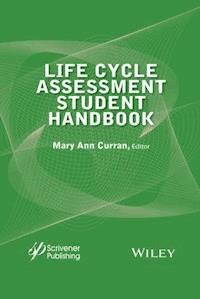
This student version of the popular bestseller, Life Cycle Assessment Handbook, is not a watered-down version of the original, but retains all of the important information and valuable lessons provided in the first book, along with helpful problems and solutions for the student learning about Life Cycle Assessment (LCA). As the last several decades have seen a dramatic rise in the application of LCA in decision making, the interest in the life cycle concept as an environmental management and sustainability tool continues to grow. The LCA Student Handbook offers a look at the role that life cycle information, in the hands of companies, governments and consumers, may have in improving the environmental performance of products and technologies. It concisely and clearly presents the various aspects of LCA in order to help the reader better understand the subject. The international success of the sustainability paradigm needs the participation of many stakeholders, including citizens, corporations, academia, and NGOs. The handbook links LCA and responsible decision making and how the life cycle concept is a critical element in environmental sustainability. It covers issues such as building capacity in developing countries and emerging economies so that they are more capable of harnessing the potential in LCA for sustainable development. Governments play a very important role with the leverage they have through procurement, regulation, international treaties, tax incentives, public outreach, and other policy tools. This compilation of points to the clear trend for incorporating life cycle information into the design and development processes for products and policies, just as quality and safety concerns are now addressed throughout product design and development. The Life Cycle Assessment Student Handbook is not just for students. It is also a valuable resource for practitioners looking for a desktop reference on LCA or for any engineer, manager, or policy-maker wishing to learn about LCA.
Sie lesen das E-Book in den Legimi-Apps auf:
Seitenzahl: 502
Veröffentlichungsjahr: 2015
Ähnliche



















Contents
Cover
Half Title page
Title page
Copyright page
Chapter 1: Introduction to Life Cycle Assessment
References from the LCA Handbook
Aims of the Chapter
1.1 Purpose of the Student Handbook
1.2 Why LCA?
1.3 Evolution of Environmental toward Life Cycle Thinking
1.4 Examples of Environmental Impact Trade-Offs
1.5 LCA Methodology
1.6 Maintaining Transparency (Openness)
1.7 Conclusions
References
Chapter 1 Exercises
Chapter 2: Goal and Scope Definition in Life Cycle Assessment
References from the LCA Handbook
Aims of the Chapter
2.1 Introduction
2.2 Components of a Well-Defined Study
2.3 Consequential LCA
2.4 Carbon Footprint versus LCA
2.5 Creating a Goal Statement
2.6 Preparing a Goal and Scope Document
References
Appendix: Hypothetical Example of a Comparative, Attributional Life Cycle Assessment to Support Government Decision Making
Chapter 2 Exercises
Chapter 3: Life Cycle Inventory
References from the LCA Handbook
Aims of the Chapter
3.1 Introduction
3.2 Modeling Inputs and Outputs
3.3 Methodology Issues
3.4 Data Uncertainty and Sensitivity Analysis
3.5 Databases and Data Sources
3.6 Collecting LCI Data
3.7 Reporting Life Cycle Inventory
3.8 Life Cycle Inventory Data Quality
3.9 Economic Input/Output (EIO) Data
3.10 Consequential LCA
3.11 LCA Software
References
Chapter 3 Exercises
Chapter 4: Life Cycle Impact Assessment
References from the LCA Handbook
Aims of the Chapter
4.1 Introduction
4.2 Choice of Impact Models and Categories
4.3 Current LCIA Approaches
4.4 The Agri-Food Sector
4.5 LCIA Models and Tools
References
Annex: Available Midpoint and Endpoint Characterization Methodologies
Chapter 4 Exercises
Chapter 5: Normalization, Grouping and Weighting in Life Cycle Assessment
References from the LCA Handbook
Aims of the chapter
5.1 Introduction
5.2 Current Practice of Normalization and Weighting in LCIA
5.3 Principles of External Normalization
5.4 Issues with External Normalization
5.5 Inherent Data Gaps
5.6 Masking Salient Aspects
5.7 Compensation
5.8 Spatial Boundaries and Time Frames
5.9 Divergence in Databases
5.10 Principles of Internal Normalization
5.11 Compensatory Methods
5.12 Partially Compensatory Methods
5.13 Weighting
5.14 Multi-Criteria Decision Making
References
Appendix
Chapter 5 Exercises
Chapter 6: Life Cycle Assessment: Interpretation and Reporting
References from the LCA Handbook
Aims of the Chapter
6.1 Introduction
6.2 LCA Interpretation according to ISO
6.3 Uncertainty and Sensitivity Analysis
6.4 Contribution Analysis
6.5 Presenting LCIA Results
6.6 Preparing the Final Report
6.7 The Review Process
6.8 Product Category Rules and Environmental Product Declarations
References
Chapter 6 Exercises
Chapter 7: Life Cycle Sustainability Assessment
References from the LCA Handbook
Aims of the Chapter
7.1 Introduction
7.2 Life Cycle Assessment and Sustainability
7.3 A Framework for LCSA
7.4 Social Responsibility
7.5 Research Needs for LCSA Methodology
References
Chapter 7 Exercises
Chapter 8: Resources for Conducting Life Cycle Assessment
Books
Organizations
LCA Centers and Societies1
Glossary
Life Cycle Assessment Student Handbook
Copyright © 2015 by Scrivener Publishing LLC. All rights reserved.
Co-published by John Wiley & Sons, Inc. Hoboken, New Jersey, and Scrivener Publishing LLC, Salem, Massachusetts. Published simultaneously in Canada.
No part of this publication may be reproduced, stored in a retrieval system, or transmitted in any form or by any means, electronic, mechanical, photocopying, recording, scanning, or otherwise, except as permitted under Section 107 or 108 of the 1976 United States Copyright Act, without either the prior written permission of the Publisher, or authorization through payment of the appropriate per-copy fee to the Copyright Clearance Center, Inc., 222 Rosewood Drive, Danvers, MA 01923, (978) 750-8400, fax (978) 750-4470, or on the web at www.copyright.com. Requests to the Publisher for permission should be addressed to the Permissions Department, John Wiley & Sons, Inc., 111 River Street, Hoboken, NJ 07030, (201) 748-6011, fax (201) 748-6008, or online at http://www.wiley.com/go/permission.
Limit of Liability/Disclaimer of Warranty: While the publisher and author have used their best efforts in preparing this book, they make no representations or warranties with respect to the accuracy or completeness of the contents of this book and specifically disclaim any implied warranties of merchantability or fitness for a particular purpose. No warranty may be created or extended by sales representatives or written sales materials. The advice and strategies contained herein may not be suitable for your situation. You should consult with a professional where appropriate. Neither the publisher nor author shall be liable for any loss of profit or any other commercial damages, including but not limited to special, incidental, consequential, or other damages.
For general information on our other products and services or for technical support, please contact our Customer Care Department within the United States at (800) 762-2974, outside the United States at (317) 572-3993 or fax (317) 572-4002.
Wiley also publishes its books in a variety of electronic formats. Some content that appears in print may not be available in electronic formats. For more information about Wiley products, visit our web site at www.wiley.com.
For more information about Scrivener products please visit www.scrivenerpublishing.com.
Library of Congress Cataloging-in-Publication Data:
ISBN 978-1-119-08354-2
Preface
This student handbook was created to serve as a companion to the 2012 Life Cycle Assessment Handbook1, a compilation of writings by eminent leaders in the field of LCA and related methodology. The LCA Handbook was designed to be as comprehensive as possible, covering every facet of LCA methodology and presenting a variety of applications. This was quite a challenge given the ever-growing scope and acceptance of LCA over the years as an environmental management tool. The final product far exceeded my initial expectation. The chapter authors provided clear insight into the various aspects of LCA methodology and practice, and they openly shared their invaluable wisdom, experience and knowledge. However, the LCA Handbook does not attempt to explain in step-wise fashion how the various phases of an LCA can be completed. Other similar books and documents have also been published on LCA reflecting the ISO-standard2 approach. But, again, few “how-to” guides exist. This student handbook is intended to fill that gap by addressing the individual steps of conducting, interpreting, and reporting an LCA.
For the sake of consistency, and maintaining a uniform “voice,” the student handbook repeats much of the text prepared by the experts who contributed to the LCA Handbook. Because of the way in which the LCA Handbook was compiled, the chapters reproduce much of the same background introductory descriptions and the discussions on key issues scattered throughout the book. The student handbook brings these parts together in the appropriate sequence so that the chapters and sections present procedural guidance for conducting an LCA.
The student handbook then builds upon the various aspects of LCA practice with pertinent exercises for the reader to complete in order to help reinforce the messages within the sections. These exercises intend to help students gain a better understanding of the details involved in conducting an LCA by putting them in the position of both commissioner and practitioner of an assessment. In most cases, the exercises are thought problems, rather than ones requiring calculations or precise solutions. The aim is to encourage readers to look closer at certain methodological issues and check their understanding of them.
After presenting a brief overview (Chapter 1), the student handbook delves into the details of the stages that comprise LCA methodology: goal and scope definition (Chapter 2), life cycle inventory (Chapter 3), life cycle impact assessment (Chapter 4), normalization, grouping, and weighting (Chapter 5), and interpretation (Chapter 6). Chapter 7 addresses forward thinking applications of LCA in Life Cycle Sustainability Assessment (LCSA) including the role of modeling social impacts. The final chapter (8) provides additional resources readers might find useful.
The handbook aims to focus on LCA methodology and not extend into related, yet tangential, topics such as the life cycle of buildings, or life-cycle (eco)design. Also, the student handbook does not address the application of exergy analysis to LCA. There are many other textbooks that the reader can refer to that cover this topic in detail. As mentioned, Chapter 7 does address the topic of Life Cycle Sustainability Assessment (LCSA), including Social LCA, which the LCA Handbook also covers. Although not in detail, the chapter introduces the topic in order to give readers an idea of the future direction that is expected for LCA as its application moves toward meeting sustainability goals.
My sincere thanks go to the authors of the chapters in the LCA Handbook, which form the basis of the student handbook. Readers are encouraged to refer to the LCA Handbook as needed. Each chapter of the student handbook begins with page references to the LCA Handbook to make this easier for the reader.
Part 1: Methodology and Current State of LCA Practice
Part 2: LCA Applications
Part 3: LCA Supports Decision Making and Sustainability
Part 4: Operationalizing LCA
“If I have seen further it is by standing on the shoulders of Giants.”Isaac Newton, Letter to Robert Hooke, February 5, 1675
Mary Ann Curran, PhD Cincinnati, Ohio, USA March 2015
1 Life Cycle Assessment Handbook: A Guide for Environmentally Sustainable Products (2012) MA Curran (ed) Scrivener-Wiley Publishing; ISBN 9778-1-118-09972-8; 640 pages.
2 ISO 14040:2006 Environmental Management – Life Cycle Assessment – Principles and Framework, International Standard, International Organization for Standardization, Geneva, Switzerland.
Chapter 1
Introduction to Life Cycle Assessment
Abstract
Life Cycle Assessment (LCA) is a holistic, cradle-to-grave environmental approach which provides a comprehensive view of the environmental aspects of a product or process throughout its life cycle. A properly conducted LCA identifies and quantifies the potential impacts of an industrial system (aiming to assess products, processes and activities). But more importantly, LCA identifies the potential transfer of environmental impacts from one media to another and/or from one life cycle stage to another. If an LCA were not performed, these trade-offs might not be recognized and properly included in the analysis because it is outside of the typical scope or focus of the decision making process.
This chapter explores why it is important to use a life cycle perspective in environmental management. It outlines the advancement of pollution strategies over the years, moving from end-of-pipe to pollution prevention (cleaner production) strategies and later to life cycle based approaches to meet sustainability goals. The key benefit of LCA, to identify potential transfer of environmental impacts, is demonstrated in a few brief examples. The chapter also presents the basic LCA methodology as described in a series of standards and technical reports produced by the International Standards Organization (ISO).
References from the LCA Handbook
1 Environmental Life Cycle Assessment: Background and Perspective 1–14
2 An Overview of the Life Cycle Assessment Method – Past, Present, and Future 14–41
3.5 Evolution of LCA Practice and Associated Issues 63–65
10.2 Why Develop an Integrated Sustainable Supply Chain Management Program? 235–238
25 Life Cycle Knowledge Informs Greener Products 585–596
Aims of the Chapter
Lesen Sie weiter in der vollständigen Ausgabe!
Lesen Sie weiter in der vollständigen Ausgabe!
Lesen Sie weiter in der vollständigen Ausgabe!
Lesen Sie weiter in der vollständigen Ausgabe!
Lesen Sie weiter in der vollständigen Ausgabe!
Lesen Sie weiter in der vollständigen Ausgabe!
Lesen Sie weiter in der vollständigen Ausgabe!
Lesen Sie weiter in der vollständigen Ausgabe!
Lesen Sie weiter in der vollständigen Ausgabe!




