


Erhalten Sie Zugang zu diesem und mehr als 300000 Büchern ab EUR 5,99 monatlich.
- Herausgeber: Pitkin
- Kategorie: Geisteswissenschaft
- Sprache: Englisch
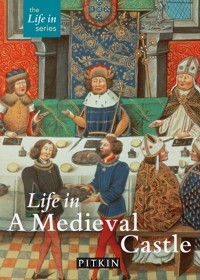
Pitkin presents the fascinating and engaging story of everyday life in and around castles – from 1066 to the 1400s. Alongside the Church, the stone castle was one of the enduring symbols of medieval life. To the poor, its intimidating walls represented the preordained social order. To many, the castle represented business, and the heights of ambition. And to the rich it represented fun and frivolity in the form of feasting, chivalry and games. The guide uncovers the complexities of life in and around such settlements: the family, the workers, the food, the wars and the entertainment. Look out for more Pitkin Guides on the very best of British history, heritage and travel, particularly the other books in the 'Life in' series: Medieval England, Tudor England, Stuart England, Georgian England and Victorian Britain.
Sie lesen das E-Book in den Legimi-Apps auf:
Seitenzahl: 49
Veröffentlichungsjahr: 2011
Das E-Book (TTS) können Sie hören im Abo „Legimi Premium” in Legimi-Apps auf:
Ähnliche


















Pitkin Publishing
The Mill, Brimscombe Port
Stroud, Gloucestershire, GL5 2QG
www.thehistorypress.co.uk
This ebook edition first published in 2013
All rights reserved
Text © Pitkin Publishing, 2011, 2013
Written by Brian Williams. The right of the Author, to be identified as the Author of this work has been asserted in accordance with the Copyrights, Designs and Patents Act 1988.
This ebook is copyright material and must not be copied, reproduced, transferred, distributed, leased, licensed or publicly performed or used in any way except as specifically permitted in writing by the publishers, as allowed under the terms and conditions under which it was purchased or as strictly permitted by applicable copyright law. Any unauthorized distribution or use of this text may be a direct infringement of the author’s and publisher’s rights, and those responsible may be liable in law accordingly.
EPUB ISBN 978-0-7524-9165-3
MOBI ISBN 978-0-7524-9164-6
Original typesetting by Pitkin Publishing
LIFE IN
A MEDIEVAL CASTLE
FROM 1066 TO THE 1500s
BRIAN WILLIAMS
IMPORTANT DATES
THE MEDIEVAL CASTLE
The medieval castle was fortress and lordly residence, the epitome of secular power. Its stone walls and towers dominated the locality – as was their builders’ intention. From the Norman Conquest of 1066 through to the reigns of Tudors in England and Stuarts in Scotland in the 16th century, castles were essential cogs in the slow-grinding wheels of the medieval state, and the focus for a community that maintained the castle and was supported – and at times protected – by it.
Though many castles are now ruins, stranded by the flowing tides of history, others still stand proud as residences, leisure and conference centres, and museums, reminding us that for 500 years the castle was part of the fabric of society, its importance extending beyond the military to the economy, law and social life. England, Scotland, Ireland and Wales have a rich medieval heritage, with castles, large and small, surviving often in unexpected places. Each has a distinct appeal to the visitor. As we climb steps worn smooth by generations of feet, or stand on wind-scoured battlements to peer down into grassed-over moats or mysterious fern-shrouded recesses, it is not easy to picture the castle as a home and place of work, full of bustle and life. Archaeology and scholarship enable us to recapture the essence of the lives spent within such walls, and explore a world more vibrant than the silent, mossy stones of those castles now in ruins might suggest.
THE AGE OF CASTLES
The Norman invaders brought stone castles to Britain, after 1066. There had been fortified settlements long before: Celtic Iron Age hillforts, Roman army fortresses, and Anglo-Saxon walled towns or burhs. But the medieval castle played a unique role in the life of local communities for some 500 years.
The Normans in England rapidly secured their conquest with wooden stockades enclosed by banks and ditches, and with timber-built halls, watch-towers and soldiers’ quarters inside. From these evolved a chain of castle strongholds – the Round Tower at Windsor dates from about 1175, the shell keep at Launceston Castle in Cornwall from about 1080.
In the 35 years following their victory over the English at Hastings, the Normans built around 200 castles. In theory at least, the king owned them all, for everyone in the realm – from noble to peasant – owed their lands and loyalty to him, but each castle became a personal and family stronghold. Its owner, a nobleman or lord (also known as a baron), managed his lands in the name of the king, raised soldiers in time of war, imposed law and order, and collected taxes from the people under his sway.
Such ‘private’ castles were costly to maintain, but protected, and were supported by, their local communities – people working inside the castle walls and in farming villages around it. Even a small castle involved a lot of work and expense for its upkeep and defences. Wooden castles did not last; they were liable to rot or catch fire, and so it was worth the effort and expense of reconstruction – to quarry, cart and raise stones, and build permanent fortress-homes. The Normans did this with gusto, and the stone castle became a symbol of their power and the subjugation of those they had overcome. Between 1100 and the early 1500s, castle-architects devised ever-more complex and costly ways to make castles increasingly difficult for an enemy army to capture, borrowing the best ideas in fortification design from across Europe, North Africa and the Near East. The apogee of British fortress design was the concentric castle of the 1300s, with two or more ring-walls encircling the central stronghold, epitomized by the mighty Welsh castles built by Edward I, king of England from 1272 to 1307. In the Wars of the Roses (1455–85) in England, most battles were fought in the open, not in castles, and by this time cannon offered a serious new threat to stone walls; as a result the castle began to look less useful as a fortress. Some castles were turned into more comfortable residences, with a continuing nod towards defensive capability; redundant castles were allowed to crumble and decay.




