


Erhalten Sie Zugang zu diesem und mehr als 300000 Büchern ab EUR 5,99 monatlich.
- Herausgeber: Pitkin
- Kategorie: Geisteswissenschaft
- Sprache: Englisch
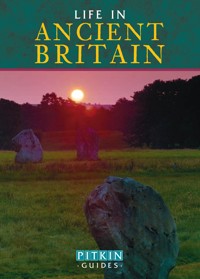
Life in Ancient Britain journeys through the ancient worlds of our ancestors: how they lived, how they shaped the landscape we know today, and how we know what we do, about their achievements. This guide offers a concise and lively introduction to the prehistory of the British Isles – covering the period from around 500,000 years ago when Palaeolithic hunters camped at Boxgrove in West Sussex, through the later Middle and New Stone Ages, and on to the Bronze Age and the start of the Iron Age. It describes how people first came to settle in Britain, and explores the rich mysteries of atmospheric ceremonial meeting places, barrows and stone circles. Also featured is the coming of the age of metals, when warrior-farmers created hilltop forts and settlements, stone brochs and lakeside villages – indeed the Celtic Britain that the Romans found, when they first landed on our shores.
Sie lesen das E-Book in den Legimi-Apps auf:
Seitenzahl: 44
Veröffentlichungsjahr: 2012
Das E-Book (TTS) können Sie hören im Abo „Legimi Premium” in Legimi-Apps auf:
Ähnliche



















Pitkin Publishing
The Mill, Brimscombe Port
Stroud, Gloucestershire, GL5 2QG
www.thehistorypress.co.uk
This ebook edition first published in 2013
All rights reserved
Text © Pitkin Publishing, 2012, 2013
Written by Brian Williams. The right of the Author, to be identified as the Author of this work has been asserted in accordance with the Copyrights, Designs and Patents Act 1988.
This ebook is copyright material and must not be copied, reproduced, transferred, distributed, leased, licensed or publicly performed or used in any way except as specifically permitted in writing by the publishers, as allowed under the terms and conditions under which it was purchased or as strictly permitted by applicable copyright law. Any unauthorized distribution or use of this text may be a direct infringement of the author’s and publisher’s rights, and those responsible may be liable in law accordingly.
EPUB ISBN 978-0-7524-9161-5
MOBI ISBN 978-0-7524-9160-8
Original typesetting by Pitkin Publishing
IMPORTANT DATES
HOW BRITAIN BEGAN
Some 9,000 years ago ‘Britain’ was still part of a wild, thinly populated European land mass. A marshy plain covered what is now the North Sea, and across it trekked bands of nomadic hunters. By approximately 6500 BC, rising sea levels finally flooded this plain, creating the British Isles. In this land of forests, rivers and bare hills traces of people were few and far between, yet humans had lived here for thousands of years.
The first people of Ancient Britain left little evidence of their passing, apart from a few bones, stone tools, outlines of campsites and glimpses of cave art. Later peoples marked the landscape, leaving Britain and Ireland with a heritage of remarkable Neolithic sites, such as Stonehenge. Ancient stones and mounds often conceal more secrets than they reveal, but we can deduce that Ancient Britons were people like us, with different but high-skill technologies, and beliefs and social structures that were in close harmony with the natural world.
To uncover the secrets of Ancient Britain we rely largely on scientists: archaeologists, botanists, geographers and geneticists. Science reveals our links to distant ancestors, and tells an intriguing detective story, helping us to picture life thousands of years ago from the evidence of bones, flakes of flint, deer antlers, broken pottery and rusted swords, and to people a lost landscape of brooding stones and windswept mounds.
DATING ANCIENT BRITAIN
In the 19th century, relative chronologies were established by ‘stratification’ – the study of artefacts, such as pottery, and their location in layers in the soil. Modern techniques include radiocarbon dating, accurate to about 50,000 years; it calculates the rate of decay of radioactive carbon 12 and carbon 14 in organic matter (such as wood or bone). Potassium-argon dating can help date rocks, while dendrochronology (‘tree ring dating’) can date wooden objects up to about 8,000 years old.
PREHISTORIC BRITAIN
When the Romans came to Britain 2,000 years ago, they could well dismiss the island peoples’ ancient past as ‘unknown’, because it was unrecorded, and probably as ‘barbarous’ as the rites of the Druids whose temples Roman soldiers tore down.
Prehistoric Britain remained largely unexplored until interest was shown by ‘antiquarians’ such as the writer Sir Thomas Browne (1605–82), whose excavations in Norfolk revealed what he called ‘sepulchrall urnes’ (actually Anglo-Saxon burials). For most Christians at this time, ‘prehistory’ did not exist. Archbishop Ussher of Armagh (1581–1656) had calculated on biblical evidence that the world had been created by God in 4004 BC. And that was that.
By the 19th century, evolutionary theory and fossil discoveries suggested that the Earth was much older. The ‘three age’ system (Stone Age, Bronze Age, Iron Age), proposed in 1836 by Christian Thomsen of Denmark, is still used to describe European prehistory, though with reservations. Stone-Age people used other materials, such as bone and antler, and while metal-using was a ‘progression’ in one sense, older technologies overlapped with it. Bronze (an alloy of copper and tin) was first used for weapons and tools in the Middle East, reaching Britain by around 2000 BC. Iron, first worked in Asia Minor and China, reached the Aegean by 1000 BC and Britain by around 700 BC.
Popular interest in prehistory was aroused in the 19th century by revelations about the origins of fossils. Prehistoric Britain, 130 million years ago, lay partly beneath a warm ocean teeming with fish, molluscs and crustaceans. On land lived dinosaurs and other reptiles. When these animals died, their skeletons were occasionally preserved as fossils in rocks for millions of years. Fossil-hunters and farmers who dug up these mysterious stone-bones believed them to be the remains of dragons, human giants or animals drowned in the Bible Flood.
In 1824, William Buckland, Oxford professor of geology, revealed otherwise: the bones of Megalosaurus (found at a quarry in Oxfordshire) were, he declared, those of an extinct ‘giant reptile’. Further proof that such strange creatures had once roamed Britain came from Mary Anning, who found Icthyosaurus in Dorset, and from Gideon and Mary Mantell, who discovered Iguanodon in Sussex. In 1841, geologist Sir Richard Owen coined the name ‘dinosaur’ (terrible lizard) for these sensational new animals.




