


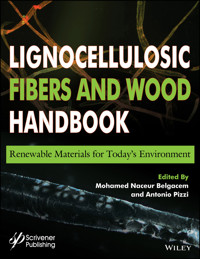
Lignocellulosic Fibers and Wood Handbook E-Book
219,99 €
Mehr erfahren.
- Herausgeber: John Wiley & Sons
- Kategorie: Fachliteratur
- Sprache: Englisch
This book will focus on lignocellulosic fibres as a raw material for several applications. It will start with wood chemistry and morphology. Then, some fibre isolation processes will be given, before moving to composites, panel and paper manufacturing, characterization and aging.
Sie lesen das E-Book in den Legimi-Apps auf:
Seitenzahl: 1888
Veröffentlichungsjahr: 2016
Ähnliche



















Contents
Cover
Half Title page
Title page
Copyright page
Dedication
Preface
Part 1: Wood and Fibres: Raw Materials
Chapter 1: Introduction and State-of-the-Art
Chapter 2: Wood and Wood Fiber Characteristics: Moisture, Biological, Thermal and Weathering
2.1 Introduction
2.2 Moisture
2.3 Biological
2.4 Thermal
2.5 Fire Retardants
2.6 Weathering
References
Chapter 3: Chemical Composition and Properties of Wood
3.1 Introduction
3.2 Cellulose
3.3 Hemicelluloses of Wood
3.4 Lignin(s)
3.5 Wood Extractives
References
Chapter 4: Recycled Fibers
4.1 The Context and the Key Data
4.2 Recovered Paper and Board Grades
4.3 Unit Operations for Paper Recycling Processes
4.4 Recycling and Deinking Lines
4.5 Deinked Pulp Quality and Controls
4.6 The Limits of Paper Recycling
Acknowledgement
References
Chapter 5: Recovered Papers Deinking by Froth Flotation
5.1 Introduction
5.2 Mass Transfer Mechanisms
5.3 Control of Process Performance by Chemical Additives
5.4 Flotation Deinking Process Modeling
References
Chapter 6: High-Yield Pulps: An Interesting Concept for Producing Lignocellulosic Fibers
6.1 Introduction
6.2 History of Mechanical Pulping
6.3 Principles of Mechanical Pulping Processes and Quality of Pulps
6.4 Quality of Mechanical Pulping Processes
6.5 Industrial Production of Mechanical Pulps
6.6 Bleaching of Mechanical Pulps
6.7 New Technologies under Development
6.8 Conclusion
References
Chapter 7: Kraft Pulping
7.1 Introduction
7.2 Chemical Reagents
7.3 Mechanism of Delignification
7.4 Degradation of Carbohydrates during Kraft Pulping
7.5 Composition of Kraft Pulps
7.6 Improvement of the Kraft Process
7.7 Recovery of Cooking Reagents
7.8 Conclusion
References
Chapter 8: Sulphite Pulping
8.1 Introduction
8.2 Brief History of Pulping Processes
8.3 Sulphite Pulping Chemicals
8.4 General Aspects of Sulphite Pulping
8.5 Reactions of Sulphite Pulping
References
Part 2: Wood and Fibres: Composites and Panels
Chapter 9: Synthetic Adhesives for Wood Fibers and Composites: Chemistry and Technology
9.1 Introduction
9.2 Urea-Formaldehyde (UF) Adhesives
9.3 Melamine-Formaldehyde (MF) and Melamine-Urea-Formaldehyde (MUF) Adhesives
9.4 Phenolic Resins
9.5 Resorcinol Adhesives
9.6 Thermosetting Adhesives Based on Natural Resources
9.7 Isocyanate and Polyurethane Wood Adhesives
9.8 Chemistry of Isocyanate Wood Adhesives
9.9 Technology of Isocyanate Adhesives
9.10 Conditions of Application of Isocyanate Adhesives for Wood
9.11 Emulsion Polymer Isocyanates (EPI)
9.12 Polyvinyl Acetate (PVAc), EVAs and Acrylics
9.13 Hot Melts
References
Chapter 10: Natural Adhesives, Binders and Matrices for Wood and Fiber Composites: Chemistry and Technology
10.1 Introduction
10.2 Tannin Adhesives
10.3 Lignin Adhesives
10.4 Mixed Tannin-Lignin Adhesives and Resins
10.5 Protein Adhesives
10.6 Carbohydrate Adhesives
10.7 Unsaturated Oil Adhesives
10.8 Wood Welding without Adhesives
10.9 Alternative Systems to Weld Wood
References
Chapter 11: Chemically-Based Modern Wood Composites
11.1 Introduction
11.2 Conventional Concepts and Products
11.3 New Concepts and Products
11.4 Outlook
References
Chapter 12: Chemical Modification of Solid Wood
12.1 Introduction
12.2 Chemical Modifications Involving the Use of Chemicals
12.3 Chemical Modifications Using Heat Treatments
12.4 Conclusions
References
Chapter 13: Modification of Natural Fibers Using Physical Technologies and Their Applications for Composites
13.1 Introduction
13.2 Wave and Radiation Technologies for Cellulosic Fiber Surface Modification
13.3 Physicochemical Technologies for Surface Modification of Cellulosic Fibers
13.4 Mechanical and Thermomechanical Technologies for Surface Modification of Cellulosic Fibers
13.5 Conclusions
References
Chapter 14: Wood and Fiber-Based Composites: Surface Properties and Adhesion
14.1 Introduction: Practical Significance of Surface Properties and Adhesion
14.2 Adhesion Theories and Mechanisms
14.3 Interfacial Phenomena in Wood and Fiber Adhesion
14.4 Adhesion Interactions as a Function of Length Scale
14.5 Wood Bonding Considerations
14.6 Wood and Fiber Surface Properties
14.7 Wood Surface Modification
14.8 Analytical Techniques to Measure Wood and Fiber Surface Properties
References
Chapter 15: Wood and Fiber Panels Technology
15.1 Introduction
15.2 Wood as a Substrate
15.3 Wood Plasticization
15.4 Types of Wood Panels
15.5 Influence of the Adhesive in Wood Panel Bonding
15.6 Influence of Wood in Wood Panel Production
15.7 Production Condition Parameters in Wood Panel Gluing
15.8 Correlation between Pressing Parameters and Physical Properties
References
Part 3: Wood and Fibres: Paper
Chapter 16: Rheology: From Simple Fluids to Complex Suspensions
16.1 Introduction
16.2 Classification of Fluid Behavior
16.3 Time-independent Fluid Behavior
16.4 Time-dependent Behavior
16.5 Viscoelastic Behavior
16.6 Small Amplitude Oscillatory Shear Motion
16.7 Elongational Flow
16.8 Rheology of Suspensions
16.9 Origins of Non-Newtonian Behavior
16.10 Implications in Engineering Applications
16.11 Concluding Summary
Acknowledgement
Nomenclature
References
Chapter 17: Papermaking and Wet-End Chemistry
17.1 Introduction
17.2 Wet-end Chemicals, Fillers and Pigments: General Considerations
17.3 Functional Additives
17.4 Processing Aids
References
Chapter 18: Paper Winding
18.1 Introduction
18.2 Winder Types Found in a Paper Mill
18.3 Winder Classes and Types
18.4 Effect of Winder Classes and Types on Wound Roll Tightness
18.5 Roll Structure Theory and Control Curves
18.6 Tightness and Roll Quality Measurement
18.7 Winding Theory Stresses inside the Roll
18.8 Winding Defects
18.9 The Reel
18.10 Two-Drum Winders
18.11 Duplex Winders
18.12 Other Operations near the Rewinder
18.13 Automation and Productivity
18.14 Profile and Moisture
18.15 Paper Mills’ Customers
18.16 Learning More about Winding
Abbreviations used in this section
References
Chapter 19: Surface Treatments of Paper
19.1 Surface Sizing of Paper
19.2 Paper Coating
19.3 Specialty Papers by Coating
19.4 Coating Machines
References
Chapter 20: Calendering of Papers and Boards: Processes and Basic Mechanisms
20.1 Introduction
20.2 Calendering Processes
20.3 Applying Pressure in a Nip
20.4 Heat Transfer in the Nip
20.5 Effect of Calendering on Paper Structure and Surface Properties
20.6 Conclusions and Trends in Calendering
References
Chapter 21: Color and Color Reversion of Cellulosic and Lignocellulosic Fibers
21.1 Introduction
21.2 Lignin-Free Cellulosic Fibers (Chemical Pulps)
21.3 Lignin-rich Cellulosic Fibers (High-Yield Pulps)
21.4 Conclusion
References
Part 4: Wood and Fibres: Properties
Chapter 22: Fire Behavior of Timber and Lignocellulose
22.1 Introduction
22.2 Wood in Structures
22.3 Basic Definition of Fire Growth
22.4 Degradation
22.5 Experimental Studies on Wood Behavior in Fire
22.6 Modeling Wood Behavior in Fire
22.7 Flammability Assessment Methods
22.8 The Role of Fire Retardants
22.9 Summary
References
Chapter 23: Testing and Evaluation of Fire-retardant-treated Wood Products
23.1 Introduction
23.2 Conditioning of Specimens
23.3 Research & Development Test Methods
23.4 Regulatory Test Methods
23.5 Product Specific Regulatory Test Methods
23.6 Other Fire Test Methods
23.7 Tests for Smoke Obscuration
23.8 Other Properties of Fire-retardant-treated Wood
23.9 Specifications for Fire-retardant-treated Wood Products
23.10 Tests for Commonly Used Fire-retardant Chemicals
23.11 Concluding Remarks
References
Chapter 24: Modern Timber Houses
24.1 Introduction
24.2 Tradition and Development of the Swiss Timber House
24.3 Timber House Systems
24.4 Heat Insulation and Protection against Moisture
24.5 Sound Protection
24.6 Fire Protection
24.7 Multistory Timber Buildings
24.8 Conclusions
References
Chapter 25: Paper Characterization and Testing
25.1 Introduction and General Considerations
25.2 Composition and Structure
25.3 Mechanical Properties
25.4 Optical Properties
Suggested Literature:
References
Chapter 26: Dimensional Stabilization of Wood and Wood Composites
26.1 Introduction
26.2 Thermal Modification
26.3 Chemical Modification
26.4 Wood Polymer Composites (WPC)
26.5 Other Applications
References
Index
Lignocellulosic Fibers and Wood Handbook
Scrivener Publishing100 Cummings Center, Suite 541JBeverly, MA 01915-6106
Publishers at ScrivenerMartin Scrivener ([email protected])Phillip Carmical ([email protected])
Copyright © 2016 by Scrivener Publishing LLC. All rights reserved.
Co-published by John Wiley & Sons, Inc. Hoboken, New Jersey, and Scrivener Publishing LLC, Salem, Massachusetts. Published simultaneously in Canada.
No part of this publication may be reproduced, stored in a retrieval system, or transmitted in any form or by any means, electronic, mechanical, photocopying, recording, scanning, or otherwise, except as permitted under Section 107 or 108 of the 1976 United States Copyright Act, without either the prior written permission of the Publisher, or authorization through payment of the appropriate per-copy fee to the Copyright Clearance Center, Inc., 222 Rosewood Drive, Danvers, MA 01923, (978) 750-8400, fax (978) 750-4470, or on the web at www.copyright.com. Requests to the Publisher for permission should be addressed to the Permissions Department, John Wiley & Sons, Inc., 111 River Street, Hoboken, NJ 07030, (201) 748-6011, fax (201) 748-6008, or online at http://www.wiley.com/go/permission.
Limit of Liability/Disclaimer of Warranty: While the publisher and author have used their best efforts in preparing this book, they make no representations or warranties with respect to the accuracy or completeness of the contents of this book and specifically disclaim any implied warranties of merchantability or fitness for a particular purpose. No warranty may be created or extended by sales representatives or written sales materials. The advice and strategies contained herein may not be suitable for your situation. You should consult with a professional where appropriate. Neither the publisher nor author shall be liable for any loss of profit or any other commercial damages, including but not limited to special, incidental, consequential, or other damages.
For general information on our other products and services or for technical support, please contact our Customer Care Department within the United States at (800) 762-2974, outside the United States at (317) 572-3993 or fax (317) 572-4002.
Wiley also publishes its books in a variety of electronic formats. Some content that appears in print may not be available in electronic formats. For more information about Wiley products, visit our web site at www.wiley.com.
For more information about Scrivener products please visit www.scrivenerpublishing.com.
Library of Congress Cataloging-in-Publication Data: Names: Belgacem, Mohamed Naceur, editor. | Pizzi, A. (Antonio), 1946-editor.Title: Lignocellulosic fibers and wood handbook : renewable materials for today’s environment / edited by Naceur Belgacem and Antonio Pizzi.Description: Hoboken, New Jersey : John Wiley & Sons, 2016. |Includes bibliographical references and index.Identifiers: LCCN 2015049859| ISBN 9781118773529 (cloth) |ISBN 9781118773833 (Adove PDF) |ISBN 9781118773550 (epub)Subjects: LCSH: Lignocellulose. | Renewable natural resources.Classification: LCC TP248.65.L54 L55 2016 | DDC 333.7–dc23 LC record available at http://lccn.loc.gov/2015049859
ISBN 978-1-118-77352-9
Dedicated to the memory of Menachem Lewin of the Polytechnic Institute of New York who first originated the idea of such a volume
Preface
In addition to food demand, men need energy, materials and fine chemicals. Today, the main source to supply these non-food requirements is based on fossil resources, viz. petrol, natural gas and coal. These sources are unfortunately not renewable within a time scale compatible with human life. Such a situation made the market prices of petrol very fluctuating making difficult the world industrial activity and inducing localized geopolitical instabilities.
The major part of petroleum is used for energy purposes (around 90% of the 4 billion of tons consumed every year in the world). The rest is composed of 6–7% destined for polymer synthesis and 3–4% for pharmacy and cosmetics. The production of petroleum-based polymers is around 250 Million of tons. To replace (at least partially) these organic material, wood could be considered as a potential source of raw material. One of the major constituents of this remarkable natural material is lignocellulosic fibers. Wood has been used for ever as a raw material for shelters, and later, for paper, textile, cellulose derivatives (films, binders, explosives… Wood contains various components, namely: (i) cellulose fibers, essentially for papermaking, but also as reinforcing elements in composite materials; (ii) lignin as a macromonomer for novel plastics, or as a source of valuable chemicals like vanillin; (iii) bark tannins for leather treatment and as components for resins, plastics, foams and adhesives; and (iv) specific minor chemicals.
This book focuses on one topic within this broad issue, namely the use of lignocellulosic fibers to prepare various materials in the papermaking and panel and timber fields. It concentrates the efforts of a number of specialists whose purpose is each to contribute by a comprehensive chapter to cover the state of the art and the perspectives related to the numerous facets of these materials. It starts with chapters dealing with the isolation of these fibers followed by two sections devoted to the two selected applications and finishes with a section covering the characterization of the prepared fiber-based materials. We hope that this handbook will constitute a useful tool for all those developing research programs associated with natural fibers, which we consider as the fibers of the future.
Mohamed Naceur Belgacem and Antonio PizziJanuary 12, 2016
Part 1
WOOD AND FIBRES: RAW MATERIALS
Chapter 1
Introduction and State-of-the-Art
Mohamed Naceur Belgacem and Antonio Pizzi
Industry is using several types of fibers in various applications such as composites, nonwoven materials, textiles, paper, etc. These strong materials can be classified as synthetic, artificial or natural fibers. Other classification criteria are available such as metallic, inorganic or organic fibers, optical, etc. Several subdivisions may also be given, as, for example, vegetal or animal fibers concerning the natural fibers family, or regenerated or modified regenerated types associated with artificial fibers.
Synthetic fibers are produced from synthetic polymers (the starting monomers are originating from fossil resources). The most common manufacturing processes of synthetic fibers are the Melt-Spinning and/or Solution-Spinning techniques. In both cases, the polymer is molten or dissolved in a solvent and drawn through well-calibrated nozzles, as quickly as possible. Such a process yields anisotropic fibers and allows the alignment of the polymer macromolecules in a parallel arrangement, providing them an easy crystallization, which in turn gives strong mechanical strength. In the Melt-Spinning process, the drying of the fibers is ensured by heat-loss, whereas in the Solution-Spinning technique this operation is guaranteed by solvent loss. The commercial synthetic fibers dominating the market are nylon, polyester, acrylic and polyolefin. Synthetic fibers are more durable than most natural fibers. They have several other advantages, such as stretching ability and water and stain resistance.
Lignocellulosic fibers are a worldwide natural material available from different sources. Moreover, this organic material possesses several advantages such as abundance, renewable character, low price, availability in different chemical composition and morphologies, low density, biodegradability at the end of life and many others. This remarkable raw material has always contributed to fulfilling the needs of industrial societies and has also played a key role in the development of a sustainable global economy. In fact, wood and its derivatives, as well as cellulose (used in the preparation of panels, textile and paper-based products), have played an important role as materials for humanity through their exploitation in a progressively more elaborated fashion. They have progressively shifted from empirical exploitation to more sophisticated technologies associated with papermaking, textile and wood processing.
Economic and environmental issues associated with the use of depleting fossil resources have placed the focus on lignocellulosic materials as a potential alternative feedstock for the production of chemicals, fuels and biocompatible materials. Thus, nowadays, in addition to the classical use of such materials (paper, wood and wood-based products and textiles), large contributions are emerging everywhere in the world that deal with the use of such a raw material for the production of bioethanol, biodiesel and as a reinforcing component in polymer composites. In fact, in the last context, wood-plastic and natural fibers-reinforced polymeric composites are a well-established industrial reality, even if more work is needed to achieve economically efficient industrialization in several sectors.
Lignocellulosic materials in general, and as fibers in particular, possess three major drawbacks: (i) they are highly polar and consequently very sensitive to water uptake and release; (ii) their chemical composition could vary as a function of the vegetal species, the growing conditions and soils, the season, the plant age, etc. This makes their industrial exploitation very hard to rationalize and renders them difficult to characterize. Thus, several innovative methods of lignocellulosic materials characterization are needed. In this context, recently, several advanced analytical techniques were developed, namely: time-of-flight secondary ion mass spectrometry, 2D heteronuclear single quantum correlation Nuclear Magnetic Resonance Spectroscopy, Atomic Force Microscopy, Field Emission Gun Scanning Electron Microscopy, Matrix Assisted Laser Desorption Ionization Mass Spectrometry and Raman microscopy.
Wood is a natural fibrous structural composite used by man for thousands of years as a construction material and to produce thermal energy. Wood is an organic material composed of cellulose fibers (reinforcing phase) embedded in lignin (a polyphenolic crosslinked polymer) as a matrix. Its third component is the hemicelluloses, which play the role of compatibilizing agent between the reinforcing cellulose fibers and the lignin matrix.
The amount of wood on earth is about one trillion tons, with a growing rate of about 3% per year. Wood has been always an important raw material for human needs. Thus, this remarkable natural material was used forever in construction of houses, doors, windows and boats. Wood has also served as water pipes. The use of engineered wood products is increasing in the construction industry, both for residential and commercial buildings, as structural and aesthetic materials. Cement- and concrete-based buildings also use wood as a supporting material, namely, as shuttering material (mold into which concrete is poured), interior doors and their frames, and as exterior cladding, wood flooring and others.
Wood can also be found in several other areas of applications, namely:
The wood industrial sector practically uses such a raw material in its integrality. Thus, wood waste, residue from construction wood unsuitable for construction, is mechanically milled to produce fibers or chips or chemically treated to prepare cellulose. The ensuing materials are used as a raw material for a variety of boards and panels. Thus, particleboard, oriented strandboard (OSB), hardboard and medium density fiberboard are all prepared by this route. An example is Medium-Density Fiberboard (MDF). MDF has several advantages, such as high stiffness and smoothness and the absence of knots, and it is isotropic and easily machined. During cutting and sanding, but also during the rest of its service life, although at a much lower rate, MDF can release hazardous substances, such as formaldehyde. Moreover, during these operations, very fine dust can be produced. Masks and goggles are recommended for people handling such operations.
Paper is a largely consumed commodity product throughout the world. In fact, the worldwide consumption of paper is around 400 millions of tons. The worldwide growing rate in this sector is around 3%. Several paper grades are available. They can be classified into three main categories: (i) printing and writing; (ii) packaging, and (iii) specialty paper grade. The first two families cover more than 90% of the overall paper marketed. They are commodity products. The last family is of high added value products. It includes security papers such as those used for money, passports, fiduciary documents, but also more common product such as carbonless, thermal (used for fax and invoices), fireproof papers, etc.
Paper has also been used for a long time by humanity. In the beginning it was mostly used as a communication medium, before shifting to a much larger number of applications. Most of them are classical, meaning conventional sectors like printing and writing paper, as well as packaging materials, tissues, photos, tubes and cores…. Others are very surprising, such as separator in batteries or in electrical capacitor, shuttering material, i.e., molds into which concrete is poured. Paper is also used to fulfill a very specific functionality in flexible films packaging, such as oil-proof, water-proof and release. The present tendency is to use a combination of printed electronics and paper to prepare flexible batteries, screens, photovoltaic devices, functional wallpapers (magnetic, light emitting, energy restituting, etc.).
This book provides a survey of the state-of-the-art associated with the isolation and characterization of lignocellulosic fibers and their use in different areas. It also deals with the preparation of panels, boards and paper, as well as their characterization. It is destined for students and academic and industrial researchers who work in the fields of wood and panels, paper, and lignocelluloses-based composites. It includes four sections, dealing, respectively, with raw materials, composites and panels, paper and their properties and testing.
The first section of the book starts with describing the raw material and contains eight chapters dealing with wood and the isolation and the characterization of lignocellulosic fibers. Thus, the first chapter deals with wood and wood fiber characteristics and their behavior toward moisture. Then, their biological, thermal, and weathering properties are described and discussed. The second chapter is devoted to the chemistry of wood and wood fibers and describes their chemical composition, as well as the organization of the cell wall of the fibers. The third chapter deals with recycled fibers and the processes related to their recovery and cleaning before a second use. The following chapter reports the main processes associated with the deinking of old papers. The last two chapters are of great interest, since more than 60% of lignocellulosic fibers used in papermaking are recycled. Then, three chapters devoted to the isolation of wood fibers are given. The first one describes the mechanical processes of preparing pulps for papermaking, whereas the two others deal with the most important chemical processes of cellulose fibers, i.e., basic pulping process: kraft and its acidic counterpart: sulphite pulping.
The second section deals with composites and panels and contains seven chapters. The first two are devoted to the description of synthetic and natural adhesives for wood fibers and composites. A detailed description of the chemistry and technology for wood fibers and composites is given. The third chapter gives the recent development of chemically-based modern wood composites. Then, two chapters summarizing the chemical modification of wood and wood fibers, as well as the physical modifications of cellulosic fibers, in view of their use in the composite materials area is given. Then, two chapters describing wood and fiber composites are given. The first one is devoted to surface states and surface states modification, whereas the second one reports types of wood and fiber composites, their process control technology and describes their characteristics. The main reasons for using cellulose fibers in composite applications resides in the ease with which they can be recycled at the end of their life cycle, which is totally different when dealing with glass fibers-based or other mineral fiber composites. In fact, their recycling in the material stream or in energy recovery is much easier. Finally, cellulose fibers possess additional advantages like low density and modest abrasive impact. The chemical grafting of cellulose fibers is associated with coupling new chemical groups at their surface or within a limited depth. Such an approach allows generating novel specific properties compared with those of the pristine material, without affecting the bulk properties of these reinforcing elements. Thus, the chemical functions involved in these transformations are mostly hydroxyl groups of cellulose. These moieties were exploited for a long time in the synthesis of cellulose derivatives.
The third section is devoted to papermaking and it contains six chapters. It starts with a chapter dealing with the rheological phenomena in pulp and papermaking and describes the basic scientific phenomena observed in fiber suspension under shearing and flow. Then, a chapter entitled “Papermaking and Wet-End Chemistry in Papermaking,” and dealing with a brief description of the paper machine and papermaking process, is given before shifting to the chemical aids used in this sector and their working mechanism. The third chapter concerns another operation unit, namely, winding and unwinding, and gives the most relevant phenomena occurring in these processes. The two following chapters are devoted to physical and mechanical treatments of the surface of paper. More precisely, coating and calendering are described. In this context, the coating color formulation, the machinery coaters, the super and soft calenders, as well as the basic concepts of nip calculations, etc., are given. The last chapter of this section reports the fundamentals of photochemistry associated with fiber yellowing and the color reversion of paper.
The last section of this book is dedicated to the characterization techniques of panels, paper and paperboards. It contains five chapters. The first two provide insights about the fire resistance of timber and lignocellulose materials and describe the associated tests and the solution yielding fireproof properties. Then, a chapter dealing with timber for construction and housing, details the use of these remarkable materials in everyday life. In the following chapter, a description of the most commonly used tests for paper characterization is given. These tests includes: (i) physical characteristics such as thickness, basis weight and apparent density; (ii) optical, like opacity, whiteness, gloss; (iii) mechanical (tear, burst, tensile, internal cohesion, etc.) and structural, like roughness, air permeability and porosity. The last chapter describing the dimensional stabilization of wood and wood composites is also of great importance, since this property strongly influences the conditions under which the materials in question are used.
Chapter 2
Wood and Wood Fiber Characteristics: Moisture, Biological, Thermal and Weathering
Roger M. Rowell*
Pioneering Scientist (Retired), USDA, Forest Service, Forest Products Laboratory, Madison, Wisconsin, USA
Professor Emeritus, University of Wisconsin, Madison, Wisconsin, USA
Guest Professor, EcoBuild, SP Trätek, Stockholm, Sweden
*Corresponding author: [email protected]
Abstract
As a natural bioresource, wood is hygroscopic, attacked by a wide variety of micro- and macroorganisms, unstable at high temperatures and degraded by ultraviolet radiation. The cell wall polymers and the matrix they are in are responsible for the properties and performance of wood and wood-based composites.
Keywords: Wood, moisture, swelling, repellency, dimensional stability, decay, ants, beetles, marine, mechanism, fungi, pyrolysis, weathering, ultraviolet
2.1 Introduction
The properties, performance and characteristics of wood and wood fiber depend on many variables including: type of wood, where the wood was grown, what part of the tree the wood came from, moisture level, environment, age, history and chemistry. In a materials science definition, wood is not a material as it is not consistent, uniform, predictable or reproducible. Since wood is a biological resource, its characteristics vary within a tree, from tree to tree within the same species, within a board, between boards of the same species, and so on.
Wood is best thought of as a porous three-dimensional anisotropic biopolymer composite composed of an interconnecting network of cellulose, hemicellulose and lignin, with minor amounts of inorganic elements and organic extractives. The characteristics of this resource are best defined and understood using this model of wood.
In terms of the porosity of wood, one cubic inch of an average softwood has an inter-surface area of 22,000 square feet, or about half an acre. That cube contains about 5 million fibers, each about 3.5 mm long. There are about two million late wood fibers and three million early wood fibers.
As an introduction to the moisture, biological, ultraviolet and thermal characteristics of wood: wood changes dimensions with changing moisture content because the cell wall polymers contain hydroxyl and other oxygen-containing groups that attract moisture through hydrogen bonding [1, 2]. The hemicelluloses are mainly responsible for moisture sorption, but the accessible cellulose, non-crystalline cellulose, lignin, and surface of crystalline cellulose also play major roles. Moisture swells the cell wall, and the fiber expands until the cell wall is saturated with water (fiber saturation point, FSP). Beyond this saturation point, moisture exists as free water in the void structure and does not contribute to further expansion. This process is reversible, and the fiber shrinks as it loses moisture below the FSP.
Wood is degraded biologically because organisms recognize the carbohydrate polymers (mainly the hemicelluloses) in the cell wall and have very specific enzyme systems capable of hydrolyzing these polymers into digestible units. Figure 2.5 shows a general scheme of wood being degraded by fungi. Biodegradation of the cell wall matrix and the high molecular weight cellulose weakens the fiber cell [3]. Strength is lost as the cell wall polymers and matrix undergoes degradation through oxidation, hydrolysis and dehydration reactions.
Wood exposed outdoors undergoes photochemical degradation caused by ultraviolet radiation. This degradation takes place primarily in the lignin component, which is responsible for the characteristic color changes [4]. The lignin acts as an adhesive in the cell walls, holding the cellulose fibers together. The surface becomes richer in cellulose content as the lignin degrades. In comparison to lignin, cellulose is much less susceptible to ultraviolet light degradation. After the lignin has been degraded, the poorly bonded carbohydrate-rich fibers erode easily from the surface, which exposes new lignin to further degradative reactions. In time, this “weathering” process causes the surface of the composite to become rough and can account for a significant loss in surface fibers.
Lesen Sie weiter in der vollständigen Ausgabe!
Lesen Sie weiter in der vollständigen Ausgabe!
Lesen Sie weiter in der vollständigen Ausgabe!
Lesen Sie weiter in der vollständigen Ausgabe!
Lesen Sie weiter in der vollständigen Ausgabe!
Lesen Sie weiter in der vollständigen Ausgabe!
Lesen Sie weiter in der vollständigen Ausgabe!
Lesen Sie weiter in der vollständigen Ausgabe!
Lesen Sie weiter in der vollständigen Ausgabe!
Lesen Sie weiter in der vollständigen Ausgabe!
Lesen Sie weiter in der vollständigen Ausgabe!
Lesen Sie weiter in der vollständigen Ausgabe!
Lesen Sie weiter in der vollständigen Ausgabe!
Lesen Sie weiter in der vollständigen Ausgabe!
Lesen Sie weiter in der vollständigen Ausgabe!
Lesen Sie weiter in der vollständigen Ausgabe!
Lesen Sie weiter in der vollständigen Ausgabe!
Lesen Sie weiter in der vollständigen Ausgabe!
Lesen Sie weiter in der vollständigen Ausgabe!
Lesen Sie weiter in der vollständigen Ausgabe!
Lesen Sie weiter in der vollständigen Ausgabe!
Lesen Sie weiter in der vollständigen Ausgabe!
Lesen Sie weiter in der vollständigen Ausgabe!
Lesen Sie weiter in der vollständigen Ausgabe!
Lesen Sie weiter in der vollständigen Ausgabe!
Lesen Sie weiter in der vollständigen Ausgabe!
Lesen Sie weiter in der vollständigen Ausgabe!
Lesen Sie weiter in der vollständigen Ausgabe!




