


Erhalten Sie Zugang zu diesem und mehr als 300000 Büchern ab EUR 5,99 monatlich.
- Herausgeber: Mercier Press
- Kategorie: Fachliteratur
- Serie: The Fighting Stories
- Sprache: Englisch
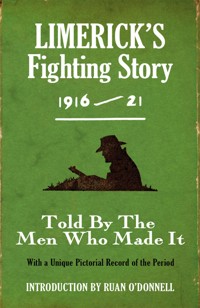
Limerick's Fighting Story offers eye witness and first hand accounts of the struggle for independence in Limerick city and county.When the Truce was declared in the War of Independence in July 1921, each of Limerick's brigade areas, west, mid and east had flying columns in the field. While the challenge of city fighting and urban guerrilla tactics were high on the list of concerns for the mid brigade, the east and west flying columns were active raiders and ambush artists.This new edition of the classic Limerick's Fighting Story features stories and reports from every aspect of the conflict in Limerick from the Limerick Heroes of 1916, through the nights of terror and violence in Limerick city as Tans killed residents, to the exploits of the women of Cumman na mBan.
Sie lesen das E-Book in den Legimi-Apps auf:
Seitenzahl: 608
Veröffentlichungsjahr: 2009
Das E-Book (TTS) können Sie hören im Abo „Legimi Premium” in Legimi-Apps auf:
Ähnliche
















MAP OF LIMERICK DETAILING BRIGADE AREAS
INTRODUCTION BY RUÁN O’DONNELL SERIES EDITOR: BRIAN Ó CONCHUBHAIR
MERCIER PRESS 3B Oak House, Bessboro Rd Blackrock, Cork, Ireland
www.mercierpress.ie
http://twitter.com/IrishPublisher
http://www.facebook.com/mercier.press
Originally published by The Kerryman, 1948 This edition published by Mercier Press, 2009
© Preface: Brian Ó Conchubhair, 2009 © Introduction: Ruán O’Donnell, 2009 © Text: Mercier Press, 2009
ISBN: 978 1 85635 642 8
ePub ISBN: 978 1 78117 074 8
Mobi ISBN: 978 1 78117 075 5
This eBook is copyright material and must not be copied, reproduced, transferred, distributed, leased, licensed or publicly performed or used in any way except as specifically permitted in writing by the publishers, as allowed under the terms and conditions under which it was purchased or as strictly permitted by applicable copyright law. Any unauthorised distribution or use of this text may be a direct infringement of the author’s and publisher’s rights and those responsible may be liable in law accordingly.
CONTENTS
PREFACE (2009) BY BRIAN Ó CONCHUBHAIR
ACKNOWLEDGEMENTS
INTRODUCTION (2009) BY RUÁN O’DONNELL
FOREWORD
THE IRISH VOLUNTEERS IN LIMERICK CITY
LIFE AND DEATH OF COMMANDANT EDWARD DALY
EDWARD DALY’S COMMAND DUBLIN, 1916
CON COLBERT OF ATHEA, HERO AND MARTYR
SEÁN HEUSTON’S LIFE AND DEATH FOR IRELAND
BISHOP O’DWYER OF LIMERICK SETS THE NATION ON MARCH TO VICTORY
LIMERICK CHALLENGE TO BRITISH TYRANNY
DARING RESCUE OF SEÁN HOGAN AT KNOCKLONG
TRIALS AND EXECUTIONS OF EDMOND FOLEY AND PATRICK MAHER OF GALBALLY
WHEN THE IRA HELD NEWCASTLEWEST TOWN
FORMATION OF THE EAST LIMERICK BRIGADE, ITS FIRST COMMANDER
DESTRUCTION OF BALLYLANDERS POLICE BARRACKS
DESTRUCTION OF KILMALLOCK RIC BARRACKS
BRITISH JUSTICE AS DEMONSTRATED IN KILMALLOCK
THE FLYING COLUMN ORIGINATED IN EAST LIMERICK
BALLINAHINCH AND BRUREE AMBUSHES
Destruction of Bruff Courthouse
ARMS AND AMMUNITION CAPTURED FROM DEFEATED TANS AT KILDORRERY
Shooting of Thomas Murphy and Dan Tobin
MASTERLY OPERATIONS AGAINST VASTLY SUPERIOR FORCES AT GRANGE (BRUFF )
THE AMBUSH AT GLENACURRANE
RAIDS FOR ARMS AT KILBALLYOWEN HOUSE, BRUFF
CROSS OF THE TREE AMBUSH
THE ENGAGEMENT AT CAHERGUILLAMORE, BRUFF
AEROPLANE BROUGHT DOWN NEAR KILFINANE
BLACK AND TANS ANNIHILATED AT DROMKEEN
The Columns make Contact
Dispositions
The Convoy Engaged
IRA SURPRISED AT SHRAHARLA AND LACKELLY
IRA surprised at Lackelly
THE LIMERICK CITY CURFEW MURDERS OF 7 MARCH 1921
Who was George Clancy?
How George Clancy Died
The Murder of Michael O’Callaghan
Mayoralty, 1920
First Death Notice
First Raid
‘On The Run’
Final Death Notice
Election of George Clancy to Mayoralty
Second Raid
Third Raid
Murder Raid
Murder of Volunteer Joseph O’Donoghue
THE IRA CAMPAIGN IN WEST LIMERICK
Con Collins of Monegea
Years of Re-organisation
Soloheadbeg Men in Limerick
Police Aggression
Shooting of RIC in Rathkeale Hotel
Arms for the Column
The Attack on Kilmallock Barracks
West Limerick Men in Brosna Barracks Attack
Enemy Patrols Attacked
Captivity of General Lucas in West Limerick
The General’s Escape
IRA Losses in Burning of Croom Courthouse
Ambush at Barrygone
East Limerick Column in Athea
The Fight at Ballyhahill
The Death of Seán Finn
The March to East Limerick
Black and Tans Successfully Attacked in Abbeyfeale
Burning of Newcastlewest Courthouse
Black and Tans Ambushed in Dromcollogher, Burning of Courthouse
BLACK AND TANS IN WEST LIMERICK
BRIGADE COMMANDANT SEÁN FINN OF THE WEST LIMERICK COLUMN
THE HONOURABLE MARY SPRING-RICE
FATHER MICHAEL HAYES, PRIEST AND PATRIOT
WITH THE MID-LIMERICK BRIGADE 2ND BATTALION
Rescue and Death of Robert Byrne
Fitting Funeral Tribute
Raids for Arms
Second Battalion activities during 1920
Welsh Fusiliers Run Amok
A Remarkable Escape
Daylight Attack on Black and Tans in Henry Street
Brutal Vengeance by Black and Tans
An Orgy of Terrorism
Attack on General Prescott Dieces
Murder of Tom Blake
Raid on Gunsmiths
Attempted Rescue of Brigade Officers from Ordnance Military Barracks
Melody inside the Barracks
John Street Ambush
Black and Tan Shot Dead
Reprisals – Official and Unofficial
Attacks on Royal Irish Constabulary at Carey’s Road and Singland Bridge
Pennywell Ambush
Tragic Days for the Mid-Limerick Brigade
Execution of Captain Tom Keane
Plan to Rescue IRA Men
Auxiliary Train’s Narrow Escape
Thrills by Shannon Shore
Attacks on RIC
A Tribute to Labour
FIANNA ÉIREANN IN LIMERICK CITY
GALLANT CUMANN NA MBAN OF LIMERICK
PREFACE (2009)
AS WE APPROACH the centenary of the 1916 Easter Rising and the Irish War of Independence/Anglo-Irish War (1919–1921), interest among scholars and the general public in these historic events gathers unrelenting pace. Recent years have witnessed a slew of books, articles, documentaries and films, emerge at home and abroad all dealing with the events and controversies involved in the struggle for political independence in the period 1916–1922. While many of these projects have re-evaluated and challenged the standard nationalist narrative that dominated for so long, and indeed have contributed to a more nuanced and complex appreciation of the events in question, the absence of the famous Fighting Story series – initially published by The Kerryman newspaper and subsequently republished by Anvil Books – is a notable and regrettable absence. First published in Christmas and special editions of The Kerryman newspaper in the years before the Second World War, the articles subsequently appeared in four independent collections entitled Rebel Cork’s Fighting Story, Kerry’s Fighting Story, Limerick’s Fighting Story and Dublin’s Fighting Story between 1947–49. The choice of counties reflecting the geographical intensity of the campaign as Dr Peter Hart explains in his new introduction to Rebel Cork’s Fighting Story: ‘The Munster IRA … was much more active than anywhere else except Longford, Roscommon and Dublin city.’ Marketed as authentic accounts and as ‘gripping episodes’ by ‘the men who made it’, the series was dramatically described as ‘more graphic than anything written of late war zones’, with ‘astonishing pictures’ and sold ‘at the very moderate price of two shillings’. Benefiting from The Kerryman’s wide distribution network and a competitive price, the books proved immediately popular at home and abroad, so much so that many, if not most, of the books, were purchased by, and for, the Irish Diaspora. This competitive price resulted in part from the fact that ‘the producers were content to reduce their own profit and to produce the booklet at little above the mere cost of production’. Consequently, however, the volumes quickly disappeared from general circulation. Dr Ruán O’Donnell explains in the new introduction to Limerick’s Fighting Story, ‘The shelf life … was reduced by the poor production values they shared. This was a by-product of the stringent economies of their day when pricing, paper quality, binding and distribution costs had to be considered [which] rendered copies vulnerable to deterioration and unsuited to library utilisation.’
The books targeted not only the younger generation, who knew about those times by hearsay only, but also the older generation who ‘will recall vividly a memorable era and the men who made it’. Professor Diarmaid Ferriter notes in the new introduction to Dublin’s Fighting Story that these volumes answered the perceived need for Volunteers to record their stories in their own words in addition to ensuring the proper education and appreciation of a new generation for their predecessors’ sacrifices. The narrative, he writes ‘captures the excitement and the immediacy of the Irish War of Independence and the belief that the leaders of the revolution did not urge people to take dangerous courses they were not themselves prepared to take’. These four books deserve reprinting therefore not only for the important factual information they contain, and the resource they offer scholars of various disciplines, but also because of the valuable window they open on the mentality of the period. As Professor J.J. Lee observes in the introduction to Kerry’s Fighting Story, for anyone ‘trying to reconstruct in very different times the historical reality of what it felt like at the time, there is no substitute for contemporary accounts, however many questions these accounts may raise. We know what was to come. Contemporaries did not.’ The insight these books offer on IRA organisation at local level suggest to Dr Peter Hart ‘why IRA units were so resilient under pressure, and how untrained, inexperienced men could be such formidable soldiers … Irish guerrillas fought alongside their brothers, cousins, school and teammates, and childhood friends – often in the very lanes, fields and streets where they had spent their lives together’. In addition these texts reveal the vital roles, both active and passive, women played in the struggle of Irish Independence.
The establishment of Anvil Books in 1962 saw a reissuing of certain volumes, Cork and Limerick in particular. The link between The Kerryman and Anvil Books was Dan Nolan (1910–1989). Son of Thomas Nolan, and nephew of Daniel Nolan and Maurice Griffin, he was related to all three founders of The Kerryman newspaper that commenced publishing in 1904. His obituary in that newspaper describes how he ‘was only a nipper when he looked down the barrels of British guns as His Majesty’s soldiers tried to arrest the proprietors of The Kerryman for refusing to publish recruitment advertisements. And he saw the paper and its employees being harassed by the Black and Tans.’ On graduating from Castleknock College, he joined the paper’s staff in 1928 replacing his recently deceased uncle, Maurice Griffin. His father’s death in 1939 saw Dan Nolan become the paper’s managing director and his tenure would, in due course, see a marked improvement in its commercial performance: circulation increased and ultimately exceeded 40,000 copies per week, and advertisement revenue also increased significantly. Under his stewardship The Kerryman, according to Séamus McConville in an obituary in the paper, ‘became solidly established as the unchallenged leader in sales and stature among provincial newspapers’. Recognising his talent, the Provincial Newspaper Association elected him president in 1951. Among his projects were the Rose of Tralee Festival, Tralee Racecourse and Anvil Books. Founded in 1962 with Nolan and Rena Dardis as co-directors, Anvil Books established itself as the pre-eminent publisher of memoirs and accounts dealing with the Irish War of Independence. Indeed the first book published by Anvil Books was a 1962 reprint of Rebel Cork’s Fighting Story in a print run of 10,000 copies.
Conscious, no doubt, of the potential for controversy the original foreword was careful not to present the Fighting Stories as ‘a detailed or chronological history of the fight for independence’, and acknowledged ‘that in the collection of data about such a period errors and omissions can easily occur and so they will welcome the help of readers who may be able to throw more light upon the various episodes related in the series. Such additional information will be incorporated into the second edition of the booklets which the present rate of orders would seem to indicate will be called for in the very near future.’ Subsequent editions of Rebel Cork’s Fighting Story and Limerick’s Fighting Story did appear in print with additional material as O’Donnell discusses in his enlightening introduction to Limerick’s Fighting Story, but the proposed Tipperary’s Fighting Story, as advertised in the Limerick volume with a suggested publication date of 1948 and a plea for relevant information or pictures, never materialised. This 2009 edition adheres to the original texts as first published by The Kerryman rather than the later editions by Anvil Books. A new preface, introduction and index frame the original texts that remain as first presented other than the silent correction of obvious typographical errors.
The preface to the final book, Dublin’s Fighting Story, concluded by noting that the publishers ‘would be satisfied if the series serves to preserve in the hearts of the younger generation that love of country and devotion to its interests which distinguished the men whose doings are related therein’. The overall story narrated in these four books is neither provincial nor insular, nor indeed limited to Ireland, but as Lee remarks in Kerry’s Fighting Story, it is rather ‘like that of kindred spirits elsewhere, at home and abroad, an example of the refusal of the human spirit to submit to arbitrary power’. The hasty and almost premature endings of several chapters may be attributed to the legacy of the Irish Civil War whose shadow constantly hovers at the edges threatening to break into the narrative, and in fact does intrude in a few instances. Lee opines that writers avoided the Civil War as it ‘was still too divisive, still too harrowing, a nightmare to be recalled into public memory. Hence the somewhat abrupt ending of several chapters at a moment when hopes were still high and the horrors to come yet unimagined.’
Ireland at the start of the twenty-first century is a very different place than it was when these books were first published. Irish historiography has undergone no less a transformation and to bridge the gap four eminent historians have written new introductions that set the four Fighting Stories in the context of recent research and shifts in Irish historiography. Yet Lee’s assessment in reference to Kerry holds true for each of the four volumes: ‘Whatever would happen subsequently, and however perspectives would inevitably be affected by hindsight, for better and for worse, Kerry’s Fighting Story lays the foundation for all subsequent studies of these foundation years of an independent Irish state.’ As we move toward the centenary of 1916, the War of Independence, the Anglo-Irish Treaty and the Civil War, it is appropriate and fitting that these key texts be once again part of the public debate of those events and it is sincerely hoped that as Ruán O’Donnell states: ‘This new life of a classic of its genre will facilitate a fresh evaluation of its unique perspectives on the genesis of the modern Irish state.’
DR BRIAN Ó CONCHUBHAIR SERIES EDITOR UNIVERSITY OF NOTRE DAME EASTER 2009
ACKNOWLEDGEMENTS
I AM GRATEFUL not only to the scholars who penned the new introductions for their time and expertise, but also to the following who assisted in numerous ways: Beth Bland, Angela Carothers, Aedín Ní Bhroithe-Clements (Hesburgh Library), Professor Mike Cronin, Rena Dardis, Ken Garcia, Dr Michael Griffin, Alan Hayes, Dr Liam Mac Peaircín, Dyann Mahorr, Don and Patrica Nolan, Nora Noonan, Seán Seosamh Ó Conchubhair, Interlibrary Loans at the Hesburgh Library, University of Notre Dame, and Eoin Purcell, Wendy Logue and the staff at Mercier Press. The Limerick map appears in a later version of Limerick’s Fighting Story: From 1916 to the Truce with Britain, edited by Colonel J.M. MacCarthy also published by Anvil Books. Táim an-bhuíoch do gach éinne atá luaite thuas, m’athair ach go háirithe as a chuid foighne agus as a chuid saineolais a roinnt liom go fial agus do Thara uair amháin eile a d’fhulaing go foighneach agus an obair seo ar bun agam.
DR BRIAN Ó CONCHUBHAIR
INTRODUCTION (2009)
THE HISTORIOGRAPHY OF the War of Independence has yet to attain the critical mass necessary to adequately contextualise the position of Limerick during the revolutionary period. The only twentieth-century county level overview was Limerick’s Fighting Story. If by no means a comprehensive volume, the book contained invaluable material and has been mined by interim histories of the times. The book comprised a nexus where the generally disparate actions of the IRA’s Mid-Limerick and East Limerick brigades, organised to the east of the River Maigue, were connected to those of the West Limerick brigade on the opposite bank.
The first paperback edition was printed by The Kerryman newspaper in Tralee in 1948. No editor was named, in keeping with the egalitarian policy of anonymity observed by several similar releases on the conflict. The full title of the publication, Limerick’s Fighting Story, 1916-21, Told by the Men Who Made It, was not merely descriptive but also declaratory in this regard.1 The second revised edition, however, was credited to its editor, Colonel J.M. MacCarthy, in 1966. While the main title remained unchanged, the subtitle was replaced with another reading From 1916 to the Truce with Britain. This referenced an uncomfortable truth known to all adult contemporaries: the Truce may have terminated conflict with British forces but did not herald the end point of a revolutionary cycle set in motion in 1916. Given that the Irish secondary school curriculum did not then encompass the Civil War, potential readers may have been reassured that the thematic range of the book would eschew painful and competing narratives of 1922–23.
Whereas the initial release of Limerick’s Fighting Story coincided with the Republic of Ireland Act (1948), the second edition appeared at a time when the fiftieth anniversary of the 1916 Rising stimulated an outpouring of republican assertion, rhetoric, nostalgia and celebration. The last prisoners of the IRA’s 1956–62 ‘Border Campaign’ had been released and the quest for civil rights in the North of Ireland had not reached the intensity it attained in 1968–69. The collection contained important historical content on republican affairs in 1916, which fully merited its re-release by the Anvil Books’ imprint of The Kerryman newspaper.2
Inevitably, MacCarthy’s membership of the Free State army during the Civil War gave rise to accusations that he had produced a partisan version of events. In actuality, his major excision from the original was a chapter by a man who wrote himself into the account of the attack on Ballylanders barracks.3 MacCarthy neither disparaged nor ignored those he fought against in the Civil War. Any disposition to do so was probably lessened by the cut-off date of the Truce when the IRA was a united entity. Indeed, the conspicuous dearth of allusions to Civil War allegiance is indicative of a desire to avoid divisive issues.
The shelf life of both paperback texts was reduced by the poor production values they shared. This was a by-product of the stringent economies of their day when pricing, paper quality, binding and distribution costs had to be considered. Another title of Limerick interest, Florence O’Donoghue’s No Other Law appeared in 1954 courtesy of The Irish Press. This biography of the Limerick born leader of anti-Treaty IRA during the Civil War was not republished until 1986 when Anvil once again took the initiative.4Limerick’s Fighting Story also went out of print and, if not particularly rare due to a relatively high issue, weak binding rendered copies vulnerable to deterioration and unsuited to library utilisation.5
Significantly, the Limerick volume was one of a wider ‘fighting story’ series. While all planned titles did not appear, those that did represented advances into pioneering territory. Far from standing alone and making pretensions to definitive status, the rationale of the set was to create a skeletal framework which subsequent and kindred volumes would flesh out. The fact that the collation and editing of the accounts was left in the hands of prominent veterans of the period was also pertinent. In many respects, the volumes are closer to synoptic memoirs in sequence than standard historical narratives, although this was generally disguised by using anonymous contributors.
The first edition was sufficiently well received commercially and critically to suggest a second, albeit after a lapse of almost twenty years. While certainly discussed in Munster republican circles, the main criticism of the text was confined to the records of the Bureau of Military History, which at that time were inaccessible. The major difference between the two editions was the acknowledgement of the many contributors in the MacCarthy variant. Whereas the original edition of Limerick’s Fighting Story featured some thirty-six articles, nineteen of which were written anonymously or under a pseudonym, the MacCarthy edition of the Limerick volume comprised thirty-three short chapters by seventeen writers. Unusually, all but two of the contributors are explicitly credited in MacCarthy’s edition indicating that both ‘Lindisfarne’ and ‘Volunteer’ preferred obscurity. Transparency militated against the repetition of the problem in the first edition where one or two unnamed authors had elevated themselves at the expense of others. MacCarthy was deeply engaged and provided the preface and six chapters. Donnachadh O’Hannigan, one of the most prominent IRA leaders in the Limerick sector (to whom MacCarthy had acted as adjutant) also wrote two chapters. A presentation copy given by MacCarthy to the O’Hannigan family noted that his comrade could well have written a great deal extra. The inscription read: ‘in tribute to his old comrade-in-arms … who figures so prominently in this book (and who figured even more than the limited scope of the volume could adequately record)’.6 It is unclear why this did not occur, although the desirability of including other voices may have been a concern.
A number of nationally famous names were represented in both editions, not least Madge Daly of Limerick city’s best known Irish Republican Brotherhood (IRB) dynasty. Piaras Béaslaí of IRA general headquarters contributed a general foreword and a chapter on 1916 martyr Edward Daly, brother of Madge and brother-in-law of Tom Clarke. The collective intimacy of the group is illustrated by the fact that Madge Daly had also known Seán Heuston when he was in the Limerick city Na Fianna Éireann along with Con Colbert of Athea, Limerick. Heuston and Colbert were shot in Kilmainham, Dublin, in the aftermath of the 1916 Rising.7
Interweaved strands of personal contact provide much of the anecdotal wealth of both books and permeate the bulk of the segments concerning the advent and course of the War of Independence in Limerick. Survivors of a coterie which had coalesced under the banner of the republican movement were reunited in print to relate the stories of episodes and individuals of which they had direct knowledge. The primacy of the first-hand perspective not only informed the selection of incidents discussed, but also strongly influenced their evaluations of the past. The uneven division of labour and imperfect chronology did not evince a project driven by a stringent or sophisticated editorial line. The tone of the book is emphatically republican, unapologetic and at times verges on hagiographic veneration of its subjects. If typical of the heroic phase of Irish history writing, the harsh content imparted ensured that it was by no means a romantic fantasy.
Chapter titles signal from the outset that the IRA rescue of Seán Hogan was ‘daring’ whereas killings carried out by the British army in Castleconnell were ‘cold-blooded murders’. Yet MacCarthy included unflattering truths such as the loss of vital weapons dumps and misfired ambushes. No attempt is made to gloss over the fact that many Volunteers recruited during the 1918 ‘Conscription Crisis’ could not be retained. More seriously, it is acknowledged that a security lapse in the foothills of the Galtee Mountains created a situation in which chance alone saved the East Limerick flying column from encirclement and probable disaster. Contributors must have been conscious that their representation of incidents was open to repudiation. Dan Breen’s precociously early volume, My Fight for Irish Freedom, had elicited a vociferous backlash following publication in 1924. As late as 1948 Tom Barry drafted a blunt corrective to allegedly erroneous comments published in 1926 by Piaras Béaslaí.8 Whereas the authors of Limerick’s Fighting Story could consider subtle elisions and minor exaggerations, gross misrepresentation of basic facts was impossible. Multiple writers spread the responsibility for creating a fair record whilst creating a mutual interest in the composite product. At a time when individual reputations were in focus this methodology cultivated a degree of moral authority.9
The book was intended to sit amongst the limited bibliography of the War of Independence. In the course of a wider themed chapter, O’Hannigan referred to a report of the Dromkeen ambush he had prepared for An t-Óglach, an illegal and ephemeral IRA publication which few could have accessed.10 The second Limerick volume, however, contained MacCarthy’s version of events at Dromkeen, written from his vantage as O’Hannigan’s adjutant.11Limerick’s Fighting Story was evidently geared towards securing Limerick’s claim to a prime position on the republican pantheon. This entailed grappling with problematic themes, not least the failure of the city and county Volunteers to rise in 1916 and the anomalous experience of a city ‘soviet’ in 1919.
The Limerick Volunteers were expected to play their part in the Easter Rising, 1916. Two were directly involved in the doomed attempt to liaise with the Aud conveying vital firearms and ammunition from Germany to the coast of Kerry. The decision to scuttle the cargo produced the countermanding order from Eoin MacNeill that paralysed Limerick and other sectors when the leadership adhering to Tom Clarke, Pádraig Pearse, et al, forged on regardless on 24 April. After much internal wrangling the decision of Volunteer Commandant Michael Colivet to surrender part of the city’s armament to Mayor Stephen Quin of Limerick, a suspected unionist, confirmed that the local units would not rise. If ultimately vindicated by the executive of the Irish Volunteers, the inactivity of the sector cast a long shadow.12 The slow deterioration in relations between what the British regarded as the lawful authority and that recognised by many Irish people was exemplified by the general strike of 14–25 April 1919. The ‘Limerick Soviet’, as it became known, evoked the successful Bolshevik bid for power in Russia in 1917, although this was clearly not attempted in Ireland. The incident was triggered by the unwise decision of the Brigadier-General C.J. Griffin to impose intolerable conditions on the freedom of movement of city workers and residents. The draconian Defence of the Realm Act (DORA) was used to designate Limerick as a ‘special military area’ but the army held back from direct confrontation.13
The catalyst for popular unrest was the death of IRA officer and union activist Robert ‘Bobby’ Byrne. He had been jailed on arms charges in January 1919 and as O/C of the IRA prisoners in Limerick jail embarked on a hunger strike to secure better conditions of confinement. On being moved to the Limerick Workhouse (aka Union Infirmary), an IRA squad led by Michael Stack attempted a rescue on 6 April. One RIC (Royal Irish Constabulary) member was mortally wounded, as was Byrne, who expired that night near Meelick, County Clare. Martial law was declared in the city on 9 April to prevent Byrne’s funeral degenerating into a riot and on 14 April the Limerick Trades and Labour Council ordered a general strike. Up to 15,000 men effectively took over the city which was then cordoned off by the military. Defusing the situation required the intercession of the Catholic Bishop of Limerick, Denis Hallinan, and the Sinn Féin Lord Mayor, Alphonsus O’Mara. The strikers issued paper currency endorsed ‘The workers of Limerick … against British militarism’ and printed a newssheet.14
The bulk of Limerick’s Fighting Story concerns the War of Independence which commenced near Soloheadbeg, Tipperary, on 21 January 1919. This coincided with the inaugural session of the First Dáil in the Mansion House, Dublin, which was dominated by Sinn Féin following their triumph in the December 1918 general election. The small IRA detachment in Tipperary shot and killed two members of an RIC patrol whom they had targeted over a number of days. The purpose of this unilateral action was evidently to press Sinn Féin to utilise its electoral mandate in pursuance of the Republic and to follow its declaration of sovereignty in Dublin with an endorsement of an IRA offensive.15 The groundswell of unrest gained strength in Limerick city. On 1 February 1920 a British soldier was shot and wounded on O’Connell Avenue and an RIC sergeant was seriously injured three weeks later on William Street. Constable Murphy of the RIC was wounded in Thomas Street on 10 March, as was Sergeant Conroy the following week. The RIC were further provoked by the IRA’s seizure of the mails on Davis Street on 9 March. Such activities were calculated to disrupt official administration, pressurise the police and gain intelligence. Lowlevel operations provided practical experience to the Volunteers and helped test unit security, command and capacity.
The RIC’s inability to maintain a semblance of law and order in much of rural Ireland was addressed by the formation of the ‘Black and Tans’ in January 1920 and ‘Auxiliaries’ in July. Many of these ex-soldiers engaged in casual murder, assault and theft and succeeded in driving many nationalists towards tacit or active support for the IRA. Well-founded accounts of military depredations disconcerted British liberals and may have boosted London’s interest in a negotiated settlement in 1920–21. Limerick’s Fighting Story recounted numerous claims of military brutality and indiscriminate violence, instances which served to contextualise if not also justify the vigorous prosecution of revolutionary warfare by the IRA. The counter-insurgency strategy managed from Dublin Castle did not spare prominent republicans. On 20 March 1920 an RIC death squad led by District Inspector (DI) Oswald Swanzy smashed their way into the Cork home of Tomás MacCurtain and shot him dead. He was the Sinn Féin lord mayor of Cork and an IRA brigade commander. Similar events in Limerick the following year proved that the assassination in Cork was no aberration.16 By April 1920 the RIC had ceded so much social and moral control that over five hundred bases had to be abandoned. The vacuum was filled by the robust counter-authority of Dáil Éireann, the Dáil courts and the IRA. On 4 April 1920 republicans burned approximately three hundred vacated barracks to ensure the permanent destruction of the infrastructure of repression.
On the night of 3–4 April 1920 Davy Dundon led part of ‘C’ company, 2nd battalion, Mid-Limerick brigade on a raid of the O’Connell Street tax offices and seized valuable documents. Joe O’Brien led ‘D’ company into the tax offices on Rutland Street, which, like those attacked by Dundon, was saved by the fire brigade when torched. Welsh Fusiliers responded by running amok and shooting dead a publican in Roche’s Street and an usherette in the Coliseum Cinema. If anything, the deaths of innocents spurred the IRA to greater exertions. Unoccupied RIC barracks at Kilmurry, Ballinacurra and Blackboy Pike were razed on 9 April, a level of arson which underlined the strength of the IRA in the communities in which they lived.17 Driving the British out of Ireland, however, necessitated removing them from strategic complexes they were prepared to defend. On 27 April 1920 the East Limerick brigade, backed by the South Tipperary brigade, struck an impressive blow in this regard by capturing Ballylanders RIC barracks. Tom Malone commanded on the occasion. Francis Costello in The Irish Revolution pinpointed the importance of core IRB activists and suggests that their militancy was a significant factor in securing the hitherto unparalleled success.18 Improved tactics ensured that Kilmallock RIC barracks fell on 28–9 May 1920 in an attack which aroused particular attention given that the IRA succeeded where the Fenian assault in 1867 had failed.19 MacCarthy’s account of Ballylanders avoided direct comment on the fact that the incident helped resolve a damaging dispute between groupings aligned to Liam Manahan and Donnchadh O’Hannigan. MacCarthy only references factionalism within the East Limerick brigade in terms of the inactivity it caused.20
Seán Wall, a key figure in Sinn Féin and the East Limerick brigade, played a critical role in the Kilmallock victory. Wall’s maternal uncle had taken part in the Fenian attempt and his reprise hastened his rise to the chairmanship of Limerick County Council.21 Wall died in disputed circumstances on 6 May 1921 when republicans alleged he was summarily executed by the RIC once separated from associates near Annacarty, Tipperary.22 By then the Limerick man had garnered sufficient kudos to become the subject of one of MacCarthy’s chapters in Limerick’s Fighting Story. The fact that Malone did not receive a discrete biographical sketch is explained by his good fortune in surviving the conflict rather than his roots outside the county. Equally daring was the Limerick city ambush of a Black and Tan patrol on 20 June 1920. William Barrett led part of ‘E’ company, Mid-Limerick brigade, in an attack on Henry Street in which one Tan was shot dead and two others disarmed. It was not deemed necessary to kill all three as the procurement of weapons was deemed a priority. Two ex-soldiers were acquitted of the killing, one of whom, Patrick Blake, had a brother shot dead by an RIC death squad at Oola. The other accused man, Jimmy O’Neil, was separately accosted on his return journey and shot by the RIC.
In mid to late August 1920, a series of incidents in the city led to the death of another Black and Tan and two RIC sergeants in Mallow Street. An escaping IRA prisoner, Michael Scanlon of Galbally, was tracked to a house in Little Catherine Street and mortally wounded by an Auxiliary on 27 October 1920. The tri-colour was taken from his coffin in William Street en route for burial but replaced by another before interment. This event was in turn avenged on 20 November 1920 when General Prescott Dieces, an intelligence expert, narrowly survived an attack on O’Connell Avenue. Two senior staff officers were wounded despite being escorted by Crossley tenders. Ireland was becoming ungovernable by any normal standards.23 The ebb and flow of the unprecedented guerrilla campaign, replete with local detail and personalities, is well documented in Limerick’s Fighting Story.
The county was distinguished in the annals of the IRA by virtue of being the first to develop the ‘flying column’ tactic. Fenians had manoeuvred with surprising freedom around Dublin, Limerick and Cork in 1867, but much of the continuity of theory and practice was lost in the long decades running down to 1919. In June 1920 the East Limerick flying column was assembled in order to maximise the impact of a comparatively small number of well-armed Volunteers. Inspiration was evidently taken from the Boer ‘Commandoes’ extolled by Arthur Griffith’s United Irishman newspaper in 1899– 1902, but Irish conditions shaped the variant used in the War of Independence. The decision to move with firearms in daylight was politically significant as it exemplified IRA confidence of popular support and combat readiness.
Compact locally recruited guerrilla forces were well suited to move cross-country and initiate opportunist attacks. In cases where good intelligence was available, combined columns were used to mount major ambushes. Personnel were typically highly motivated, well led and equipped with the best quality weaponry at the disposal of brigade level quartermasters. The IRA’s limited stock of war material was replenished by successful encounters with the British and, while ammunition remained scarce throughout the conflict, the columns received the lion’s share. In June 1920 Donnchadh O’Hannigan and Paddy Clancy were instrumental in putting this ambitious proposition to the test. Columns of twenty to forty men quickly proved themselves the equal of any similarly sized body of enemy regulars. British forces were obliged to commit large numbers of troops to generally fruitless and demoralising sweeping operations. If contact was established with the IRA under such conditions, their quarry invariably broke through the periphery of the cordon. Initiative and surprise often determined which protagonist secured a favourable casualty ratio and the intelligence sources available to the British military did not yield major success in the course of the conflict. Limerick, Tipperary and Cork fared better than other parts of the country where circumstances were less favourable.24
The survival of Limerick IRA activists was in no small part due to the republican counter-intelligence capacity which was as effective and ruthless as the campaign demanded. Identified informers were shot without compunction, in some cases by ex-members of the British army. While IRA GHQ did not deem it necessary to seed rural brigades with specially tasked units such as the Dublin ‘Squad’, certain Limerick City Volunteers were to the fore in shooting informers on the Canal Bank near Park Street and at other locations.25 The necessity of such drastic actions was illustrated by the fate of Tom Malone who underwent extreme interrogation when captured by Auxiliaries in Cork in December 1920. Malone very probably avoided immediate execution by virtue of an elaborate cover identity which kept him alive long enough to mount a jailbreak.26
The Dromkeen ambush of 3 February 1921 was one of the most decisive of its kind. Hard won experience encouraged diligent planning and IRA surveillance; tactics, field craft and execution were excellent. The chance to spring a major ambush on a small convoy of Black and Tans and RIC drew the East Limerick and Mid-Limerick flying columns together to provide the requisite balance of forces.27 The infliction of eleven fatalities on the Tans and RIC for just one wounded republican was a major success in the wake of a series of reverses. A combination of the brutal conduct of the military in Limerick in preceding months and a directive from IRA GHQ sealed the fate of the two healthy combatants taken prisoner at Dromkeen. Tom Toomey has established that a former member of the British army shot the pair while two of their badly wounded comrades were being medically attended.28 This was obscured in MacCarthy’s Dromkeen chapter in Limerick’s Fighting Story which did, however, note the ‘determined fight against hopeless odds’ by several defenders.29
On 7 March 1921 George Clancy and Michael O’Callaghan were shot dead in their homes. Both had served as Sinn Féin mayors in a corporation controlled by the party since January 1920. Joseph O’Donoghue was also killed during the night of the ‘curfew murders’.30 It transpired that Major George Nathan, a British intelligence officer based in Dublin Castle, had led the assassins in Limerick. Nathan was destined to die fighting with the 15th International Brigade in Spain in 1937 alongside a number IRA veterans of the Irish War of Independence in Munster.31 His actions in 1921 did nothing to reconcile the population to the administration responsible for carrying them out.
The original readership of Limerick’s Fighting Story were apprised that the last men from the county to be executed under British rule remained interred in Mountjoy prison, Dublin. Edward Foley and Patrick Maher were implicated in the Knocklong ambush of May 1919 yet held until 7 June 1921 when they were shot in Dublin. In October 2001 these final two of the ‘Mountjoy Ten’ were reburied in their native county.32 As important political legacies of the revolutionary period inch towards closure, Mercier Press have reissued Limerick’s Fighting Story. This new life of a classic of its genre will facilitate a fresh evaluation of its unique perspectives on the genesis of the modern Irish state.
1Limerick’s Fighting Story1916–21, Told By The Men Who Made It (Tralee 1948).
2 Colonel J.M. MacCarthy (ed.), Limerick’s Fighting Story, from 1916 to theTruce with Britain, 2nd revised edition (Tralee 1966). All citations refer to the MacCarthy edition.
3 Information of Tom Toomey, 26 March 2009. IRA veteran Tom Malone (aka ‘Seán Forde’) was irritated by Seán O’Riordan’s pseudonymous attempt to minimise his major role in the Ballylanders and Kilmallock operations. This grievance was undoubtedly sharpened by rivalry emanating from the Civil War and subsequent party political allegiances.
4 Florence O’Donoghue, No Other Law (Dublin, 1954).
5 Three of MacCarthy’s chapters and Béaslaí’s generic introduction also appeared in With the IRA in the Fight for Freedom, 1919 to the Truce, The Red Path of Glory (Tralee, n. d.). The preface of the book outlined The Kerryman’s policy of producing a collection of ‘in a cheap and handy form’. Ibid., p. 2.
6 See image of title page on www.philcleary.com.au. (Accessed 20 March 2009). O’Hannigan died in Dublin in August 1962. See Irish Times, 27 August 1962.
7 For the Daly family in Limerick see Nora de hOir, Laochra Luimnigh,Uí Dhálaigh Luimnigh agus Éirí Amach na Cásca 1916, pamphlet, Dublin, 2001 and Piaras F. Mac Lochlainn, Last words, Letters and Statements of the Leaders Executed after the Rising at Easter 1916 (Dublin, 1990), pp. 65–74. The Daly Papers are in the Special Collections of the University of Limerick Library.
8 Tom Barry, Guerrilla Days in Ireland (Dublin, 1962), p. 136. The book was completed by Barry in 1948 and first published by the Irish Press in 1949. The Corkman objected to Béaslaí’s contention in Michael Collins and the Making of a New Ireland (New York, 1926) that Munster area IRA officers informed GHQ in 1921 of their incapacity to maintain the campaign (Barry, Guerrilla Days, p. 136).
9 The book was well if not extensively reviewed. See Nenagh Guardian, 6 and 13 August 1966.
10Limerick’s Fighting Story, p. 89.
11Ibid., p. 124. O’Hannigan also sided with the Free State in 1922 and was central to efforts to avoid a bloody conflict in Limerick city. See Liam Deasy, Brother Against Brother (Cork, 1998), pp. 65, 91.
12 See John O’Callaghan, ‘The Limerick Volunteers and 1916’, in Ruán O’Donnell (ed.) The Impact of 1916, Among the Nations (Dublin, 2008), pp. 1–23. See also Charles Townshend, Easter 1916, The Irish Rebellion (London, 2005), pp. 231–2
13 For the impact of the DORA see Brian P. Murphy, OSB, ‘The Wind that shakes the Barley: Reflections on the writing of Irish history in the period of the Easter Rising and the Irish War of Independence’ in O’Donnell (ed.) Impact of 1916, pp. 200–20.
14 See Liam Cahill, Forgotten Revolution, Limerick Soviet 1919, A threat to British power in Ireland (Dublin, 1990), p. 76.
15 Interview with Paddy Ryan, Dublin, 4 December 2004.
16 For Swanzy see Jim McDermott, Northern Divisions, The Old IRA and the Belfast pogroms, 1920–22 (Belfast, 2001), p. 50.
17Limerick’s Fighting Story, p. 158.
18 Francis Costello, The Irish Revolution and its Aftermath, 1916-1923 (Dublin, 2003), pp. 51–2.
19Limerick’s Fighting Story, p. 23.
20 See Tom Malone, Alias Seán Forde, The Story of Commandant Thomas Malone, Vice O.C. East Limerick flying column, Irish Republican Army (Dublin, 2000), p. 41.
21Limerick’s Fighting Story, pp. 52-3.
22Ibid., p. 55.
23Ibid., pp. 159-3.
24 See Joost Augusteijn, From Public Defiance to Guerrilla Warfare, the Experience of Ordinary Volunteers in the Irish War of Independence, 1916-1921 (Dublin, 1996), Chapter Four.
25 Interview with John Moloney, New York, 5 October 2007.
26 Malone, Alias Seán Forde, pp. 72–6.
27 See [Tom Toomey], The Dromkeen Ambush, 3rd February 1921, pamphlet [2009].
28 [Toomey], Dromkeen Ambush, (n. p.).
29Limerick’s Fighting Story, p. 128.
30 Matthew Potter, The Government and the People of Limerick, The History of Limerick Corporation/ City Council 1197–2006 (Limerick, 2006), pp. 376–81.
31 Seán Cronin, Frank Ryan, The Search for the Republic (Dublin, 1980), pp. 120-21.
32Limerick Leader, 20 October 2001 and Irish Times, 13 October 2001. See also the National Graves Association pamphlet Honouring the Mountjoy Martyrs (The Forgotten Ten) (Dublin, 2001).
DR RUÁN O’DONNELL UNIVERSITY OF LIMERICK MARCH 2009
FOREWORD
ALMOST THIRTY YEARS ago a small body of men engaged in combat with the armed force of an empire. Militarily they were weak. Their strength lay in their faith in their cause and in the unflinching support of a civilian population which refused to be cowed by threats or by violence.
For almost two years these men successfully maintained the unequal struggle and finally compelled their powerful adversary to seek a truce. The battles in which they fought were neither large nor spectacular: they were the little clashes of guerrilla warfare – the sudden meeting, the flash of guns, a getaway, or the long wait of an ambush, then the explosive action, and death or a successful decision. And the stake at issue was the destiny of an ancient people.
Before the war years imposed a restriction upon newsprint, as upon other commodities, TheKerryman, in its various Christmas and other special numbers, told much of the story of these men, the men of the flying columns, the active service units of the Irish Republican Army. It now gathers these stories into book form together with others hitherto unpublished. First in the series was Rebel Cork’sFighting Story; Kerry’s Fighting Story followed. Now Limerick’s Fighting Story is presented.
All the stories in these Fighting Series booklets are either told by the men who took part in the actions described, or else they are written from the personal narrative of survivors. The booklets do not purport to be a detailed or chronological history of the fight for independence, but every effort has been made to obtain the fullest and most accurate information about the incidents described. The publishers are conscious, however, that in the collection of data about such a period errors and omissions can easily occur and so they will welcome the help of readers who may be able to throw more light upon the various episodes related in the series. Such additional information will be incorporated to the second edition of the booklets which the present rate of orders would seem to indicate will be called for in the future.
The publishers believe that the younger generation who know about those times by hearsay only will find these survivors’ tales of the fight of absorbing interest, while to the older generation they will recall vividly a memorable era and the men who made it. In short, they feel that Fighting series, the story of the Anglo-Irish War county by county, is a series that will be welcomed by Irish people everywhere. For that reason, so that the booklets may have the widest possible circulation, they are being sold at a price within the reach of everyone. To sell these booklets, with their lavish collection of illustrations of unique historical interest, at the very moderate price of two shillings, the publishers were content to reduce their own profit and to produce the booklet at little above the mere cost of production. They will be satisfied if the series serve to preserve in the hearts of the younger generation that love of country and devotion to its interests which distinguished the men whose doings are related therein.
The Editor
THE IRISH VOLUNTEERS IN LIMERICK CITY
by A.J. O’HALLORAN
ON 14 DECEMBER 1913, a conference was held in the council chamber, Town Hall, Limerick, to consider the advisability of inaugurating a corps of the Irish Volunteers in the city. It had been convened under the following circumstances. There were two organisations primarily interested in the project – the Irish Republican Brotherhood and the Ancient Order of Hibernians. The AOH, though but recently introduced locally, was numerically very strong, and was, for several reasons, regarded with jealous disfavour by many of the other societies. Realising this, the members felt that if they were to take the initiative, it would militate against the success of a movement which was intended to embrace all sections of the community, so patriotically they refrained from making the attempt. On the other hand, the IRB, comparatively weak in numbers, wielded disproportionate power, because working sub rosa, they exercised influence in many and unexpected quarters. They also felt that if their open organisation, the Wolfe Tone club, were to undertake the task, the Volunteers would come into existence with the brand of intransigence, and having regard to the timorous attitude of the people generally to anything that savoured of ‘Fenianism’, it was not considered politic to launch the movement under its auspices. However, liaison was established between the two bodies, and arrangements made for a meeting on the day stated.
Informal invitations were conveyed to all cultural, friendly, political and labour societies in the city, but it was intimated that no delegates need be appointed, and that everyone who attended would do so in his individual capacity. The meeting took place as arranged, and was characterised by the utmost harmony. Mr James Ledden presided, and Mr C.C. Cregan acted as secretary. Amongst those who attended as recorded in the original minutes in the possession of Mr Cregan were:
Messrs John Dalton, BC, High St; J.P. O’Connor, 17 Hartstonge St; Daniel Bourke, 47 Rosboro’ Rd.; Denis Curtin, 1 Bowman St; Joseph Halpin, Garryowen; Edward Fitzgibbon, 41 O’Connell Street; Garret O’Hanlon, Green Hill; P. Whelan, 22 Mt Pleasant Avenue; Michael Brennan, Meelick Cross; J.J. O’Beirne, 15 Emmet Place; Thomas Ryan, 17 Patrick St; James Quigley, do.; J. Brouder, do.; James Gubbins, 17 Thomas St; Seán Ó Murthuile do.; William O’Sullivan, do.; Peter McMahon, do.; George Clancy, do.; Joseph Purcell, do.; John Wixted, do.; Thomas O’Donnell, 16 Arthur’s Quay; W.J. Fitzgerald, 8 Crescent Avenue; A.J. Blake, King’s Island; C. Thompson, 63 Catherine St; J. Foley, 7 Sandmall; M.J. O’Brien, 12 Rutland St; A.J. O’Halloran, 6 Sexton St; John Lehane, F. McNamara (City Technical Institute); Richard Hogan, 22 Bowman St; William Barton, 6 Lower Henry St; William Henry, 15 Emmet Place; Liam Forde, 2 Church St; David Benson, 19 Ellen St; Martin Fitzpatrick, 27 Charlotte Quay; John McCaull, 11 Caledonia Terrace; Patrick O’Mara, 2 Little Newenham St; James Ledden, Thomas St; B. Collins, 14 Caledonia Place; P. Killeen, 2 Myles St; John McMahon, 2 St Joseph’s Terrace; George Benson, 19 Ellen St; Thomas Devanny, 35 Pennywell; Joseph Dalton, Rutland St, and C.C. Cregan, 40 Mill View Terrace.
It was unanimously decided to arrange for a public meeting at which the movement could be formally launched, and the following were appointed a provisional committee, with the power of co-option, to carry out the work: Messrs George Clancy, P. O’Halloran, J.P. O’Connor, J. Brouder, F. McNamara, James Dalton, E. Fitzgibbon, A.J. O’Halloran, M. Fitzpatrick, P. Clarke, J. Quigley, P. Whelan, P. O’Sullivan, James Ledden, and C.C. Cregan. Curiously enough, representation on the committee was shared equally by the IRB and the AOH.
The first meeting was held on 17 December, 1913, when preliminary talks as to the proposed public meeting took place, and the following were co-opted members: Messrs M.P. Colivet, 2 Castle View Terrace; M. Moore, O’Connell Avenue; P. Kelly, Thomas Devanny, Pennywell; John McSweeney, Mungret St, and T. Ryan, 17 Patrick St. Quite informally, those present discussed scenes that had occurred on 14 December in Cork, when at a public meeting held to establish a Volunteer corps, the platform had been stormed by men stated in the press to be members of the AOH, and the chairman, Mr J.J. Walsh, and others were brutally assaulted. It was considered that this outbreak had origin in the hostility prevailing in the southern capital between the followers of William O’Brien and the adherents of the Irish Parliamentary Party under John Redmond, and holding no significance for Limerick.
The next meeting of the committee was held on 22 December, and at this the members associated with the AOH sprang a surprise by urging that having regard to the turmoil in Cork, it would be well to await further developments before making definite arrangements for a public meeting. This was strongly combated by other members, and eventually it was decided to adjourn consideration to the next meeting. This was held early in the New Year, and when the matter came up for discussion, two or three members of the AOH supported the proposal to go on with the arrangements, and so the meeting was held.
It was ascertained later that the attitude of the AOH was the outcome of a confidential circular which had been sent to all divisions of the order counselling them to a certain course of action with regard to the movement. This was a most unwise proceeding, foreshadowing the disastrous effect of the attempt made by John Redmond at a later stage to capture control of the Volunteer organisation. No fear of such a lamentable development crossed the mind of any one present in the Athenaeum Hall on Sunday evening, 25 January 1914, when the mayor, Alderman P. O’Donovan, presiding, a crowded audience cheered to the echo as Pádraig Pearse and Roger Casement appealed to them to enlist in the Irish Volunteers. Elaborate arrangements had been made to deal with a possible disturbance, but these were not necessary, because no more unanimous or enthusiastic meeting had ever been held in Limerick, and practically every man present ‘joined up’. Thereafter, the work of organising proceeded apace. Offices were opened at No. 1 Hartstonge Street, where enrolments took place nightly. It had been decided to organise on a territorial basis, and the regiment was divided into eight companies corresponding to the eight wards into which the city was partitioned for the purpose of municipal government. Care was taken to file separately the application forms of those who had service in the British army, with a view to establishing a section of drill instructors. Mr John Holland, who had been a member of a cadet corps, being appointed in charge, with the title of lieutenant.
At first, company drill was taught in a number of more or less unsuitable premises in different parts of the city, but eventually the use of the Butter Market Hall, and the Corn Market was secured and proved ideal for the purposes of the regiment. There, every Sunday, and on one evening in each week, parades were held, and the utmost enthusiasm and earnestness were displayed. Co-option took place at almost every meeting of the committee, so that eventually it become rather an unwieldy body, but no attempt was ever made to ‘pack’ in the interests of any section. Yet, despite that fact, there was an undercurrent of dissatisfaction prevailing amongst the rank and file, though the committee had announced their intention of holding an election at an early date.
Almost from the beginning, the provisional committee had appointed a sub-committee under the title of military committee, which, as its name denotes, was intended to deal with matters of a purely military nature, such as the procuring of equipment. The records of the committee’s proceedings have been lost, but it became, in effect, an executive body, which would make decisions on matters of an urgent nature. The personnel were practically that of the original provisional committee.
The first conflict of opinion was manifested at a meeting of the provisional committee held on 26 May 1914, when some of the members commented strongly on the fact that no public parade of the regiment had been ordered for the previous day to celebrate the third passing of the Home Rule Bill in the House of Commons. A long discussion ensued, but ended amicably.
Elections for the different offices, and a board of management were held on 25 June, when the following were declared elected: president, James Ledden; commander, John Holland; recording secretary, R.P. O’Connor; financial secretary, Liam Forde; organising secretary, James Dalton; hon. treasurer, P. O’Halloran; trustees, E. O’Toole and William Ebrill; committee, George Clancy, John Lehane, Michael Hartigan, M.P. Colivet, John Grant and C.P. Close. It has been found impossible to ascertain the total number in the regiment at that time; estimates vary from 1,200 to 2,000, but it was probably about 1,400. Yet not even 500 exercised the franchise at that election. And still the fact remains, that although most of those elected had not hitherto identified themselves with any political party, and only four of them were members of the IRB, the hostility that had manifested itself against the provisional committee was to be transferred to the board of management almost immediately after the election. In the month of July, the election of company officers took place, it being arranged that the first three heading the poll in each company would be provisionally selected as captain, 1st and 2nd lieutenant, but would have to undergo one month’s special training and probation before appointment. The results of this election are not available.
On 10 August, the board of management passed a resolution having reference to certain declaration made by Mr John Redmond, and ending: ‘That we are intended for the rights and liberties of the people of Ireland, and not for the crown or for the empire and if the conditions of service are considered by us to offend our national honour, dignity or self-respect, as Irishmen to whom Ireland comes first, we shall decline to accept same.’ It was ordered that this should be sent to the provisional committee, Dublin, with a request that the position would be clarified. Seemingly, no comment on, or even acknowledgement of, this resolution was ever received. On 26 August, Seán MacDermott was on a visit to Limerick, and being a member of the provisional committee, called to the Markets to witness the Volunteers on parade. The board of management took advantage of his presence to hold a special meeting in order to point out of him how the resolution had been ignored, but he stated that he could not throw any light on the matter, as he had been away from Dublin for some time. At the request of the board, Seán MacDermott consented to address the Volunteers at the finish of drill. Apart from complimenting the regiment on their smart turnout, and referring in glowing terms to the Volunteers who had received the guns at Howth, he said very little, but the fact that he was allowed to speak at the parade at all created umbrage amongst a certain section, because he was prominently identified with what was termed in ignorance – the Sinn Féin movement.
On 18 September, 1914, the Home Rule Bill received the Royal assent, but with the proviso that it was not to come into operation for a minimum period of twelve months, or until the war was ended, and at the parade at on Sunday 26 September, a manifesto from the drill instructors, who were then acting as company commanders, was handed in. It expressed dissatisfaction with the refusal of the board of management to order a public parade through the city in celebration of that event, and also made certain demands connected with the general administration of the board. At the parade held on Wednesday 23 September matters moved to a climax. There was a regular émeute, and for a while things looked dangerous. Eventually the parade broke up in disorder, but without any violence being used. This was the parting of the ways. Those who believed in the wisdom of John Redmond’s policy took one path; those who adhered to the original constitution of the Irish Volunteers, the other.
Of the 1,400 estimated members of the regiment, how many remained Irish Volunteers? At the first parade after the split, about two hundred and fifty mustered, but there were powerful factors at work against the organisation. The war fever had gripped Ireland through the cleverness of English propaganda, and probably more than 90 per cent of the population regarded anyone who was not ‘pro-Ally’ as a traitor. Hence, ‘pressure’ in business and employment circles was brought to bear on the so-called ‘Sinn Féin Volunteers’, with the result that the weak-kneed succumbed. From a regimental roll in the possession of Mr M.P. Colivet, commandant, it is obvious that there was an immediate falling off in numbers. At the first recorded parade which was held on 4 October 1914, two hundred and eight were present, and exactly the same number attended on Sunday 11 October; but never again, until the threat of conscription came to swell the ranks, were there as many Volunteers on parade. The average attendance was little more than one hundred. Of the board of management the following members served their connection with the Irish Volunteers: Messrs John Holland and C.P. Close, while for business reasons, Mr J. Lehane had to retire. Some time subsequently the following were co-opted members: Rev. Fr Hennessy, OSA, and Michael O’Callaghan.
Before the split, a number of guns had been secured and these, with some 20,000 rounds of .303 ammunition, had been entrusted to the keeping of people who had remained to faithful to the ideals of the Irish Volunteers. Arrangements were soon made to have them distributed amongst the rank and file. It is impossible to state now with exactitude how many were available but the total number was




