


16,99 €
Mehr erfahren.
- Herausgeber: John Wiley & Sons
- Kategorie: Fachliteratur
- Sprache: Englisch
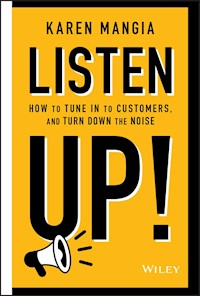
There's one voice that matters more than any other: the voice of the customer. Learn how to fully understand the number one source of your organization's prosperity, profits, and productivity. These actionable insights will help you to better connect with your customers and gain an undeniable lead over your competition. Listen Up!: How to Tune In to Customers and Turn Down the Noise teaches readers how to create a customer experience that's built on listening and designed for engagement. Author and Salesforce executive Karen Mangia has created a practical and comprehensive examination of how best-of-breed companies listen and respond to customer demands--creating a foundation of customer success, loyalty, and brand evolution. Listen Up! features discussions about: How to go beyond the survey: best practices associated with customer understanding, customer experience, and customer service * How to move from deep listening to data-based insights into customer behavior * The statistics and stories behind companies, organizations, and even city governments that have created a customer-centric culture * How powerful new questions can offer a fresh perspective into any customer, anywhere: empowering your customer-facing teams, including sales teams, in the current market * Winning greater mindshare, and market share, with a fresh look at the future of customer service, customer success, and customer satisfaction Perfect for anyone in a leadership or management role in a customer-facing organization, including sales teams, business development leaders and marketing professionals, Listen Up! belongs on the bookshelves of executives, customer service and success employees, and leaders who want to better engage with the one voice that matters most: the voice of the customer.
Sie lesen das E-Book in den Legimi-Apps auf:
Seitenzahl: 317
Veröffentlichungsjahr: 2020
Ähnliche


















Table of Contents
Cover
PRAISE FOR
LISTEN UP!
Foreword
CHAPTER 1: The Breakdown Before the Breakthrough
HOW DO I MANAGE THIS CRISIS?
RECOVERY AND RESILIENCE
SERVING AT A HIGHER LEVEL
THE BREAKDOWN LEADS TO A BREAKTHROUGH
CHAPTER 2: Don't Bet on Your Blind Spots
HOW “WHAT IF?” BECAME, “WHY NOT?”
THE GREATEST NIGHTMARE ANY CEO CAN FACE
DECREASE DISTANCE BETWEEN YOUR HOME OFFICE AND THE C‐SUITE: FIRST STEPS
CHAPTER 3: The Beginner's Mindset
A FALSE SENSE OF SECURITY
LISTENING IS THE FIRST STEP IN DECISION MAKING
CHAPTER 4: Big Impact
CHAPTER 5: When Organizations Are Out of Alignment
ACTION IS WHERE MANTRAS AND MISSIONS COME TO LIFE
CHAPTER 6: Defining the Digital Divide
YOU ARE NOT ALONE
PEOPLE BEFORE PROCESS
HOW BIG IS TOURISM IN AMSTERDAM?
TRANSPORTATION CONSIDERATIONS
REDEFINING CROWDSOURCING
A SINGLE SIGNAL IS EFFECTIVELY FALSE
CHAPTER 7: Better Questions, Better Answers
OUT OF THE MOUTHS OF BABES
CHAPTER 8: Got Genius?
MOVING DAY: ENTERING THE UNKNOWN
FINDING GENIUS
CHAPTER 9: Genius, Revealed
MYTH #1: CUSTOMERS DEMAND QUICK ANSWERS AND SHORT CALL DURATION TIMES
MYTH #2: THE SURVEY IS THE SOLUTION
MYTH #3: “EASE OF DOING BUSINESS” IS AN OPERATIONS PLAY, SO ATTACKING IT LIKE A PROJECT IS BEST
MYTH #4: CUSTOMER SUPPORT IS ABOUT RESOLVING COMPLAINTS
MYTH #5: WE DON'T HAVE THE RESOURCES TO TRANSFORM OUR CUSTOMER EXPERIENCE/CUSTOMER SUPPORT RIGHT NOW
MYTH #6: GREAT CUSTOMER SUPPORT IS ABOUT AGENT KNOWLEDGE, PRODUCTIVITY, AND EXTENSIVE TRAINING
MYTH #7: THE PROCESS IS THE SOLUTION
CHAPTER 10: The Secret Sauce
WHAT HAPPENS WHEN EGO ENTERS THE CONVERSATION
WHAT'S NECESSARY ISN'T ALWAYS EASY
CHAPTER 11: Dealing with Disruption
A NEW DESTINATION
THE RIGHT PLAYERS AT THE RIGHT TIME
CHAPTER 12: How to Win
THE CUSTOMER ADVISORY BOARD
PRESS PAUSE ON POWERPOINT
CHAPTER 13: Moving at the Speed of the Customer
THE VALUE IN BIAS
WHY YOU HAVE TO EARN THE CUSTOMER
OWNING THE JOURNEY
NEW VALUE, NEW SOLUTIONS
HUMAN‐CENTERED DESIGN
CHAPTER 14: Look Who's Talking
FINDING VALUE
A MATCH MADE IN HEAVEN
THE CUSTOMER EXPERIENCE ASSESSMENT
BUILDING THE RELATIONSHIP
COMMUNITY KILLS COMPETITION
CHAPTER 15: Moment of Signal
RESTORING HOPE
About the Author
Acknowledgments
Index
End User License Agreement
Guide
Cover
Table of Contents
Begin Reading
Pages
i
v
vi
vii
xiii
xiv
1
2
3
4
5
6
7
9
10
11
12
13
14
15
16
17
18
19
21
22
23
24
25
26
27
28
29
30
31
32
33
34
35
37
38
39
40
41
42
43
44
45
47
48
49
50
51
52
53
54
55
56
57
59
60
61
62
63
64
65
66
67
68
69
71
72
73
74
75
76
77
78
79
80
81
83
84
85
86
87
88
89
90
91
92
93
94
95
96
97
98
99
100
101
102
103
104
105
106
107
108
109
111
112
113
114
115
116
117
118
119
121
122
123
124
125
126
127
129
130
131
132
133
134
135
136
137
138
139
140
141
142
143
144
145
146
147
148
149
150
151
152
153
155
156
157
158
159
160
161
163
164
165
167
168
169
170
171
172
173
174
175
176
177
178
PRAISE FOR LISTEN UP!
“Listening with authentic intent gets results. Karen has lived it in her career. Now she has written an accessible and real book that can be used again and again. Leading with questions, locking in on values, and meeting your customers where they are at are just a few takeaways from this riveting read. A must for every conscious leader.”
—Sean Magennis,
COO, Young Presidents Organization (YPO)
“Karen Mangia clearly and powerfully articulates the significant benefits of cultivating a Listen Up! company culture. As a former chief customer officer and CMO, I can clearly see how businesses can build long‐lasting customer relationships and advocacy by following this brilliant blueprint.”
—Vala Afshar,
Chief Digital Evangelist, Salesforce
“The most powerful strategy for creating trust and lasting relationships is intimacy. The best way to gain intimacy is to care enough to give someone your full focus and listen. REALLY listen. The superpower in business is caring, and Listen Up! is a practical, tactical guide to real and improved customer experience.”
—S. Anthony Iannarino,
writer, speaker, and author of
The Only Sales Guide You'll Ever Need
“Customer perception is everything. Listen Up! enables you to query, explore, and act on new and surprisingly valuable dimensions of customer perception.”
—Peter E. Cohan,
author,
Great Demo!
Listen UP!
How to Tune In to Customers and Turn Down the Noise
KAREN MANGIA
Copyright © 2021 John Wiley & Sons. All rights reserved.
Published by John Wiley & Sons, Inc., Hoboken, New Jersey.
Published simultaneously in Canada.
No part of this publication may be reproduced, stored in a retrieval system, or transmitted in any form or by any means, electronic, mechanical, photocopying, recording, scanning, or otherwise, except as permitted under Section 107 or 108 of the 1976 United States Copyright Act, without either the prior written permission of the Publisher, or authorization through payment of the appropriate per‐copy fee to the Copyright Clearance Center, Inc., 222 Rosewood Drive, Danvers, MA 01923, (978) 750‐8400, fax (978) 646‐8600, or on the Web at www.copyright.com. Requests to the Publisher for permission should be addressed to the Permissions Department, John Wiley & Sons, Inc., 111 River Street, Hoboken, NJ 07030, (201) 748‐6011, fax (201) 748‐6008, or online at http://www.wiley.com/go/permissions.
Limit of Liability/Disclaimer of Warranty: While the publisher and author have used their best efforts in preparing this book, they make no representations or warranties with respect to the accuracy or completeness of the contents of this book and specifically disclaim any implied warranties of merchantability or fitness for a particular purpose. No warranty may be created or extended by sales representatives or written sales materials. The advice and strategies contained herein may not be suitable for your situation. You should consult with a professional where appropriate. Neither the publisher nor author shall be liable for any loss of profit or any other commercial damages, including but not limited to special, incidental, consequential, or other damages.
For general information on our other products and services or for technical support, please contact our Customer Care Department within the United States at (800) 762‐2974, outside the United States at (317) 572‐3993 or fax (317) 572‐4002.
Wiley publishes in a variety of print and electronic formats and by print‐on‐demand. Some material included with standard print versions of this book may not be included in e‐books or in print‐on‐demand. If this book refers to media such as a CD or DVD that is not included in the version you purchased, you may download this material at http://booksupport.wiley.com. For more information about Wiley products, visit www.wiley.com.
Library of Congress Cataloging‐in‐Publication Data is available:
ISBN 9781119642114 (Hardcover)
ISBN 9781119723868 (ePDF)
ISBN 9781119723875 (ePub)
Cover Design and Illustration: Wiley
Author Image: © Rogue Images Photography.
To my grandfather—my most cherished mentor in business and in life
Foreword
When I started out in business late in the 1970s, we were all working off an industrial playbook, where product was king, and capital was the scarce ingredient in the economic equation. Information technology was having a revolutionary impact on improving the efficiency of the supply chain and the back office. The big disruption was the Internet, enabling global outsourcing which, in turn, drove down the costs of products and services dramatically while simultaneously fueling a rising middle class in China, India, and other heretofore underdeveloped economies. By the end of the 20th century, we were giving ourselves high fives—mission accomplished!
Then, at the beginning of this century, a second technology revolution began to unfold around consumer applications enabled by cloud computing and mobile smartphones. Digital communication went from being an elite medium, to a commonplace experience, and finally to a de facto standard—all in the space of a couple of decades. Digital transformation is reengineering our enterprise value chains end to end. We now live in a world where access to products, and all of the information about them, is ubiquitous. We also are living in a world where taking title to products is being displaced by subscription models and as‐a‐service transactions. Product, in other words, is no longer king. Now it is the customer who is the scarce ingredient in the economic equation.
And that is what has led to this book.
In the Age of the Customer, every enterprise must reengineer its processes to be “customer first.” That means reframing functions like Customer Support as Customer Success. It also means reorienting sales calls from presentation plus demo to provocation plus dialogue. It means focusing our products and services on outcomes, not just on deliverables. We need to secure adoption, not just ownership. We need to get inside the minds of the customers to make sure that we are addressing the things about which they really care deeply.
Marketing is no longer about what we say. Instead, it begins with what we hear. Then it must translate what we hear into what we do. That, in turn, will ultimately translate into what other people say about us. Sure, we still have our taglines and positioning statements. But now, more than ever, we have to walk the talk—we have to show that we are listening, that we do care, and that we can respond. And that means we have to listen up.
How can we listen better? For many a spouse, that can pose a lifelong challenge. Think how much more challenging it is, then, to institutionalize listening across an entire enterprise. That, in essence, is what the Age of the Customer demands, and it is precisely here then why this book can be of such great help. As an executive at Salesforce, Karen has had a front‐row seat in the company that perfected the customer success function, that has lived the as‐a‐service mission from day one, and that has learned how dependent a land‐and‐expand sales model is upon customer satisfaction and retention.
Since I wrote Crossing the Chasm: Marketing and Selling Technology Products to Mainstream Customers (HarperCollins, 1991), I've been watching companies succeed and fail in the face of disruption, digitalization, and more. Now, in the midst of millions of messages, creating new impact requires that we listen in new ways.
Salesforce enables companies to prioritize customers unlike anyone else in the marketplace. I discovered that commitment to innovation firsthand in my work on Zone to Win: Organizing to Compete in an Age of Disruption (Diversion Publishing, 2015). And the companies in this book are demonstrating how to put best practices into action. No matter what industry you're in, clinging to past paradigms isn't going to build your future.
Karen has created the guidebook for leaders who are ready to listen to the voice that matters most. This book delivers a customer‐focused message with clarity and precision, demonstrating that the value of your business is tied directly to the customers that you serve. Did you hear that? That's why the Age of the Customer demands your attention: It's the lifeblood of your business.
This book will show you how to tune in and tune up the most important connections in your organization. When it comes to innovation, transformation, and adding value, Salesforce gets it—and so does Karen. Read this book and you'll see why.
Geoffrey Moore, February 2020
Author of Crossing the Chasm and Zone to Win
CHAPTER 1The Breakdown Before the Breakthrough
I was afraid.
The needle mark in my arm was still fresh, stinging from yet another blood test. My bare feet dangled off the side of the examination table. My purse sat on the floor beside my backpack, unzipped and bursting with unfinished work. I had come here to learn what was wrong, but I didn't know if I could handle the answer. Nearly four years of poking, prodding, testing, and trials had brought me into this too‐bright room with turquoise shelves, where glass jars held tongue depressors and eight‐inch Q‐tips underneath an inspirational poster of an eagle. The long‐haired man in the white lab coat held a manila folder in his hands. The pen in his pocket matched the silver color of his hair. On a single page, just outside of my view, was my fate. My future. My fear.
“We know what's wrong, and this last blood test will confirm it,” my doctor said. He closed the folder and looked straight at me. “And we are going to get this fixed.”
I took a deep breath. I had spent most of my thirties in the middle of a health crisis. I had watched myself gain weight, lose energy, experience symptoms of jaundice and hair loss—all without any answers as to the cause. Strange lumps in my neck were a constant unsolved mystery. The variety of medications that surrounded the sink in my bathroom had only given me new symptoms, adverse reactions, and lots of questions. I wasn't getting better. Nothing worked. So far, five doctors had failed to give me anything close to a concrete diagnosis. But today was different.
On this day, everything changed.
“I've developed a plan of treatment,” Dr. Logan explained to me. “We're going to get your life back. It's going to take some time, but at least we know what we're fighting. And what we need to do to win.”
As the world has faced off against the threat of the coronavirus, I can't help but be reminded of my own personal battle. A mysterious disease had me in its clutches. Luckily for me, it wasn't COVID‐19. But is there any such thing as a “good” health crisis? Is one life‐threatening disease more favorable than another? Unfortunately, life doesn't allow us to choose what we get. We only get to choose how we react.
I was battling against an unseen and unknown foe. Teams of doctors were confused; what they called diagnoses seemed to me to be just guesswork. Dysfunction and disappointment had led me here to a holistic doctor. Dr. Logan was as fluent in ancient Eastern healing as he was in modern medicine. When he found what others couldn't, he gave me my life back.
I wrote about my personal health journey in detail in my first book, Success With Less. Suffice it to say that, as a child, I had somehow contracted pesticide poisoning. Growing up in Southern Indiana, we were always outdoors. I don't know where I encountered the unnamed chemical, but it lay dormant until I entered my thirties. Then the poison woke up with a vengeance.
The journey back to health wasn't easy. At least I knew what I needed to do. I was facing the future with a new understanding. Finally, I had a plan and a path forward.
On that day, I knew I was never going back.
On that day, I discovered the power inside a horrible disease. Sounds strange, doesn't it?
On that day, I discovered how a breakdown can lead to a breakthrough.
As we face the repercussions of COVID‐19, business leaders are wondering what lies ahead. We all are. Organizations have to reevaluate, reconstruct, and reprioritize. How can you care for your company, customers, and employees and find a way forward?
That's where I know I can help: because I've had to battle back from more than one setback. And I've helped thousands of companies around the world do the same.
HOW DO I MANAGE THIS CRISIS?
The first step toward getting back to health was perhaps the most vital. I had to listen—listen to the resources that could help me most. Because, when I knew what I needed to do, the real healing could begin. The doctor had given me great feedback. Now I had to use it.
In my case, my soft‐spoken doctor was the voice that brought me to hear what I so desperately needed. Dr. Logan was the voice of reason and understanding—a perspective that proved to be my solution. When it was time to move forward, it was time to listen up. He pointed me toward my own resourcefulness, expanding my knowledge in a way that transformed my lifestyle. And my life.
What seemed impossible, elusive, and hidden was now revealed. Discovered. Expanded.
Have you ever had that moment when you learn something new, and you know you're never going back to the way it was before? That even if you revisit a familiar place, you know it's not the same and neither are you? When I saw the path forward—the path to health—I knew I would never be the same.
Today, as I reflect back on my battle to eliminate this poison, there's one thing I know for certain: what's past has passed. In business as in life, things follow a similar path.
A crisis forces us to pause. To prioritize. To rethink our surroundings and solutions so that we can find a way forward. Have you been there? I think we all have. I think that life has asked us all to pause and prioritize. But how do we do that in a way that's going to lead us back to professional and organizational health so that we don't just survive—rather, we thrive?
You have to listen to the people who can help you most. You have to tune in to the voice that will help you to find your future. I'm not talking about trying out a new doctor or talking to yourself during quarantine.
I'm talking about turning to resources that know what you don't know and that see what you can't see—resources that have exactly what you need (even if it's difficult to hear) during a time of crisis.
Healing begins with listening—listening to your customer.
Your customer wants to know how to find success—hopefully, via your products and services. Leading a remote workforce, driving new customer experiences, and capturing customer success. Your clients want to know how to do these things and many others, as they are striving to find their path to financial health.
I wonder: Do your customers know that they have an expert guide who's invested in their journey? I wrote this book so that they will have just that—so that you can be that guide, and so that you will know, in no uncertain terms, how to listen up more effectively, actively, and deeply than ever before. Because coming out of this crisis demands a new course of action. A treatment plan, if you will, that begins with the way that you treat your customers.
RECOVERY AND RESILIENCE
When I was sick, my mind was writing checks my body couldn't cash. I wondered:
How do I manage through this crisis, when I don't even know what “manage” means right now or the exact extent of this crisis?
How do I reprioritize my life?
What can I keep, what can I discard, and what am I terrified to lose?
How do I keep up with customer calls, meetings, and the day‐to‐day requirements of life?
Have you been there? As a result of my illness, I was out of energy. But thankfully, I wasn't out of options. And neither are you.
Your customer needs you. Can you hear that?
The products and services your customers need, right now and tomorrow, are waiting for you to discover. Are you listening? The future belongs to those who align and connect in more powerful ways. To hear and respond in ways that others don't. Or won't. Or can't.
SERVING AT A HIGHER LEVEL
Inside this book, you will explore the source of true recovery, resilience, and revenues. You'll take concepts like “customer success,” “live listening,” and “voice of the customer” to a new level—the level of healing, prosperity, and growth. I'll share proven and time‐tested strategies that have helped thousands of companies from Birmingham to Brisbane and back again. We'll look at the strategies of international giants as well as the neighborhood merchants whom you've never heard of—but you will. Along the way, I'll share access to thought leaders who are innovating in the face of adversity.
Each chapter will point you toward practical and tactical advice: ideas that you can implement right away to change your results. These strategies are called “C‐Sparks,” and they are designed to ignite your creativity, innovation, and connection to the one source of wellness in a transformed world.
Together, we will reveal what my doctor gave to me: Clarity. Direction. Guidance. And a new path forward.
THE BREAKDOWN LEADS TO A BREAKTHROUGH
Through these pages and chapters, you'll learn how to ask better questions, take ego out of the conversation, build greater alignment, and add value to your company's bottom line. You will find the changes that you need to make and which your customers crave. Because listening is everyone's job. And the only way forward is together.
When you have a Listen Up! organization, you win as a team—often, as a team of teams. An organization that listens up understands that connecting with customers isn't just the job of a particular division, sector, or service squad. Working remotely can still mean that we're working together. Listening means building a community—a community that can stand and expand on the culture inside your organization, to shift the hearts and minds of the people who support it.
At Google, here's how they describe their customer experience team:
There is no single research group.
There is no single research role.
There is no single research process.
1
What could that kind of alignment and understanding mean to you and your company? More importantly, to your customers? It's time to find out.
Ultimately, a Listen Up! organization will deliver shared value. Shared success, because our focus in these pages is on growth. But from where, exactly, is that growth going to come?
I will share with you the answer that is true, but only 100 percent of the time: growth comes from your customers. If you're wondering how your business will recover and thrive, that's another great question.
Better ask the person who holds the answers. Guess who that is?
Customer success is what drives every business today.1 According to the Customer Success Association (https://www.customersuccessassociation.com/), the mission of customer success is to increase sustainable proven value for both the customers and the company. While Salesforce (https://www.salesforce.com/) didn't invent customer success (that title goes to another CRM company called Vantive, where Marie Alexander created the first Customer Success department in 1996), many believe that Salesforce perfected it. In 2005, Salesforce quickly built what has become the largest and best‐known Customer Success departments in any industry, called “Customers for Life.” The purpose of the group was to increase retention and adoption—words that point to profitability, service, and impact.
Here are the four pillars of Customer Success. These are ideas that we will explore in detail in the pages that follow:
Technology Is the Turning Point.
Machine learning and artificial intelligence are here to stay. Success will involve using these tools to understand your customers like never before. We will focus on the strategy and intention that will help you to forge new and deeper relationships, so that you can deliver more intelligent, personalized experiences. More importantly, we will focus on the people behind the process, offering a kind of authentic intelligence to complement the artificial ones.
Success Depends on Every Stakeholder.
From the interns to the C‐Suite, engagement is the driver of exceptional customer success. Coach Phil Dickens at Indiana University often said, “You practice like you play.” Practice taking care of your people or, as the saying goes, they will take care of you (and not in a good way). The
Listen Up!
organization works from outside in: listening to the people who matter most drives the behaviors that create results. But aren't your internal employees your customers as well? Listening to every stakeholder is putting success into practice. And playing to win.
The Gap Is Shrinking.
The gap between what customers really want from business and what's actually possible is vanishing rapidly. That shift is changing everything, from expectations to possibilities. The future isn't about learning to be better at doing what we already do. It's about how far we can stretch the boundaries of our imagination. You might even say our genius. The ability to produce success stories that weren't possible a few years ago to help customers thrive in dramatic new ways is what's going to become a driver of growth for any successful company. The gap between what's possible and what's available is getting smaller every day. Meanwhile, what's getting bigger and bigger? Customer expectations.
Wanted
—
Miracle Workers.
I believe that we're entering a new age in which customers will demand miracles from you. Whether you make cars, solar panels, television programs, or anything else, opportunities for modern‐day miracles are everywhere. Sound far‐fetched? So was penicillin, once upon a time. As Eleanor Roosevelt famously said, “The future belongs to those who create it.” Innovation is the only way forward—blazing new trails to meet new expectations. We have to resist the urge to make quick marginal improvements and spend more time listening deeply to what customers really want, even if they're not fully aware of it yet. In the end, you can make miracles happen, especially when you see that customer success is built on connection.
Today we sit at an inflection point. We find ourselves at the intersection of “too much information” and “what really matters.” What you've done before and what got you to this point isn't going to get you (and your customers) where you need to go. It's time to make the right turn.
We need a new map—a better GPS—for the road ahead.
This book will give you the tools to engage your entire organization in developing possibilities. You will see new connections. Ask better questions. Lead your teams (and your customers) to powerful new results. And discover that everyday miracles are within your grasp.
Every company approaches listening in its own way. I can't guess what you might spend on your customer experience, but I can tell you the exact cost of doing nothing.
Half‐measures and poor execution are two things that you can't afford, no matter what your balance sheet says. Ignore the voice of the customer, and you will bankrupt your organization.
There is a way forward—for you and for your team. The cure is here, right in front of you, but it takes time. Commitment. I can tell you from my own experience. To get through a crisis, you've got to turn to the one resource that can help you most. In business, that means listening for the answers that will guide your future. A new experience—and a new way of looking at customer success—is in your hands, right now. You don't have to wait for a breakthrough. The journey has already begun.
Note
1
Chapman, Chris (2018). “User Experience Research: Behavioral Science to Improve Product Experience.” Presented at the Annual Convention of the American Psychological Association. San Francisco: August 2018.
CHAPTER 2Don't Bet on Your Blind Spots
Ashley Revell is the typical guy next door. Average height. Average weight. Average amount of hair. Gainfully employed with a modest savings account. Single and seeking. One day, he had a drink with some friends, and Ashley decided to break the rules. That was when a happy‐hour dare turned him from pub patron to gutsy gambler.
“Wouldn't it be great,” his friends asked him, “if we went to Las Vegas … and bet everything on one spin?”
The ultimate bet. The gambler's dream. The big payoff.
Through the cloudy haze of beers and bravado, this intriguing inquiry captured Ashley's attention in a way that was far from average. As he thought about the idea of betting it all, adrenaline found him quickly—like a tenacious tiger pursuing its prey.
Ashley wondered: “What If?”
HOW “WHAT IF?” BECAME, “WHY NOT?”
Ashley inventoried his assets. Just over $15,000 in savings. A used BMW in pretty good shape. He still had his Rolex. Golf clubs. What did he have to lose? he wondered. Curiously, “everything” was not the first thought to cross his mind.
“At pretty much every stage, everyone I knew said it was just a stupid thing to do. My [mother] obviously said it was a silly idea and that I should be settling down. My father was exactly the same,” he recalled.
He didn't listen to their advice. Over the next six months, Ashley sold all of his possessions. Reasoning would only slow him down at this point, so he didn't have time for it. He was on an adventure—determined to reject average. He boarded his high‐stakes flight to Las Vegas in a rented tuxedo, paid for with the money he earned when he sold all of his clothes.
Ashley stepped onto the bright, plush carpet at the Plaza Casino and Hotel. Rehearsed and ready, with an entourage and photographers in tow, he felt almost famous.
The cashier raised an eyebrow when she saw the crew and the cameras approaching the cash cage. She shook her head as she methodically transformed Ashley's life savings—now $135,000—into 14 rows of neatly stacked chips. Each clink of the plastic chips reminiscent of the clink of the pint glasses nearby. Ashley looked down at the stacks of chips, his lifetime achievements placed meticulously on the red velvet in front of him.
Intent on his mission, Ashley ignored the smell of musky cologne and wafting tobacco residue as he stepped away from the cashier. Carrying his life in his hands, he stepped forward to find the roulette table that would determine his future.
At the table, one glaring question punctured the brief and sudden silence:
“Red or black?”
Ashley gingerly placed the chips on the table. He took a deep breath as he pushed his future toward the croupier.
“When I spin the ball, if it goes around more than three times before you say red or black, it's a ‘no’ bet,” said the man behind the wheel.
Months of planning and execution had numbed him to what was at stake. His eyes focused on a single square with a single number. His number. His big success. Or his big regret. Which would it be … ?
Would you be willing to bet your business—or your career—on a single number?
Unlikely.
Yet thousands of businesses (and CEOs) gamble the future on a daily basis by going all in on Net Promoter Score (NPS). They're playing a high‐stakes game of chance based on a single number. Are you? Like corporate croupiers, these leaders ask customers one self‐administered question: “How likely are you to recommend our business, based on your recent experience?”
Then the real gambling begins.
In 2018, NPS was cited more than 150 times in earnings conference calls by 50 S&P 500 companies, according to a Wall Street Journal analysis of transcripts. Compared with the same organizations from five years earlier, that's more than four times as many mentions—a 400 percent increase in NPS chatter! In five years, nearly three times as many companies were focused on this single number, according to transcript analysis.
The same study went on to discover dozens of public companies also report NPS scores in securities filings, even tying NPS results to employee compensation. So, is that a fair bet?
A growing number of companies are going all in on a single square.
Like Ashley Revell, these organizations are betting the house on a single number.
How do you think that's going to turn out? (By the way, if you're interested in the outcome of Ashley's sensational spin, visit karenmangia.com/biggamble.)
Are you the Ashley Revell of your C‐Suite, with all of your company's assets riding on an outcome that you're unable to predict and unlikely to sustain?
Red or black
Promoter or detractor
Place your bets
Are the odds really in your favor?
This corporate roulette game isn't the same. The house almost never wins, because NPS is a bad bet for everybody involved. When the results are revealed, how equipped are you and your senior leaders to discern the answers to these mission‐critical questions:
Why do you win?
Why do you lose?
How do you influence, sustain, or change that outcome?
The Challenge: We're asking the wrong questions—and we're asking the wrong questions of the wrong people
How often do we as human beings do what we say we're going to do? Like when the dentist asks, “Are you going to floss your teeth?”—there's really only one answer.
But is it the truth?
The doctor wants to know if you're going to eat more vegetables. Of course, you and I say yes because we only have the best intentions, right?
But intention is not action, and that's the issue with the NPS question. Asking, “How likely are you to recommend our business based on your recent experience?” is a measure of one key sentiment: likelihood. How LIKELY are you to floss? Eat better? Really do something to recommend my business?
CEO Christine Marcus discovered the dangers of asking the wrong questions of the wrong people the hard way—by losing her largest customer. Talking backstage with her at a conference in Amsterdam, I had the chance to hear her story firsthand.
Having emigrated from Egypt with her family to escape religious persecution, Christine was no stranger to hardship. Her prearranged marriage at age 17—a cultural tradition—ended in divorce. As a single mother, she needed to provide for herself and for her children. Like many female entrepreneurs, doing what had to be done was the motivation to start her own business (https://bit.ly/listenup-ChristineMarcus).
And that's exactly what she did. Christine knew two things really well: food and service. But not just serving food—she wanted to cook up something different. Something unique. A business that created delicious experiences. She built her B2B business around organizations that realize how the overall employee experience is a big part of attracting and retaining top talent.
Alchemista (https://www.alchemista.com/) is a premier corporate catering concierge service, delivering creative food and brand solutions for high‐growth businesses. Her customers are, according to Christine, “elite and specific.” They believe that they have to have an awesome office culture, with free meals as an employee benefit. But not just burgers and fries for her clients.
“We help companies compete with Google,” she explains. “Food plus experience equals culture [for our customers], and that's where Alchemista comes in. We don't make any food—we're just really good at finding great stuff.” Her company sources unique culinary choices—from fast to slow food. “And then,” Christine adds, “we make everything better.
“We're never going to have thousands of customers—that's not our approach. We have a short list of clients.” Hers is a subscription model, delivering onsite multiple days per week. Christine clarifies, “It's hospitality service. Not food delivery.”
As Christine's business grew, her growing leadership responsibilities resulted in fewer opportunities to interact directly with customers. Like most founders, she trusted her account team with the task of retention. On the surface, it seemed so simple: keep customers by keeping customers happy.
Resting on residual relationships established earlier in her career, interspersed with occasional account team conversations, she became removed from day‐to‐day client contact.
For her teams, she asked just one question: “How likely are we to retain this customer?”
Ah. A single, simple ask. Sounds familiar, doesn't it?
Which do you choose: Red or black?
THE GREATEST NIGHTMARE ANY CEO CAN FACE
Christine was sitting at her desk in her Boston headquarters when an email arrived on a cloudy Friday morning. The Chief Executive at her largest customer sent her a short but stunning message.
“Thank you very much. Your service stinks. Our employees hate it. You guys are fired. Don't even bother sending anyone in on Monday.”
The email sent shockwaves through Christine's body. She blinked. She looked at the header. The subject line: “Whaaaaaaaaaaaaat?”
How could this have happened? Where did this come from? Whatever happened to the 30‐day notice in the customer agreement?
She felt her heart pounding as she instantly calculated the damages: over 50 percent of her revenue had just walked out the door.
Of course, she didn't let her initial anxiety stop her. She knew she could turn this around … right?
She immediately picked up the phone. Her call to the CEO was not answered—just like the next 862 calls she would make.
The CEO refused to talk to her.
Emails landed unanswered.




