


18,99 €
Mehr erfahren.
- Herausgeber: John Wiley & Sons
- Kategorie: Fachliteratur
- Sprache: Englisch
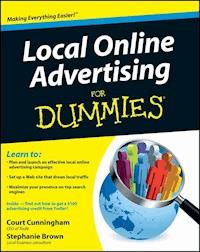
Kick your local online advertising into high gear with thisfriendly, timely guide! Add the newest means of advertising your business into yourmarketing mix by developing an online advertising strategy. Thisget-down-to-business guide will show you how. Written by executivesfrom Yodle, a New York-based firm specializing in onlineadvertising, this book reveals the best and brightest ways to getthe word out, from creating a Web presence that draws visitors, tousing SEO, to jumping boldly into social media advertising. * Online advertising market is estimated to grow to $10-$19billion by 2011, and you'll want your business to be part of thishuge shift * Explores how to research your audience, set goals, and build aplan * Provides steps and tips on creating an effective Web presenceand landing pages-then covers how to drive visitors to your sitewith search engine optimization, AdWords, e-mail blasts, and socialmedia marketing * Examines blogs, chat rooms, video, and other ways to wincustomers Don't miss the free offer from Yodle that comes with thispractical guide!
Sie lesen das E-Book in den Legimi-Apps auf:
Seitenzahl: 588
Veröffentlichungsjahr: 2010
Ähnliche



















Local Online Advertising For Dummies®
Local Online Advertising For Dummies®
by Court Cunningham and Stephanie Brown
Local Online Advertising For Dummies®
Published byWiley Publishing, Inc.111 River St.Hoboken, NJ 07030-5774www.wiley.com
Copyright © 2010 by Wiley Publishing, Inc., Indianapolis, Indiana
Published simultaneously in Canada
No part of this publication may be reproduced, stored in a retrieval system, or transmitted in any form or by any means, electronic, mechanical, photocopying, recording, scanning, or otherwise, except as permitted under Sections 107 or 108 of the 1976 United States Copyright Act, without either the prior written permission of the Publisher, or authorization through payment of the appropriate per-copy fee to the Copyright Clearance Center, 222 Rosewood Drive, Danvers, MA 01923, 978-750-8400, fax 978-646-8600. Requests to the Publisher for permission should be addressed to the Permissions Department, John Wiley & Sons, Inc., 111 River Street, Hoboken, NJ 07030, (201) 748-6011, fax (201) 748-6008, or online at http://www.wiley.com/go/permissions.
Trademarks: Wiley, the Wiley Publishing logo, For Dummies, the Dummies Man logo, A Reference for the Rest of Us!, The Dummies Way, Dummies Daily, The Fun and Easy Way, Dummies.com, Making Everything Easier, and related trade dress are trademarks or registered trademarks of John Wiley & Sons, Inc. and/or its affiliates in the United States and other countries, and may not be used without written permission. All other trademarks are the property of their respective owners. Wiley Publishing, Inc., is not associated with any product or vendor mentioned in this book.
Limit of Liability/Disclaimer of Warranty: The publisher and the author make no representations or warranties with respect to the accuracy or completeness of the contents of this work and specifically disclaim all warranties, including without limitation warranties of fitness for a particular purpose. No warranty may be created or extended by sales or promotional materials. The advice and strategies contained herein may not be suitable for every situation. This work is sold with the understanding that the publisher is not engaged in rendering legal, accounting, or other professional services. If professional assistance is required, the services of a competent professional person should be sought. Neither the publisher nor the author shall be liable for damages arising herefrom. The fact that an organization or Website is referred to in this work as a citation and/or a potential source of further information does not mean that the author or the publisher endorses the information the organization or Website may provide or recommendations it may make. Further, readers should be aware that Internet Websites listed in this work may have changed or disappeared between when this work was written and when it is read.
For general information on our other products and services, please contact our Customer Care Department within the U.S. at 877-762-2974, outside the U.S. at 317-572-3993, or fax 317-572-4002.
For technical support, please visit www.wiley.com/techsupport.
Wiley also publishes its books in a variety of electronic formats. Some content that appears in print may not be available in electronic books.
Library of Congress Control Number: 2010922570
ISBN: 978-0-470-49742-5
Manufactured in the United States of America
10 9 8 7 6 5 4 3 2 1
About the Authors
Court Cunningham is the CEO of Yodle, a leading local online advertising company that works with over 6,000 local businesses across America. At Yodle, Court oversees all aspects of operations and strategy, including technology, product development, sales, and marketing. Prior to joining Yodle, Court held the position of COO at Community Connect, a niche social networking company, where he lead consumer marketing, product management, and development efforts. Before that, as SVP/GM of the Marketing Automation group at DoubleClick, he was instrumental in establishing DARTmail as the industry leading e-mail marketing solution. Court received a BA in English from Princeton University and an MBA from Harvard Business School.
For more information about Court and his company Yodle, go to www.yodle.com.
Stephanie Brown has been evangelizing Internet marketing since 1994. In fact, she specializes in helping clients use many of the tools and techniques contained in this book to grow their businesses. Over the years, she has held management positions at marketing firms and Internet companies, where she has led teams in creating customer-focused online solutions for accounts big and small, local and national. Today she is a partner at Word Communications, an integrated marketing firm in Albany, New York. Her clients are a living laboratory for exploring the latest best practices — in e-mail, social media, search marketing, landing page design, Web analytics and optimization, and offline integration.
Stephanie can be reached at [email protected] or www.wordcommunications.com.
Dedication
Court Cunningham I want to dedicate this book to all small business owners, the hardest working people I know.
Stephanie Brown: This book is dedicated to the people and the dogs I ignored during the researching and writing of it. (You know who you are.) I also dedicate this book to my mother, Helga Olsson, and my stepmother, Ruth Brown, whose examples have always taught me to persevere.
Authors’ Acknowledgments
Court Cunningham A large number of people on the Yodle team played significant roles in creating this book — not the least of which was Cam Lay — who was instrumental in helping to organize the content of this book, leveraged his own marketing background to give us another set of eyes for each and every chapter, and arduously provided the first round of edits. Additional content contributors from Yodle included Joseph Sievers, Michael Baker, Arpan Jhaveri, Milind Mehere, and the invaluable John Switzer. Finally, I want to thank the Yodle Marketing team members who provided further feedback including Kara Silverman, Herman Mallhi, Allyse Coughlin, and Alisa Adler — as well as our Senior Director of Marketing, Joel Laffer, who encouraged me to do this book in the first place.
Stephanie Brown: It would be a sin not to acknowledge the two people who worked tirelessly (and occasionally feverishly) to bring the best out in this book: Editorial Assistant David Idema, whose wry humor makes this a fun read, and Yodle’s Cam Lay, whose steady support and gentle task-mastering got us through. Eat your peas!
Publisher’s Acknowledgments
We’re proud of this book; please send us your comments through our online registration form located at http://dummies.custhelp.com. For other comments, please contact our Customer Care Department within the U.S. at 877-762-2974, outside the U.S. at 317-572-3993, or fax 317-572-4002.
Some of the people who helped bring this book to market include the following:
Acquisitions, Editorial
Project Editor: Jean Nelson
Executive Editor: Steven Hayes
Copy Editor: Jennifer Riggs
Technical Editor: Michelle Oxman
Editorial Manager: Kevin Kirschner
Media Development Project Manager: Laura Moss-Hollister
Media Development Assistant Project Manager: Jenny Swisher
Media Development Associate Producers: Josh Frank, Marilyn Hummel, Douglas Kuhn, and Shawn Patrick
Editorial Assistant: Amanda Graham
Sr. Editorial Assistant: Cherie Case
Cartoons: Rich Tennant (www.the5thwave.com)
Composition Services
Project Coordinator: Katherine Crocker
Layout and Graphics: Christine Williams
Proofreader: Susan Hobbs
Indexer: Potomac Indexing, LLC
Special Help: Leah Cameron, Teresa Artman, Becky Whitney
Publishing and Editorial for Technology Dummies
Richard Swadley, Vice President and Executive Group Publisher
Andy Cummings, Vice President and Publisher
Mary Bednarek, Executive Acquisitions Director
Mary C. Corder, Editorial Director
Publishing for Consumer Dummies
Diane Graves Steele, Vice President and Publisher
Composition Services
Debbie Stailey, Director of Composition Services
Introduction
Not long ago, the Internet came along and changed everything. Or at least it changed the way a lot of things get done, including how consumers look for and find local businesses.
With the rise of the Internet as the primary way consumers connect with local businesses, a huge number of tools and techniques have emerged for local businesses to better capture those consumers and turn them into customers. Not only do these businesses seem to have done so almost overnight, but the smartest companies and Web consultants have already tried them, refined them, and came up with new ones. In other words, the Internet marketing tool kit is big, and getting a whole lot bigger every day.
Understandably, this whole Internet phenomenon can seem pretty complex, even intimidating, to local business owners who’ve relied for years on traditional advertising channels and methods. In reality, all the Web does is greatly accelerate the speed that traditional marketing concepts can now be applied and responded to by eager customers and prospects.
In Local Online Advertising For Dummies, we look at how local businesses can put online marketing to profitable use. We break down the subject into manageable, understandable chunks. By reading this book, you’ll become comfortable with the big picture of the online marketing process and with how each of its parts contributes to the whole. Most important, you’ll be ready to put many of those elements to work for your own business — and to be happily surprised by the results they bring you.
About This Book
You don’t have to read this book from front to back. Rather, think of it as a sort of library from which you can extract and examine only the pieces that interest you. You’ll find that (for the most part) the discussions in each chapter — and in each section within each chapter — are self-contained.
Of course, we wouldn’t mind at all if you did read everything in order. Local online advertising is one of those subjects that has a natural build to it, so going with the logical flow isn’t a bad idea. But, hey — it’s your book now, and you can read it however you want.
In any case, this book isn’t a textbook; it’s a reference, or a guide. This book’s purpose is to give you a basic introduction to local online advertising, from which you can then go on to more sophisticated sources, if necessary.
Conventions Used in This Book
We use a few conventions throughout this book to make things easier for you:
We use italics for emphasis and to set off a particular term that we define.
We use a computerese font to highlight Web addresses (or URLs), such as www.dummies.com.
Also, 99.99 percent of what we talk about in the book applies to both PC and Mac users. The very few references made to Microsoft applications aren’t exclusionary; Mac users can use versions of the same applications.
What You Don’t Have to Read
Here and there throughout this book, you see sidebars — text boxes that are separate from the regular content and feature a gray background. Sidebars include information that’s related to the content in the chapter but is also independent of it. The bottom line is that you don’t have to read them, and your understanding of the chapter’s subject matter won’t suffer if you don’t. Then again, if you do read them, you may discover something new. We leave the choice up to you.
Another thing you can safely skip without worrying about it is the occasional paragraphs with a Technical Stuff icon beside them. Big surprise, this is stuff for tech-minded readers. The geekier you are, the more likely you’ll value these pieces. The geekier you aren’t, the less likely you’ll care. And that’s just fine.
Foolish Assumptions
In writing a book like this, it’s difficult to know how broad and deep each reader’s existing knowledge is. We figure it’s pretty safe to assume that you know the rudiments of computer use and that you’ve had some experience with the Internet, which also means you’re probably familiar with search engines. Beyond those givens, this book assumes that you’re more or less a novice when it comes to local online advertising.
Of far greater importance, however, is our assumption that as the owner of a business, you’re nobody’s fool. Sure, online marketing may be a new concept, but we’re sure you have the fundamentals of business down cold. You know your market. You know your products and services inside and out. You know what kind of customers you sell to and what kinds of prospects you hope to turn into customers. And you understand profit and loss, competition, and the importance of investing your assets wisely. On all those scores, you’re an expert. So we don’t define universal business terms you already know.
How This Book Is Organized
We organized the chapters in this book into five parts. Each chapter is broken into sections, which are broken into sub-sections, and even into sub-sub-sections.
We compiled this book that way so that you can, with very little effort, get as much (or as little) information you need at any particular moment. Zip, zop, and you’re there. If only the rest of life was so easy.
The following sections briefly describe what the five parts in this book cover.
Part I: Getting Started with Local Online Advertising
This part gives you an overall picture of local online advertising: Why it’s become such a major tool for local businesses to generate more new and repeat customers, the evolution of search engines as they relate to local businesses, and the kind of pre-planning that the online space requires to be used successfully.
Part II: Setting the Foundation for Local Online Advertising Success
Here you discover the importance of building a quality Web site for your business, including whether you should handle this task or get outside help. We also explore the concept of landing pages, the range of interactive tools available, and the factors that go into analyzing the results of your online marketing efforts.
Part III: Doing the Advertising Part of Local Online Advertising
This is really the nuts and bolts of the book. We look, in some detail, at search engine advertising and the elements of a successful e-mail campaign. You also find out how to employ techniques, such as advertising in banner ads, directories, and sponsorships. We also discuss the uses of social media (such as Facebook) and how public relations can help drive traffic to your Web site.
Part IV: Keeping Your Customers Coming Back
Winning over prospects and turning them into paying customers is no easy task. After you do it, how do you make them repeat customers? We answer that question by examining several ways to keep your business at the top of customers’ minds and to reward them for their loyalty. We conclude with a discussion of database marketing — that is, how to use the customer data you collect to sharpen your online marketing campaigns.
Part V: The Part of Tens
If you’ve read through other parts of the book before coming to the Part of Tens, you’ll have been exposed to a lot of information. In this part, we provide you with lists of ten do’s and don’ts. This part makes for a handy resource that you can refer to quickly whenever the need arises.
Icons Used in This Book
At times in the course of this book, we separate certain points to broaden your understanding of a particular subject by placing an icon next to that paragraph.
Occasionally we give you a little hard-won, real-world insight into how to apply the tool or technique we’re discussing. Consider each of these icons as a sort of “If we were you, we’d . . .” piece of advice.
This icon is a friendly reminder of a specific point that we want to make sure you keep in mind as you proceed in your reading.
Take heed of a Warning: This can prevent you from doing something that could get you into trouble (primarily, legal trouble).
For those who like to delve into every technical detail, Technical Stuff icons may be of interest. For the rest, they’re eminently skippable.
Where to Go from Here
You’re ready to use this book, and the Table of Contents or index is the best place to start. Find the section or topic that interests you and jump right to that page. Or just turn the page and start with Chapter 1. We leave the decision up to you. Either way, we hope you enjoy — and profit by — what you find in this book.
Part I
Getting Started with Local Online Advertising
In this part . . .
Call us stuffy old traditionalists, but we think the best place to begin is always at the beginning. To get started, Chapter 1 provides an overview of the online marketing world as it currently exists, including things like search engine marketing, identifying your best prospective customers, planning how best to reach and motivate them, and the importance of measuring your results.
Chapter 2 gets a bit more specific about the tools (and advertising venues) that the Web makes available to you. Chapter 3 talks about the importance of formulating an online advertising plan that makes sense for your business and then dives into choosing the kind of strategies that help you bring that plan to life.
Get ready to cast off, full speed ahead — and get down to business (pun intended).
Chapter 1
Online: It’s Where Your Customer s Are
In This Chapter
Getting a feel for today’s online marketplace
Using search engines to drive prospects to your business
Understanding local search trends
Thinking tactically about available online tools
Back in the 1920s and ’30s, Willie Sutton robbed a lot of banks. When asked why, he responded, “Because that’s where the money is.” Sutton may have been a criminal, but it’s hard to argue with his logic. Which brings us to the 21st century, and you, your customers, and why you should advertise your business online — because that’s where the customers are.
In this chapter, we give you some background on the online world and explain some of the general forces that fuel it. In the succeeding chapters, we break down what you as a small business owner need to know about Internet marketing in general and about local online advertising in particular.
Understanding Online Consumer Trends
More and more consumers spend more and more time online, and the numbers of households that are online has steadily increased.
But more important is how much consumers are online and how they’ve adopted Internet usage as part of their daily routine much faster than anyone could have predicted. For instance:
Ninety-four million American adults use the Internet every day (that’s nearly one-third of the total U.S. population).
Lesen Sie weiter in der vollständigen Ausgabe!
Lesen Sie weiter in der vollständigen Ausgabe!
Lesen Sie weiter in der vollständigen Ausgabe!
Lesen Sie weiter in der vollständigen Ausgabe!
Lesen Sie weiter in der vollständigen Ausgabe!
Lesen Sie weiter in der vollständigen Ausgabe!
Lesen Sie weiter in der vollständigen Ausgabe!
Lesen Sie weiter in der vollständigen Ausgabe!
Lesen Sie weiter in der vollständigen Ausgabe!
Lesen Sie weiter in der vollständigen Ausgabe!
Lesen Sie weiter in der vollständigen Ausgabe!
Lesen Sie weiter in der vollständigen Ausgabe!
Lesen Sie weiter in der vollständigen Ausgabe!
Lesen Sie weiter in der vollständigen Ausgabe!
Lesen Sie weiter in der vollständigen Ausgabe!
Lesen Sie weiter in der vollständigen Ausgabe!
Lesen Sie weiter in der vollständigen Ausgabe!
Lesen Sie weiter in der vollständigen Ausgabe!
Lesen Sie weiter in der vollständigen Ausgabe!
Lesen Sie weiter in der vollständigen Ausgabe!
Lesen Sie weiter in der vollständigen Ausgabe!
Lesen Sie weiter in der vollständigen Ausgabe!
Lesen Sie weiter in der vollständigen Ausgabe!
Lesen Sie weiter in der vollständigen Ausgabe!




