


9,99 €
Mehr erfahren.
- Herausgeber: Bruno Editore
- Kategorie: Fachliteratur
- Sprache: Englisch
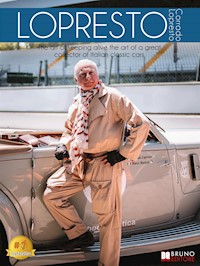
Corrado Lopresto's car collection is considered one of the most significant and important in the world today, especially due to its value as a testimony to the tradition of Italian automotive design.
But what’s behind this collection? Which decisions and events have defined its nature and enabled its realization? The answers to these questions gently take shape in these pages among glimpses of Corrado’s life just as in a novel, guiding the reader to discover the fascinating world of classic cars.
A book for everyone, enthusiasts and the curious alike, in which personal anecdotes and lessons on restoration techniques are covered in equal measure.
An authentic story which is also intended to be a tribute to Italian ingenuity and to inspire a more conservative approach to historic cars, one that can restore their souls.
ABOUT THE AUTHOR
Corrado Lopresto, architect and entrepreneur of Milan, is now the world’s most famous Italian classic car collector (27th in the world rankings). His passion for these cars came about during his childhood in Bagnara and it has grown over the years, leading him to collect and restore unique pieces, prototypes and special cars, all strictly Italian. For years Lopresto has been a point of reference for the philological approach to restoration, experimenting with new techniques and unconventional methods in this complex subject which differ according to the car being worked on. His cars are an important testimony to the history of Italian car design and have received more than 280 awards at various concours d’elegance. Lopresto has often participated in and organized exceptional exhibitions both in Italy and abroad.
Das E-Book können Sie in Legimi-Apps oder einer beliebigen App lesen, die das folgende Format unterstützen:
Veröffentlichungsjahr: 2022
Ähnliche



















CORRADO LOPRESTO
LOPRESTO
The art of keeping alive the art of a great collector of Italian classic cars
Title
“LOPRESTO”
Author
Corrado Lopresto
Publisher
Bruno Editore
Website
https://www.brunoeditore.it
All rights reserved. No part of this book may be reproduced by any means without the prior written permission of the Author and the Publisher. It is expressly forbidden to transmit this book to others, either in paper or electronic format, either for money or free of charge. The strategies reported in this book are the result of years of study and specialization and thus achievement of the same results of personal or professional growth is not guaranteed. Readers accept full responsibility for their decisions, aware of the risks associated with any form of activity. This book is intended solely for educational purposes.
Contents
Preface by Antonio Ghini
Prologue
Chapter 1: Bagnara
Chapter 2: Lessons of life
Chapter 3: My first cars
Chapter 4: Milan
Chapter 5: In the garage
Chapter 6: Thelas
Conclusion
Standing on the shoulders of giants.
Prefaceby Antonio Ghini
Upon reading this book, as engrossing as a novel and, for a classic car enthusiast, as precious as a manual, always to be kept at hand, I realized that an autobiography can also be a gesture of humility.
Each of us, in our journey through life, takes stock of positive and negative episodes which have occurred due to our merit or demerit or, more simply, as is often the case, due to mere chance. Nietzsche has Zarathustra say:“Let chance come to you”. Who could deny the wisdom of these words? But upon reflection it becomes clear that, at times, we try to ignore or avoid whatever happens by chance.
In this life story, however, the opposite happens. Corrado lets himself be guided by chance, which offers itself to him with the patient tenacity of a feline waiting for the right moment to jump on its prey. He did so as a child, albeit respecting his family which, as would be said today, appliedwithout exception the good manners firmly held in the hands of a patriarch; he did so when he wanted to establish himself in his work with the pride of achieving his goals all by himself; he did so when he decided that his life was to be dedicated to carsand to what this represents in the culture of our time. Lastly, he did so when he himself became the patriarch of a family which lives in the modern world respecting, with the naturalness of an ancient upbringing, rules which are far too often forgotten.
All this is reflected in the way in which he has built up his collection and in which he has breathed life back into cars which could have been abandoned as vehicles created not to be reproduced, unique models, prototypes, the dreams of designers and technicians which have remained such.
Where is the humility in all this, we may ask? The answer is very simple: each of us takes refuge behind an image that we have constructed. This image is the result of decisions, be they conscious or unconscious, which make each person a unique, impenetrable individual. Each of us is nothing other than whatwe allow others to perceive.
We make sure not to let slip which stories, ambitions and fears have made us become so. However, if we narrate our story sincerely, warts and all, we suddenly become different thanks to the humility of having been able to say what usually remains hidden.
This makes us become very different and defined with respect to how we might have been perceived.
Anyone who knows Corrado is aware that behind his polite courtesy he is impenetrable. You watch him, speak to him, argue with him and he maintains the manner and expression typical of the aristocrats of Southern Italy. You’ll never understand what he’s thinking or feeling. This alone makes all the difference. Not to speak of when he’s interested in buying a large property or a car. The potential seller will have no way of knowing what he’s thinking!
This is how Corrado has, throughout his life, been able to secure masterpieces which are the object of envy to all today.
What’s more, he never shies away from challenging himself. If something is impossible, he cannot tolerate the idea that it might be impossible for him. In order to understand the original colours of his amazing Alfa Romeo 6C 1750 GS Aprile, one example among many, of which he had only been able to find old black and white photos in which the car had been snapped in front of buildings and gardens, he went and looked for the places where the photos had been taken. Upon finding them, he compared the colours of the houses, roofs and grating to understand the various shades of grey of the colours in the black and white images and, using film restoration techniques, managed to trace the right shade of the original blue of the car.
As Corrado sees it, a classic car has to be returned to its original state by saving and recovering everything which has stood the test of time - even those things which seemingly no longer exist but which are suggested by the studies he conducts. The Scat presented at Villa d’Este in 2018, which had once belonged to a noble family but had been unceremoniously abandoned for more than seventy years, showed no evident signs of the lineage of the ancient family which had been its former owners. Yet there should have been a sign or a coat of arms. With great patience, using products which had first been carefully tested to gauge their effect, he began to look for traces of a possible noble crest. In the days of the carriage, such crests were painted on the doors thereof. He was on the right track. The first signs appeared and the shapes and even some colours re-emerged from oblivion. The Scat now has its coat of arms, the real, original one, restored by specialists in the field of great restoration projects.
God forbid that it should be repainted today. God forbid! What’s more, even though he does not say so – some secrets are allowed after all – he is convinced that every car has a soul. He has understood this from his earliest youth, looking at an abandoned car, half-submerged in a river which, re-surfacing from an oblivion which appeared to be its fate, seemed to look at him and implore: “Save me”. And how could he not?
This way of thinking and acting lies at the very heart of his passion. When he sensed that he had the chance to salvage the first Isotta Fraschini made, the 1901 001 chassis, he threw himself into this new adventure. In fact, he bought a chassis. If restored, it would be an important museum piece. Museums, by their very nature, house objects which have given up their souls in order to be consecrated to history. In the poems in which Ugo Foscolo speaks of the sepulchres of the church of Santa Croce, in Florence, where such figures of the world of art and culture as Galileo, Machiavelli and Michelangelo rest, we read: “Even Spes, the last goddess, abandons the tombs”. It is impossible to imagine Lopresto consigning one of his cars to a museum where, as at Santa Croce, all hope of being admired alive and running would fade away. Never.
In his opinion that chassis hadto come back to life, but its originality could not be violated. Corrado sees this as an unbreakable law. So he did something which not even an alchemist could have imagined. He constructed a transparent, plexiglas platform which left the original mechanics perfectly visible. On this he placed two woven straw seats (weaving having been an art form which was well-established at the time the car was constructed) perfectly and immediately removable to take it back, when necessary, to its origin, and maybe do two London – Brighton races.
Isn’t this just the way to return the soul to an object belonging to the heritage of humanity? Furthermore, from the depths of his passion, Corrado is able to come up with solutions for damage which could become a problem in the preservationof what is original. UNESCO has acknowledged that he knows how to do this by giving him an important award (the first time in history) for the ingenious conservative restoration of the Giulietta SZT prototype found in its perfectly original form but deeply weathered by time after years of being forgotten.
The humility to be found in these pages, which also reveal extremely personal things about Corrado, is combined with an transparent confession of adventures in restoration which might hold secrets but which Lopresto does not want to make his own.
Corrado tells it like it is. This is what makes this book so captivating. Anyway, I’ve taken up too much of your time. Let’s listen to Corrado explaining the hows and whys of his decision to become the conservator/collector of Italian cars now well-known and appreciated worldwide?
His reputation is a source of great pride for Italy and the respect he receives demonstrates that this country of talent, too often judged superficially, has not lost the skills of the Renaissance workshops or the taste for pure beauty which must be preserved as it originally was. This is true for cars too and, in Corrado’s hands, their pure beauty finds its soul once more.
Antonio Ghini
Prologue
The sun, already high in the sky, pains the eyes of the small crowd coming out of the Chiesa del Carmine. After the hour of semi-darkness spent inside, keeping them open is an agonizing effort and thus I find myself surrounded by narrowed eyes and frowning faces. Further tormented by the tingling of threatening tears, their eyes wander in search of shade and dark objects upon which to rest themselves. A dark shape rises solemnly in the middle of the square of pale cobblestones, an intense contrast which not even the iridescent reflections of the paint can soften.
The car looks like a very long brushstroke of enamel on an earth-tinted painting. The tailgate is open, solemnly awaiting its sole silent passenger, who is unhurriedly boarded under the heartbroken gaze of those present.
With perfect calm, the driver walks around the car, his face turned downwards bearing an expression somewhere between bored and contrite. He turns on the engine and the noise seems to echo a more distant rumble. While the view in front of me loses its contours, a memory takes hold of my senses: the smell of the sea, the strong light, the wait, a passing seagull mewing overhead.
I am sitting at the kitchen table enjoying a late breakfast. From the way in which my feet are swinging between the legs of the chair I would say that I am no more than six or seven years old. At a certain point I hear a sound outside. From the French window I catch sight of a dark silhouette quickly approaching the house, skimming along on the surface of the water. In the piercing light of that late morning, I immediately recognize the outline of Gregorio, father’s handyman, large as life on the boat, standing out between the blue of the sky and the blue of the sea.
I get up from the table, excited about this unexpected arrival and, skipping, I reach him on the shore. «Hello Corradino» he greets me affectionately, ruffling my hair in the manner of a grown up. He’ll be around ten years older than me but his casual ways and powerful build transform him from a possible playmate into an unattainable idol who is allowed to do adult things.
He puts the engine into neutral and, with great dexterity, drags the boat to the shoreline. Then he turns towards the house, loudly calling the nanny: «Maria, Mariaaaaa. Is he awake?»
The plump, forever flushed face of the nanny appears over the wall of the seafront. «Yes. He’s getting dressed», she calls back.
«Corrado, don’t stand there in the sun getting burnt. Come on in and wash your hands. We’ll be eating soon» she says to me, in a tone brooking no disobedience.
I go back to my place at the kitchen table. For the next hour I never lose sight of the boat which Gregorio, whilst waiting, is taking around the bay of the “Baietta”, my neighbourhood. He comes and goes, leaving only to come back a little later and repeat everything all over again. It seems like the choreography of a ballet in which the dancers meet each other again and again after elaborate pirouettes. A dance punctuated by intermittent shouts: «And now? Is he ready now?»«He just needs to shave and then he’ll be right with you. You know he never likes to go out looking untidy»«But the only ones who’ll be seeing him will be me and the fish!» And again: «Mariaaaa, what the heck’s happened to him?»«He’s on his way. Just finishing reading the paper.»
Even from far away I can sense that the young lad’s nerves are being sorely tried. He wisely decides to say nothing and to take it out on the fishing rods which he roughly moves from one part of the boat to the other.
Another interminable 15 minutes go by before my father decides to make his entrance in the living room. Not a wrinkle of expression nor a furrowed brow reveal any sense of hurry or pressure. Quite the contrary. His seraphic face betrays a hint of enjoyment.
I remember that I always envied the gentlemanly calm with which he lived his life, the impassiveness with which he accepted losses of millions of lire at the gaming tables. He used his poker face as much at the tables as in everyday life, letting nothing of his state of mind show. Only very rarely did I see him lose his temper. It was as if he felt that most material issues weren’t worth getting het up about or wasting energy on. He much preferred to turn failure and problems into reasons for laughter and play.
It was the 1960s and, like many of his peers, he had a strong desire to leave the war behind, to live his life in a carefree and passionate manner. He downplayed every obstacle until it was no bigger than the proverbial pea under the mattress. Enjoying life became a serious commitment to which he dedicated himself with constancy.
Like the time Gregorio won – by an incredible margin – the annual race of Bagnara’s cycling enthusiasts, organized to coincide with the Giro d’Italia. Only later did we find out that my father, President of the local cycling team, together with his prankster pals, had tied Gregorio’s bicycle to his car with fishing line and hauled him up the hill, Shades of the film “Amici Miei”.
This propensity for lightheartedness and play, together with a capacity to produce huge sums of money, made him a man of irresistible charm.
As if to underline this last thought, I am carried along by the flood of people behind me who, half shoving each other, flow out of the church. We all move in different directions, trying to find a space on the crowded terrace. Only our eyes move in the same direction, following the theatrical movements of the four pallbearers and the coffin on their shoulders.
I believe it was in that moment that the idea of the book first took shape in my head. I felt that an important chapter of my life had come to an end and I felt a desire to set it down on paper.
Writing an autobiography involves making an introspective effort to look inside yourself without filters. It does, however, give you the chance to interpret your life in a different way, to connect the dots (as Steve Jobs used to say). They seem, from up close, to have fallen at random like marbles on the beach but, from a distance, to be joined up in constellations in which one can re-read one’s own destiny.
Chapter 1:Bagnara
I have memories of my life from a very young age. They come to me in flashes unchronologically. As if my life were a giant jigsaw, another piece of which I find every so often.
Most of these memories are soaked in romantic nostalgia for a lost world. There’s nothing left of that sophisticated era - the 1960s and 1970s. Gone are the landscapes, at times rural, at times adorned by the royal palaces of Caserta; the legendary characters whose feats filled the heads of us children. Even the turtles have left the Straits. Progress and technology are very poor consolation for the loss of everything that time has taken away.
Roberto Vecchioni addressed Milan, saying:
Let’s do a swap. By all means, take that little bit of money, that little bit of fame, but give me back my Fiat 600.
Well I have kept the cars of that splendid period. When I began to collect them I may have had a foreboding that a beautiful world was slipping away like sand between my fingers and, in an attempt to stop this, I started to bottle the grains.




