



0,99 €
Mehr erfahren.
- Herausgeber: e-artnow
- Kategorie: Gesellschafts- und Liebesromane
- Sprache: Englisch
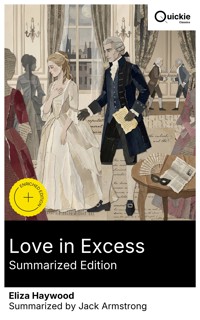
Love in Excess is Eliza Haywood's best known novel. As the story was written by a woman – it is revolutionary in the fact that it shows multilayered characters of real women who have their own sexual agendas. The first part details the competition between Alovisa and Amena, two upper-class young women of disparate wealth, for D'Elmont's attentions. The narrator specifically mentioned the "custom which forbids women to make a declaration of their thoughts." That women were not permitted to express their affections or choice until a suitor formally proposed marriage is important to both the plot and the theme of the novel.[4] Alovisa writes an unsigned letter to D'Elmont in hopes of eliciting a definite amorous response from him, which inadvertently leads D'Elmont to court Amena. Amena's father refuses to allow his daughter to continue meeting with D'Elmont without a proposal of marriage, which forces the pair to meet via subterfuge. With the help of Anaret, Amena's woman servant, two attempts for the pair to meet are made, the second of which sees Amena and D'Elmont alone in the Tuileries at night.
Das E-Book können Sie in Legimi-Apps oder einer beliebigen App lesen, die das folgende Format unterstützen:
Veröffentlichungsjahr: 2022
Ähnliche













Love in Excess
Table of Contents
TO Mrs. Eliz. Haywood, ON HERNOVELCALL’DLove in Excess, &c.
By an unknown Hand. To the most Ingenious Mrs Haywood, on her NOVEL Entitled,Love in Excess:
VERSESWrote in the Blank Leaf of Mrs. Haywood’s Novel.
Part the First.
In the late War between the French and the Confederate Armies, there were two Brothers, who had acquir’d a more than ordinary Reputation, under the Command of the great and intrepid Luxembourgh. But the Conclusion of the Peace taking away any further Occasions of shewing their Valour, the Eldest of ’em, whose Name was Count D’elmont, return’d to Paris, from whence he had been absent two Years, leaving his Brother at St. Omer’s, ’till the Cure of some slight Wounds were perfected.
The Fame of the Count’s brave Actions arriv’d before him, and he had the Satisfaction of being receiv’d by the King and Court, after a Manner that might gratify the Ambition of the proudest. The Beauty of his Person, the Gayity of his Air, and the unequal’d Charms of his Conversation, made him the Admiration of both Sexes; and whilst those of his own strove which should gain the largest share in his Friendship; the other vented fruitless Wishes, and in secret, curs’d that Custom which forbids Women to make a Declaration of their Thoughts. Amongst the Number of these, was Alovisa, a Lady descended (by the Father’s Side) from the Noble Family of the D’ La Tours formerly Lord of Beujey, and (by her Mothers) from the equally Illustrious House of Montmorency. The late Death of her Parents had left her Coheiress (with her Sister,) of a vast Estate.
Alovisa, if her Passion was not greater than the rest, her Pride, and the good Opinion she had of her self, made her the less able to support it; she sigh’d, she burn’d, she rag’d, when she perceiv’d the Charming D’Elmont behav’d himself toward her with no Mark of a distinguishing Affection. What (said she) have I beheld without Concern a Thousand Lovers at my Feet, and shall the only Man I ever endeavour’d, or wish’d to Charm, regard me with Indifference? Wherefore has the agreeing World join’d with my deceitful Glass to flatter me into a vain Belief I had invincible Attractions? D’elmont sees ’em not! D’elmont is insensible. Then would she fall into Ravings, sometimes cursing her own want of Power, sometimes the Coldness of D’elmont. Many Days she pass’d in these Inquietudes, and every time she saw him (which was very frequently) either at Court, at Church, or publick Meetings, she found fresh Matter for her troubled Thoughts to work upon: When on any Occasion he happen’d to speak to her, it was with that Softness in his Eyes, and that engaging tenderness in his Voice, as would half persuade her, that, that God had touch’d his Heart, which so powerfully had Influenc’d hers; but if a glimmering of such a Hope gave her a Pleasure inconceivable, how great were the ensuing Torments, when she observ’d those Looks and Accents were but the Effects of his natural Complaisance, and that to whomsoever he Address’d, he carried an equality in his Behaviour, which sufficiently evinc’d, his Hour was not yet come to feel those Pains he gave; and if the afflicted fair Ones found any Consolation, it was in the Reflection, that no Triumphant Rival could boast a Conquest, each now despair’d of gaining. But the impatient Alovisa disdaining to be rank’d with those, whom her Vanity made her consider as infinitely her Inferiors, suffer’d her self to be agitated almost to Madness, between the two Extreams of Love and Indignation; a thousand Chimeras came into her Head, and sometimes prompted her to discover the Sentiments she had in his Favour: But these Resolutions were rejected, almost as soon as form’d, and she could not fix on any for a long time; ’till at last, Love (ingenious in Invention,) inspir’d her with one, which probably might let her into the Secrets of his Heart, without the Shame of revealing her own.
* * * *
The Celebration of Madam the Dutchess of Burgundy’s Birth-day being Solemniz’d with great Magnificence; she writ this Billet to him on the Night before.
* * * *
To Count D’elmont.
Resistless as you are in War, you are much more so in Love; Here you conquer without making an Attack, and we Surrender before you Summons; the Law of Arms obliges you to show Mercy to an yielding Enemy, and sure the Court cannot inspire less generous Sentiments than the Field. The little God lays down his Arrows at your Feet, confesses your superior Power, and begs a Friendly Treatment; he will appear to you to morrow Night at the Ball, in the Eyes of the most passionate of all his Votresses; search therefore for him in Her, in whom (amongst that bright Assembly) you would most desire to find Him; I am confident you have too much Penetration to miss of him, if not bypass’d by a former Inclination, and in that Hope, I shall (as patiently as my Expectations will let me) support, ’till then, the tedious Hours.
Farewell.
This she sent by a trusty Servant, and so disguis’d, that it was impossible for him to be known, with a strict Charge to deliver it to the Count’s own Hands, and come away before he had read it; the Fellow perform’d her Orders exactly, and when the Count, who was not a little surpriz’d at the first opening it, ask’d for the Messenger, and commanded he should be stay’d; his Gentleman (who then was waiting in his Chamber,) told him he ran down Stairs with all the speed imaginable, immediately on his Lordship’s receiving it. D’elmont having never experienc’d the Force of Love, could not presently comprehend the Truth of this Adventure; at first he imagin’d some of his Companions had caus’d this Letter to be wrote, either to sound his Inclinations, or upbraid his little Disposition to Gallantry; but these Cogitations soon gave Place to others; and tho’ he was not very vain, yet he found it no difficulty to perswade himself to an Opinion, that it was possible for a Lady to distinguish him from other Men. Nor did he find any thing so unpleasing in that Thought as might make him endeavour to repell it; the more he consider’d his own Perfections, the more he was confirm’d in his Belief, but who to fix it on, he was at a Loss as much as ever; then he began to reflect on all the Discourse, and little Railleries that had pass’d between him and the Ladies whom he had convers’d with since his Arrival, but cou’d find nothing in any of ’em of Consequence enough to make him guess at the Person: He spent great part of the Night in Thoughts very different from those he was accustom’d to, the Joy which naturally rises from the Knowledge ’tis in one’s Power to give it, gave him Notions which till then he was a Stranger to; he began to consider a Mistress as an agreeable, as well as fashionable Amusement, and resolv’d not to be Cruel.
In the mean time poor Alovisa was in all the Anxiety imaginable, she counted every Hour, and thought ’em Ages, and at the first dawn of Day she rose, and calling up her Women, who were amaz’d to find her so uneasy, she employ’d ’em in placing her Jewels on her Cloaths to the best Advantage, while she consulted her Glass after what Manner she should Dress, her Eyes, the gay; the languishing, the sedate, the commanding, the beseeching Air, were put on a thousand times, and as often rejected; and she had scarce determin’d which to make use of, when her Page brought her Word, some Ladies who were going to Court desir’d her to accompany them; she was too impatient not to be willing to be one of the first, so went with them immediately, arm’d with all her Lightnings, but full of unsettled Reflections. She had not been long in the Drawing Room, before it grew very full of Company, but D’elmont not being amongst ’em, she had her Eyes fix’d towards the Door, expecting every Moment to see him enter; but how impossible is it to represent her Confusion, when he appear’d, leading the young Amena, Daughter to Monsieur Sanseverin, a Gentleman, who tho’ he had a very small Estate, and many Children, had by a partial Indulgence, too common among Parents, neglecting the rest, maintain’d this Darling of his Heart in all the Pomp of Quality. The Beauty and Sweetness of this Lady was present-Death to Alovisa’s Hope’s; she saw, or fancy’d she saw an usual Joy in her Eyes, and dying Love in his; Disdain, Despair, and Jealousie at once crowded into her Heart, and swell’d her almost to bursting; and ’twas no wonder that the violence of such terrible Emotions kept her from regarding the Discourses of those who stood by her, or the Devoirs that D’elmont made as he pass’d by, and at length threw her into a Swoon; the Ladies ran to her assistance, and her charming Rival, being one of her particular Acquaintance, shew’d an extraordinary assiduity in applying Means for her Relief, they made what hast they cou’d to get her into another Room, and unfasten her Robe, but were a great while before they could bring her to herself; and when they did, the Shame of having been so disorder’d in such an Assembly, and the Fears of their suspecting the Occasion, added to her former Agonies, had rack’d her with most terrible Revulsions, every one now despairing of her being able to assist at that Night’s Entertainment, she was put into her Chair, in order to be carry’d Home; Amena who little thought how unwelcome she was grown, would needs have one call’d, and accompany’d her thither, in spight of the Intreaties of D’elmont, who had before engag’d her for his Partner in Dancing; not that he was in Love with her, or at that time believ’d he cou’d be touch’d with a Passion which he esteem’d a Trifle in it self, and below the Dignity of a Man of Sense; but Fortune (to whom this Lady no less enamour’d than Alovisa) had made a thousand Invocations, seem’d to have allotted her the glory of his first Addresses; she was getting out of her Chariot just as he alighted from his, and offering her his Hand, he perceiv’d hers trembled, which engaging him to look upon her more earnestly than he was wont, he immediately fancy’d he saw something of that languishment in her Eyes, which the obliging Mandate had describ’d: Amena was too lovely to make that Belief disagreeable, and he resolv’d on the Beginnings of an Amour, without giving himself the trouble of considering the Consequences; the Evening being extreamly pleasant, he ask’d if she wou’d not favour him so far as to take a turn or two within the Palace-Garden; She who desir’d nothing more than such a particular Conversation, was not at all backward of complying; he talk’d to her there for some time, in a manner as could leave her no room to doubt he was entirely Charm’d, and ’twas the Air such an Entertainment had left on both their Faces, as produc’d those sad Effects in the jealous Alovisa. She was no sooner led to her Apartment, but she desir’d to be put to Bed, and the good natur’d Amena, who really had a very great kindness for her, offer’d to quit the Diversions of the Ball, and stay with her all Night; but the unfortunate Alovisa was not in a Condition to endure the Presence of any, especially her, so put her off as civilly as her Anxiety would give her leave, chusing rather to suffer her to return to the Ball, than retain so hateful an Object (as she was now become) in her sight; and ’tis likely the other was not much troubled at her Refusal. But how, (when left alone, and abandon’d to the whirlwinds of her Passion,) the desperate Alovisa behav’d, none but those, who like her, have burn’d in hopeless Fires can guess, the most lively Description wou’d come far short of what she felt; she rav’d, she tore her Hair and Face, and in the extremity of her Anguish was ready to lay violent Hands on her own Life. In this Tempest of Mind, she continu’d for some time, till at length rage beginning to dissipate it self in Tears, made way for cooler Considerations; and her natural Vanity resuming its Empire in her Soul, was of no little Service to her on this Occasion. Why am I thus disturb’d? Mean Spirited as I am! Said she, D’elmont is ignorant of the Sentiments I am possess’d with in his favour; and perhaps ’tis only want of Incouragement that has so long depriv’d me of my Lover; my Letter bore no certain Mark by which he might distinguish me, and who knows what Arts that Creature might make use of to allure him. I will therefore (persu’d she, with a more cheerful Countenance) direct his erring Search. As she was in this Thought (happily for her, who else might have relaps’d) her Women who were waiting in the next Room, came in to know if she wanted any thing; yes, answer’d she, with a Voice and Eyes wholly chang’d, I’ll rise, one of you help me on with my Cloaths, and let the other send Charlo to me, I have instant Business with him. ’Twas in vain for ’em to represent to her the Prejudice it might be to her Health to get out of her Bed at so unseasonable an Hour, it being then just Midnight: They knew her too absolute a Mistress not to be obey’d, and executed her Commands, without disputing the Reason. She was no sooner ready, than Charlo was introduc’d who being the same Person that carry’d the Letter to D’elmont, guess’d what Affair he was to be concern’d in, and shut the Door after him. I commend your Caution, said his Lady, for what I am now going to trust you with, is of more concernment than my Life. The Fellow bow’d, and made a thousand Protestations of an eternal Fidelity. I doubt it not, resum’d she, go then immediately to the Court, ’tis not impossible but in this hurry you may get into the Drawing Room; but if not, make some pretence to stay as near as you can ’till the Ball be over; listen carefully to all Discourses where you hear Count D’elmont mention’d, enquire who he Dances with, and above all, watch what Company he comes out with, and bring me an exact Account. Go, continu’d she hastily, these are all the Orders I have for you to Night, but to Morrow I shall employ you farther. Then turning to her Escritore, she sat down, and began to prepare a second Letter, which she hop’d wou’d be more lucky than the former. She was not long writing, Love and Wit, suggested a World of passionate and agreeable Expressions to her in a Moment: But when she had finish’d this so full a Discovery of her Heart, and was about to sign her Name to it; not all that Passion which had inspir’d her with a Resolution to scruple nothing that might advance the compassing her Wishes, nor the vanity which assur’d her of Success, were forcible enough to withstand the shock it gave her Pride; No, let me rather die! Said she, (starting up and frighted at her own Designs) than be guilty of a Meanness which wou’d render me unworthy of Life, Oh Heavens! To offer Love, and poorly sue for Pity! ’tis insupportable! What bewitch’d me to harbour such a Thought as even the vilest of my Sex wou’d blush at? To pieces then (added she, tearing the Paper) with this shameful Witness of my Folly, my furious Desires may be the destruction of my Peace, but never of my Honour, that shall still attend my Name when Love and Life are fled. She continu’d in this Temper (without being able to compose herself to rest) till Day began to appear, and Charlo returned with News which confirmed her most dreaded Suspicions. He told her that he had gain’d admittance to the Drawing Room several Times, under pretence of delivering Messages to some of the Ladies; that the whole Talk among ’em was, that D’elmont, was no longer insensible of Beauty; that he observ’d that Gentleman in very particular Conference with Amena, and that he waited on her Home in his Chariot, her own not being in the way, I know it, said Alovisa (walking about in a disorder’d Motion) I did not doubt but that I was undone, and to my other Miseries, have that of being aiding to my Rival’s Happiness: Whatever his Desires were, he carefully conceal’d ’em, till my cursed Letter prompted a Discovery; tenacious as I was, and too, too confident of this little Beauty! Here she stop’d, and wiping away some Tears which in spight of her ran down her Cheeks, gave Charlo leave to ask if she had any more Commands for him. Yes (answer’d she) I will write once more to this undiscerning Man, and let him know, ’tis not Amena that is worthy of him; that I may do without prejudicing my Fame, and ’twill be at least some Easement to my Mind, to undeceive the Opinion he may have conceiv’d of her Wit, for I am almost confident she passes for the Authoress of those Lines which have been so fatal to me; in speaking this, without any further Thought, she once more took her Pen, and wrote these Words.
* * * *
To CountD’elmont.
If Ambition be a Fault, ’tis only in those who have not a sufficient stock of Merit to support it; too much Humility is a greater in you, whose Person and Qualities are too admirable, not to render any Attempt you shall make justifiable, as well as successful. Heaven when it distinguish’d you in so particular a Manner from the rest of Mankind, design’d you not for vulgar Conquests, and you cannot without a manifest Contradiction to its Will, and an irreparable Injury to your self, make a present of that Heart to Amena, when one, of at least an equal Beauty, and far superior in every other Consideration, would Sacrifice all to purchase the glorious Trophy; continue then no longer in a wilful Ignorance, aim at a more exalted flight, and you will find it no difficulty to discover who she is that languishes, and almost dies for an Opportunity of confessing (without too great a breach of Modesty) that her Soul, and all the Faculties of it, are, and must be,
Eternally Yours.
This she gave to Charlo, to deliver with the same Caution as the former; but he was scarce got out of the House before a new Fear assaulted her, and she repented her uncircumspection. What have I done, cry’d she! Who knows but D’elmont may shew these Letters to Amena, she is perfectly acquainted with my Hand, and I shall be the most expos’d and wretched Woman in the World. Thus Industrious was she in forming Notions to Torment herself; nor indeed was there any thing of Improbability in this Conjecture. There are too many ungenerous enough to boast such an Adventure; but D’elmont tho’ he would have given good Part of his Estate to satisfy his Curiosity, yet chose rather to remain in a perpetual Ignorance, than make use of any Means that might be disadvantagious to the Lady’s Reputation. He now perceiv’d his Mistake, and that it was not Amena who had taken that Method to engage him, and possibly was not disgusted to find she had a Rival of such Merit, as the Letter intimated. However, he had said too many fine Things to her to be lost, and thought it as inconsistent with his Honour as his Inclination to desist a Pursuit in which he had all the Reason in the World to assure himself of Victory; for the young Amena (little vers’d in the Art of Dissimulation, so necessary to her Sex) cou’d not conceal the Pleasure she took in his Addresses, and without even a seeming reluctancy, had given him a Promise of meeting him the next Day in the Tuilleries; nor could all his unknown Mistress had writ, perswade him to miss this Assignation, nor let that be succeeded with another, and that by a third, and so on, ’till by making a shew of Tenderness; he began to fancy himself really touch’d with a Passion he only design’d to represent. ’Tis certain this way of Fooling rais’d Desires in him little different from what is commonly call’d Love; and made him redouble his Attacks in such a Manner, as Amena stood in need of all her Vertue to resist; but as much as she thought her self oblig’d to resent such Attempts, yet he knew so well how to excuse himself, and lay the Blame on the Violence of his Passion, that he was still too Charming, and too Dear to her not to be forgiven. Thus was Amena (by her too generous and open Temper) brought to the very brink of Ruin, and D’elmont was possibly contriving Means to compleat it, when her Page brought him this Letter.
* * * *
To Count D’elmont.
Some Malicious Persons have endeavour’d to make the little Conversation I have had with you, appear as Criminal; therefore to put a stop to all such Aspersions, I must for the future deny my self the Honour of your Visits, unless Commanded to receive ’em by my Father, who only has the Power of disposing of
Amena.
The Consternation he was in at the reading these Lines, so very different from her former Behaviour, is more easily imagin’d than express’d, ’till casting his Eyes on the Ground, he saw a small Note, which in the opening of this, had fallen out of it, which he hastily took up, and found it contain’d these Words.
* * * *
I guess the Surprize my lovely Friend is in, but have not time now to unriddle the Mystery: I beg you will be at your Lodgings towards the Evening, and I will invent a Way to send to you.
’Twas now that D’elmont began to find there were Embarrassments in an Intrigue of this Nature, which he had not foreseen, and stay’d at Home all Day, impatiently expecting the clearing of an Affair, which at present seem’d so ambiguous. When it grew a little Duskish, his Gentleman brought in a Young Woman, whom he immediately knew to be: Anaret, an Attendant on Amena; and when he had made her sit down, told her he hop’d she was come to make an Eclaircissment, which would be very obliging to him, and therefore desir’d she wou’d not defer it.
My Lord, said she, ’tis with an unspeakable Trouble I discharge that Trust my Lady has repos’d in me, in giving you a Relation of her Misfortunes; but not to keep you longer in suspence, which I perceive is uneasy to you; I shall acquaint you, that soon after you were gone, my Lady came up into her Chamber, where, as I was preparing to undress her, we heard Monsieur Sanseverin in an angry Tone ask where his Daughter was, and being told she was above, we immediately saw him enter, with a Countenance so inflam’d, as put us both in a mortal Apprehension. An ill use (said he to her) have you made of my Indulgence, and the Liberty I have allow’d you! Could neither the Considerations of the Honour of your Family, your own Reputation, nor my eternal Repose, deter you from such imprudent Actions, as you cannot be ignorant must be the inevitable Ruin of ’em all. My poor Lady was too much surpriz’d at these cruel Words, to be able to make any Answer to ’em, and stood trembling, and almost fainting, while he went on with his Discourse. Was it consistent with the Niceties of your Sex, said he, or with the Duty you owe me, to receive the Addresses of a Person whose Pretensions I was a Stranger to? If the Count D’elmont has any that are Honourable, wherefore are they conceal’d? The Count D’elmont! (cry’d my Lady more frighted than before) never made any Declarations to me worthy of your Knowledge, nor did I ever entertain him otherwise, than might become your Daughter. ’Tis false (interrupted he furiously) I am but too well inform’d of the contrary; nor has the most private of your shameful Meetings escap’d my Ears! Judge, Sir, in what a Confusion my Lady was in at this Discourse; ’twas in vain, she muster’d all her Courage to perswade him from giving Credit to an Intelligence so injurious to her; he grew the more enrag’d, and after a thousand Reproaches, flung out of the Room with all the Marks of a most violent Indignation, But tho’ your Lordship is too well acquainted with the mildness of Amena’s Disposition, not to believe she could bear the Displeasure of a Father (who had always most tenderly lov’d her) with indifference; yet ’tis impossible for you to imagine in what an excess of Sorrow she was plung’d, she found every Passage of her ill Conduct (as she was pleas’d to call it) was betray’d, and did not doubt but whoever had done her that ill Office to her Father, wou’d take care the Discovery should not be confin’d to him alone. Grief, Fear, Remorse, and Shame by turns assaulted her, and made her incapable of Consolation; even the soft Pleas of Love were silenc’d by their Tumultuous Clamours, and for a Time she consider’d your Lordship in no other view than that of her Undoer. How! cry’d D’elmont (interrupting her) cou’d my Amena, who I thought all sweetness, judge so harshly of me. Oh! my Lord, resum’d Anaret, you must forgive those first Emotions, which as violent as they were, wanted but your Presence to dissipate in a Moment; and if your Idea had not presently that Power, it lost no Honour by having Foes to struggle with, since at last it put ’em all to flight, and gain’d so entire a Victory, that before Morning, of all her Troubles, scarce any but the Fears of losing you remain’d. And I must take the Liberty to assure your Lordship, my Endeavours were not wanting to establish a Resolution in her to despise every thing for Love and you. But to be as brief as I can in my Relation; the Night was no sooner gone, than Monsieur her Father came into the Chamber, with a Countenance, tho’ more compos’d, than that with which he left us, yet with such an Air of Austerity, as made my timerous Lady lose most of the Spirit she had assum’d for this Encounter. I come not now Amena, said he, to upbraid or punish your Disobedience, if you are not wholly abandon’d by your Reason, your own Reflections will be sufficiently your Tormentors. But to put you in a way, (if not to clear your Fame, yet to take away all Occasion of future Calumny,) you must write to Count D’elmont.
I will have no denials continu’d he, (seeing her about to speak) and leading her to her Escritore, constrain’d her to write what he dictated, and you receiv’d; just as she was going to Seal it, a Servant brought word that a Gentleman desir’d to speak with Monsieur Sanseverin, he was oblig’d to step into another Room, and that absence gave her an Opportunity of writing a Note, which she dextrously slip’d into the Letter, unperceiv’d by her Father at his return, who little suspecting what she had done, sent it away immediately. Now, said he, we shall be able to judge of the sincerity of the Count’s Affections, but till then I shall take care to prove my self a Person not disinterested in the Honour of my Family. As he spoke these Words, he took her by the Hand, and conducting her, thro’ his own, into a little Chamber (which he had order’d to be made ready for that purpose) shut her into it; I follow’d to the Door, and seconded my Lady in her Desires, that I might be permitted to attend her there; but all in vain, he told me, he doubted not but that I had been her Confident in this Affair, and ordered me to quit his House in a few Days. As soon as he was gone out, I went into the Garden, and saunter’d up and down a good while, hoping to get an Opportunity of speaking to my Lady through the Window, for I knew there was one that look’d into it; but not seeing her, I bethought me of getting a little Stick, with which I knock’d gently against the Glass, and engag’d her to open it. As soon as she perceiv’d me, a Beam of Joy brighten’d in her Eyes, and glisten’d tho’ her Tears. Dear Anaret, said she, how kindly do I take this proof of thy Affection, ’tis only in thy Power to alleviate my Misfortunes, and thou I know art come to offer thy Assistance. Then after I had assur’d her of my willingness to serve her in any command, she desir’d me to wait on you with an Account of all that had happen’d, and to give you her Vows of an eternal Love. My Eyes, said she weeping, perhaps may ne’er behold him more, but Imagination shall supply that want, and from my Heart he never shall be Absent. Oh! do not talk thus, cry’d the Count, extreamly touch’d at this Discourse. I must, I will see her, nothing shall hold her from me. You may, answer’d Anaret, but then it must be with the Approbation of Monsieur Sanseverin, he will be proud to receive you in Quality of a Suitor to his Daughter, and ’tis only to oblige you to a publick Declaration that he takes these Measures. D’elmont was not perfectly pleas’d with these Words: he was too quick sighted not to perceive immediately what Monsieur Sanseverin drove at, but as well as he lik’d Amena, found no inclination in himself to Marry her; and therefore was not desirous of an Explanation of what he resolv’d not to seem to understand. He walk’d two or three turns about the Room, endeavouring to conceal his Disgust, and when he had so well overcome the shock, as to banish all visible Tokens of it, I would willingly said he coldly, come in to any proper Method for the obtaining the Person of Amena, as well as her Heart; but there are certain Reasons for which I cannot make a Discovery of my Designs to her Father, ’till I have first spoken with her. My Lord, reply’d the subtle Anaret (easily guessing at his Meaning) I wish to Heaven there were a possibility of your Meeting; there is nothing I would not risque to forward it, and if your Lordship can think of any way in which I may be serviceable to you, in this short Time I am allow’d to stay in the Family, I beg you would command me. She spoke this with an Air which made the Count believe she really had it in her Power to serve him in this Occasion, and presently hit on the surest Means to bind her to his Interest. You are very obliging, said he, and I doubt not but your Ingenuity is equal to your good Nature, therefore will leave the Contrivance of my happiness entirely to you, and that you may not think your Care bestow’d on an ungrateful Person, be pleas’d (continu’d he, giving her a Purse of Lewis-Dor’s) to accept this small Earnest of my future Friendship. Anaret, like most of her Function, was too mercinary to resist such a Temptation, tho’ it had been given her to betray the Honour of her whole Sex; and after a little pause, reply’d, Your Lordship is too generous to be refus’d, tho’ in a Matter of the greatest Difficulty, as indeed this is; for in the strict Confinement my Lady is, I know no way but one, and that extreamly hazardous to her; however, I do not fear but my Perswasions, joyn’d with her own Desires, will influence her to attempt it. Your Lordship knows we have a little Door at the farther End of the Garden, that opens into the Tuillerys. I do, cry’d D’elmont interrupting her. I have several times parted from my Charmer there, when my Entreaties have prevail’d with her to stay longer with me than she wou’d have the Family to take notice of. I hope to order the Matter so, resum’d Anaret, that it shall be the Scene this Night of a most happy Meeting. My Lady unknown to her Father, has the Key of it, she can throw it to me from her Window, and I can open it to you, who must be walking near it, about Twelve or One a Clock, for by that time every body will be in Bed. But what will that avail, cry’d D’elmont hastily; since she lies in her Father’s Chamber, where ’tis impossible to pass Without alarming him. You Lovers are so impatient rejoyn’d Anaret smiling, I never design’d you should have Entrance there, tho’ the Window is so low, that a Person of your Lordship’s Stature and Agility might mount it with a Galliard step, but I suppose it will turn to as good an Account, if your Mistress by my Assistance stets out of it. But can she, interrupted he; will she, dost thou think? Fear not, my Lord, reply’d she, be but punctual to the Hour, Amena, shall be yours, if Love, Wit and Opportunity have power to make her so. D’elmont was transported with this Promise, and the Thoughts of what he expected to possess by her Means, rais’d his Imagination to so high a pitch, as he cou’d not forbear kissing and embracing her with such Raptures, as might not have been very pleasing to Amena, had she been witness of ’em. But Anaret who had other things in her Head than Gallantry, disengag’d her self from him as soon she cou’d, taking more Satisfaction in forwarding an Affair in which she propos’d so much Advantage, than in the Caresses of the most accomplish’d Gentleman in the World.
When she came Home, she found every thing as she cou’d wish, Monsieur Abroad, and his Daughter at the Window, impatiently watching her return, she told her as much of the Discourse she had with the Count as she thought proper, extolling his Love and Constancy, and carefully concealing all she thought might give an umbrage to her Vertue. But in spight of all the Artifice she made use of, she found it no easie Matter to perswade her to get out of the Window; the fears she had of being discover’d, and more expos’d to her Father’s Indignation, and the Censure of the World, damp’d her Inclinations, and made her deaf to the eager Solicitations of this unfaithful Woman. As they were Disputing, some of the Servants happ’ning to come into the Garden, oblig’d ’em to break off; and Anaret retir’d, not totally dispairing of compassing her Designs, when the appointed Hour should arrive, and Amena should know the darling Object of her Wishes was so near. Nor did her Hopes deceive her, the Resolutions of a Lover, when made against the Interest of the Person belov’d, are but of a short duration; and this unhappy Fair was no sooner left alone, and had leisure to Contemplate on the Graces of the Charming D’elmont, but Love plaid his part with such Success, as made her repent she had chid Anaret for her Proposal, and wish’d for nothing more than an Opportunity to tell her so. She pass’d several Hours in Disquietudes she had never known before, till at last she heard her Father come into the next Room to go to Bed, and soon after some Body knock’d softly at the Window, she immediately open’d it, and perceiv’d by the Light of the Moon which then shone very bright, that it was Anaret, she had not Patience to listen to the long Speech the other had prepar’d to perswade her, but putting her Head as far as she could, to prevent being heard by her Father. Well Anaret, said she, where is this Adventrous Lover, what is it he requires of me? Oh! Madam, reply’d she, overjoy’d at the compliable Humour she found her in, he is now at the Garden Door, there’s nothing wanting but your Key to give him Entrance; what farther he requests, himself shall tell you. Oh Heavens! cry’d Amena, searching her Pockets, and finding she had it not; I am undone, I have left it in my Cabinet in the Chamber where I us’d to lie. These Words made Anaret at her Wits end, she knew there was no possibility of fetching it, there being so many Rooms to go thro’, she ran to the Door, and endeavour’d to push back the Lock, but had not Strength; she then knew not what to do, she was sure D’elmont was on the other side, and fear’d he would resent this usage to the disappointment of all her mercenary Hopes, and durst not call to acquaint him with his Misfortune for fear of being heard. As for Amena, she was now more sensible than ever of the violence of her Inclinations, by the extream vexation this Disappointment gave her: Never did People pass a Night in greater uneasiness, than these three; the Count who was naturally impatient, could not bear a balk of this nature without the utmost chagrin. Amena languish’d, and Anaret fretted to Death, tho’ she resolv’d to leave no Stone unturn’d to set all right again. Early in the Morning she went to his Lodgings, and found him in a very ill Humour, but she easily pacify’d him, by representing with a great deal of real Grief, the Accident that retarded his Happiness, and assuring him there was nothing cou’d hinder the fulfilling it the next Night. When she had gain’d this Point, she came Home and got the Key into her possession, but could not find an opportunity all Day of speaking to her Lady, Monsieur Sanseverin did not stir out of Doors, and spent most of it with his Daughter; in his Discourse to her, he set the Passion the Count had for her in so true a light, that it made a very great alteration in her Sentiments; and she began to reflect on the Condescensions she had given a Man, who had never so much as mention’d Marriage to her, with so much shame, as almost overwhelm’d her Love, and she was now determin’d never to see him, till he should declare himself to her Father in such a manner as would be for her Honour.
In the mean time Anaret waited with a great deal of Impatience for the Family going to Bed; and as soon as all was hush, ran to give the Count Admittance; and leaving him in an Alley on the farther side of the Garden, made the accustom’d Sign at the Window. Amena presently open’d it, but instead of staying to hear what she would say, threw a Letter out, Carry that, said she, to Count D’elmont, let him know the Contents of it are wholly the result of my own Reason. And as for your part, I charge you trouble me no farther on this Subject; then shutting the Casement hastily, left Anaret in a strange Consternation at this suddain Change of her Humour; however she made no delay, but running to the Place where the Count waited her return, deliver’d him the Letter, but advis’d him (who was ready enough of himself) not to obey any Commands might be given him to the hindrance of his Designs. The Moon was then at the full, and gave so clear a Light, that he easily found it contain’d these Words.
* * * *
To CountD’elmont.
Too many Proofs have I given you of my weakness not to make you think me incapable of forming or keeping any Resolution to the Prejudice of that Passion you have inspir’d me with: But know, thou undoer of my Quiet, tho’ I have Lov’d and still do Love you with a Tenderness, which I fear will be Unvanquishable; yet I will rather suffer my Life, than my Virtue to become its Prey. Press me then no more I conjure you, to such dangerous Interviews, in which I dare neither Trust my Self, nor You, if you believe me worthy your real Regard, the way thro’ Honour is open to receive You; Religion, Reason, Modesty, and Obedience forbid the rest.
Farewel.




