


45,99 €
Mehr erfahren.
- Herausgeber: John Wiley & Sons
- Kategorie: Geisteswissenschaft
- Sprache: Englisch
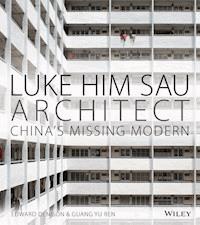
Luke Him Sau/Lu Qianshou (1904–1991) is best known internationally and in China as the architect of the iconic Bank of China Headquarters in Shanghai. One of the first Chinese students to be trained at the Architectural Association in London in the late 1920s, Luke’s long, prolific and highly successful career in China and Hong Kong offers unique insights into an extraordinary period of Chinese political turbulence that scuppered the professional prospects and historical recognition of so many of his colleagues.
Global interest in China has risen exponentially in recent times, creating an appetite for the country’s history and culture. This book satiates this by providing a highly engaging and visual account of China’s 20th-century architecture through the lens of one of the country’s most distinguished yet overlooked designers. It features over 250 new colour photographs by Edward Denison of Luke’s buildings and original archive material.
The book charts Luke’s life and work, commencing with his childhood in colonial Hong Kong and his apprenticeship with a British architectural firm before focusing on his education at the Architectural Association (1927–30). In London, Luke was offered the post of Head of the Architecture Department at the newly established Bank of China, where IM Pei’s father was a senior figure. Luke spent the next seven years in the inimitable city of Shanghai designing buildings all over China for the Bank before the Japanese invasion in 1937 forced him, and countless others, to flee to the proxy wartime capital of Chongqing. In 1945 he returned to Shanghai where he formed a partnership with four other Chinese graduates of UK universities; but civil war (between the Communists and Nationalists) once again caused him and others to uproot in 1949. Initially intent on fleeing with the Nationalists to Taiwan, Luke was almost convinced to stay in Communist China but decided finally to move to Hong Kong. There, for the third time in his life, he had to establish his career all over again. Despite many challenges, he eventually prospered, becoming a pioneer in the design of private residences, schools, hospitals, chapels and public housing.
Sie lesen das E-Book in den Legimi-Apps auf:
Seitenzahl: 371
Veröffentlichungsjahr: 2014
Ähnliche



















Contents
Cover
Half Title page
Copyright page
Title page
Acknowledgements
A Note on Spelling
Introduction: A Mirror to China
Chapter 1: A Complicated Birth
Luke’s Childhood
International Architectural Education
Notes
Chapter 2: London Calling
Chinese Life in 1920s London
The Architectural Association Years (1927–30)
The Grand Tour
Notes
Chapter 3: Bank Building
Bank Beginnings
A New Home
Bank of China – Shanghai
Bank of China – Qingdao
Bank of China – Jiangsu Province
The Bank of China Head Office, Shanghai
Exodus
Notes
Chapter 4: Architectural Retreat
The Architect at War
Out of the Frying Pan
Architectural Strain
Notes
Chapter 5: Hong Kong
New Beginnings
Private Practice
Public Works
Charity
Architectural Ascendance
Modernity’s Fate
Operation Golden Age
Notes
Chapter 6: Luke’s Legacy
Notes
Luke Him Sau: List of Works
Selected Reading
Journals
Key Search Terms
Picture Credits
LUKE HIM SAUARCHITECT
This edition first published 2014Copyright © 2014 John Wiley & Sons Ltd
Registered officeJohn Wiley & Sons Ltd, The Atrium, Southern Gate, Chichester, West Sussex, PO19 8SQ, United Kingdom
For details of our global editorial offices, for customer services and for information about how to apply for permission to reuse the copyright material in this book please see our website at www.wiley.com.
All rights reserved. No part of this publication may be reproduced, stored in a retrieval system, or transmitted, in any form or by any means, electronic, mechanical, photocopying, recording or otherwise, except as permitted by the UK Copyright, Designs and Patents Act 1988, without the prior permission of the publisher.
Wiley publishes in a variety of print and electronic formats and by print-on-demand. Some material included with standard print versions of this book may not be included in e-books or in print-on-demand. If this book refers to media such as a CD or DVD that is not included in the version you purchased, you may download this material at http://booksupport.wiley.com. For more information about Wiley products, visit www.wiley.com.
Designations used by companies to distinguish their products are often claimed as trademarks. All brand names and product names used in this book are trade names, service marks, trademarks or registered trademarks of their respective owners. The publisher is not associated with any product or vendor mentioned in this book.
Limit of Liability/Disclaimer of Warranty: while the publisher and author have used their best efforts in preparing this book, they make no representations or warranties with respect to the accuracy or completeness of the contents of this book and specifically disclaim any implied warranties of merchantability or fitness for a particular purpose. It is sold on the understanding that the publisher is not engaged in rendering professional services and neither the publisher nor the author shall be liable for damages arising herefrom. If professional advice or other expert assistance is required, the services of a competent professional should be sought.
ISBN 978-1-118-44902-8 (hardback) ISBN 978-1-118-44897-7 (ebook) ISBN 978-1-118-44898-4 (ebook) ISBN 978-1-118-44899-1 (ebook) ISBN 978-1-118-44900-4 (ebook)
Executive Commissioning Editor: Helen CastleProject Editor: Miriam SwiftAssistant Editor: Calver Lezama
Acknowledgements
History is nothing without memory. Throughout the 20th century, individual and collective memories in China have been uniquely interrupted, obscured and fragmented. Only recently have these fragments started being pieced together, creating a clearer, richer and more vibrant picture not only of China’s recent past but also of the myriad global interconnections that have been overlooked or forgotten. Among the most abundant sources of these fragments are family archives of key personalities who played a role in China’s first encounter with modernity in the first half of last century. This story of Luke Him Sau could not have been told without the broadmindedness and munificence of his family, most notably his son, Dr Luk Shing Chark, and his granddaughter, Luk Men-Chong, who have so generously supported this research and made publicly available Luke’s professional and personal archive. Thank you also to the valuable inputs of Luk Men-Ching. Without their contribution and commitment, this single fragment of architectural history could not have been told. Other families too have contributed important information and material that further support our thesis that China’s encounter with architectural modernity was not one caused by a single monolithic movement emanating from a mythical core, as conventional histories would have us believe, but was uniquely multifarious and multi-directional. We are extremely grateful to Lin Ci Brown, the granddaughter of the architect Yang Tingbao, and his son, Yang Shixuan, and applaud their efforts to create a museum to this great Chinese architect in Nanjing. We are indebted too to the kindness and generosity over the years of Holly Fairbank, the daughter of Wilma and John, who were close friends of Liang Sicheng and Lin Huiyin. We owe enormous thanks to Wang Haoyu (Grace) for her exceptional academic research and writing on the subject of Chinese architectural history culminating most especially in her excellent PhD thesis. Thank you also to our friends who, though scattered around the globe, have a close connection with or affinity for China and have helped us in our work and supported us throughout: Lynn Pan, Frances Wood, Margaret Richardson, Michelle Garnaut, Tess Johnston, Alan Hollinghurst, Lily Brett, David Rankin, the Hansons, the Steeles and the Tops, Nancy Berliner and Paul French. We are particularly indebted to Adrian Forty, Murray Fraser and the Bartlett’s Architectural Research Fund for supporting this research and guiding its direction. Any mistakes are purely those of the authors and bear no reflection to the immense amount of intellectual support we have received. Special thanks, as always, go to our parents for their unstinting support; to Dr Anne Witchard for her outstanding work on Lao She; to the Architectural Association, especially the archivist Ed Bottoms and Tom Weaver for accepting an article on Luke to appear in AA Files; to all the staff at the Bank of China in Shanghai, especially Mr Li Qin and his colleagues; to Dr Robert Bickers; to Jeremy Tilston for his excellent design; to Abigail Grater for her unfailing and exceptional editorial input; and last but by no means least to all the staff at John Wiley & Sons, including Calver Lezama, Miriam Swift and, as ever, the tireless Helen Castle, for accepting this book and being so patient and supportive during its delivery.
A NOTE ON SPELLING
The unavoidable problem of spelling Chinese names in English is one that will never please everyone all of the time. In this book we have had to cope not only with Mandarin in both the Pinyin and older versions of phonetic transcription, but also Cantonese. In the interests of simplicity for an international readership we have adopted a flexible approach that for the sake of consistency adheres to conventional Pinyin, but also accommodates exceptions where, for example, the accepted spelling of names of people or places are not in Pinyin. We hope this satisfies the most readers most of the time and plead forgiveness from any remaining critics.
INTRODUCTION
A Mirror to China
Temperatures in Hong Kong in the summer of 1967 were running abnormally high. A combination of unseasonably sultry weather and the threat of the Great Proletarian Cultural Revolution smouldering across China’s border causing a regional conflagration pushed tensions in this entrepreneurial city close to boiling point. Standing in the centre of the commercial district, at the heart of this tinderbox, was one of the tallest buildings in Hong Kong and the brightest beacon of Communist China beyond its borders: the Bank of China. Leftist agitators exploited this architectural monument with calculated efficiency, creating an icon around which communist sympathisers gathered to incite riots, organise strikes and plant bombs throughout the city. Huge red banners draped over the building’s imperious facade carried slogans of Mao Zedong (1893–1976) – ‘Chairman Mao’ – whose portrait hung in profile on a giant red flag above the main entrance. Loudspeakers fixed to the Chinese-style roof broadcast braying propaganda over the central business district and adjacent lawns of the city’s normally serene cricket pitch. The municipality’s response – to blast Chinese opera from mobile sound systems aimed at the Bank – added to the cacophony that shattered the composure of the city’s famous harbour setting and disturbed the usual businesslike atmosphere of the surrounding streets, disrupting the legions of bankers, brokers and bureaucrats whose domain bore the brunt of the disorder.
Luke Him Sau, Shanghai, c 1948. This photograph was taken around the time Luke was preparing to leave Shanghai for Hong Kong, the fifth time he had had to uproot his life and begin again.
The Bank of China’s Hong Kong branch was no ordinary bank building. Towering over the Legislative Council, one of the pillars of Hong Kong’s colonial administration, it had been commissioned under the Nationalist Government of Chiang Kai Shek (1887–1975), but its completion in 1950 by the victorious Communists under Chairman Mao made it an unwitting yet essential cog in the Communist apparatus. In no other building did architecture, economics and politics combine to form such a powerful statement of China’s growing aspirations under its new rulers. Chinese detailing in the design intimated the building’s provenance, while its sheer stature deliberately eclipsed the neighbouring Hong Kong & Shanghai Banking Corporation (HSBC) Headquarters with its pompous colonial pretensions. Throwing off the shackles of monotonous Western neoclassicism that litters China’s former treaty ports – the scars of a malignancy from which China had only recently been relieved – the Bank of China’s architectural aura was sleek and self-assured. Soaring lines of elongated windows cut from crisp granite blocks thrust it onwards and upwards as it advanced towards a new, confident and altogether more modern era – one in which China no longer suffered the indignity of foreign occupation and exploitation.
Palmer & Turner (with the assistance of Luke Him Sau), Bank of China Hong Kong branch, Hong Kong, 1950. As China’s primary foreign exchange facility, this building became a symbol of China’s resistance beyond its borders and in 1967 at the height of the Great Proletarian Cultural Revolution was adorned with Maoist slogans, red flags and loudspeakers that stood in contrast to the cosy village-green atmosphere of the colonial cricket pitch.
However, the route to modernity that the building’s architects had envisaged back in the 1940s took an unexpected detour. Conceived as an architectural monument to an independent Republic of China governed by the Kuomintang, the Bank of China became the most potent symbol of Communist China beyond the mainland and the pre-eminent instrument in a propaganda war by the People’s Republic of China against the capitalist West and, more specifically, Britain – the colonial power that not merely owned the territory on which the building proudly stood but had severed it from the Chinese mainland over a century earlier using a ruthlessly effective combination of military force and narcotics trafficking. Consequently, the mood in Hong Kong in the summer of 1967 was decidedly downcast. Confronted by intimidation, bombing, economic instability, water rationing and the prospect of a Communist invasion, Hong Kong’s residents were divided. Expatriates buried their heads in the sand, safe in the knowledge that this subtropical island was a temporary habitat en route to a comfortable retirement in Britain’s Home Counties or further afield. The city’s Chinese residents faced a similar predicament but in reverse. Those who could leave for impermanent abodes abroad, did. Foreign consulates ran out of visa application papers as Hong Kong’s indigenous professional classes – doctors, lawyers, accountants, scientists and architects – fled for the safety of surrogate homes overseas. Among this exodus was Luke Him Sau (1904–1991), an architect who had spent much of his life devoted not only to building Hong Kong and the Bank of China, but also had a hand in designing the very branch that was being used to whip up the impending storm. On 3 June 1967, at the height of the political unrest, Luke launched ‘Operation Golden Age’.
Luke Him Sau, Hong Kong, 1926. This photograph was taken before Luke left to take up his studies at the Architectural Association in London.
Operation Golden Age was not a single-handed counteroffensive against Communist agitation but a retirement plan. It was Luke’s way of bringing the curtain down on a long, prolific and episodic career that began in interwar London and was enriched in Europe, blossomed in Shanghai in its hedonistic heyday, braved besiegement in Chongqing during the Second World War and enjoyed resurrection and maturity in post-war Hong Kong. Architecture had been kind to Luke. For a Chinese man born in Hong Kong, trained in the West and living through the 20th century, it had granted him not only asylum, but also a unique perspective on the world and the fragility of the human condition. It had also allowed him to make sense of China’s extraordinary predicament during this chaotic epoch as he observed his country, at once a civilisation and a nation, tread tentatively along the path towards that nebulous notion of modernity. By the time the retired Luke arrived in Houston, Texas, aged just 64, he was a seasoned survivor and had become one of his country’s many missing moderns – an exclusive group of creative professionals who had been leading figures in China’s encounter with modernity before 1949 but, because of their departure from China before the onset of Communism or their strategic retreat into obscurity after 1949, have been largely omitted from the historical record.
As the threat of a Communist invasion of Hong Kong subsided, Luke’s experience urged caution. Since his birth in Hong Kong in 1904, China had been ruled by three different regimes from three different capitals, been exploited by more foreign nations than any country in the world, been raped by Japan, fought a civil war, taken a great leap backwards, was presently embarking on a very uncultured revolution and faced international isolation. Luke’s life was at the mercy of (as much as a mirror to) China’s travails throughout the 20th century, while his architectural career bestowed on China and Hong Kong some of the century’s most thoughtful, celebrated and often hidden buildings and planning schemes. Luke’s career and his country were uniquely fragmented. Both suffered appalling violence and loss. Both struggled with identity. Both had to negotiate Western supremacy while striving for Eastern parity. Both wrestled with what it meant to be Chinese and modern in the 20th century. And both have been largely overlooked, concealed from the world by various factors until the 21st century when a more complete picture of this extraordinary period of history can be pieced together from fragments strewn across the globe by successive convulsions. This book is one such attempt to illuminate for the first time an architect, at once Chinese and British, whose life and work offers a unique and fascinating insight into the trials and tribulations that confronted not only his cherished culture and beloved country, but the entire world in the 20th century. An aim of this journey has been to contribute to the recalibration of architecture’s encounter with modernity and, by shedding light on the inherent complexities, contradictions and truly global nature of modernity’s arrival, to challenge histories that for too long have been set within and constrained by a purely Western gaze.
CHAPTER ONE
A Complicated Birth
At the start of the 20th century, China was just halfway through its ‘Hundred Years of Humiliation’ (Bai Nian Guo Chi). The ignominy that began in 1839, following Britain’s intercontinental drug dealing that precipitated the First Opium War (1839–42), was reaching its zenith by 1904, the year of Luke’s birth. After six decades of steady decline that had secured for China the dishonourable epithet ‘The Sick Man of Asia’, the decade leading up to 1904 was particularly unforgiving. However, the difficulties of the preceding decade paled in comparison with the next 10 years. Luke was born in the eye of a global storm that was ravaging China, and the ensuing turmoil would shape much of his life and the lives of the characters who populated it; its fallout moulding the architectural ideas and output of one of China’s most prolific and talented architects of the 20th century.
Luke Him Sau photographed in Hong Kong, c 1920.
In 1894 China went to war with Japan in what was the first major conflict with a country it had considered since time immemorial to be a subaltern neighbour and cultural underling. The Japanese, as the English poet and Orientalist Laurence Binyon (1869–1943) once noted, ‘look to China as we look to Italy and Greece, for them it is the classic land’.1 In the late 19th century, China’s superior relationship with Japan was upended. The dramatic reversal was effected by the countries’ respective responses to the unrequited advances of Western powers. Both had sought to contain foreign interference by confining trade with the West to specific ports (Guangzhou in China2 and Nagasaki in Japan), but the First Opium War and the concluding Treaty of Nanjing (1842) turned foreign interest in China from an external concern to an unavoidable and corrosive internal problem. From 1842, foreigners were granted the right to settle in China at designated ‘treaty ports’, the first five of which were defined in the Treaty of Nanjing: Guangzhou (then known as Canton), Xiamen (Amoy), Fuzhou (Foochow), Ningbo (Ningpo) and Shanghai. Hong Kong, where Luke would be born, became a Crown Colony and, unfathomable though it was to the British at the time, the Far Eastern jewel in the nation’s imperial crown. Faced with a similar predicament in 1853 following the arrival in Tokyo (Edo) Bay of the USS Mississippi carrying Commodore Matthew Perry, the Japanese were not going to concede similarly favourable terms on their own territory. Interaction with the West for Japan stopped at trade, which became its salvation; but for China, it permitted settlement, which became its downfall.
The Luke family, Hong Kong, early 1920s. Photographed at the family home at 4 Hau Fung Lane, Ship Street, Wanchai, Hong Kong, showing Luke Him Sau (back row standing third from the right), his mother and father (seated centre), his two brothers and two brothers-in-law (standing centre), his two sisters and two sisters-in-law (standing far left and far right) and his 15 nieces and nephews.
For Japan, the arrival of foreign forces was a sufficient portent to prompt sweeping reforms aimed at the wholesale modernisation of the nation. With a revolutionary zeal, the Meiji Restoration of 1868 not only laid the foundations of Japan’s swift and fundamental modernisation but also endowed the country with the keys to the elite club of Western nations. All that remained for Japan in fulfilling its emulation of the West was an empire, the appetite for which China and Korea would pay heavily. In 1885, Japan’s metaphorical passage to the West was encapsulated in an anonymous essay, ‘Datsuaron’ (‘Departing Asia’), attributed to the reformist intellectual Fukuzawa Yukichi (1835–1901), conjuring an image of Japan, drawn by the irresistible ‘winds’ from the West, setting sail and leaving Asia and its uncivilised neighbours behind.3
For China, negotiations with Western powers were conducted over the double barrels of the opium pipe and frigate cannon. The unscrupulous manner in which China was brought to the negotiating table resulted in the signing of a series of ‘unequal treaties’ with a medley of Western nations over the ensuing decades. The consequent century of humiliation instilled in China a profound distrust towards many foreign countries, but none more so than Japan, followed close behind by Britain.
When the question of influence over the former vassal state of Korea finally led to war between Asia’s old guard and rising star, many assumed that China would crush its upstart neighbour, but it was not to be. Japan delivered a defeat so complete and humiliating that the eminent Chinese reformer Liang Qichao (1873–1929) described it as a ‘thunderbolt in a dream’.4 Victory cemented Japan’s ascendant position over its cultural ancestor, whose descent had reached its nadir. The Treaty of Shimonoseki (1895) contained not only the terms of peace, but also the first drafts of the gathering storm that would engulf the country for the next two decades and beyond. It would also permanently alter the course of China’s modernisation by preparing the conditions for unprecedented construction and destruction – modernity’s loyal bedfellows. With a taste for triumph, Japan was in no mood to stop at this preliminary conflict. Half a century of accumulating gains in China would ignite a conflagration that would consume not merely the country, nor the region, but the entire globe. The winds of war in the 1930s and 1940s scattered China’s political, intellectual and artistic elites across the world, though many of those uprooted by Japan’s invasion, including Luke, who lost everything in their escape, would land nearby in China’s proxy capital, Chongqing – but that drama is for a later chapter.
The conditions of peace in 1895 forced China to recognise Korea’s independence as well as pay Japan a hefty war indemnity, but it was the surrender of sovereign territory that would have a lasting and debilitating effect on China’s future. China had to yield to Japan parts of the Manchurian coastline in the Liaodong Peninsula and several islands in the China Sea, including Taiwan (then Formosa). Such crushing terms disgraced China’s ailing Qing Government and even worried the Western powers, prompting France, Germany and Russia to call on Japan to rescind its claim on the Liaodong Peninsula and the strategic port of Lüshun (then Port Arthur). Japan honoured the request in exchange for a larger indemnity, though Russia’s demands were far from altruistic. The ice-free port of Lüshun in the China Sea was a more attractive proposition militarily and commercially than the isolated port of Vladivostok at the terminus of the Trans-Siberian Railway on the coast of the Sea of Japan. Taking advantage of both China’s impotence and gratitude to Russia for its negotiations with Japan, Russia leased the peninsula for 25 years. It was renamed the Kwantung Leased Territory and the Russians set about building a branch line of the Trans-Siberian from the frontier town of Harbin down to the coast that would become the South Manchuria Railway (SMR) and one of the most strategically important railway lines in the world. They would be forced to surrender these assets to Japan a decade later following their humiliating defeat in the Russo-Japanese War (1905) – the first time in the modern era a Western nation was defeated by an Eastern counterpart, and the completion of Japan’s second vital step in its quest for an empire.
These conflicts not only humiliated the vanquished, they also accelerated China’s industrial revolution. In a seemingly innocuous clause in a supplementary treaty to the Treaty of Shimonoseki signed by China, Japan and Britain in 1896, Japanese subjects were granted the right to ‘carry on trade, industry and manufactures’ in the territory granted to Japan.5 With the ‘Most Favoured Nation’ clause extending this right to citizens of other nations, for the first time in history foreigners residing in China were permitted to engage in industry. Having allowed foreigners to settle on their territory, the Chinese now allowed them to extract resources and manufacture goods too. The Sick Man of Asia may have been terminally ill, but his foreign accoutrements had never been so abundant. For China, the doors to modern industrial production – a hallmark of Western modernity – were unlocked not from the West but from the East.
As China plumbed the depths in search of redemption, the calls for sweeping reform grew louder. A response came in the summer of 1898 when Liang Qichao and his mentor Kang Youwei (1858–1927), under the auspices of the young Emperor Guangxu (1871–1908), initiated widespread educational, constitutional, military and economic reforms. However, desperate though China was for institutional change, the ‘One Hundred Day Reform’6 resulted in a conservative backlash and coup d’état by the Empress Dowager Cixi (1835–1908). Six reformers, including Kang’s brother, were executed and the Emperor Guangxu was placed under house arrest in Beijing’s (Peking’s) Forbidden City, where he languished until his death in 1908 – the day before the death of his aunt, the Empress Dowager, fuelling speculation of murder and political intrigue inside the Imperial Court.
Liang and Kang survived by fleeing to Japan which was regarded by China’s reformers not as a despised adversary but rather the model of Asian modernity. As the Qing Government stuttered on under the Empress Dowager’s reign in spite of further traumas such as the homicidal anarchy of the anti-foreign Boxer Rebellion in 1900, Japan provided a safe haven for China’s reformers and upcoming luminaries, including the future leader, Chiang Kai Shek, and Sun Yat Sen (1866–1925), the founding father of the Republic of China. Liang and Kang lived in Tokyo for over a decade, sustaining pressure on the Qing Government by establishing the Protect the Emperor Society (Bao Huang Hui),7 which petitioned for the reinstatement of the emperor under a system of constitutional monarchy. In his exile Liang also published the radical journals, Qing Yi Bao (Honest Criticism) and Xin Min Cong Bao (A New People), which he smuggled into China through the foreign settlements.
Luke Cheukman, Hong Kong, c 1900s. Luke Him Sau’s father in traditional dress.
Japan was not only a sanctuary for Chinese reformers, but also, in conjunction with China’s foreign concessions and colonial enclaves, an essential conduit for the passage of modern ideas into their ailing nation. Chinese translations of Western modernist literature and the latest scientific theories predominantly came from Japanese translations through intermediate settlements like Luke’s home of Hong Kong, where modern concepts and practices were more freely aired and expressed. Japan’s universities also schooled growing numbers of Chinese students who were attracted not only by the relatively inexpensive education compared with Europe or the United States of America, but also by Japan’s cultural and geographic proximity. The total number of Chinese students in Japan rose from 280 in 1901 to 15,000 by 1906 – more overseas students than at any other time or in any other country. Within a decade it would be from Japan, not the West, that China’s first trained architects emerged.8
The maelstrom that had consumed China from the late 19th century, violent though it was, was also instrumental in aligning the constellation of events, personalities and conditions that would shape Luke’s life and the lives of a generation of modern Chinese professionals. Born in the region of Xin Hui, Guangdong province, Luke shared his ancestral home with many of China’s most eminent individuals, including the reformer, Liang Qichao. Xin Hui was renowned for its scholarly standing, with a disproportionately high number of citizens entering the Imperial Court as distinguished academics and bureaucrats through the once ubiquitous Imperial Examination, which ensured, irrespective of upbringing, China’s brightest and best minds served government. Having migrated from central China to Guangdong province, Luke’s father, Luke Cheukman (1860–1938), had attempted these exams but failed, and so turned his attentions to business, though he would always maintain the primacy of education. By the time Luke was born, the Imperial Examination, like so many ancient customs, was seen as anachronistic and incompatible with the fledgling aspirations of modern China. In 1905, after supplying governments with the most talented civil servants from across the empire for well over 1,000 years, the Imperial Examination was abolished. Other ancient customs followed a similar path to redundancy or extinction, as the Qing Government did too little too late to steer China towards the modern era and vainly attempt to avert catastrophe.
Luke Cheukman, Hong Kong, c 1910s. Luke Him Sau’s father in Western dress.
The classical language, ancient modes of art production, enduring social doctrines, concepts of time, and conventional financial systems were swept aside by modernity’s unremitting march. Classical Chinese (Wen Yan Wen) was replaced by plain-speaking vernacular Chinese (Bai Hua). Artistic expression, long the preserve of the Imperial Court, was made accessible to the masses, initiating a revolution in painting, literature, music and architecture. The notion of progress and its linear connotations usurped China’s cyclical temporal precedents. Confucianism, the very essence of Chinese thought for over two millennia, was replaced by a new cultural consciousness based on scientific reason, democracy and nationalism. And the introduction of a modern banking system based on the latest Japanese model mobilised China’s first ever national banks, the Commercial Bank of China (1898) and the China Government Bank (1905), the progenitor of the Bank of China (1912). In 1911, it was the turn of the Qing Government itself – considered by too many for too long to be the root cause of China’s ills – to confront the inevitable change sweeping the country. The eventual overthrow of the Qing Dynasty in 1911 brought an end to over two thousand years of dynastic rule and heralded the birth of the Republic of China.
The Luke family home, 4 Hau Fung Lane, Ship Street, Wanchai, Hong Kong, 1920s. The large house with expansive garden was designed in a combination of Chinese and Western styles. Luke’s father, Luke Cheukman, and mother, Hung Shauching, can be seen standing on the terrace.
LUKE’S CHILDHOOD
Luke’s birthplace of Hong Kong was largely sheltered from the tempest across the border. A British colony since the 1840s, the craggy island off the coast of Canton was symptomatic of China’s unique condition – no other country on earth was as diversely carved up and exploited by outsiders. By the start of the 20th century there were approximately five different types of foreign settlements in China. The sheer variety of these settlements before the Second World War accounted for an extreme architectural and urban heterogeneity that continues to have a potent legacy in many Chinese cities. Hong Kong was a colony, like Macau (Portuguese) and Taiwan (Japanese), and thus administered from afar. This arrangement had some parallels with the puppet state of Manchukuo created by Japan after their annexation of northeast China in 1931. A leased territory was a region loaned to a foreign power for a fixed term, as Kwantung had been to Russia before it was seized by Japan, and as parts of Shandong province (where Luke would produce some of his best work) had been to Germany in 1897. Another settlement type was the foreign concession, which was granted to specific nations and governed by representatives of that nation or shared between nations. Under the iniquitous system of extraterritoriality, foreign residents of these concessions were legally immune from Chinese jurisdiction.9 Foreign concessions usually comprised a portion of another settlement type: the treaty port, which emerged after the signing of the Treaty of Nanjing. The Chinese retained jurisdiction over treaty ports but granted access to particular foreign powers. Most treaty ports were divided into separate foreign concessions, which were often surrounded by Chinese-administered areas, creating a group of independent settlements within a city – something Luke would have to tackle in the late 1940s when placed in charge of planning Shanghai’s unification after its foreign concessions had been surrendered and combined with the Chinese areas. This peculiar legacy of inequitable foreign relations remains engrained in the urban fabric of many major Chinese cities, where the tight, disorderly street pattern of historic quarters formed by municipally disinterested foreign merchants up to the mid-20th century jars with the rectilinear layouts imposed by subsequent Soviet-influenced planners from the second half of the century.
Luke Cheukman and guests, 4 Hau Fung Lane, Ship Street, Wanchai, Hong Kong, c 1910s. The guests are shown among the landscaped garden of the Luke family home.
Hong Kong’s colonial status and its detachment from China set it apart from most foreign settlement types in China. Being a colonial city, municipal bureaucrats were expected to supervise tax revenues and ensure their disbursement was in the interests of society. This required foresight and planning, effective municipal departments, and investment in infrastructure projects, formal urban development, social welfare programmes and the maintenance of law and order. Such matters were largely irrelevant or at least all too often neglected by their municipal colleagues in the foreign settlements of China’s treaty ports in favour of commerce, though in reality Hong Kong was little different. China’s foreign enclaves, colonial or otherwise, were founded on trade, and commerce always prevailed.
Hong Kong, despite being a Crown Colony, was a Chinese city and, at the expense of life’s many other facets, was fast becoming the region’s pre-eminent trading hub. Over 98 per cent of the population were Chinese, and the vast majority of those were from the eminently entrepreneurial neighbouring region of Canton, whose inhabitants are largely responsible for building Chinatowns across the globe. Among this Cantonese cohort was Luke’s father, Luke Cheukman, who made the short journey across Victoria Harbour to pursue his career as an investor initially in the ferries that plied the seas between Canton, Macau and Hong Kong, and then, among other ventures, in the city’s thriving Chinese newspaper industry. Business prospered and enabled his family to settle in the district of Wanchai, nestled between central Hong Kong and the settlement’s sporting heart of Happy Valley ringed by its inevitable British Racecourse.
Luke Cheukman’s learned upbringing had taught him that with wealth comes responsibility. As a respected elder in his community he supported local charities and even established a school for up to 60 local children, Meng Yang Xue Tang, in the old Chinese settlement of Wong Nai Chung, which he managed until the late 1920s when, nearing 70 years old, he arranged for it to be taken over by the government. Luke Him Sau was born on 29 July 1904, only days after his father had moved to 1A Wong Nai Chung Village in Happy Valley. The home was only temporary while his father had a permanent house built nearby at 4 Hau Fung Lane, Ship Street, on the steep slopes of Wanchai. Completed in 1910, the Luke family home was a sprawling and multilayered house, in an eclectic Chinese style fused with Western features, that clung to the mountainside forming an Escher-like landscape – an architectural extension of the subtropical foliage that invades and blankets the rocky terrain in this sultry climate. A warren of steps, walkways and terraces richly decorated with elaborately carved wooden latticework and covered with glazed tiles trimmed with characteristically upturned eaves connected a series of pavilions and larger stone and concrete structures to create a meandering complex that, like the city itself, was a hybrid of East and West. As was typical of a prosperous Chinese home of the time, the Luke household was a place of business, scholarly endeavour and familial retreat for an extended and growing family. The Luke home, although physically expansive, was in principle similar to a conventional Chinese courtyard house. The front portion comprised public areas for meeting and hosting guests: namely a hall, reception and dining room. Behind this frontage was the nucleus of the home, the courtyard, which in the Luke household comprised a warren of external terraces, balconies, and the miniature world of the Chinese landscaped garden framed by screens and variously shaped doors and windows. Around this intricate scene were the private areas of the home, the study and library, kitchen, and the living quarters of the immediate and extended family and domestic helpers.
Luke Cheukman and guests, 4 Hau Fung Lane, Ship Street, Wanchai, Hong Kong, 1920s. The group are standing outside one of the several pavilions that link the internal and external elements of the family home.
The Luke family home, 4 Hau Fung Lane, Ship Street, Wanchai, Hong Kong, 1920s.
The roles adopted by Luke’s parents within the home were typical of the traditional Chinese household. Luke’s father was responsible for its reputation, overseeing matters of business, hosting guests, and ensuring the family’s financial security. His mother, Hung Shauching (1866–1931), was responsible for familial affairs and the efficient running of the house, which principally involved organising the various domestic workers who performed the myriad daily tasks required to maintain a comparatively affluent Chinese home of this size: waiting on guests, cooking, cleaning and attending to the needs of the family’s five children and many grandchildren.
Luke Cheukman, Hong Kong, c 1910s. The head of the family at his desk in his library at the family home.
Luke’s mother and father had three sons and two daughters. Two boys were born first, followed by the two girls. Luke was the last and considerably younger than his siblings. Luke’s eldest brother, Kean Fai, became a doctor and had 10 children. He travelled throughout China from the northeast where he was sent to combat a plague epidemic in Manchuria, to the south, where he settled in Macau. He had to retreat to Hong Kong briefly during the Cultural Revolution and died in the 1970s. The second brother became a railway engineer and had three children. Luke’s sisters, as was customary for females in early 20th-century China, did not receive a formal education but were expected to marry into a respectable household and raise a family. His eldest sister, Shun King, had three children while his youngest sister, Fong King, married a medical doctor who was one of the first graduates of Hong Kong University’s school of medicine, and they had six children. Before Luke had even started a family he had 22 nieces and nephews from four siblings.
The male members of the Luke family, Hong Kong, early 1920s. Luke’s father, Luke Cheukman, is seated with the two brothers-in-law (left), two older brothers, Luke Kean Fai and Luke Kean Ching, (centre), and Luke Him Sau (far right).
Luke was a sickly baby, but he showed great promise intellectually and perhaps for this reason was favoured by his father who, though a highly respected and successful businessman, never lost his reverence for scholarship. When the child of any reputable Chinese family reached the age of three or four it was the convention that they would be privately tutored. Through a family friend, Luke’s father was recommended a renowned imperial scholar, Wu Daorong, who specialised in poetry and calligraphy, two uniquely Chinese art forms that Luke would grow to love and practise throughout his life. Luke’s private tuition in Chinese from such a young age would have a profound impact not only on his education, but also on his life and his career as an architect.
Luke attended Wanchai Primary School from the age of 10 and in 1918 took exams for the esteemed Queen’s College, Hong Kong’s first public secondary school, coming top in Chinese and fourth in English. Despite these achievements, his father chose to send him to St Joseph’s College, one of the city’s top schools, which he attended from 1919 to 1922. St Joseph’s College had been founded by Catholic missionaries and was a typical product of its colonial setting, priming Chinese pupils for further education at UK universities. It was popular too among the Portuguese community from Macau, with whom the Chinese boys would always feud. At the end of the school day the Catholic priests would have to lead each faction off in opposite directions to avoid them settling the day’s scores in the street. As a means of self-defence, Luke learned kung fu and became an able student of this martial art. With the exception of two native teachers giving some instruction in Cantonese, Chinese pupils were taught in English, the only language tolerated in the playground and in classroom. It was while at St Joseph’s that Luke was introduced to the world of architecture through the special courses it offered in geometrical and architectural drawing, for which the school was renowned. Luke excelled at school, and his earnest and scholarly disposition – which would determine the course of his life and his architectural output – was rewarded with the presentation of a solid gold watch upon his graduation in 1922.
Luke Kean Fai, Hong Kong, late 1910s. Luke’s eldest brother, a trained doctor, with his wife and one of his 10 children in the courtyard garden of the family’s home.
INTERNATIONAL ARCHITECTURAL EDUCATION
Unsure of the direction his career should take, Luke’s decision in 1923 to pursue the still-embryonic profession of architecture received the support of his father, who paid $2,000 for a four-year apprenticeship with the British firm of architects, civil engineers and surveyors, Denison, Ram & Gibbs. In the early 1920s, architecture was still largely the preserve of foreigners in China and remained a relatively mysterious profession among prospective Chinese students, whether resident in the colonies, treaty ports or Chinese-administered areas. Architecture had no precedent in China. This so-called ‘art of building’ was not even considered an art, but rather a utilitarian trade associated with various types of woodwork. The closest artisan to building was Jiang Ren, the person responsible for constructing palaces and temples. However, in China’s strictly ordered traditional society it made no difference whether one fabricated palaces or cooking utensils, they still occupied the rank of carpenter and could never be considered comparable to those engaged in the exalted arts of poetry, painting or music. As China confronted modernity and began to break free of these ancient strictures, it was through engineering that most Chinese were introduced to architecture.
Engineering graduates greatly outnumbered architects in China and had started travelling overseas for education long before their architectural colleagues. China’s first engineering graduate was Zhan Tianyou (1861–1919) who received a PhD in Civil Engineering from Yale University and in so doing helped to elevate the standing of the relatively unknown subject of engineering in Chinese society at the turn of the century. In 1912, as China became a Republic, Zhan helped establish the Chinese Society of Engineers (Zhong Hua (later Guo) Gong Chong Shi Xue Hui), an institution that promoted the cause of engineering and preceded its architectural equivalent (of which Luke would one day be president) by 15 years. Engineering’s earlier emergence in China and its warm endorsement by government meant architecture consistently lagged behind. It is no surprise, then, that China’s first trained architects emerged from engineering backgrounds. Shen Liyuan (1890–1951), for example, studied engineering at a technical school in Naples in 1909 before switching to architecture and returning to China in 1915 to establish his own firm, Hua Xing Architecture and Engineering, in the northern treaty port of Tianjin.
Luke Fong King, Hong Kong, 1910s. Luke’s sister in traditional Chinese dress, including double-heeled shoes and bound feet.
The ‘first generation’ of Chinese architects was forced to make individual, disparate and often desperate efforts to receive a foreign education. Until Europe and the United States of America became viable destinations for significant numbers of Chinese students (which did not happen for architecture until the 1920s), Japan was the obvious and only choice for most prospective students. A larger proportion of China’s early architectural graduates were trained in Japan than occurred in the ‘second generation’ who enjoyed considerable state support, particularly through the Boxer Indemnity Fund which had been set up after the Boxer Rebellion of 1900 as a means of directing China’s crippling compensation payments towards a mutually beneficial cause, notably education. Consequently, China’s first taste of architectural education came from Japan as a version of Western pedagogy received second-hand. Among the first Chinese architecture students to benefit from this mediated modern form of Japanese education were Liu Shiying (1893–1973) and Liu Dunzhen (1897–1968), both of whom attended the Tokyo Higher Technical School in the 1910s and returned to China in the early 1920s, together establishing the Hua Hai Architectural Practice in Shanghai in 1923 – the same year Luke began his apprenticeship at Denison, Ram & Gibbs.
Luke’s mother, Hung Shauching, Hong Kong, c 1910s. Dressed in richly embroidered traditional Chinese clothes, concealing double-heeled shoes and bound feet.
By the 1920s Denison, Ram & Gibbs were among the old guard of British establishments in Asia, those early firms created by enterprising engineers and architects bored by the mundanity of municipal life in Britain’s industrial cities and in search of something more exciting. These were the men who were enticed overseas by the heady cocktail of opportunity, remuneration and adventure. Those who washed up in China laid the filaments of the modern industrial world – railways, tramlines, telegraphs, docks, power stations, water treatment plants and gasworks. Denison, Ram & Gibbs were cast in this mould. Albert Denison and Edward A Ram (1858–1946) established the firm in 1896 – Denison the engineer and Ram the architect. As Ram’s apprentice, Luke continued an esteemed architectural lineage. Ram had been the pupil of George Somers Clarke (1822–1882), who in turn had been the pupil of Charles Barry (1795–1860) and had worked with him on his most famous project, the Palace of Westminster, better known as London’s Houses of Parliament. Ram qualified in 1885 and worked in Westminster before travelling to Belgium and Holland and then to Asia in 1889, where he later met Denison. In 1900, Denison & Ram were joined by Lawrence Gibbs (1865–unknown), a civil engineer who had come to Hong Kong in 1890 as an employee of the Public Works Department. The firm continued to work on many of Hong Kong’s major public projects, including the Kowloon waterworks that Gibbs had supervised when at the Public Works Department.
Luke Him Sau, Hong Kong, c




