


Erhalten Sie Zugang zu diesem und mehr als 300000 Büchern ab EUR 5,99 monatlich.
- Herausgeber: The History Press
- Kategorie: Geisteswissenschaft
- Sprache: Englisch
When war was declared in 1939, Britain was almost completely dependent on imported timber – but only had seven months of it stockpiled. Timber was critical to the war effort: it was needed for everything from aircraft and shipbuilding to communications and coal mining. The British timber trade was in trouble. Enter the Lumberjills. Lacking in both men and timber, the government made a choice. Reluctantly, they opened lumber work for women to apply – and apply they did. The Women's Timber Corps had thousands of members who would prove themselves as strong and as smart as any man: they felled and crosscut trees by hand, operated sawmills, and ran whole forestry sites. They may not have been on the front line, but they fought their own battles on the home front for respect and equality. And in the midst of heavy labour and wartime, they lived a life, making firm friends and even finding soulmates. In Lumberjills, researcher Joanna Foat tells their story for the first time, and gives them the recognition they so truly deserve.
Sie lesen das E-Book in den Legimi-Apps auf:
Seitenzahl: 437
Veröffentlichungsjahr: 2019
Das E-Book (TTS) können Sie hören im Abo „Legimi Premium” in Legimi-Apps auf:
Ähnliche




















About the Author
Joanna grew up in Surrey, the most wooded county in England, loved to climb trees as a girl, and was often outside working on things with her father. She studied Psychology at Hull University and spent two years in France snowboarding, surfing and living in Les Landes, one of the largest pine forests in Europe. Inspired by an interest in organisational behaviour and gender issues at work, after several years as a PR consultant she studied for an MSc in Occupational and Organisational Psychology at Surrey University.
After raising two daughters, Joanna discovered the Lumberjills while working for the Forestry Commission. With a wild, adventurous spirit and a passion for forests, she felt a connection with their story. Few people had heard of them, so Joanna travelled the country to meet them and tell their story. Joanna worked with the Daily Mail, Woman’s Hour, Wartime Farm, Countryfile, How We Won the War and The Great British Menu to increase recognition for their war work. She then concentrated on writing a novel that eventually turned into her debut history book – Lumberjills.
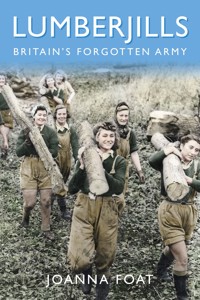
Cover illustrations:Front: Women of the Forestry Commission section of the Women’s Land Army carry logs on their shoulders in Suffolk, 1 December 1941. (Photo by M. McNeill/Fox Photos/Hulton Archive/Getty Images) Back: Women’s Timber Corps using a mobile sawbench 1945 (Images © Crown Copyright. Courtesy of Forestry Commission)
First published 2019
The History PressThe Mill, Brimscombe PortStroud, Gloucestershire, GL5 2QGwww.thehistorypress.co.uk
© Joanna Foat, 2019
The right of Joanna Foat to be identified as the Author of this work has been asserted in accordance with the Copyright, Designs and Patents Act 1988.
All rights reserved. No part of this book may be reprinted or reproduced or utilised in any form or by any electronic, mechanical or other means, now known or hereafter invented, including photocopying and recording, or in any information storage or retrieval system, without the permission in writing from the Publishers.
British Library Cataloguing in Publication Data.A catalogue record for this book is available from the British Library.
ISBN 978 0 7509 9160 5
Typesetting and origination by The History PressPrinted and bound in Great Britain by TJ International Ltd
Contents
Foreword
Acknowledgements
Introduction
1 Women Didn’t Wear the Trousers
2 Domestic Servants, Shop Assistants and Hairdressers
3 Promise of ‘A Healthy, Happy Job’
4 Green Beret, Tacketty Boots and Special Issue Undies
5 It Felt Like Prison on Training Camp
6 She Fells with Ease 10-Ton Trees
7 Danger, Dust and Noise in Sawmills
8 Heave Ho, Haulage, Tractors and Transport
9 Notebook, Measuring Tape and Mathematics
10 Bonfires, Charcoal Burning and Planting
11 Thirty-Two Shillings a Week or Less
12 Freezing Cold Camps and Nowhere to Stay
13 How We Survived All Day on Jam Sandwiches, I’ll Never Know
14 Prejudice: The Female ‘Forestry Handicap’
15 A Nomadic Life Through All Seasons
16 Lifelong Friendship, Love and Romance
17 Three-Quarters Off Sick for a Month
18 Praise and Jubilation at the End of the War
19 We Hate to Think We’re Forgotten
20 First World War: Pioneering Women in Forestry
Timeline
Notes
Bibliography
Foreword
I grew up hearing wonderful stories of adventure, hard work, glamour and – above all – friendship from my mother, who had very proudly served in the Women’s Land Army, Women’s Timber Corps and North German Timber Control during and after the Second World War. Having heard her tales, it came as some surprise to me that there had been no formal recognition of their work, and there was little readily available information on the Lumberjills and the crucial contribution these remarkable women made to the war effort.
My mother was delighted that Joanna had asked her to contribute to this book. Not only did it give her the chance to reminisce about one of the most extraordinary times of her life, but it was also an opportunity to talk about these women whose work had largely been forgotten. Now it seemed hers, and many others’ stories, would be told, in their own words.
The Land Army and Timber Corps waited a long time for the recognition they so deserved. It was only in 2008 that they were given some credit, when the British Government issued a commemorative badge. A decade on, I am delighted that Joanna has given a voice to the Lumberjills. As many of them reach the end of their lives, she has captured their personal experiences in their own words ensuring that their stories endure for future generations.
I first met Joanna in 2018 when she invited me to attend a talk she was giving about the Lumberjills at the WI’s Centre for Learning. Just a few months after my mother’s death at the age of 94, I found the stories she told of these women’s shared history moving, humbling and fascinating. She has uncovered so much about what these young women coped with, from the sheer physical effort they made undertaking extremely dangerous work, to the terrible living conditions, lost loves and the loneliness of being posted miles from home at such a young age. Alongside this darker side of their experiences, Joanna has also captured the adventures, the fun, the glamour and friendships that were made.
My mother’s own experience in Devon was of horrible landladies, flea-infested billets, bombs, the hazards of felling trees, and working alongside prisoners of war. But most of all, she loved to talk about the fun times had with the women she worked and lived with and grew to love. ‘We were a great gang, always going around together and trying to look glamorous,’ I remember her saying of those women, whose friendships were to last the rest of her life. My brother Michael and I were brought up within that extended family, with Betty, Fran, Evelyn and Olive becoming our aunts and their children, our cousins.
Contributing so much to this country and its war effort produced so many strong, capable women. Having worked and thrived as Lumberjills during the war, many went on to have successful careers, raise children, travel the world and have other great adventures – none of which, it could be argued, would have happened without that early freedom, training, discipline and comradery that came with the difficult circumstances of being young women in a war.
Joanna’s book brings to life the stories of those women and represents a love letter to all those who served working in the forests in wartime.
Mary CollinsDaughter of Hazel Collins (née Hacker)
Acknowledgements
A special thank you to all the Lumberjills and their families for sharing their stories and giving permission to reproduce their photos: Edna Barton, Audrey Broad, Mary Broadhead, Rose Burton, Hazel Collins, Peggy Conway, Katie Dowson, Joyce Earl, Olive Edgley, Frieda Ellerby, Gladys Fife, Margaret Finch, Patricia Frayn, Joyce Gaster, Brenda Harrison, Nancy Harrison, Edna Holland, Kathleen Hutchby, Mrs Lawrie, Enid Lenton, Eileen Mark, Ann Moffat, Betty Morley’s son John Morley, Doreen Musson, Dorothy Naylor, Ethel Oliver, Violet Parker, Molly Paterson, Winnie Renshaw, Dorothy Scott, Irene Snow, Dorothy Swift, Evelyn Taylor, Joan Turner, Diana Underwood, Lilian Veitch and the only lumberjack Alfie Weir.
Thank you to my family and dear friend Sophie Artemis for their unrelenting support and belief. Thank you also to those people along the way who have offered encouragement and advice, especially Ann Kramer.
A special thanks also goes to the Imperial War Museum, The National Archives, Forestry Commission, European Ethnological Research Centre, Ex Libris Press, Best of British Magazine.
***
I would like to thank the following Lumberjills and their families and the one and only lumberjack for kindly providing interviews, letters, personal photographs and Women’s Timber Corps memorabilia for this book:
Edna Barton (née Packwood) – Born 1920.
Women’s Land Army 1941–42, Women’s Timber Corps 1942–45.
Training at Culford, Bury St Edmonds, Suffolk, felling at Coombe Abbey on the outskirts of Coventry. (With kind permission of Peter Barton.)
Audrey Broad (née Wilcock) – Born 3 October 1925.
Women’s Timber Corps 22 March 1943–14 February 1948.
Worked in Arundel, Poynings and Southwater, Sussex, as a measurer, calculating wages based on piecework. (With kind permission of Jenny Ansell.)
Mary Broadhead (née Swannick).
Women’s Land Army, Women’s Timber Corps 1940–46, when married.
Training at Culford, Bury St Edmonds, Suffolk, felling near Elveden, Brandon and Lakenheath and sawmilling in Chartham, near Canterbury, Kent. (With kind permission of Robert Broadhead.)
Hazel Collins (née Hacker) – Born 7 July 1923.
Women’s Land Army 1940–42, Women’s Timber Corps 1942–46, North German Timber Control May 1946–50.
Felling timber for Thornbury Mill, Holsworthy, Devon. Sawmill in Kingston, Devon. Office work for the Control Commission in Hanover, Germany. (With kind permission of Mary Collins.)
Katie Dowson – Born 1926.
Women’s Timber Corps 1944–48.
Felling, brashing, planting and fencing at High and Low Muffles, Pickering, and calculating wages at Dalby Forest, North York Moors, North Yorkshire.
Olive Edgley (née Spoor) – Born 9 June 1924.
Women’s Timber Corps 1940–45.
Acquisitions from Western-super-Mare, Somerset, to Cleveland, North Yorkshire, Savernake Forest in Wiltshire to Malmesbury, Stroud, Winchcombe and Westonbirt in Gloucestershire and Monmouthshire reporting to the Ministry of Supply HQ in Bristol. (With kind permission of Rosamund Edwards.)
Frieda Ellerby (née Hardy).
Women’s Timber Corps 1940–45, when she got married.
Worked in forests in North Yorkshire loading pits props into trailers for the Bevin Boys in Durham, loading lorries heading for Thornton Dale Station.
Gladys Fife (née Holtby).
Women’s Timber Corps 1943–48.
Based at Cropton, North Yorkshire, worked in felling, brashing, planting and fencing at High Muffles, Pickering, and other forests in the North York Moors.
Margaret Finch – Born 1924.
Women’s Timber Corps.
Training in Wetherby, Yorkshire, sawmilling, felling, loading and driving timber haulage lorries in Kings Langley and Epping Green Corner, Hertfordshire.
Edna Holland (née Lloyd) – Born 28 March 1925.
Women’s Timber Corps October 1942.
Trained in Wetherby and worked in felling, haulage using horses and driving caterpillar tractors at Dalby, Boltby, South Wood and other forests in the North York Moors, North Yorkshire. (With kind permission of Fiona Jane Holland.)
Lillian Julian (née Veitch).
Women’s Timber Corps 1942–44, Women’s Land Army 1944–46, and left when married.
Brashing on an estate between Coldstream and Berwick upon Tweed, Northumberland.
Enid Lenton (née Anderson) – Born 11 July 1915.
Women’s Timber Corps 1940.
Feller and supervisor at Alyth and Blairgowrie, Perthshire, in charge of forty girls. (With kind permission of Anne Ogden.)
Eileen Mark (née Worsley) – Born 1923.
Women’s Timber Corps 1942–46, when she was married.
Trained at Culford, near Bury St Edmunds, Suffolk, and worked in Walderton and Compton, West Sussex, clearing brush, making fires, planting, stacking and loading and driving tractors. (With kind permission of Kevan Mark.)
Ethel Oliver (née Bailey) – Born 28 June 1923.
Women’s Land Army 1941, Women’s Timber Corps 1942–46.
Training in the Lake District and became a measurer in Chopwell Wood, Tyne and Wear, and Barnard Castle, in Teesdale, County Durham. (With kind permission of Randle Oliver.)
Violet Parker (née Talling) – Born 24 June 1924.
Women’s Timber Corps 1942 until the end of the war.
Based at Lostwithiel, she worked stacking timber onto lorries at a sawmill in Lanhydrock, Cornwall.
Molly Paterson (née Douglas) – Born 1922.
Women’s Timber Corps 1940–44.
Clerical work for the timber section of the Ministry of Supply in Ardbrecknish Forest, Argyll, Scotland. Later calculated wages, cubic feet of timber, preparing dockets for the stationmaster and loading. (With kind permission from Alison Tomlinson.)
Joyce Elizabeth Rampton (née Gaster).
Women’s Timber Corps 1940–15 May 1946.
Trained as a measurer at the Forest of Dean, worked at Haltwhistle in Cumbria, Northumberland and Alice Holt Forest in Hampshire and was one of six women to represent the Women’s Timber at the Victory Parade on 8 June 1946. (With kind permission from Shirley and Maurice Rampton.)
Dorothy Scott (née Turner) – Born 1923.
Women’s Timber Corps 1942–45.
Training in Wetherby, Yorkshire, and worked felling in Stapleford Wood near Newark, then to Leicestershire and near Tideswell and Snake Pass, Derbyshire.
Muriel Patricia Shopland (née Pat Frayn) – Born 26 November 1923.
Women’s Timber Corps.
Worked in Bradridge Woods, Launceston, Cornwall, Keepers Lodge Wood and Tower Hill Sawmills. (With kind permission from Angie Barr.)
Irene Snow (née Hannam) – Born 9 June 1923.
Women’s Land Army 1941, Women’s Timber Corps 1942–45.
Felling trees in Dulverton, Porlock Hill and South Molton in Devon.
Joan Turner – Born 1923.
Women’s Timber Corps 1942–January 1946.
Training at Culford, Bury St Edmunds, Suffolk, felling, planting and fencing Slades Wood, Monmouthshire, Stoke Rochford, Grantham, Lincolnshire, Derby, Derbyshire and Tamworth, Staffordshire.
Diana Underwood (née Fortescue) – Born December 1922.
Women’s Timber Corps 1940–autumn 1943, when she married.
Trained at the Forest of Dean in Parkend as a measurer and then went on to work in the New Forest working inside sawmills. (With kind permission from Mary Hobbins.)
Thanks also goes to Rose Burton; Brenda Harrison (née Simmons); Nancy Harrison (née Lowe) (with kind permission of John Harrison); Grace Hollands (née Hatch); Ann Moffatt; Sylvia Mole; Doreen Musson; Daisy Pragnell (née Lodge); Winnie Renshaw; Dorothy Swift; Evelyn Taylor; Maisie Triggel (née Arnold); Lillian Veitch; and Alfie Weir.
Introduction
I first heard about the Women’s Timber Corps when I was working for the Forestry Commission as a public relations consultant. I was working for the best boss I’d ever had, David Williamson. He gave me freedom to choose the stories I worked on. He was so encouraging and supportive and asked me to speak to the staff and find the best stories I could.
It was, in fact, one of my conversations with him which led me to discover the Women’s Timber Corps. He spoke about his all-female management team in the Chilterns based at Wendover Woods, Buckinghamshire, and how proud he was of them. (Little did he or I know at the time that this was in fact where the very first women had worked in forestry in the UK in the First World War.) This piqued my interest, as it seemed a far cry from the bearded, ale-drinking men one more commonly associated with forestry. So, with little to go on, I pitched the idea of ‘Women in Forestry’ to a BBC Radio 4 Woman’s Hour reporter, whom I had been working with on another story.
She said she’d done a piece on female lorry drivers before and so she thought it could be of interest. But she needed something more to go on, something topical or newsworthy, to make it work. So, I began to research into women in forestry and found little to begin with, until I spoke to a wonderful woman in the Human Resources department at the Forestry Commission. She said, ‘You know it is nothing new women working in forestry, the first women to work in forestry was in the war.’
This was what interested both the Woman’s Hour reporter and me. So, I spoke to male and female foresters I knew and what was intriguing was that no one had ever heard of them before. I researched the Women’s Timber Corps and found one page on a website about the Scottish members of the Women’s Timber Corps.1 But there was very little information online back in 2010.
I tried to contact people with connections to the website, but they were now living in Canada, having married Canadian foresters they met during the war. I couldn’t work out whether the Women’s Timber Corps was part of the Land Army or a separate division and I felt thwarted in my quest to discover anything about these women. Eventually, the Woman’s Hour contact went cold.
After this I discovered that the first statue dedicated to the Women’s Timber Corps went up in the Queen Elizabeth Forest Park, near Aberfoyle, Scotland, in 2007, some sixty-five years after the Women’s Timber Corps was formed.2 Following an appeal by Forestry Commission Scotland 100 of the original women got in touch and many attended the unveiling. I became fascinated by the story of these women and wondered what had happened to the women who worked in England. Where were they now and what was their story?
So I kept researching and making new contacts with people who may have known these women, until one day I was politely asked not to do any more work on the Women’s Timber Corps, as there were other stories that might be more fruitful. But I didn’t stop. Everything I did now was in my own time. My first port of call was The National Archives in Kew.3 Here I found one folder with a note saying all the records on the Women’s Timber Corps except one sample folder had been destroyed.
It felt like the story would stay forgotten unless something was done; after all, who would believe that the women could fell trees as well as the men? I knew Churchill’s attitude to women and that women had to give up their wartime work, often to go back to domestic service, so the men could return to their jobs after the war.4 My gut feeling then, as it is now, was that this was a cover-up: the government wanted the Women’s Timber Corps to be forgotten, or worse, the women’s contribution was regarded as insignificant.
My continued research found that even in Women’s Land Army history books, the Women’s Timber Corps at most receive one chapter, at worst a passing reference or a few lines. But I felt inspired by what little I had heard about these women. I had an affinity with them: I had always been proud of my own physical fitness and strength, I loved being in the forests, felt passionate about my job at the Forestry Commission and I was fascinated by the varied nature of forestry work and exploring the relationship between forests, people and the economy. If I had been a young woman during wartime I would have signed up with the Women’s Timber Corps.
Then, eventually, I made contact with Stuart Olssen, who had campaigned for years to get the Women’s Land Army and Women’s Timber Corps acknowledged for their work. He explained that, like the Women’s Land Army, the Women’s Timber Corps received no recognition after the war, no gratuities, medal or pension, and they were excluded from Remembrance Day events. All his years of hard work eventually paid off when, in 2000, the women were allowed to march past the Cenotaph for the very first time in over fifty years since the war had ended. He was also instrumental in the prime minister, Gordon Brown, awarding medals to veterans of the Women’s Land Army and Women’s Timber Corps in 2008.5
Stuart Olssen invited me to the Remembrance Day Parade in 2011 at the Cenotaph, dedicated only to the Women’s Land Army and Women’s Timber Corps. This was the first time I met the Lumberjills, Eileen Mark and Audrey Broad, and they had wonderful stories to tell. I was even more enthused by the story of the Women’s Timber Corps, so I enlisted support from colleagues across the Forestry Commission to help me uncover photos and any more information we could find. Richard Darn, PR consultant, had already begun the search for the forgotten Women’s Timber Corps in the north of England.
So I visited the Forest Research Library and was invited to search the archives in Kielder Castle. To my surprise, the archives were no more than a jumbled storage space in the attic filled with old rusting forestry tools, dusty boxes and files covered in bat guano. It took me and my best friend Sophie two days to go through every box and shift each piece of machinery to discover, at last, some photos of the Women’s Timber Corps, a rare book Meet the Members: A Record of the Timber Corps of the Women’s Land Army published in the 1940s, a brass badge bearing the two crossed axes and a most prized armband from the Women’s Forestry Service in the First World War.6
The stories, facts and photos I gleaned told the story of the powerful strength and potential of women and nature working together behind the scenes to support men on the front line at war. My enthusiasm for the story caught on in the organisation and, by good fortune, for the first time in almost 100 years the Forestry Commission had a female chair, Pam Warhurst. So, under her lead the organisation launched a nationwide search to rediscover the forgotten Women’s Timber Corps of the Second World War and she commissioned a sculpture to be dedicated to the Lumberjills.
Over 100 women came forward, many in their late 80s and 90s, but we discovered from family members that many had sadly passed away. I then began a nationwide tour to meet the women from Cornwall to Suffolk, and from Yorkshire to Argyll in Scotland. I met many amazing, spirited women during the course of my research, who never imagined that their wartime contribution was of interest to anyone after all these years. Many were still either upset or angry that they had not been recognised for their contribution during the war for so many years.
I travelled four hours by train to meet Edna Holland, one of the first Lumberjills I met, but when I arrived at 10 a.m. and called to let her know, she didn’t answer. I waited all day in a cafe, tried calling her every hour throughout the day, but there was still no reply. Just when I had decided to leave at 5 p.m., I thought I’d try one more time and to my surprise she answered. She said she was feeling unwell and didn’t want to see me. I could hear she was upset, nearly in tears. She said, ‘Don’t waste your time, no one cares about us old people now. We are the forgotten army.’ I replied that this wasn’t true because I cared. Reluctantly she agreed to meet me. She was quite unfriendly when I arrived and shared little of her memories, at which point I was wondering why I had bothered. So, as a last resort, I showed her the brass crossed axes badge I had found at Kielder Castle, and she suddenly changed. She had lost her badge in the forest back in the 1940s and it brought back a fondness and memories close to her heart. She showed me the end of a pit prop she had kept as a souvenir from the 1940s and all of her memorabilia from that period. By the time I left, she was laughing, smiling and wanted to tell me all of her stories.
So, this is the true story about the thousands of women who worked as Lumberjills in the Second World War. The overwhelming feeling you get when you speak to the original Women’s Timber Corps is that they were given little respect for what they did in the war, quite unlike the heroic images of the fighter pilots you see on postcards at the Imperial War Museum saying, ‘Never was so much owed by so many to so few.’ That was quite simply untrue. There were millions of others who played their part in the war, among them the heroines of the Women’s Timber Corps.
It is important to say that the Second World War was not the first time women worked in forestry. The first pioneering women to ever work with an axe and saw were in the Women’s Forestry Service in the First World War, which was also a branch of the Women’s Land Army. This is an amazing story in itself, but one that even less is known about. After just twenty years of the interwar period between 1919 and 1939 it seemed it had all been forgotten, but for a few key women in the Women’s Liberation Federation. By the time I started researching, it was too late for me to meet any women from the First World War. Although, bizarrely, I discovered the great-grandmother of my first boyfriend from school days was one of those Lumberjills. Unfortunately, his family had been left no photos or memories of her life and work. So, for completeness, I have included a chapter about the Women’s Forestry Service in the First World War at the end of the book.
1
Women Didn’t Wear the Trousers
Life in the 1940s
In the 1940s people didn’t believe women could work in forestry, they didn’t believe they could fell trees, they didn’t believe they were strong. As Laura Bates says in her book Everyday Sexism: ‘Disbelief is the first great silencer.’1
The Lumberjills were laughed at, they were ridiculed, and their competence was questioned. Life was very different to today in so many ways that we might find it difficult to imagine. Firstly, women did not wear the trousers! I don’t mean they only wore a pair of jeans at the weekend. I mean they never wore trousers. It was as acceptable for a woman to wear trousers in the 1940s as it would be for a young man to walk down the high street in a skirt today.
Women wearing trousers were also regarded as being more ‘sexually available’. They were thought to be ‘provocative’ and ‘promiscuous’. And why? Because they were able to open their legs more widely in a pair of trousers perhaps? But then, skirts provide easier access. It didn’t make much sense then and it certainly doesn’t today.
In the 1940s women were regarded as the ‘fairer sex’. Women were expected to be genteel, well-behaved, polite, quiet, coy and feminine. They were told by their parents to be ‘good girls’, which implied they mustn’t talk too much, voice their opinion or sound precocious. The young women were actually called ‘girls’ in the 1940s and referred to themselves as ‘girls’, and it never occurred to them that this might be patronising. We are far more aware of this discrimination now with campaigns such as Always’ #Likeagirl.2 But worse still, 1940s society generally accepted that women were inferior to men; women were the weaker sex, less intelligent and more incompetent than men. There was an assumption that the standard human model was male, and the female version was a variant and as a result worth less.
I really do mean worth less. In the 1940s there was no such thing as equal pay. Women were paid less than men, even if they did the same job better. The government, under Churchill’s leadership, did not believe women deserved equal wages. Earning money was connected to status and so women were only permitted a modest amount of financial autonomy when they went out to work during wartime. The fear was that working women might become working wives and ruin marital harmony, not only because it presented a threat to a man’s identity as the ‘bread winner’, but also to the concept of the full-time housewife.
To help maintain the status quo and keep women in their place, women were not allowed responsibility for household finances or even their own finances. It was not until 1975 and the Sex Discrimination Act that a British woman could open a bank account in her own name, without her husband’s permission.3 Single women still couldn’t apply for a loan or credit card in their own name without a signature from their father, even if they earned more than him.4
The best career path for women was to gain experience in domestic service to prepare them for looking after their own homes when they were married. So when you begin to read the Lumberjills’ stories, don’t forget the default destination for all women was to become a housewife. When I met Lumberjill Audrey Broad, she spoke of the pain she felt to be told by her parents that she could not continue in education like her brothers, because she was needed at home to look after her baby brother, Fred. Over and over again I heard stories of the young women being pulled out of education because their families could not justify the expense when they would be getting married, having babies and staying at home. There was no need to invest in a career for women.
I began writing a fictional account of Lumberjills in wartime, but when I shared this novel with the Lumberjills I had interviewed I felt that they did not want their story told as a piece of fiction, glorified and exaggerated for entertainment. Because for the Lumberjills their stories were true and yet no one had believed, acknowledged or remembered what they did in the war for their whole lives. By fictionalising their war work it downplayed the challenges they faced, the stigma they experienced and the incredible advances they made in eroding a view of women as substandard. In the 1940s they smashed down what society thought women were physically and mentally capable of, they forced men to rethink what women could achieve, and they proved women could do things differently to men and still succeed.
So, to give these women a voice, I have written the book using their words as much as possible to let their voices shine. This is their true story. I have used first-hand accounts of the lives of these women, which I had the incredible good fortune to meet, in order for you to immerse yourself in a personal and intimate retelling of their journeys. They have made me laugh and cry with their stories, they have inspired me and been my role models since I met them. They are wonderful. When I have found life tough, I always knew that writing about the Lumberjills would make me feel strong again and they have been there for me in spirit, pushing me on.
I happened to be the person who stumbled across their story and it fired up a storm in my belly. The teenage young woman in me said loudly, ‘I would have been a Lumberjill.’ I have no doubt that, had I been born at that time, I would have signed up for the Women’s Timber Corps. I was very good at maths, I was really strong, very practical and I love being out in nature. My father, who passed away more than a decade ago, even gave me an axe for Christmas one year, long before I had ever heard of the Lumberjills. Bless him! It was one of the most gratefully received and surprising presents I have ever had.
There is another important factor which needs to be brought to your attention. The Lumberjills worked in the forests of Britain. It is an environment which released the young women from their limitations that were preconditioned by society, and gave them a clarity and confidence that they could do anything they wanted. It has long been recognised that being outdoors in nature is a human need, which brings us joy and a natural happiness.
Meet the Lumberjills
Let me introduce you to a few of the Lumberjills to help you to get to know them a little better. You will hear more from the following women throughout the book.
Audrey Broad is the first woman you will hear from and was the first Lumberjill I met. She worked in Southwater, near Horsham in West Sussex, during the war and stayed there for the rest of her life. She was upset that she was not allowed to continue with her education so she could become a teacher like her best friend. When I met her at age 86, she was lovingly placing canes next to rows of gerbera in her large garden to ensure the stems remained perfectly straight. Reluctantly and modestly, she shared how she had often won first, second and third prize in the annual flower show, vegetable growing, jam-making and cake competitions she entered. She was adorable, generous and very astute.
I met Mary Broadhead at her home in Barnsley, South Yorkshire. She had a very pronounced Yorkshire accent and I soon discovered that she had lost a thumb in the sawmills in Kent while working as a Lumberjill. She worked in a sawmill in Kent by day and volunteered to be a Red Cross ambulance driver by night, to help provide emergency medical services bringing casualties from boats and trains to hospital. She was a tough woman.
I first met mischievous Margaret Finch when we were doing filming for The Great British Menu. The film production company wanted one of the chefs to create a menu inspired by the story of the Lumberjills, so we met in a local hotel in Upton upon Severn, Worcestershire. She was well dressed in a trouser suit and wore a glamourous cream head scarf. She was an adventurous woman and had some amazing stories about driving articulated lorries loaded with timber. She made me laugh so much I cried that day.
Violet Parker was one of the most soulful women I met. She knew I had arrived even before I knocked on the door, and had a wonderful peace and happiness about her. She was unusual in that she openly said she flirted around and had a wonderful time in the war with all forces based in Lostwithiel, Cornwall, and didn’t marry until she was 33 years old. She didn’t want me to leave until I had watched a film with her, The Magdelene Sisters. It was about young girls who had fallen pregnant, had babies taken away and were put to work in a convent laundry. It was deeply upsetting how the young girls were treated. She was involved in filming some of the convents recently, because she worked in one after the war which was just like that. It was terrible.
Dorothy Swift was ‘an outdoor girl at heart’ and trained to become a Lumberjill in West Yorkshire.5 There she became a timber measurer and then moved all over the country, working in forests from Greater Manchester to County Durham and Herefordshire. She campaigned successfully to get underwear listed as part of the official Women’s Timber Corps uniform.
On a trip down to Cornwall I met Enid Lenton, one of the Scottish Women’s Timber Corps, and having read about these strong, determined and professional forestry workers I was not disappointed. It was very fitting that I met Enid not long after the London 2012 Summer Olympics, as she had just missed out on the chance to compete at the Olympics before the war as a swimmer and was a role model for young women in the 1940s to encourage them to do exercise and sport. The pictures of the muscular Lumberjills reminded me so much of the female Olympic athletes that exciting summer.
I went to see the gorgeous Irene Snow in her house in South Molton in Devon. Straight away she said, ‘No one ever asks me about what I did in the war. I didn’t think anyone was interested after all these years.’ I knew she’d be surprised by my enthusiasm and how much I knew, and we shared stories as if we had been there together. She was a size 18 in the war and always ordered her clothes too small, and it made me laugh when she said, ‘Every time I lifted my leg [to climb on the lorry] I ripped my dungarees a bit more.’
In April 1939, Barbara Beddow married a boy she had known from school days.6 But in September of the same year he was killed: ‘He was in the Irish Guards, in barracks in Dover where they were shelled from across the Channel.’ So, later that year she went to the Forest of Dean to be trained in forestry. Later promoted to forewoman, she was put in charge of a special project in the New Forest to extract a highly valuable shrub which was used by the military for making high explosives.
The war brought an abrupt end to Margaret Grant’s dreams of becoming a professional singer.7 She was a pacifist, attended meetings of the ‘peace pledge’ union and was determined not to join any service. However, on second thoughts she decided to volunteer to work in forestry, in case they sent her to munitions factories. Although she found it hard to begin with, her life was transformed, and she discovered an idyllic and peaceful existence working alongside the banks of Loch Awe in Argyll.
All of these women were adorable individuals with different stories and takes on their time at war. But they all had a common shared experience of fighting from the forests to help win the war. All along in my journey with these women, I could hear their voices saying, ‘We were never appreciated for what we did,’ and, ‘We have been forgotten.’
2
Domestic Servants, Shop Assistants and Hairdressers
In September 1939:
Just after war was declared we were in church and the siren went off to test it. So it felt that no place was safe. It was a very frightening thought for a fourteen-year-old. The start of the war had a great effect on my life. It upset the house where we lived. It was strongly built with big beams and so we did not need an air-raid shelter. Our parents moved our iron beds belonging to Myra, Arthur and me to the downstairs room and that’s where we had to sleep. One night in the early hours of the morning I heard a screeching plane coming down. So I remember rolling out of bed on to the floor and getting underneath it. That plane ended up in Swanbourne Lake in Arundel. It was a German plane and the pilot died. That was an awakener and made you think about the war.
For the young women like Audrey Broad, age 14, the beginning of the war was very frightening. It is hard to imagine what it would be like today to hear the prime minister declare we are at war. But at 11.15 a.m. on 3 September 1939, families sat around the wireless to hear Neville Chamberlain broadcast the following statement to the nation:
This morning the British Ambassador in Berlin handed the German Government a final Note stating that, unless we heard from them by 11 o’clock that they were prepared at once to withdraw their troops from Poland, a state of war would exist between us. I have to tell you now that no such undertaking has been received, and that consequently this country is at war with Germany.
The outbreak of war meant families had to make difficult decisions. There were new financial constraints and the practical problems of travelling to and from school or work. Many young men were being conscripted, leaving behind young women and children; it naturally fell to the young women like Audrey Broad to look after younger children in the family.
At Christmas time in 1939, I was just over 14 years old and it was just a matter of looking for a job. I passed a scholarship to go to college. But, when war was declared my parents advised that it was better not to spend any money on going to college. Mary, my best friend, went on to high school and became a teacher. I was quite upset, and it still hurts that I wasn’t able to go to college and become a teacher and that it could not be changed. Although, I would not want to speak badly of my parents as they did what they thought was right at the time. They were very sorry about it. Mum had a new baby, my little baby brother called Fred, and I was needed to help look after him.
We came from a middle-class family with five children. Bernard was the eldest, then Arthur, me, Myra and Fred. Bern went to the boy’s service in the navy at 15 years old and Arthur joined the navy later during national service, after some time as a carpenter. Bern benefitted from going to the navy, where he had a lot of encouragement and education in the navy to do well. He did do very well and stayed in the navy for twenty-two years.
Audrey was so determined to prove herself like her brothers. ‘In 1942 I was already training with the girls’ brigade and became a sergeant. I must have been very authoritative as a sergeant in the girls’ brigade. I can’t believe it really as I was so withdrawn when I lived at home.’
Education
Across the country, many young women like Audrey Broad were discouraged from continuing with education beyond the age of 14. Molly Paterson would have liked to have gone on to Oban High School and Hostel. However, the system in the Highlands of Scotland in those days was for those living in the outlying areas to stay in the hostel all week, because it was not practicable to travel on a daily basis:
But even though I was probably bright enough to get through the entrance exam Mum said that I would have to go out to work. So I went to Dundee to stay with my aunt and get a job. I started work as a needlework apprentice in a large department store where I had to sweep floors, make tea and learn the stitches.
It was common practice in the day that only young women from wealthier families, like Olive Edgley, should remain in education:
My twin sister, Vera, and I were born in Newcastle, moved to Wooley Bay when we were 2 years old and when we were 7, father bought a house on the side of Lake Ullswater where we spent holidays. Then when war broke out we stayed in the Lake District and went to school at Queen Elizabeth Grammar in Penrith.
In the 1940s, Britain was divided by class and women from poorer families had no choice but to leave school and start work at 14 years old. When Irene Snow grew up she lived between Bradford and Bingley, West Yorkshire, in a village called Wilsden: ‘After I left school I worked in the woollen mills. I was one of seven children. We didn’t have a lot of money but always had enough food as we were tenants living on a farm.’ Edna Holland also worked in the woollen mills and was a spinner.
In the south, working-class women were employed in factories, making products such as medicine, poison or baby bottles in a glass factory or cigarettes, snuff and cigars in a tobacco factory.
Domestic Service
The beginning of the war signalled very uncertain times and big changes were on the way. Most young women were still under parental control in their teenage years and it was commonplace in the 1940s for women to be sent to work in domestic service roles. Often employed in larger houses with a team of staff, the young women would clean and tidy reception rooms, serve afternoon tea, dinner and answer room service bells as maids, scullery maids or the more senior parlour maids.
Diana Underwood was from a middle-class family; her father was a solicitor.1 But in August 1930, when she was aged just 7, her mother died. A month later her father sent her away from home to boarding school. She was from Deddington in Oxfordshire and was sent over 100 miles away to a school in Tunbridge Wells in Kent. After school, when Diana came home, her father, always ‘careful’ with money, thought she would be likely to get married quickly and there was no point in him paying for her to train as a secretary – knowing how to run a household would be more useful (for him and then any husband that came along). So she was sent to a domestic science college. She said, ‘I wasn’t very good at that. I wanted to do secretarial work, but Dad didn’t agree.’
High Street
Barbara Beddow won a scholarship to study at grammar school but ended up working as a shop assistant:
I grew up in a country village in the then West Riding of Yorkshire. I was an only child, quite bright, gained a scholarship to a grammar school and was academically inclined, but my father, who was an electrical engineer working with a firm of gas engineers, became a victim of the 1930s depression and at 14½ years, I left school and got a job in a rather upmarket shop – a children’s outfitters. We catered for children going away to prep school and sold the local grammar school uniforms. Later I moved to a very select ladies’ fashion shop.2
Other young women worked as secretaries, office clerks, sales assistants in shops, department stores and wholesalers. But as foreboding and fear spread across the country, Violet Parker’s life in Cornwall had to change like many others:
I grew up in Lostwithiel and went to school until I was 14 years old and then worked in a milk bar in town. We served milkshakes, coffees and made our own ice cream. I did that for four years until I was 18. It was very sociable and I enjoyed doing it. I just enjoyed every day and I wasn’t frightened of anything. It was a lovely peaceful life. Everyone had boats and we went up and down the river. It was a peaceful and good life. It was a shock when the war came and my brother had to go when he was 18. It was terrible.
Dorothy Scott from Chesterfield, Derbyshire, was a ladies’ hairdresser ‘but the war changed all that. The call up papers landed on the doormat one morning and I had to report to the local Labour Exchange.’3
A Nation in Need
The imminent threat of the Second World War signalled great changes for the nation and people’s lives. Little did these women know what lay ahead of them. But the nation was in need. On the eve of the Second World War, an article in The Times warned that, ‘should this country be engaged in a major war in the next few years, she will be in a much less advantageous position for timber supplies than in 1914’.
The problem was that at the beginning of the war, Great Britain imported 96 per cent of its timber by ship from the Baltic States, Scandinavia and Canada.4 It was the largest timber-importing nation in the world. With the risk that war could bring a stop to ‘one of our bulkiest imports’5, collieries, which needed pit wood to keep the mines open, were acutely worried.
The efforts by the Forestry Commission in the interwar period to replant woodlands that had been felled in the First World War were still too young to be used for pit props. The trees that should have been reaching maturity in 1939 had already been felled in the First World War, leaving only the poor quality wood behind. There were fears that there would not be anywhere near enough trees in Britain to fuel wartime industries in the Second World War.
Surprisingly, there was no provision to stockpile timber. There was just seven months’ worth of pit props in reserve. So collieries made desperate pleas for more forestry workers, as the British timber trade only employed 14,000 people at the time.
Lady Gertrude Denman
Lady Gertrude Denman, otherwise known as Trudie, understood the needs of the nation at this time.6 She was the only daughter of the wealthy industrialist Weetman Pearson, who later became Viscount Cowdray. Her father ran successful businesses in engineering, coal mining and newspaper publishing. He developed oilfields in Mexico, produced munitions in the First World War and built the Sennar Dam on the River Nile. He was a staunch Liberal who supported free trade, Irish Home Rule and Women’s Suffrage. With this strong influence on Trudie, she learnt from her father’s experiences and recognised the increasing industrial demands and domestic needs of war.
In addition, Trudie’s mother, Annie Pearson (née Cass), the daughter of a farmer from Bradford in Yorkshire, was a strong woman, a feminist and active member of the executive of the Women’s Liberation Federation. Trudie and her mother shared feminist values and the belief that women were equal to men. Trudie saw the opportunity for women during wartime: men were being conscripted and she believed that women could step into roles previously thought of as for men only, namely farming and perhaps more surprisingly forestry.
Trudie had experience of working for the Women’s Liberal Federation, Women’s Suffrage and had become chairman of the Women’s Institute Sub-Committee of the Agricultural Organisation Society in 1917. She was instrumental in setting up the Women’s Land Army in the First World War and so she was the ‘go to’ person for the Second World War.
On 9 April 1938, the Ministry of Agriculture called a meeting to discuss farm labour in England and Wales in the event of war and the establishment of a women’s branch with Lady Gertrude Denman at the helm. Trudie knew her responsibility was to the nation at war, even though she had only just recovered from a very serious illness. She saw an opportunity in her role as head of the Women’s Institute to facilitate the recruitment of women into the Land Army. County leaders and organisers could also be drawn from the ranks of the Women’s Institute (WI).
But the government was slow to mobilise war preparations to step up production of home-grown food, and Trudie was anxious Women’s Institute members would be recruited for other war work. At the beginning of 1939, Trudie urged that shadow County Chairmen should be allowed to find out which farmers would be willing to take on Land Girls, where billets would be found and that a decision on minimum wages should be made. ‘Official cold water’ was, however, firmly poured on her proposals, the Treasury writing to the Ministry that Lady Denman’s ideas were a ‘sledge-hammer to crack a nut’. At the end of April, Trudie felt obliged to deliver an ultimatum that she would be forced to resign unless she was allowed to choose and appoint her headquarters staff. This produced the desired effect, the Permanent Secretary replying that he recognised that ‘her request was completely reasonable’.
And so Trudie set up the Women’s Land Army, and the Control Labour Officer for the government drew up a list of sources from which fresh supplies of workers could be recruited to replace the drift of men into the forces.7 The government needed to increase the number of forestry workers and members of the Women’s Land Army were added to the list. But not all welcomed the idea of women working in forestry.
3
Promise of ‘A Healthy, Happy Job’
Walking along Shandwick Place in Edinburgh one afternoon in June 1942, I saw photographs of the girls working in the woods in a shop window and thought ‘That’s for me!’ They looked so happy and, as I was on the point of making up my mind about war service, it seemed to solve my problem.1
Young women like Marie Henderson were among those who were won over by the idyllic idea of working out in nature. A young woman wearing a green jersey, breeches, open-necked shirt, boots and an axe over her shoulder would have been an unusual sight. These young women would certainly never have heard of the Women’s Timber Corps.
Posters of happy, smiling women advertising the beautiful world of trees and nature were very appealing, and key to the success of the Women’s Land Army recruitment campaign led by Lady Gertrude Denman. Trudie had become director of the Westminster Press in 1933 (age 39), which published four morning papers, nine evening papers, over thirty weekly and sports papers and one Sunday newspaper.2 The weekly circulation figures in total reached 6 million copies and they had 3,500 staff. She became an active board member supporting more liberal editorial content, including a better representation of Women’s Institute activities. So she was all too familiar with the benefits of great publicity and understood which images, editorial and advertising content were appealing to young women.




