


Erhalten Sie Zugang zu diesem und mehr als 300000 Büchern ab EUR 5,99 monatlich.
- Herausgeber: CLXBX
- Kategorie: Geisteswissenschaft
- Sprache: Englisch
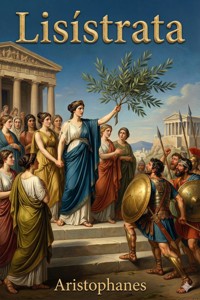
Lysistrata by Aristophanes is a bold and satirical comedy from ancient Greece that combines humor, political critique, and social commentary in a strikingly original way. First performed in 411 BCE during the Peloponnesian War, the play presents a daring and imaginative solution to the endless conflict between Athens and Sparta. At the center of the story is Lysistrata, a clever and determined Athenian woman who grows frustrated with the ongoing war and its toll on society. In an unprecedented act of unity, she gathers women from rival city-states and persuades them to withhold intimacy from their husbands until peace is achieved. This unconventional strategy sets the stage for a series of comedic encounters, witty exchanges, and escalating tensions between the sexes. Through sharp dialogue and exaggerated situations, Aristophanes uses humor to explore serious themes such as the futility of war, the dynamics of power, and the role of women in a male-dominated society. The play challenges traditional gender roles and highlights the intelligence, influence, and solidarity of women, even within a restrictive cultural framework. Blending farce with meaningful reflection, Lysistrata remains one of Aristophanes' most enduring works. Its playful yet pointed critique of politics and human behavior continues to resonate with modern audiences, offering both laughter and insight into the timeless desire for peace and understanding.
Sie lesen das E-Book in den Legimi-Apps auf:
Seitenzahl: 70
Veröffentlichungsjahr: 2026
Das E-Book (TTS) können Sie hören im Abo „Legimi Premium” in Legimi-Apps auf:
Ähnliche








Lysistrata
Aristophanes
Copyright © 2026 by Aristophanes
All rights reserved.
No part of this book may be reproduced in any form or by any electronic or mechanical means, including information storage and retrieval systems, without written permission from the author, except for the use of brief quotations in a book review.
Contents
Introduction
Chapter 1
Introduction
The ‘Lysistrata,’ the third and concluding play of the War and Peace series, was not produced till ten years later than its predecessor, the ‘Peace,’ viz. in 411 B.C. It is now the twenty-first year of the War, and there seems as little prospect of peace as ever. A desperate state of things demands a desperate remedy, and the Poet proceeds to suggest a burlesque solution of the difficulty.
The women of Athens, led by Lysistrata and supported by female delegates from the other states of Hellas, determine to take matters into their own hands and force the men to stop the War. They meet in solemn conclave, and Lysistrata expounds her scheme, the rigorous application to husbands and levers of a self-denying ordinance—“we must refrain from the male organ altogether.” Every wife and mistress is to refuse all sexual favours whatsoever, till the men have come to terms of peace. In cases where the women must yield ‘par force majeure,’ then it is to be with an ill grace and in such a way as to afford the minimum of gratification to their partner; they are to lie passive and take no more part in the amorous game than they are absolutely obliged to. By these means Lysistrata assures them they will very soon gain their end. “If we sit indoors prettily dressed out in our best transparent silks and prettiest gewgaws, and with our ‘mottes’ all nicely depilated, their tools will stand up so stiff that they will be able to deny us nothing.” Such is the burden of her advice.
After no little demur, this plan of campaign is adopted, and the assembled women take a solemn oath to observe the compact faithfully. Meantime as a precautionary measure they seize the Acropolis, where the State treasure is kept; the old men of the city assault the doors, but are repulsed by “the terrible regiment” of women. Before long the device of the bold Lysistrata proves entirely effective, Peace is concluded, and the play ends with the hilarious festivities of the Athenian and Spartan plenipotentiaries in celebration of the event.
This drama has a double Chorus—of women and of old men, and much excellent fooling is got out of the fight for possession of the citadel between the two hostile bands; while the broad jokes and decidedly suggestive situations arising out of the general idea of the plot outlined above may be “better imagined than described.”
Chapter1
Lysistrata (alone).
Ah! if only they had been invited to a Bacchic revelling, or a feast of Pan or Aphrodité or Genetyllis,* why! the streets would have been impassable for the thronging tambourines! Now there’s never a woman here—ah! except my neighbour Calonicé, whom I see approaching yonder. . . . Good day, Calonicé.
Calonicé.
Good day, Lysistrata; but pray, why this dark, forbidding face, my dear? Believe me, you don’t look a bit pretty with those black lowering brows.
Lysistrata.
Oh! Calonicé, my heart is on fire; I blush for our sex. Men will have it we are tricky and sly. . . .
Calonicé.
And they are quite right, upon my word!
Lysistrata.
Yet, look you, when the women are summoned to meet for a matter of the last importance, they lie abed instead of coming.
Calonicé.
Oh! they will come, my dear; but ’tis not easy, you know, for women to leave the house. One is busy pottering about her husband; another is getting the servant up; a third is putting her child asleep, or washing the brat or feeding it.
Lysistrata.
But I tell you, the business that calls them here is far and away more urgent.
Calonicé.
And why do you summon us, dear Lysistrata? What is it all about?
Lysistrata.
About a big affair.
Calonicé.
And is it thick too?
Lysistrata.
Yes indeed, both big and great.
Calonicé.
And we are not all on the spot!
Lysistrata.
Oh! if it were what you suppose, there would be never an absentee. No, no, it concerns a thing I have turned about and about this way and that of many sleepless nights.
Calonicé.
It must be something mighty fine and subtle for you to have turned it about so!
Lysistrata.
So fine, it means just this, Greece saved by the women!
Calonicé.
By women! Why, its salvation hangs on a poor thread then!
Lysistrata.
Our country’s fortunes depend on us—it is with us to undo utterly the Peloponnesians. . . .
Calonicé.
That would be a noble deed truly!
Lysistrata.
To exterminate the Bœotians to a man!
Calonicé.
But surely you would spare the eels.
Lysistrata.
For Athens’ sake I will never threaten so fell a doom; trust me for that. However, if the Bœotian and Peloponnesian women join us, Greece is saved.
Calonicé.
But how should women perform so wise and glorious an achievement, we women who dwell in the retirement of the household, clad in diaphanous garments of yellow silk and long flowing gowns, decked out with flowers and shod with dainty little slippers?
Lysistrata.
Nay, but those are the very sheet-anchors of our salvation—those yellow tunics, those scents and slippers, those cosmetics and transparent robes.
Calonicé.
How so, pray?
Lysistrata.
There is not a man will wield a lance against another . . .
Calonicé.
Quick, I will get me a yellow tunic from the dyer’s.
Lysistrata.
. . . or want a shield.
Calonicé.
I’ll run and put on a flowing gown.
Lysistrata.
. . . or draw a sword.
Calonicé.
I’ll haste and buy a pair of slippers this instant.
Lysistrata.
Now tell me, would not the women have done best to come?
Calonicé.
Why, they should have flown here!
Lysistrata.
Ah! my dear, you'll see that like true Athenians, they will do everything too late. . . . Why, there’s not a woman come from the shoreward parts, not one from Salamis?
Calonicé.
But I know for certain they embarked at daybreak.
Lysistrata.
And the dames from Acharnæ! why, I thought they would have been the very first to arrive.
Calonicé.
Theagenes wife* at any rate is sure to come; she has actually been to consult Hecaté. . . . But look! here are some arrivals—and there are more behind. Ah! ha! now what countrywomen may they be?
Lysistrata.
They are from Anagyra.
Calonicé.
Yes! upon my word, ’tis a levy en masse of all the female population of Anagyra!
Myrrhiné.
Are we late, Lysistrata? Tell us, pray; what, not a word?
Lysistrata.
I cannot say much for you, Myrrhiné! you have not bestirred yourself overmuch for an affair of such urgency.
Myrrhiné.
I could not find my girdle in the dark. However, if the matter is so pressing, here we are; so speak.
Lysistrata.
No, but let us wait a moment more, till the women of Bœotia arrive and those from the Peloponnese.
Myrrhiné.
Yes, that is best. . . . Ah! here comes Lampito.
Lysistrata.
Good day, Lampito, dear friend from Lacedæmon. How well and handsome you look! what a rosy complexion! and how strong you seem; why, you could strangle a bull surely!
Lampito.
Yes, indeed, I really think I could. ’Tis because I do gymnastics and practise the kick dance.*
Lysistrata.
And what superb bosoms!
Lampito.
La! you are feeling me as if I were a beast for sacrifice.
Lysistrata.
And this young woman, what countrywoman is she?
Lampito.
She is a noble lady from Bœotia.
Lysistrata.
Ah! my pretty Bœotian friend, you are as blooming as a garden.
Calonicé.
Yes, on my word! and the garden is so prettily weeded too!*
Lysistrata.
And who is this?
Lampito.
’Tis an honest woman, by my faith! she comes from Corinth.
Lysistrata.
Oh! honest, no doubt then—as honesty goes at Corinth.
Lampito.
But who has called together this council of women, pray?
Lysistrata.
I have.
Lampito.
Well then, tell us what you want of us.
Lysistrata.
With pleasure, my dear.
Myrrhiné.
What is the most important business you wish to inform us about?
Lysistrata.
I will tell you. But first answer me one question.
Myrrhiné.
What is that?
Lysistrata.
Don’t you feel sad and sorry because the fathers of your children are far away from you with the army? For I’ll undertake, there is not one of you whose husband is not abroad at this moment.
Calonicé.
Mine has been the last five months in Thrace—looking after Eucrates.
Lysistrata.
’Tis seven long months since mine left me for Pylos.*
Lampito.




