


56,99 €
Mehr erfahren.
- Herausgeber: John Wiley & Sons
- Kategorie: Fachliteratur
- Serie: Wiley Finance Editions
- Sprache: Englisch
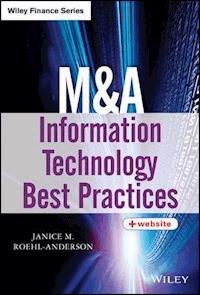
Add value to your organization via the mergers & acquisitions IT function As part of Deloitte Consulting, one of the largest mergers and acquisitions (M&A) consulting practice in the world, author Janice Roehl-Anderson reveals in M&A Information Technology Best Practices how companies can effectively and efficiently address the IT aspects of mergers, acquisitions, and divestitures. Filled with best practices for implementing and maintaining systems, this book helps financial and technology executives in every field to add value to their mergers, acquisitions, and/or divestitures via the IT function. * Features a companion website containing checklists and templates * Includes chapters written by Deloitte Consulting senior personnel * Outlines best practices with pragmatic insights and proactive strategies Many M&As fail to meet their expectations. Be prepared to succeed with the thorough and proven guidance found in M&A Information Technology Best Practices. This one-stop resource allows participants in these deals to better understand the implications of what they need to do and how
Sie lesen das E-Book in den Legimi-Apps auf:
Seitenzahl: 764
Veröffentlichungsjahr: 2013
Ähnliche


















Table of Contents
Series Page
Title Page
Copyright
Preface
This Book's Setup
Acknowledgments
PART I: Introduction
Chapter 1: Introduction to the IT Aspects of Mergers, Acquisitions, and Divestitures
Role of IT in M&A
Due Diligence
Integration/Separation Planning
Integration/Separation Execution
Wrapping It Up
Chapter 2: The Role of IT in Mergers and Acquisitions
Quest to Capture Synergies
Capturing the Benefits
Wrapping It Up
Chapter 3: Aligning Business and IT Strategy during Mergers, Acquisitions, and Divestitures
The Business-Aligned Integration Model
Enterprise Blueprint and IT Alignment
IT's Role in Functional Blueprinting
Decision Making and Business Alignment
Business Alignment in Due Diligence
Wrapping It Up
Chapter 4: Mergers and Acquisitions IT Strategy, Approach, and Governance: IT and Its Customers
Strategy
Approach
Governance
Finance
Operations
Human Resources
Information Technology
Wrapping It Up
PART II: Information Technology's Role in Mergers, Acquisitions, and Divestitures
Chapter 5: IT Due Diligence Leading Practices
Objectives and Complexities of IT Due Diligence
Areas of Investigation
Proprietary or Product Technology–Driven Due Diligence
Impact of Transaction Type on the Due Diligence Investigation
Investigation for Strategic Buyers versus Financial Buyers
Considerations of Planning IT Due Diligence
Considerations of Conducting IT Due Diligence
Considerations of Finalizing IT Due Diligence
Tying Due Diligence to the Next Steps in the Post-Merger Process
Wrapping It Up
References
Chapter 6: IT Infrastructure Aspects of Mergers, Acquisitions, and Divestitures
IT Infrastructure Blueprinting
IT Infrastructure Planning
IT Infrastructure Dependencies
Wrapping It Up
Chapter 7: M&A IT and Synergies
IT's Role and Contribution to Synergy Capture
Synergy Capture and Benefits Tracking during the Merger, Acquisition, and Divestiture Lifecycle
Wrapping It Up
Chapter 8: Supporting Business Objectives with M&A-Aware Enterprise Architecture
Sources of IT-Related Synergies during M&A
Post-Merger IT Integration Planning: The Model Makes the Difference
M&A-Aware Enterprise Architecture Models
Divestitures and the Enterprise Architecture Frameworks
Wrapping It Up
Chapter 9: The Importance of a Tested IT Strategy and Approach for Mergers, Acquisitions, and Divestitures
M&A IT Organization and Strategy
A Tested and Repeatable Approach for IT Integrations
A Tested and Repeatable Approach for IT Divestitures
Wrapping It Up
Chapter 10: Cloud Considerations for M&A IT Architecture
Understanding Cloud Solutions
Types of Cloud Solutions
Cloud Solution: Potential Benefits
Opportunity during Post-M&A Integration
Cloud Solutions for Post-M&A Plug-and-Play IT Frameworks
Determining Suitability for Cloud Solutions
Assessing Cloud Migration Timing
Establishing a Cloud Strategy
Evaluating Cloud Providers
Cloud Solution Success Factors
Wrapping It Up
Chapter 11: Data Implications of Mergers and Acquisitions
Criticality of Data Management in M&A Transactions
Data Governance and Organizational Considerations
Data Confidentiality, Privacy, Security, and Risk Management
Data Archiving Requirements
Data Management Road Map
Customer Data Considerations
Wrapping It Up
Chapter 12: Using M&A to Streamline the Applications Portfolio
Overview of an Applications Rationalization Program
Achieving Cost Synergies through Applications Rationalization
Achieving Operational Synergies through Applications Rationalization
Technology and Cost Impact in a Divestiture Event
Emerging Trends
Best Practices for Applications Rationalization in an M&A Scenario
Wrapping It Up
Chapter 13: Third-Party Contracts in M&A: Identifying and Managing Common Implications
Challenges Inherent in Different Types of M&A Transactions
Typical Realities
Primary Challenges
Tackling Challenges
Program Management
Wrapping It Up
Case Studies
Lessons Learned
Chapter 14: M&A IT Architecture and Infrastructure: Developing and Delivering Transition Services Agreements
Plan Early and Resource Appropriately
Foster Deal Team and Business Collaboration to Document Appropriately
Price Services Conservatively
Establish a Practical Governance Approach
Plan Exits and Remove Stranded Costs
Wrapping It Up
Chapter 15: Day 1 Implications for IT Functions
Top Day 1 Priorities for IT
Wrapping It Up
Chapter 16: Transition Services Agreement (TSA)—Untangling the Web
Key Considerations for Drafting an Effective TSA
Structuring the TSA
Managing TSAs
Governance of TSA Services through a Parallel Structure
Rationale for Accelerated Exit of a TSA
Key Considerations for TSA Exit
Wrapping It Up
Chapter 17: IT Risk, Security, and Controls in M&A: Identifying and Managing Common Considerations
Understanding the IT Risk, Security, and Controls Current State
Practices for Managing IT Risk, Security, and Control Considerations
Wrapping It Up
PART III: The People Aspects of Mergers, Acquisitions, and Divestitures
Chapter 18: The Role of the CIO in Mergers, Acquisitions, and Divestitures
The Double-Duty Role
The Internal Role
The External Role
Some Lessons Learned
Wrapping It Up
Chapter 19: The Role of CFO
Strategist Face
Catalyst Face
Operator Face
Steward Face
Wrapping It Up
Chapter 20: Managing the People Side of IT M&A
Key Priority: Communicating for Impact
Merger Stages
Effective M&A Communication
Key Priority: Defining the Future-State IT Organization
Steps in M&A Organization Design
Key Priority: Assessing and Selecting IT Talent
Key Priority: Managing Change
Start with Your Leadership Team
Transition Employees
Consider Cultural Implications
Assess Integration Progress
Wrapping It Up
Chapter 21: Planning for Business Process Changes Impacting Information Technology
Pre-Day 1 Planning
Day 1 Integration Imperatives
Long-Term Integration Requirements
Wrapping It Up
PART IV: M&A IT Project Governance, Testing, and Business Intelligence
Chapter 22: Integration Management Office Best Practices
Roles and Responsibilities
Key Activities
Sample IMO Templates and Deliverables
Managing the Deal
Wrapping It Up
Chapter 23: IT Program Governance during the Deal
Establish Governance Model
Establish the Program Management Office
Execute the Plan
Wrapping It Up
Chapter 24: Important Role of Data in an M&A Transaction
Current Challenges and Lost Opportunities
Top 10 Ways to Use Information Management to Improve M&A
Wrapping It Up
Chapter 25: Overview of Testing
Types of Testing
Testing Functions and Tools
Test Preparation Activities
Timing of Testing
Wrapping It Up
PART V: Conclusion
Chapter 26: Why Mergers, Acquisitions, and Divestitures Fail, and Considerations to Help Avoid a Similar Fate
M&A Risks
Common Pitfalls
Critical Success Factors
Wrapping It Up
Chapter 27: M&A IT Key Success Factors
Key Success Factors
Wrapping It Up
Chapter 28: M&A IT, Summing It All Up
Best Practices
Best Practices to Be Considered Prior to the Deal
M&A IT Strategy, Approach, and Governance Best Practices
M&A IT Security and Privacy Implications Best Practices
M&A IT and Synergies Best Practices
M&A IT Contracts Best Practices
M&A IT Organizational Implications Best Practices
Best Practices to Consider in Order to Execute the Deal
Lessons Learned
Wrapping It Up
Appendix A: M&A IT Playbook Overview
Scope of the Playbook
M&A Playbooks Should Be Alive
Variation in M&A IT Playbook Considerations Due to Differences in Types of M&A Deals
Deal Type—IT Divestures
Tools and Templates
Wrapping It Up
Appendix B: Sample M&A IT Checklists
IT Due Diligence
IT Integration Readiness
IT Divestiture Readiness
IT Transition Services Agreements (TSAs)
Data Requirements
Wrapping It Up
Appendix C: M&A IT Sample Case Studies
Introduction
Case Studies
Wrapping It Up
About the Editor
About the Website
Index
Founded in 1807, John Wiley & Sons is the oldest independent publishing company in the United States. With offices in North America, Europe, Australia, and Asia, Wiley is globally committed to developing and marketing print and electronic products and services for our customers’ professional and personal knowledge and understanding.
The Wiley Finance series contains books written specifically for finance and investment professionals as well as sophisticated individual investors and their financial advisors. Book topics range from portfolio management to e-commerce, risk management, financial engineering, valuation and financial instrument analysis, as well as much more.
For a list of available titles, visit our Web site at www.WileyFinance.com.
Cover image: © iStockphoto.com/nadla
Cover design: Wiley
Copyright © 2013 by John Wiley & Sons, Inc. All rights reserved.
Published by John Wiley & Sons, Inc., Hoboken, New Jersey.
Published simultaneously in Canada.
No part of this publication may be reproduced, stored in a retrieval system, or transmitted in any form or by any means, electronic, mechanical, photocopying, recording, scanning, or otherwise, except as permitted under Section 107 or 108 of the 1976 United States Copyright Act, without either the prior written permission of the Publisher, or authorization through payment of the appropriate per-copy fee to the Copyright Clearance Center, Inc., 222 Rosewood Drive, Danvers, MA 01923, (978) 750-8400, fax (978) 646-8600, or on the Web at www.copyright.com. Requests to the Publisher for permission should be addressed to the Permissions Department, John Wiley & Sons, Inc., 111 River Street, Hoboken, NJ 07030, (201) 748-6011, fax (201) 748-6008, or online at http://www.wiley.com/go/permissions.
Limit of Liability/Disclaimer of Warranty: While the publisher and author have used their best efforts in preparing this book, they make no representations or warranties with respect to the accuracy or completeness of the contents of this book and specifically disclaim any implied warranties of merchantability or fitness for a particular purpose. No warranty may be created or extended by sales representatives or written sales materials. The advice and strategies contained herein may not be suitable for your situation. You should consult with a professional where appropriate. Neither the publisher nor author shall be liable for any loss of profit or any other commercial damages, including but not limited to special, incidental, consequential, or other damages.
For general information on our other products and services or for technical support, please contact our Customer Care Department within the United States at (800) 762-2974, outside the United States at (317) 572-3993 or fax (317) 572-4002.
Wiley publishes in a variety of print and electronic formats and by print-on-demand. Some material included with standard print versions of this book may not be included in e-books or in print-on-demand. If this book refers to media such as a CD or DVD that is not included in the version you purchased, you may download this material at http://booksupport.wiley.com. For more information about Wiley products, visit www.wiley.com.
Library of Congress Cataloging-in-Publication Data:
M&A information technology best practices / Janice M. Roehl-Anderson, editor.
pages cm. — (Wiley finance series)
Includes index.
ISBN 978-1-118-61757-1 (cloth) – ISBN 978-1-118-74095-8 (ePDF) – ISBN 978-1-118-74106-1 (ePub) – ISBN 978-1-118-69202-8 (o-Book) 1. Information technology–Management. 2. Consolidation and merger of corporations. 3. Business enterprises. I. Roehl-Anderson, Janice M., editor.
HD30.2.M3 2013
004.068′1—dc23
2013019139
Preface
One of the most important aspects of many executives' jobs can be making sure a merger, acquisition, or divestiture is successfully completed and anticipated benefits are realized. Additionally, these executives need to help ensure that the information technology (IT) aspects of the deal are appropriately addressed.
In 2012 alone, the global deal volume was over $2.6 trillion.1 Given the increasing importance of IT over the past several years, there has been a significant amount of change in how systems impact the ultimate success (or failure) of a transaction. As a result, it is hard to stay abreast of the latest system trends and best practices2 for mergers, acquisitions, and divestitures. This book is focused on providing executives with an understanding of some of the most important system-related areas that can impact a merger, an acquisition, or a divestiture.
This Book's Setup
This book has been written to serve as a guide to mergers, acquisitions, and divestitures for executives and their direct reports. It is written in nontechnical terms and focused on helping facilitate successful deals by appropriately leveraging the IT function throughout the transaction. In short, it is a guide to IT best practices for mergers, acquisitions, and divestitures.
This book is divided into the following parts:
Part I: Introduction (Chapters 1 to 4):
Many organizations can fail to successfully address the systems aspects of a merger, acquisition, or divestiture. This part includes a detailed discussion of the IT aspects of deals, the role of IT during those deals, how business and IT strategy can be aligned during a deal, and some key components of how IT needs to manage its operations during a deal.
Part II: Information Technology's Role in Mergers, Acquisitions, and Divestitures (Chapters 5 to 17):
Information technology generally plays a critical role in the successful completion of a deal. As a result, it is important the IT area be included from deal conception to closure. In this part of the book the following key topics are discussed:
The importance of conducting thorough IT due diligence prior to deal closure.
Why it is important to assess and address the IT infrastructure (e.g., the hardware, software, and networks) prior to, during, and after the deal closes.
How IT can help capture significant synergies, including rationalizing the applications portfolio.
The importance of considering cloud computing as part of the deal, and why the data aspects of the transaction must be addressed up front.
An overview of third-party contracts and why they need to be considered during any deal.
Day 1 and Day 2 IT implications and the importance of transition services agreements (TSAs).
This part concludes with an overview of the IT-related risk, security, and control aspects of a merger, acquisition, or divestiture and why they need to be addressed.
Part III: The People Aspects of Mergers, Acquisitions, and Divestitures (Chapters 18 to 21):
One of the most important aspects of a merger, acquisition, or divestiture is addressing the people aspects of the deal. It is imperative for executives to understand the people-related components of these deals, whether they are the buyer or the seller. This part of the book contains overviews of and best practices related to the following aspects of these deals: the role of the CIO and CFO in mergers, acquisitions, and divestitures; an overview of how to manage the people side of the deal; and the importance of planning business process changes impacting IT.
Part IV: M&A IT Project Governance, Testing, and Business Intelligence (Chapters 22 to 25):
In this part, we review a number of topics critical to the success of a deal: program management office (PMO) best practices, the importance of strong IT governance during the deal, the business intelligence–related aspects of a deal, and the importance of testing the new systems.
Part V: Conclusion (Chapters 26 to 28):
This part of the book covers a number of topics that are important to any executive involved with a merger, acquisition, or divestiture: why deals fail and how to try to avoid a similar fate; the critical success factors for a merger, acquisition, or divestiture; and an overview of the key aspects the deals.
This book also includes valuable appendixes for readers as they embark on a merger, acquisition, or divestiture, including:
Appendix A: An overview of an IT playbook that can be used to help guide the IT team during the deal.
Appendix B: Sample IT checklists that can assist companies with making sure they are addressing the key aspects of a deal.
Appendix C: Case studies.
Notes
1 “Headwinds Put Crimp on Global M&A Deals,” Anapreeta Das and Dana Cimilluca Wall Street Journal, January 2, 2013.
2 “Best practices” represent the contributing authors' collective experience of what works in the real world and hundreds of years of their combined time facilitating the successful delivery of information technology projects.
Acknowledgments
Given the rapidly changing merger, acquisition, and divestiture environment, it was critical for the material in this book to be as timely and relevant as possible and also to represent the collective 200-plus years of experience of the contributing authors. The contributing authors, listed here in alphabetic order, wrote the chapters as follows:
In addition, the following individuals should be acknowledged for their outstanding support:
Janet Foutty, Deloitte Consulting LLP, who sponsored this book and provided guidance on its successful completion
Mark Walsh and Asish Ramchandran, Deloitte Consulting LLP, who led our M&A and M&A IT practices and provided support and wisdom
Mark Twomey and Suzanne Kounkel, Deloitte Consulting LLP, who were involved in building the eminence of the book
Mark White, Deloitte Consulting LLP, who has coordinated the marketing plans for the book
Tom Galizia, Deloitte Consulting LLP, who helped support the writing of the book
Jared Faellaci, Deloitte Consulting LLP, who is involved with marketing the book
Tony Scoles, Deloitte Consulting LLP, who provided outstanding legal support
Heidi Boyer, Deloitte Consulting LLP, who coordinated the marketing of the book
Eva Rowe, Deloitte Consulting LLP, who spent untold hours editing the book
Rupen Patil, Deloitte Consulting LLP, who assisted with tracking the chapters
Abhishek Singh, Deloitte Consulting LLP, who assisted with coordinating the development of the website materials
Piper Sims, Deloitte Consulting LLP, from Deloitte's Nerve Center, who helped launch the book
Danika Woods, Deloitte Consulting LLP, who assisted with preparing the book for publication
I am also indebted to the amazing folks at John Wiley & Sons, including:
Sheck Cho, Executive Editor
Stacey Rivera, Development Editor
Helen Cho, Editorial Program Coordinator
Kimberly Monroe-Hill, Senior Production Editor
Their ability to form the vision and guide the writing and editing of this book was beyond compare.
PART I
Introduction
Chapter 1
Introduction to the IT Aspects of Mergers, Acquisitions, and Divestitures
Varun JoshiSaurav Sharma
While many mergers and acquisitions (M&A) transactions fail to deliver value, a lesser-known but by some measures a more important fact is that the axis of value in mergers, acquisitions, and divestitures is more directly linked to getting information technology (IT) right than anything else. Information technology is generally the single biggest cost element in an M&A event (see Exhibit 1.1)—and can be the single biggest enabler of synergies. Getting IT involved early and often throughout the M&A lifecycle can be critical for effective execution and realization of benefits from a merger, acquisition, or divestiture.
Exhibit 1.1 M&A Spend Distribution
Source: Deloitte Analysis
Today, more than ever, the role of IT is under the lens as significant simultaneous disruptive forces are altering the technology landscape, and expectations are higher than ever from IT to enable changing business demand patterns. Disruptive technologies such as cloud computing, social media, mobility, and big data require a fundamental shift in the delivery and consumption of IT services. Business users now expect cheaper and more rapid deployment of technology to support business objectives through cloud computing and everything as a service (XaaS) platforms. Social technologies are enabling opportunities for collaboration, communication through social networks—the connected web of people and assets—and providing vehicles for discovering, growing, and propagating ideas and expertise. Mobility trends such as bring your own device (BYOD) are redefining mobile device management and enterprise security and privacy policies and procedures. Finally, through the application of big data, enterprises are looking to harness unstructured data formats that are not easily analyzed through existing business intelligence/analytics tool implementations.
These disruptive trends provide IT organizations with new tools to add to their arsenals, and through their appropriate utilization IT organizations can increase the likelihood of achieving three critical goals of an M&A transaction:
Role of IT in M&A
While the drivers for M&A can be varied, at the most fundamental level an M&A transaction is largely about realization of business benefits through synergy capture—whether cost savings or growth/strategy enablement (or both). The heavy reliance on information technology (IT) for business operations, management information, and financial reporting in today's business environment makes IT a priority item in the M&A agenda. An M&A transaction can add a significant degree of complexity to preexisting and often complex IT environments. Integrating or carving out complex systems requires a very strong focus on IT. However, companies often neglect or give low priority to IT during the early stages of the M&A lifecycle. The lack of focused IT involvement early on can have serious consequences, including:
Lesen Sie weiter in der vollständigen Ausgabe!
Lesen Sie weiter in der vollständigen Ausgabe!
Lesen Sie weiter in der vollständigen Ausgabe!
Lesen Sie weiter in der vollständigen Ausgabe!
Lesen Sie weiter in der vollständigen Ausgabe!
Lesen Sie weiter in der vollständigen Ausgabe!
Lesen Sie weiter in der vollständigen Ausgabe!
Lesen Sie weiter in der vollständigen Ausgabe!
Lesen Sie weiter in der vollständigen Ausgabe!
Lesen Sie weiter in der vollständigen Ausgabe!
Lesen Sie weiter in der vollständigen Ausgabe!
Lesen Sie weiter in der vollständigen Ausgabe!
Lesen Sie weiter in der vollständigen Ausgabe!
Lesen Sie weiter in der vollständigen Ausgabe!
Lesen Sie weiter in der vollständigen Ausgabe!
Lesen Sie weiter in der vollständigen Ausgabe!
Lesen Sie weiter in der vollständigen Ausgabe!
Lesen Sie weiter in der vollständigen Ausgabe!
Lesen Sie weiter in der vollständigen Ausgabe!
Lesen Sie weiter in der vollständigen Ausgabe!
Lesen Sie weiter in der vollständigen Ausgabe!
Lesen Sie weiter in der vollständigen Ausgabe!
Lesen Sie weiter in der vollständigen Ausgabe!
Lesen Sie weiter in der vollständigen Ausgabe!
Lesen Sie weiter in der vollständigen Ausgabe!
Lesen Sie weiter in der vollständigen Ausgabe!
Lesen Sie weiter in der vollständigen Ausgabe!
Lesen Sie weiter in der vollständigen Ausgabe!
Lesen Sie weiter in der vollständigen Ausgabe!
Lesen Sie weiter in der vollständigen Ausgabe!
Lesen Sie weiter in der vollständigen Ausgabe!
Lesen Sie weiter in der vollständigen Ausgabe!
Lesen Sie weiter in der vollständigen Ausgabe!
Lesen Sie weiter in der vollständigen Ausgabe!
Lesen Sie weiter in der vollständigen Ausgabe!
Lesen Sie weiter in der vollständigen Ausgabe!
Lesen Sie weiter in der vollständigen Ausgabe!




