


27,59 €
Mehr erfahren.
- Herausgeber: Packt Publishing
- Kategorie: Fachliteratur
- Sprache: Englisch
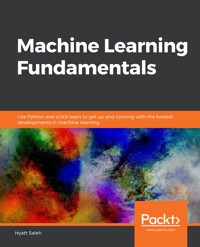
As machine learning algorithms become popular, new tools that optimize these algorithms are also developed. Machine Learning Fundamentals explains you how to use the syntax of scikit-learn. You'll study the difference between supervised and unsupervised models, as well as the importance of choosing the appropriate algorithm for each dataset. You'll apply unsupervised clustering algorithms over real-world datasets, to discover patterns and profiles, and explore the process to solve an unsupervised machine learning problem.
The focus of the book then shifts to supervised learning algorithms. You'll learn to implement different supervised algorithms and develop neural network structures using the scikit-learn package. You'll also learn how to perform coherent result analysis to improve the performance of the algorithm by tuning hyperparameters.
By the end of this book, you will have gain all the skills required to start programming machine learning algorithms.
Das E-Book können Sie in Legimi-Apps oder einer beliebigen App lesen, die das folgende Format unterstützen:
Seitenzahl: 254
Veröffentlichungsjahr: 2018
Ähnliche



















Machine Learning Fundamentals
Use Python and scikit-learn to get up and running with the hottest developments in machine learning
Hyatt Saleh
Machine Learning Fundamentals
Copyright © 2018 Packt Publishing
All rights reserved. No part of this book may be reproduced, stored in a retrieval system, or transmitted in any form or by any means, without the prior written permission of the publisher, except in the case of brief quotations embedded in critical articles or reviews.
Every effort has been made in the preparation of this book to ensure the accuracy of the information presented. However, the information contained in this book is sold without warranty, either express or implied. Neither the author, nor Packt Publishing, and its dealers and distributors will be held liable for any damages caused or alleged to be caused directly or indirectly by this book.
Packt Publishing has endeavored to provide trademark information about all of the companies and products mentioned in this book by the appropriate use of capitals. However, Packt Publishing cannot guarantee the accuracy of this information.
Author: Hyatt Saleh
Managing Editor: Neha Nair
Acquisitions Editor: Aditya Date
Production Editor: Samita Warang
Editorial Board: David Barnes, Ewan Buckingham, Simon Cox, Manasa Kumar, Alex Mazonowicz, Douglas Paterson, Dominic Pereira, Shiny Poojary, Saman Siddiqui, Erol Staveley, Ankita Thakur, and Mohita Vyas
First Published: November 2018
Production Reference: 1291118
ISBN: 978-1-78980-355-6
Table of Contents
Preface i
Introduction to Scikit-Learn 1
Introduction 2
Scikit-Learn 2
Advantages of Scikit-Learn 4
Disadvantages of Scikit-Learn 4
Data Representation 5
Tables of Data 5
Features and Target Matrices 7
Exercise 1: Loading a Sample Dataset and Creating the Features and Target Matrices 7
Activity 1: Selecting a Target Feature and Creating a Target Matrix 10
Data Preprocessing 12
Messy Data 12
Exercise 2: Dealing with Messy Data 17
Dealing with Categorical Features 22
Exercise 3: Applying Feature Engineering over Text Data 23
Rescaling Data 25
Exercise 4: Normalizing and Standardizing Data 26
Activity 2: Preprocessing an Entire Dataset 28
Scikit-Learn API 29
How Does It Work? 30
Supervised and Unsupervised Learning 33
Supervised Learning 33
Unsupervised Learning 35
Summary 37
Unsupervised Learning: Real-Life Applications 39
Introduction 40
Clustering 40
Clustering Types 40
Applications of Clustering 41
Exploring a Dataset: Wholesale Customers Dataset 42
Understanding the Dataset 43
Data Visualization 45
Loading the Dataset Using Pandas 45
Visualization Tools 46
Exercise 5: Plotting a Histogram of One Feature from the Noisy Circles Dataset 48
Activity 3: Using Data Visualization to Aid the Preprocessing Process 51
k-means Algorithm 52
Understanding the Algorithm 52
Exercise 6: Importing and Training the k-means Algorithm over a Dataset 55
Activity 4: Applying the k-means Algorithm to a Dataset 59
Mean-Shift Algorithm 59
Understanding the Algorithm 60
Exercise 7: Importing and Training the Mean-Shift Algorithm over a Dataset 61
Activity 5: Applying the Mean-Shift Algorithm to a Dataset 63
DBSCAN Algorithm 64
Understanding the Algorithm 64
Exercise 8: Importing and Training the DBSCAN Algorithm over a Dataset 65
Activity 6: Applying the DBSCAN Algorithm to the Dataset 67
Evaluating the Performance of Clusters 67
Available Metrics in Scikit-Learn 68
Exercise 9: Evaluating the Silhouette Coefficient Score and Calinski–Harabasz Index 69
Activity 7: Measuring and Comparing the Performance of the Algorithms 70
Summary 71
Supervised Learning: Key Steps 73
Introduction 74
Model Validation and Testing 74
Data Partition 74
Split Ratio 76
Exercise 10: Performing Data Partition over a Sample Dataset 78
Cross Validation 81
Exercise 11: Using Cross-Validation to Partition the Train Set into a Training and a Validation Set 82
Activity 8: Data Partition over a Handwritten Digit Dataset 84
Evaluation Metrics 84
Evaluation Metrics for Classification Tasks 84
Exercise 12: Calculating Different Evaluation Metrics over a Classification Task 88
Choosing an Evaluation Metric 90
Evaluation Metrics for Regression Tasks 90
Exercise 13: Calculating Evaluation Metrics over a Regression Task 92
Activity 9: Evaluating the Performance of the Model Trained over a Handwritten Dataset 93
Error Analysis 94
Bias, Variance, and Data Mismatch 95
Exercise 14: Calculating the Error Rate over Different Sets of Data 98
Activity 10: Performing Error Analysis over a Model Trained to Recognize Handwritten Digits 101
Summary 102
Supervised Learning Algorithms: Predict Annual Income 105
Introduction 106
Exploring the Dataset 106
Understanding the Dataset 107
Naïve Bayes Algorithm 111
How Does It Work? 111
Exercise 15: Applying the Naïve Bayes Algorithm 114
Activity 11: Training a Naïve Bayes Model for Our Census Income Dataset 116
Decision Tree Algorithm 117
How Does It Work? 117
Exercise 16: Applying the Decision Tree Algorithm 119
Activity 12: Training a Decision Tree Model for Our Census Income Dataset 120
Support Vector Machine Algorithm 120
How Does It Work? 120
Exercise 17: Applying the SVM Algorithm 124
Activity 13: Training an SVM Model for Our Census Income Dataset 125
Error Analysis 126
Accuracy, Precision, and Recall 126
Summary 129
Artificial Neural Networks: Predict Annual Income 131
Introduction 132
Artificial Neural Networks 132
How Do They Work? 133
Understanding the Hyperparameters 139
Applications 142
Limitations 142
Applying an Artificial Neural Network 143
Scikit-Learn's Multilayer Perceptron 143
Exercise 18: Applying the Multilayer Perceptron Classifier Class 144
Activity 14: Training a Multilayer Perceptron for Our Census Income Dataset 145
Performance Analysis 147
Error Analysis 147
Hyperparameter Fine-Tuning 148
Model Comparison 151
Activity 15: Comparing Different Models to Choose the Best Fit for the Census Income Data Problem 152
Summary 153
Building Your Own Program 155
Introduction 156
Program Definition 156
Building a Program: Key Stages 156
Understanding the Dataset 159
Activity 16: Performing the Preparation and Creation Stages for the Bank Marketing Dataset 163
Saving and Loading a Trained Model 165
Saving a Model 165
Exercise 19: Saving a Trained Model 166
Loading a Model 167
Exercise 20: Loading a Saved Model 167
Activity 17: Saving and Loading the Final Model for the Bank Marketing Dataset 168
Interacting with a Trained Model 170
Exercise 21: Creating a Class and a Channel to Interact with a Trained Model 171
Activity 18: Allowing Interaction with the Bank Marketing Dataset Model 173
Summary 174
Appendix 177
>
Preface
About
This section briefly introduces the author, the coverage of this book, the technical skills you'll need to get started, and the hardware and software required to complete all of the included activities and exercises.
1
Introduction to Scikit-Learn
Learning Objectives
By the end of this chapter, you will be able to:
Describe scikit-learn and its main advantagesUse the scikit-learn APIPerform data preprocessingExplain the difference between supervised and unsupervised models, as well as the importance of choosing the right algorithm for each datasetThis chapter gives an explanation of the scikit-learn syntax and features in order to be able to process and visualize data




