


18,49 €
Mehr erfahren.
- Herausgeber: The History Press
- Kategorie: Geisteswissenschaft
- Sprache: Englisch
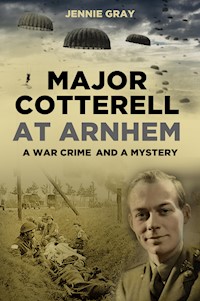
Conscripted into the British Army in 1940, talented journalist Anthony Cotterell was never going to make a natural soldier. The Army eventually realised that his abilities lay elsewhere and he was transferred to a new department of the War Office where he could do what he did best – write. He would become one of the Army's top journalists, eventually covering the D-Day landings and the Normandy campaign. Anthony managed to blag himself a place in the parachute drop at Arnhem in September 1944 as part of Operation Market Garden. Captured, on 23 September he was one of a group of British prisoners wounded or killed when SS guards opened fire. Treated in a German dressing station with the other wounded, Anthony then vanished without trace, the only member of the party to do so. In Major Cotterell at Arnhem, Jennie Gray tells the story of Anthony's rise to journalistic fame in the Army, the Arnhem adventure, the SS war crime and the disappearance. She then recounts the dramatic and painful three-year search to find Anthony mounted by the War Crimes Group, the Search Bureau and the Netherlands War Crimes Commission, in tandem with the private search made by Anthony's devoted brother, Geoffrey Cotterell. Best-selling author Geoffrey has kindly co-operated in in the writing of this book. Complemented by Anthony's own words, official War Crime Group documentation and the letters about the search that Geoffrey wrote almost daily to his mother, this is a poignant story of one man lost in the tumult of war.
Das E-Book können Sie in Legimi-Apps oder einer beliebigen App lesen, die das folgende Format unterstützen:
Veröffentlichungsjahr: 2012
Ähnliche




















For Shubbs, devoted brother of Anthony Cotterell, who contributed so much to this book but sadly did not live to see it published.
One could only understand Anthony at all well by keeping always in mind that he was a writer. He was that more than anyone I ever met.
Ernest Watkins, autobiography
The battle for Arnhem contains all the ingredients of a classical tragedy, both from a civilian and military point of view.
Piet Kamphuis, Holland at War Against Hitler
ACKNOWLEDGEMENTS
This book would not have been possible in this form without the involvement of Geoffrey Cotterell, Anthony’s brother. When I first got to know him, Geoffrey was in his late eighties and had had a major operation to replace his hip, yet during the course of the next two years we enjoyed two phenomenally successful research trips to Holland together. Geoffrey gave me many photographs and all the surviving Cotterell family documents which related to Anthony. The latter included not only the incredible sequence of letters which Geoffrey wrote to his mother in 1945–46, and those between his mother and his aunt Jane of the same period, but also all Anthony’s surviving unpublished typescripts, including the wonderful D-Day and Normandy material.
Geoffrey, a novelist who had had a string of best-sellers in the first twenty-five or so years after the war, took a huge interest in the projected book. He had a phenomenal memory, and what he told me about the search for Anthony was invariably verified when that particular facet of the search was covered by official documents. This was also the case with his correspondence with his mother in 1945–46. It is obvious that he was always truthful and scrupulously accurate with her, never hiding the worst potential explanations for Anthony’s disappearance.
The trips to Holland included exciting, amusing and, occasionally, rather harrowing times. The most moving experience of all was visiting No.12 Rozenhoflaan, the house in Zutphen in which Anthony’s wounds had been medically treated just before he vanished forever. After we got back to England, Geoffrey sent me the following email:
Re my impression of Rozenhoflaan I did send you an email which I’ve just failed to find under ‘sent’, so just possibly it didn’t get to you. I know what I said was similar to your own feelings, that there is a tremendous atmosphere, I said like the feeling you have when you enter an old enormous cathedral, full of immanence and history, with the space on the right of the front door a special very holy chapel, and I thought of Tone there being a sort of Christ figure from many an old master oil painting, down from the cross and attended by Mary etc. And looking towards the second door on the left, amazed that it was all just as Tannenbaum had described it to me. And therefore real. A haunted, awesome place.
Geoffrey had never ceased to grieve deeply over the loss of his brother, and even in old age still felt responsible for never having managed to find him or discover his fate. In his eighties, he once again began to make enquiries in Holland, hoped that perhaps the passage of time and the opening up of archives might shed light on Anthony’s disappearance. When I joined forces with him, I also had great hopes that I might solve the mystery, but a mystery it remains. I greatly regret this, but most of all I am sad that Geoffrey did not live to see this book published, one to which he contributed so much.
I would also especially like to thank Frits and Jeanne Slijkoord, who not only made the trip to No.12 Rozenhoflaan possible but also gave many details of life under the Occupation in Holland. Frits with great kindness translated some Dutch documents for me and helped in numerous other ways. Jeanne was the most invaluable eyewitness; as a child, she had seen the shooting in Brummen marketplace, and the horror of that event had made an indelible impression upon her.
An equally important helper in Holland has been Bob Gerritsen. Bob has an unrivalled knowledge of the battle of Arnhem and a stupendous archive of material, all of which he shared with me with the most perfect generosity, simply in the interests of establishing the truth. Several of the photographs in this book were sourced by Bob, including the astonishing picture of the British prisoners in Saint Eusebius in Arnhem. Bob thoroughly read the manuscript of this book and made many detailed and helpful comments. Bob also helped Geoffrey a great deal when Geoffrey first opened up the new enquiries about Anthony at Arnhem.
I owe a great deal to a number of other Dutch people. The owners of No.12 Rozenhoflaan, Rene Schepers and Renske Boersma, could not be there when we visited due to a sudden death in the family. However, with the greatest kindness they did not cancel the visit, but instead asked a kind neighbor to show us round their house.
I also owe a debt to Ymi Ytsma whose father-in-law, Police Detective Jan Arend IJspeerd of the Almelo Investigation Department, had been involved in the search for Anthony in 1945–46. Ymi shared with me the Kamp documents from The Hague and other material relevant to the search.
I would like to thank the following: Dick Schlüter of the Airborne Museum, Oosterbeek; Dirk Jan Dolfing of the Regionaal Archief, Zutphen; Adrie Roding of the Stadsarchief Enschede; and Ton Wientjen, a historian living at Enschede, who checked the Dutch archives to make sure that I had not missed vital information about Anthony’s disappearance. Ton also read the manuscript and made very helpful comments.
I must not leave out Wim Brekveld, who did such a marvellous job of driving me and Geoffrey around Holland, and who helped to make our two trips so enjoyable.
So far as English helpers are concerned, my grateful thanks go to Tony Hibbert, not only for talking to me at length about Anthony and Arnhem, but also for giving me a copy of his Arnhem and post-Arnhem diaries and allowing me to quote extensively from them. Another great source of information was Jim Flavell, who shared with me his memories of Arnhem and the paratroopers.
Roy Hemington at the Commonwealth War Graves Commission gave invaluable information about the British prisoners’ graves at Enschede. Rosemary Mcgrath, Anthony and Geoffrey’s cousin, filled in details of the family background. Graham Page, who is writing a biography of Barbara Skelton, notified me of the fascinating connection between Barbara and Anthony, revealed in her diaries. I thank them all.
I would also like to thank the following: Mark Hickman of the Pegasus Archive for helping with my enquiries and for permission to quote from the Pegasus Archive website, including the 1st Airborne Reconnaissance Squadron war diary (Crown Copyright). Thanks also go to Simon Middleton-Briggs for sharing Bernard Briggs’ document of the British prisoners’ wanderings after the shooting at Brummen; Kevin Bending, who helped identify the RAF station from which Anthony flew in December 1943 as Woodhall Spa; and Fred Preller, Webmaster for 384th Bomb Group in the Second World War, who supplied documents relating to Anthony’s flights with the 8th Air Force on bombing missions.
The Robert Graves connection to Anthony, through his daughter Jenny Nicholson, was a rich source of information. I would like to thank Caroline Shaw, the archivist at the St John’s College Robert Graves Trust, and Lucia Graves, Sam Graves, and Richard Graves. A useful letter from Anthony to Robert Graves also surfaced in the Robert Graves archive of the Poetry Collection, the University of Buffalo, and I thank James Maynard, the assistant curator, for finding it.
An incredibly rich seam of knowledge was found in the University of Calgary’s Special Collections, where Ernest Watkins’ papers are deposited. Watkins knew Anthony extremely well because he worked with him at WAR for two years. Having the greatest admiration for Anthony, he wrote extensively about him and their work for ABCA in his unpublished autobiography. I would like to thank Ernest Watkins’ sons, Tim and Nick, for permission to quote from their father’s writings, and for the picture of Ernest on his motorbike in Iceland. I would also like to thank the archivist Apollonia Steele of the Special Collections, for her great help in tracking down the relevant material.
I am very grateful to the following for the permission to quote from key texts: Judy Urquhart (Major General R.E. Urquhart, Arnhem); Jeremy Lewis (Tears Before Bedtime, estate of Barbara Skelton); Bob Gerritsen and Niall Cherry (Red Berets and Red Crosses: The Story of the Medical Services in the 1st Airborne Division in World War II); The History Press (Stuart Mawson, Arnhem Doctor); The Second World War Experience Centre (Sir John Killick, interviews with Peter Liddle and John Hutson); Pen and Sword Publishing (Major General John Frost, A Drop Too Many); Random House Group Ltd (Stephen Watts, Moonlight on a Lake in Bond Street). My best efforts have been made to obtain permission for certain other quotations, but it has not been possible to make contact.
Lastly, my thanks go to Helen Chapman, who was an enormous help in transcribing Geoffrey’s letters and following various leads, and to Professor Andrew Thorpe of the University of Exeter, who supervised my dissertation on Anthony and WAR, and gave me a great deal of encouragement at a time when the scale of this project looked somewhat daunting.
CONTENTS
Title
Dedication
Quote
Acknowledgements
Dramatis Personae
Prologue
PART ONE • BECOMING A SOLDIER: MARCH 1940 – JUNE 1941
1The Cotterell Family
2Fleet Street Journalist
3Conscript Life
4The Antelope and Other Unmilitary Activities
5Depression
6Officer Training
7Platoon Commander, Infantry Battalion
8‘Pleasantly Irresponsible and Relatively Entertaining’
PART TWO • WAR CORRESPONDENT: JUNE 1941 – SEPTEMBER 1944
9ABCA-CADABRA
10Expanding the Brief
11Shubbs’ War, Jenny Nicholson, and Anne
12Parachutist
13Prelude to D-Day
14D-Day
15With the Tank Crew
16The Battle of Fontenay
17Interlude
18‘We are Jumping to a Conclusion’
PART THREE • ARNHEM: 17–23 SEPTEMBER 1944
19Sunday, 17 September 1944
20The Defence of the Bridge
21Prisoner of War
22Murder
23The Dressing Station at Zutphen
PART FOUR • THE SEARCH: SEPTEMBER 1944 ONWARDS
24After the Shooting
25‘Missing, Believed Wounded and Prisoner of War’
26Watkins’ Pilgrimage
27Janie and the Search for Anthony
28Witnesses, Helpers and War Office Stonewallers
29Geoffrey Takes Over the Search
30Hamburg
31The War Crimes Group and the Search Bureau
32Back to Holland
33Etter
34The Enschede Connection
35Dr Saniter and Thomson the Orderly
36Schmidt, Fritzsche and Other Leads
37Demob and Afterwards
38What Happened to Anthony Cotterell?
Epilogue
Appendix: The Graves at Enschede General Cemetery
Notes
Bibliography
Plates
Copyright
DRAMATIS PERSONAE
Surname
First name
Rank/title
Role
Description
Adam
Sir Ronald
General
ABCA & War Office
Adjutant-General of the British Army, ultimately responsible for WAR
Beattie
Edward
American war reporter/PoW
As PoW, taken to Berlin to meet Nazi hierarchy – possible parallel to Anthony’s treatment
Braden
Unknown
Dr
German Military in Holland
Travelling in the car with Etter when they came across the Brummen shooting
Briggs
Bernard
Captain
Airborne Forces
On the truck at Brummen
Cairns
John
Lieutenant
Airborne Forces
On the truck at Brummen, cared for Anthony after he was shot
Conroy
David
Major
Search Bureau
Key part of the search for Anthony
Cotterell
Geoffrey
Family
Brother of Anthony
Cotterell
Graham
Family
Father of Anthony and Geoffrey
Cotterell
Mintie
Family
Mother of Anthony and Geoffrey
Etter
Gustav
Oberleutnant
German Military in Holland
Wehrmacht Intelligence Officer, prevented further shooting at Brummen
Finlay Wilson
R.
Lieutenant
Airborne Forces
On the truck at Brummen
Fritzsche
Hans
Dr
German Propaganda
Chief of the Radio Division of the Ministry of Propaganda under Goebbels from 1942
Frost
John
Lieutenant-Colonel
Airborne Forces
CO of 2nd Battalion, 1st Parachute Brigade
Gough
Freddie
Major
Airborne Forces
CO at the Arnhem bridge after Frost wounded, senior British officer at Brummen
Hibbert
Tony
Major
Airborne Forces
Brigade Major of 1st Parachute Brigade HQ, escaped at Brummen
Kamp
Gerrit
Sergeant
Netherlands War Crimes Commission
Military policeman, key figure in search for Anthony
Kinsleigh
H.P.
Captain
War Crimes Group (NWE)
Chief investigating officer, Team 3, Field Investigation Section
Korteweg
Anton
Dr
Dutch in Brummen
Attended to the wounded after the Brummen shooting
Lathbury
Gerald
Brigadier
Airborne Forces
CO of 1st Parachute Brigade
Lathe
Heinrich
Dr
German Military in Holland
Doctor at No. 12 Rozenhoflaan on the night of 23 September 1944
Matzke
Rudolf
Unterscharführer
German Military in Holland
SS guard, accused of murdering the British prisoners at Brummen
McCracken
Ernest
Private
Airborne Forces
Shot at Brummen, died the same day
McNabb
Trevor
Lieutenant
Airborne Forces
Shot at Brummen, died four days later at St Joseph’s, Enschede
Pool
Janie
Family
Aunt of Anthony and Geoffrey
Reade
A.E.E.
Major
War Crimes Group
Legal Section of War Crimes Group (NWE) at HQ, BAOR
Saniter
Erich
Dr
German Military in Holland
Doctor at No. 12 Rozenhoflaan on the night of 23 September 1944
Schmidt
Paul
Dr
German Propaganda
Chief of the Press Division of Ribbentrop’s Foreign Office
Shubbs
Family
Family petname of Geoffrey
Staubwasser
Anton
Obersturmführer
German Military in Holland
Chief Intelligence Officer of Model’s Heeresgruppe B, superior officer of Etter
Tannenbaum
Albert
Lieutenant
Airborne Forces
Shot and seriously wounded at Brummen, survived
Taubert
Eberhard
Dr
German Military in Holland
Propaganda chief in the Netherlands, in charge of Radio Hilversum under Goebbels
Tigges
Ernst
Dr
German Military in Holland
Soldier-Journalist providing news for Radio Hilversum
Tjeenk Willink
Aps
Dutch in Brummen
Mother of Dick, hid Tony Hibbert after shooting, key helper in search for Anthony
Tjeenk Willink
Dick
Dutch in Brummen
Son of Aps, hid Tony Hibbert after shooting, key helper in search for Anthony
Urquhart
Roy
Major-General
Airborne Forces
CO of 1st Airborne Division
Watkins
Ernest
Captain
ABCA & War Office
Worked for Anthony on WAR, took over as Major after Anthony’s disappearance
Watts
Stephen
Captain
ABCA & War Office
Worked with Anthony on WAR until early 1943
PROLOGUE
Brummen, Province of Gelderland, Holland, 23 September 1944
It was a warm afternoon and the weather was beautiful, with the fine clear light often seen in Gelderland as autumn approaches. In Brummen, the Dutch were going about their usual Saturday business and the German occupiers were likewise going about theirs. Village children played in the sunshine whilst their adults shopped in the small marketplace. But beneath the calm surface of an apparently ordinary day there lay an immense trembling excitement. It was 23 September 1944, exactly six days since the largest airborne attack in history had been launched by the Allies on Dutch bridges at Eindhoven, Nijmegen and Arnhem.
Brummen lay a mere eight miles north-east of Arnhem on what was now one of the main routes to Germany. From Sunday until Wednesday night, the villagers had heard the thunderous din of a battle fought as fiercely as that for Stalingrad. They had seen the black clouds of smoke rising from the ruined town and had heard stories of the desperate struggle. Hopelessly outnumbered, a small British force had fought on at Arnhem bridge until the early hours of Thursday morning. Then the incessant thunder of the guns had faded, though it could still be heard from a little farther down the Rhine at Oosterbeek, where the British general, Urquhart, and his men were holding out.
From first light on Monday, straggling groups of refugees from Arnhem had been passing through the village. Some had found shelter there; others had continued on their way. But with the battle lost, a far more dramatic exodus had started – the victors were moving their prisoners to Germany. The villagers had already seen several batches of prisoners driven past in lorries, or marched through under armed guard. After four years of German occupation, the airborne soldiers were an astonishing sight. Although the British had lost the battle, the villagers still saw them as liberators, close to heroes of legend in their valour. The soldiers’ red berets were very striking, as was their smiling courage in the face of adversity. They were singing or whistling ‘It’s a long, long way to Tipperary’, the archetypal song of the European resistance, which was sometimes quietly echoed by the villagers to show where their sympathies lay. Other villagers waved a scrap of material in the Dutch national colour, orange, or surreptitiously made the illegal V-Victory sign.1
At around 6.00pm a solitary German army lorry, travelling at high speed and without escort, arrived in Brummen. In the driver’s cab sat the driver and two Waffen-SS men. On the running board, armed with a sub-machine, was another SS guard. The back of the lorry had wooden side-boards and tail-board, but the usual tarpaulin cover had been removed and the passengers could be clearly seen. Two Luftwaffe guards were sitting by the tail-board, armed with pistols and rifles. They were guarding some thirty British airborne soldiers, almost all of them officers, who were having to stand because space was so limited. A couple of the officers had found an uncomfortable perch on the metal roof of the driver’s cab. One of these was a 27-year-old Major, slight in build and strikingly good-looking, with dark brown hair, a pale complexion, and brown-green eyes.
The truck came down the side of the marketplace and turned left into the sharp bend of the road to Zutphen. Owing to the combination of the bend and the crowd of villagers, the speeding vehicle was forced to slow right down. Two of the SS guards jumped off, apparently to deal with some villagers who were making the V-Victory sign. As they did so, Dutch onlookers suddenly noticed that two British officers were making an escape attempt. One jumped off to the left of the lorry, the other to the right. The second man stumbled and fell as he landed but was up immediately, running for his life in a hail of bullets. By a thoroughly unlucky chance, another German lorry had just appeared from the opposite direction and its driver alerted the first lorry that it was losing its prisoners. SS soldiers jumped down from the second lorry and opened fire. In a split second, the peaceful scene in the marketplace had degenerated into a maelstrom of chaos, violence and bloodshed. The civilians fled in horrified panic. On reaching the safety of home, some watched the scene from behind their curtains. They saw the truck with the remaining British soldiers move out of the marketplace around the sharp bend into the Zutphen road. The truck stopped with a jerk by the Post Office, a large handsome building which stood in a quiet and pleasant street.
The prisoners had lost their balance and had been sent sprawling when the truck stopped. None of them were trying to escape, yet firing was still going on. Then as suddenly as it had all started, everything seemed to stop. Events had happened so quickly, had been so terrifying and confusing, that, as yet, none of the Dutch were sure exactly what had happened. But one nightmare thing was obvious – an SS soldier had been shooting into the now stationery truck with a sub-machine gun at point-blank range. Only the jamming of the gun or the emptying of his magazine had prevented a mass execution. He was fumbling with his gun now, trying to make it work. Another SS soldier joined him and began taking pot shots at the prisoners with a pistol.
Only a few seconds more might have seen them murder everyone in the truck. But then, as if by a miracle, a third German vehicle chanced upon the scene, a Volkswagen staff car from Field Marshal Model’s Heeresgruppe B. In it was travelling a Wehrmacht officer, on his way to interrogate prisoners. Critically, the Wehrmacht officer outranked the SS guards at the scene. He took immediate charge of the situation. Witnesses would remember him shouting at the SS, ‘What are you doing? These are British officers, not Russians.’
All the prisoners who could move were ordered to get off the truck, and made to sit on the side of the road, cross-legged, with their hands on their head. The dead were removed, placed on the ground in front of the prisoners, and then – and only then – were the wounded taken off the truck. Amongst them was the dark-haired Major who had been sitting on the driver’s cab. He was seriously hurt, but conscious and lucid. Though the Brummen villagers did not know it yet, his name was Anthony Cotterell.
PART ONE
BECOMING A SOLDIER: MARCH 1940 – JUNE 1941
1
THE COTTERELL FAMILY
Anthony Cotterell was not a professional soldier, he was a conscript. Nor could the British Army turn him into a professional soldier once it owned him. First as an ordinary infantry private, then as a very junior infantry officer, he failed to fit the military roles for which the Army had trained him. He got the lowest pass grade achievable on his officer training course, and in subsequent postings proved something of an absent-minded liability to his commanding officers. But what he could do for the Army was write. By the time of the battle of Arnhem, he was one of the Army’s top journalists, an ambitious young man becoming famous not only in military but in civilian circles. He went to Arnhem not to fight but to record the extraordinary airborne drop of some 11,000 soldiers in an operation which was confidently expected to end the war by Christmas. Instead, the operation turned into a colossal military disaster. Amongst the thousands of prisoners taken after the battle was Anthony.
The path which led Anthony to Brummen had begun on 9 March 1940, when his call-up papers arrived at his family home in Wanstead. It was the period of the Phoney War, when, despite a few alarms and excursions, life was continuing much as it had done pre-war. Anthony, then only 23, but already a feature writer on the Daily Express, had come home for the weekend as he always did. His family was small but close-knit, consisting of his parents, Graham and Mintie, and his only sibling, his younger brother, Geoffrey, who was trying to become a novelist.
On the morning that he received the call-up letter, Anthony’s immediate preoccupation was how on earth he was going to break the dreadful news to his family. Although the letter had been expected for weeks, everyone was hoping against hope that it would be delayed for a very long time. Mintie was in a deep state of anxiety about both her sons, for Geoffrey was also on the verge of being called up. Like all her generation, Mintie remembered the slaughter of three-quarters of a million British men in the trenches of the Great War, and was haunted by the nightmare that it might all happen again.
She also had a less serious concern – she feared that army life would coarsen Anthony. This was not a view shared by his caustic Daily Express friends, who quipped that Anthony would coarsen the Army.2
The Cotterells’ family home, Ham Frith, stood opposite the Green at No. 1, Grove Park. Wanstead had once been a favourite haunt of Tudor grandees, attracted by the rich hunting in nearby Epping Forest, but their rural idyll had long ago been destroyed by the creeping growth of London. One of the few remnants of Wanstead’s golden age, the Green was a meeting place for people with dogs. It was dotted about with a few ancient trees of which the locals were extremely proud: ‘They regarded the trees as the innermost outskirts of Epping Forest and as a satisfactory substitute for the countryside.’3
Ham Frith was a very large red-brick house, built around 1900, with something of the Arts and Crafts style in its architecture. Handsome, spacious and airy, it smelt evocatively of wood and polish. Several of its furnishings were of good solid oak, carved in the fashion of the Middle Ages as interpreted by commercial disciples of Burne-Jones and William Morris. There were brick fireplaces, leather armchairs, brass candlesticks, and bits of Arts and Crafts-style pottery which had come from Mintie’s old family home in Plymouth. Because of the family’s love of music, there were two grand pianos, one in the drawing room and one in the back room. A one-storey extension, with a wall composed almost entirely of windows, overlooked the large, beautifully kept garden.
Both Anthony’s parents had made their own way in life. Mintie’s family, once wealthy, had fallen on hard times after the early death of her father, and before her marriage she had worked occasionally as a singer and a pianist. Graham had come from a respectable but impoverished middle-class background. He too had been a pianist, good enough to contemplate turning professional, but instead had chosen the more prudent path of dentistry. His local surgery was in Ham Frith itself. With its treatment room, X-ray and telephone room, dental assistant’s room and waiting room, the surgery took up about half of Ham Frith’s ground floor. Graham also had a very prestigious practice in London, in Cavendish Place, between Regent Street and Harley Street. In addition, every Saturday he held a free surgery at Queen Mary’s Hospital for the East End, in line with the medical tradition of services to the poor.
Graham had a very dry sense of humour. On Mintie’s side of the family, there were two elderly spinster aunts named Pop and Mil, still living in Plymouth – ‘dried-up, poor old things, who lived very simple lives’. After they died, someone observed of them piously, ‘All they wanted was the air to breathe,’ at which Graham snorted, ‘And that’s all they bloody well got!’4
Attractive, sociable, cynical, and very generous, Graham was not short of female admirers. He and Mintie had a strong but occasionally tempestuous marriage owing to his tendency to have affairs. Mintie was a feminist in an unobtrusive way, who once told Anthony’s cousin, Rosemary, that she should never support men against women.5 Strong-willed and passionate, Mintie had been ravishingly pretty in her youth and was still very elegant and charming, with dark hair and delicate features. Geoffrey took after Graham, but Anthony was very like his mother, a masculine version of her fine-boned feminine beauty. He and she shared the same birthday of 19 December. Although they had occasional clashes of will, they were very close to one another and she adored him.
Anthony’s bedroom was at the front of the house, overlooking the Green. He had never really moved away from home and family, and the room had been preserved for him by his parents almost unchanged since boyhood days. The arrival of the call-up letter decisively ended the life he had led for the last six years, ever since he had abandoned his medical and dental studies at Guy’s Hospital in order to follow his dream of becoming a journalist. He was now about to enter an entirely new way of life, one for which he was unfitted by tastes and character but which he was absolutely determined to make the best of. Weeks earlier, he had decided – with characteristic brio – that he would write a best-selling book about his conscript experiences. Now that the call-up letter had arrived, he immediately began to make notes for the book. It would be published ten months later under the title What! No Morning Tea?, and it would indeed become a best-seller.
What! No Morning Tea? begins at the very moment that Anthony received his call-up letter. The book’s unconventional tone, which would be anathema to conventional military types, is immediately evident in the first few paragraphs:
I was just putting the lead on the dog when our maid Daisy gave me the letter.
I took one look and knew. This was it. And it was.
A railway voucher, a postal orders for 4s, and some orders.
For the first time since I left school someone was giving me orders which I couldn’t walk out on or argue about. […]
I really laughed. The whole thing was so awful, it was funny. Everything you had ever worked for was sent up in smoke by that halfpenny circular. Every hope, every plan.
Not that I had anything in particular against the Army. But I was comfortable and I didn’t want to be disturbed. An unconscientious objector.6
The call-up letter gave Anthony less than six days to put his affairs in order – he was to go into the Army on the following Friday. Needing to be alone to digest the appalling news, he took Sam, the dog, for his accustomed Saturday walk on the Green. He stayed out for more than an hour, walking about and thinking.
I wasn’t thinking about the amputation of good-bye, or the blow of throwing up a life that was being quite kind to me. The thoughts jumping through my mind were whether I should take hair-cream and what time I should be free at nights. Then I couldn’t get there by 12 noon. That would mean catching a train before 8am, and I never get up before 9. I must wire them to say I shall be arriving later.
My God, no. I must not wire them to say I should be arriving later. That day is done. From Friday on I get there just when they say. ‘They’ had come into my life again.7
By the time he returned to Ham Frith, Anthony had decided not to say anything about the call-up letter but to carry on exactly as if nothing had happened. That way nobody would be upset, and he and the family could enjoy his last weekend at home. At some point during the following week, when he was back in London, he would ring his mother and tell her that he was going to Brighton at the weekend when in reality he would be going to his training camp. He would write and admit the truth only once he was in the Army. The sole exception to the news blackout would be Geoffrey.
Back at Ham Frith it was lunchtime.
Naturally the big topic at lunch that day was when I should be called up. The subject was quite unchangeable.
‘It can’t be long now,’ said Mother. ‘I don’t know what I shall do when it does come. I don’t know. I really don’t know. I lie awake at nights shuddering at it. My God, I never thought this would ever have to happen again.’
‘Ah well, there you are,’ I said.
‘Perhaps you’ll get another month or two.’
‘That’s right,’ I said.
It was just like every other Saturday afternoon.8
After lunch, his uncle and aunt, Ivor and Jane Pool, arrived. Jane, usually known as Janie, had no children of her own, and was very close to her sister Mintie and her nephews. A brilliantly gifted pianist, Janie had once been a child virtuoso, but the death of her and Mintie’s father had destroyed her hopes of a glittering musical career. As a young woman, Janie had earned money by playing in the small orchestra of a café popular with First World War naval officers. Amongst those officers had been Graham, who had at first found her rather attractive and paid her much attention until he met her much younger sister, Mintie. Besides being incredibly beautiful, Mintie had a captivating, bubbly, flirtatious manner. Inevitably Graham married her rather than the sweet-faced but older and more serious Janie.9
Janie’s marriage to Ivor took place almost on the rebound. Ivor was a soldier and extremely good-looking, but he was never to have Graham’s success in life. After the war, he became an engineer for the Post Office, obsessed with inventing gadgets which were always going to make his fortune but never did. The marriage was disconnected and unhappy. Ivor grew profoundly jealous of Janie’s musical brilliance and independence, and spoke of her with spiteful disparagement in front of other people. A tangential gleam of the situation between husband and wife appears in Anthony’s description of the archetypal family weekend at Ham Frith:
Week-ends in our family have always been rather stylised affairs, with the same people being punctually unpunctual for the same things.
Aunt Jane and Uncle Ivor always came out on Saturday after lunch. They had hardly missed a weekend for twenty years. For twenty years Ivor had come in and said that Jane had ruined his afternoon by not being ready at the proper time. For twenty years Ivor had driven out from town like the fire brigade to get to his golf, and then when he got there, wasted half an hour playing games with the cat, the dog or the parrot. Different cats, different dogs, different parrots, but the same games.
This ordered way of life was on the verge of coming to an end. Not only were Anthony and Geoffrey about to be conscripted, but Janie was shortly to volunteer for war service with the Entertainments National Service Association (ENSA). Her marriage with Ivor would end, and she would spend the next five years on the road. In May 1945, ENSA would take her to Holland just after the Liberation, where she would make the first on the spot enquiries in Brummen about the shooting.
Writing of this last old-style weekend at Ham Frith before everything changed forever, Anthony gently mocked his own pedestrian ways.
My week-end routine was always the same. Golf lesson Saturday morning, pictures in the afternoon, take the dog for a walk after dinner, get up late Sunday morning, play golf with our pro, Allan Dailey, after lunch.
The funny people I met up in London used to tell me I ought to get away for a change at week-ends, but I enjoyed things my way. And at home I got things my way. I enjoyed it far more than having a change spending too much money on too many drinks somewhere in the country.
I tell all this not only for personal advertisement but to indicate the rather pedestrianly routined sort of young man I was on entering the army.10
On this particular day, everything went off as it usually did. Ivor played for a while admiringly with the new kitten, Dietrich. Then he, Graham, and Graham’s friend Mr Townley, went off to the nearby golf club as they always had done on Saturday afternoons, seemingly since time immemorial. As Graham was leaving, Mintie said ‘Don’t you be late back from that club,’ knowing perfectly well that he would be. Anthony lit his Saturday afternoon cigar and settled down in a chair by the fire; Geoffrey played dance music on the gramophone. Time flew gently. At 4.00pm the two brothers, their mother and aunt had a cup of tea, and then drove to the pictures at Ilford as they had done for years on Saturday afternoons. Anthony found it sad to be doing it for the last time.
The picture ended at about 8.00pm. They emerged into a blacked-out night, lit only by the intermittent flaring glares where men were working on the tube railway extension.
Father and Ivor were home before us. We had a couple of drinks and then sat down to dinner. It was the last beef-steak pie before meat rationing. I went down to the cellar and got our Saturday night bottle of red wine.
We had our invariable argument about sex, about local personalities, and about how to run a house.11
The argument, though heated, would not have been a serious one. The family were very close, and their tenderness for one another was expressed in their various pet-names. Mintie’s Christian name was Millicent, but to Janie she was always Mintie whilst Janie to her was always Judy. Anthony was called ‘The Count’ when Mintie and Geoffrey discussed him, whereas when Mintie and Anthony discussed Geoffrey he was always ‘Our Young Friend’. On an everyday basis, Anthony was ‘Tone’ and Geoffrey was ‘Shubbs’. This latter name came from the first time that Anthony, then three years old, had seen his tiny infant brother, and with his incredible precocious intelligence had pronounced, ‘I name this little thing Shubbles’.
Anthony did not break his silence about the call-up letter either during the evening meal or in the various quiet middle-class amusements of the following day. After years of the rigours of public school, he was too fine an actor to betray his personal secrets and no one in his close family guessed a thing.
For six years Anthony had attended King’s School, Rochester, as a scholarship boarder. The school had been his own choice, not that of his parents, and it was he who had arranged the scholarship, worked for it, and won it. A hugely prestigious and ancient institution, King’s School had taught him the accent and manners which could only come from such a privileged education. It had also, however, taught him the darker arts, in particular how to tell barefaced lies without the slightest feeling of shame. Like many of his contemporaries, Anthony was about to discover that public school had been an excellent preparation for army life. As a conscript, he would comment that there could be ‘no less ardent old school boy than I’ whilst acknowledging how well he had been taught: ‘From the point of view of personal happiness give me the Army every time, but if you have been to [a public school] the Army discipline and atmosphere comes quite naturally.’12
The weekend routine at Ham Frith always concluded with Anthony packing his suitcase late on Sunday night for the return to London by train on Monday morning. On the last night that he slept in his old bedroom before going into the Army, he sat down upon the bed and in his usual hyper-observant way recorded the following:
It was like the last night of the holidays. Only the tuckbox was missing. For the room was still essentially a schoolboy’s. The Wonder Book of Why and What and the bound volumes of the Model Railway Magazine were still on the shelves. There were none of the appurtenances of young manhood. No pipe-rack, no tobacco jar, no photographs of young women. The brown Jaegar dressing-gown on the door was still marked A Cotterell, School House. Time had marked time.
By breakfast time my Sidney Carton complex was at boiling point. I was bathed in self-satisfaction; bidding silent farewells to everything in sight, even the lavatory.
Mother was up in the bathroom rummaging with the laundry when I said my usual good-bye. She looked up a minute. ‘Oh, good-bye darling. Take care of yourself. I worry, you know.’13
Still pretending that everything was normal, he kissed her goodbye affectionately and left to catch the train to London.
2
FLEET STREET JOURNALIST
On arrival in London, Anthony headed for the Express offices in Fleet Street, in the heart of the press district. Number 121-128 Fleet Street had been specially built for the Express in the early 1930s. Designed in the ultra-fashionable Art Deco style, it reflected the newspaper’s ethos of being bright, young, dynamic, and risk-taking. The exterior was covered with black Vitrolite and clear glass interspersed with chromium strips, but it was the interior which was the most remarkable, in particular the magnificently exuberant entrance hall. Mythical figures representing industry looked out over an expanse of marble and gilt, whilst from the opulent ceiling with its shining zigzag cornice there hung an immense silvered lantern. There was a Moorish influence, all mixed up with a lot of other flummery, and the whole dominated by Epstein’s head of the proprietor, Lord Beaverbrook.
Writing of his last Monday there, when he knew that he might be leaving the place for ever, Anthony gave his own, very characteristic description of it:
Downstairs in the musical comedy entrance hall I gazed pensively for a moment at Epstein’s head of Lord Beaverbrook. I never pass it without recalling the story told of little Maude Mason, the schoolgirl whose patriotic essay was mentioned in the House of Commons. With commendable public spirit the Daily Express took Maude to Parliament so that we, the people, might know what she thought about it. They brought her back to the office to be interviewed, and while going upstairs she is supposed to have leaned over the banisters and been sick on Lord Beaverbrook’s head.14
Anthony went upstairs to where he worked in a corner of the second floor. It was around 11.00am, an early hour for a London journalist to be at work, and not all his colleagues had yet arrived. There was a review copy of a book about career choice on his desk, one problem, as he observed to himself sardonically, that he did not have.
Anthony’s desk was near that of the cartoonist, Osbert Lancaster, who had recently quipped that Anthony’s departure for the Army would ‘inevitably be tinged with farce’ and that the only tears, apart from Anthony’s, would be ‘caused by laughter’.15 Other staff such as Miss Coe (who would kindly write to Anthony at conscript camp to give him all the latest office gossip) had been somewhat more sympathetic, but the Daily Express workplace culture was so vivid, cruel and worldly that it tended to drown out the quieter, kinder voices.
When Anthony had joined the staff in April 1936, the Daily Express was approaching its zenith as the most exciting and influential newspaper in Britain. Its owner, Lord Beaverbrook, dominated both the newspaper and political worlds. A close friend of Winston Churchill, his genius for organisation, motivation, and publicity would lead to him being created Minister of Aircraft Production in the summer of 1940, a position which he would make a huge success of. A political intriguer and master propagandist, Beaverbrook had acquired the Daily Express in 1916 when it was in serious financial difficulty. He had utterly transformed it. By 1937 the paper had a staggering daily circulation of 2,329,000. In October 1938, sales topped two and a half million for the first time.16 It was the perfect milieu for an ambitious, hard-working youngster like Anthony.
Before he had been taken on the staff, Anthony had worked for some months in the newspaper’s library as a general dogsbody, soaking up the ethos of the place. He had also contributed to the paper on a freelance basis, providing fodder for the gossip columns and imitating the style of ‘William Hickey’, the column written by one of the paper’s star journalists, Tom Driberg. Anthony’s anonymous contributions had become so numerous that he was soon earning around £1,000 a year, a colossal sum for a young journalist who was just starting out. The newspaper cut its expenses in half when it gave him a permanent job on a reporter’s salary.
As a new conscript, Anthony wrote – in a very temporary mood of intellectual abasement – that he enjoyed cleaning the windows of his army hut because it was ‘wonderful not having to think of anything original’. But far more characteristic was his intense love of and involvement in the whole business of words and ideas. He also loved the lifestyle that money brought, which was much drinking and eating out with friends and family, and weekly visits to the theatre or cinema. At a time when a new conscript’s wages (if he was a single man) were a mere 10s a week after deductions, Anthony would take a colossal drop in salary through being conscripted into the Army.17
Anthony had enjoyed himself on the Daily Express and had had a very good time – ‘All sorts of jobs: some fascinating, mostly interesting, and plenty daft’. One characteristic assignment was being sent to Great Tey in Essex to ask every man and woman in the village ten questions on their political convictions. Never one to neglect a skill acquired by much hard work, Anthony would later conduct similar vox populi surveys in the Army. Other memorable journalistic feats included ‘spending a week in London with the Average Man; spending two weeks with the Typical British girl (spending being the operative word), and ten days with Britain’s Happiest Married Couple’. Then there was the week in Ashton-under-Lyne, Beaverbrook’s old parliamentary constituency. Once again Anthony was conducting a survey:
A miniature social survey, comparing moral, mental and physical conditions in 1913 and 1938. This was not for publication but for Lord Beaverbrook’s private reading […] With my expenses for cars and hotel, and salary it must have cost about £50. It couldn’t have taken him more than ten minutes to read. How the rich live.18
The Daily Express employed many of Britain’s top journalists, including Paul Holt and John Rayner. Holt was famous for the acidity of his pen. The Daily Express’s editor, Arthur Christiansen, would describe Holt as ‘a £2000 a year hornet-of-a-journalist, whose sting was lethal, even in that era which was pretty tough and hard-hitting’.19 Rayner was raffish and elegant, a man of the world, who though married had affairs with delectable actresses like Vera Zorina, the star of the 1938 film The Goldwyn Follies and the 1939 film of the musical ‘On Your Toes’.
As a 19-year-old cub reporter, Anthony greatly admired Rayner, and his influence may perhaps be seen in the studio photograph of Anthony taken in 1936, the year that he joined the Daily Express staff. Beautifully lit like a film noir scene, the image shows Anthony with the collar of his overcoat theatrically turned up, looking exactly like a film star.
Rayner and his type were part of a very glamorous world in which Anthony mixed for a while. There was a certain culture of sexual licence at the Daily Express, and Anthony, as an extremely good-looking youngster, undoubtedly came in for his share of it. Once or twice, Geoffrey joined him at the many glitzy parties to which Anthony was invited, at which ultra-sophisticated people like Noel Coward held court and set the style. Anthony loved dipping into this glittering, brilliant, febrile world, but when war broke out his contact with it became more peripheral. He was too intelligent, too hard-working, and too fond of home comforts to be star-struck. Yet for a while it must all have seemed incredibly seductive.
Since the outbreak of war, various excesses on the Daily Express had been toned down. The paper, though still vibrant, was constricted by wartime regulations. Censorship had come in, together with paper rationing. The paper had dropped immediately from twenty-four pages to twelve, then to eight, then to six. By September 1940, it would be a mere four, which it remained for the rest of the war. Compression was vital, and prolixity the ultimate sin.20
On his last day in the Daily Express offices, Anthony looked over the article which he had been working on the previous week. It described his view of wartime journalism:
What is this newspaper?
It is a man running to a telephone in Amsterdam, bending over a tape machine in New York, sheltering from bombs in Helsinki, sending a cable from Shanghai, looking for a war in France.
Work. Speed. Movement. Action. These are the ingredients. So hurry. Quick. No time to spare. For in a few short avalanching hours today will be yesterday. And yesterday’s crop of headlines are as cold as yesterday’s mashed potatoes.21
After half-heartedly contemplating finishing the article, Anthony put it back in the drawer – ‘the subject of newspaper production in wartime didn’t have any point any more.’
By now it was 11.30am and people were beginning to arrive. He went to see the Features Editor to ask for a few days off as he was expecting to be called up very soon, but left out the vital point that actually he was going into the Army that Friday. Leave having been granted, he went back to his desk, picked up his hat, and glanced around the office one last time. Miss Coe was going through readers’ letters; Mr Gask was looking at the American papers for ideas; Lucy Milner was scanning a fashion drawing; John MacAdam was dictating to his secretary. ‘Well, well; just like old times,’ Anthony wrote as the epitaph to his dream job.22 And then, without fuss or farewells, he left the building, and walked back into the hubbub of Fleet Street.
His next act was to go to a barber. The Army required a butchery job, maximum hair length: one and a half inches. Anthony noted that there was ‘another candidate for military honours in the next chair’ who was practically in hysterics – ‘Oh dear, you’re not to take any more off. I won’t have it. I don’t care what they say. It’s indecent. I feel absolutely undressed.’23
The next three days were pleasant in a lugubrious sort of way. Anthony spent money lavishly, having a few drinks with everyone he knew, and re-visiting all his usual restaurants and bars. He had ‘some sentimental evenings which were all the more poignant because my companions didn’t know what I was being sentimental about’. On the last Thursday ‘before the end of the chapter’, he went to Scott’s at lunchtime to meet his brother, Geoffrey. By chance, Anthony’s closest friend on the Express, Harold Keeble, was also there, sitting a few tables away. Puckish in appearance and manner, Keeble was also witty, kind, honourable, and a brilliant journalist. He had just signed a contract with the Sunday Express which added £1,250 a year to his already extremely substantial salary. Anthony tried hard not to think about it.
Only a year or so earlier, he and Keeble had been collaborators on a mad project which they had dubbed ‘A School for Matrimony’. For five or six weeks they met two or three times a week for dinner at Kettner’s to talk over their grand plan. Their idea was for a correspondence course on proposal, engagement, wedding, reception, and matrimony. Each lesson was to be in a bulky cellophaned box containing a series of sealed envelopes and gadgets, the gadgets having nothing to do with sex as Anthony and Keeble had decided strictly against the physical in favour of the psychology of marriage. ‘There would be charts and graphs and lists of rules and quiet homely talks’, as Anthony described it in an undated private paper.24
It is difficult to say quite how seriously they took this hare-brained scheme, but it certainly appears that they expected to make a fortune out of it. Eventually it petered out, but, reluctant to waste the hours of work, Anthony turned it into a book called The Expert Way of Getting Married. Appearing in 1939, the book was a damp squib, a nothingness, its voice drowned out by the catastrophe which was by then engulfing Europe. Only a year after its publication, Anthony was describing it as ‘an odd little book’, which suggests that he was already disowning what must have come to seem a rather embarrassing creation.25 It is almost unreadable now except as a period piece. Awash with cod psychology, it is only redeemed by the occasional very funny quip, such as ‘Barbara Hutton’s wedding receptions have been successful. There are forty million reasons why. Each one a dollar.’26 Apart from the jokes, however, it is almost impossible to believe that the book was written by Anthony. It was a thoroughly unpromising beginning to his eventual total of seven books.
Anthony did not dwell long on the diametrically opposed prospects that he and Keeble were facing. Geoffrey had arrived, bringing Signe, Anthony’s Swedish girlfriend, a spectacularly beautiful fluffy blonde of the Marilyn Monroe type. Signe was a model, who had been the star of a very artistically posed and beautifully lit nude book by the well-known photographer, John Everard.27 Sweet-tempered and placid, Signe got on well with Anthony’s mother despite a froideur having being cast over their relationship by Mintie’s accidental discovery that Signe and Anthony were having sex in his tiny London flat. Born in the Victorian era, this was not something which Mintie could ever condone.
Anthony had initially been very much in love with Signe, but the relationship was to peter out once he was in the Army. He was not the romantic type, being very self-sufficient, and his driving ambition prevented him from wasting much time on girls. One of the barometers of his journalistic success was the number of letters he received each day. Each day would bring at least a handful, but his highest total was 409. Once he got twenty-nine proposals of marriage, but neither these nor Signe could tempt him to settle down.28 Something of his attitude to imprudent early marriages can be seen in an anecdote dated around November 1940:
I became very friendly with a young man who had just got married on what seemed to me a rather unsteady financial basis. I am all for love, but not on the kind of dole which most of us have to put up with in the Army. He had a considerable, if not original, intelligence […] If he worked hard and cultivated the appropriate people he would do very well a little later on. But, of course, like any young man of some spirit he wanted to eat the apples now. I lent him a book, Love in Our Time by Norman Collins, which described how a young man who got married on a modest income was gradually obliged to […] settle down to a very ordinary married life.29
Anthony, who could be something of a tease, added a trifle disingenuously, ‘I thought this young man would enjoy reading the book, but it frightened the life out of him; he accused me of trying to upset him’. Anthony had no intention of marrying in haste and repenting at leisure; he wanted to make a name and a fortune first.
As soon as Geoffrey saw Anthony at Scott’s, he noticed that his hair had been cut very short.
‘Are you for the jump?’
‘Yes, tomorrow.’30
For Geoffrey, too, the day of reckoning was looming. He would follow Anthony into the Army a month later, on 18 April. As always in their relationship, Anthony was taking the lead; once he was in the Army, he would send Geoffrey useful tips by letter on how to make life as a raw conscript more endurable.
That Thursday, anyone seeing Anthony and Geoffrey at the table at Scott’s would have known at once that they were brothers, even though Geoffrey was considerably taller and there was something a little shambolic about him which was totally missing in Anthony. Though Geoffrey took after their father whilst Anthony was more like Mintie, they had a strong facial resemblance, and an easy rapport and identical subversive sense of humour. No matter how long they had been apart, as soon as they met they instantly fell back into their old symbiotic ways.
They had always been very close. As children, Anthony had been the daring one and Geoffrey had trailed after him, sometimes terrified out of his wits but unwilling to be left out. It had always been Anthony who lit the fireworks on Guy Fawkes Night, or did anything which carried any hint of physical danger. Anthony protected and defended Geoffrey, and had done so all his life. Once, when Geoffrey was just learning how to write, Anthony, who cannot have been much more than seven years old himself, wrote carefully at the top of a blotched letter that Geoffrey had composed with much labour, ‘Excuse his scribble but he cannot help it’ and signed it with his initials, J.A.C.
For a long time Geoffrey had been quite literally in Anthony’s shadow, but in his teens he had suddenly shot up and now towered a good five inches over him. In his novel, Then a Soldier, Geoffrey gives a partial portrait of himself as Robert Halbrook.31 He has made Robert short and ‘almost very good-looking, after the style of a woman’s magazine advertisement’, as well as altering various traits of character, but there are a number of striking parallels. If asked what his job was, Robert, exactly like Geoffrey, tended to say that he was a journalist because this was much easier than trying to explain what he really did. Robert finally told a fellow conscript that he was not suited to journalism, ‘Too much work … Too much perseverance required.’ He then admitted the awful truth that he wrote pulp fiction, ‘romances with a capital R and plenty of slick action for factory girls to read. Five quid a time.’32 In real life Geoffrey worked very hard at writing pulp fiction, lurid stories which more often than not were rejected. It was a hard apprenticeship for his eventual career as a best-selling novelist.
Because Geoffrey loved and admired his brother greatly, he did not suffer from jealousy about Anthony’s successes and was perfectly happy to take advantage of them if the opportunity arose. One such episode had occurred four years earlier in 1936, whilst Geoffrey was in Berlin for several months, learning to speak German fluently. Anthony, who had just been given a permanent place on the Daily Express staff, sent him one of his new business cards. That June, Geoffrey conned his way into Hitler’s extravagant Olympic stadium, which was still being built, by flourishing Anthony’s business card. Its impressive appearance belied its flippant credentials, for it read:
April 1936
Mr Anthony Cotterell
This name makes news
Time marches ON
Daily Express
Fleet Street EC4 Phone Central 8000
It was also at this time that Geoffrey wrote a bogus letter to the Daily Express, purporting to come from five devoted readers, Englishmen living in Berlin. It gave a list of their favourite correspondents, beginning with Paul Holt and ending with Anthony Cotterell, and it ended with great correctness, ‘Thank you for your newspaper’. To complete this masterpiece, Geoffrey forged five different signatures. The Daily Express was completely taken in and the letter duly appeared in the paper. Mintie was in on the joke. When Anthony rang her up, and said ‘Have you seen the paper this morning? They’re rather pleased with it,’ she broke down in giggles and revealed the plot. On the other end of the phone, she heard Anthony collapse in laughter.
At the brothers’ last lunch together before Anthony went into the Army, they firmed up the details of another small practical joke. As soon as Anthony had an Army address and service number, Geoffrey was to go to Selfridges and get mourning cards printed with black borders. In the top right corner would be Anthony’s Army details, in the centre the words: ‘Anthony Cotterell – Not Lost but Gone Before’. The joke was barbed because so many of Anthony’s associates were also in danger of being called up. The cards would be sent out to a long list of contacts.
Some two weeks later, whilst at initial training camp, Anthony would open the Daily Express to find that Tom Driberg’s alter-ego, William Hickey, had given him a paragraph about the mourning cards. Anthony was very pleased. The certainty that he had not been forgotten greatly cheered him up, and he recorded in his diary mockingly, ‘What an amusing fellow I am’.33
After lunch with Geoffrey and Signe, Anthony went shopping for three absolute essentials: a brandy flask, its contents, and a thermometer. The latter was because he was prone to catching every passing infection and liked to monitor the incubation of his illnesses. Thus suitably equipped for life in the Army, he went back to his tiny flat in Russell Court, Bloomsbury. The flat was for little more than sleeping in from Monday to Friday, or for the occasional visit of Signe. Anthony kept the hours of a Daily Express




