


12,99 €
Mehr erfahren.
- Herausgeber: John Wiley & Sons
- Kategorie: Fachliteratur
- Sprache: Englisch
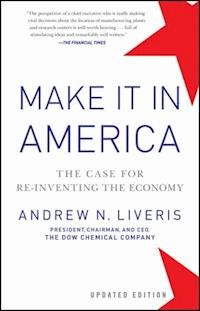
The case for revolutionizing the U.S. economy, from a leading CEO America used to define itself by the things we built. We designed and produced the world's most important innovations, and in doing so, created a vibrant manufacturing sector that established the middle class. We manufactured our way to the top and became the undisputed economic leader of the world. But over the last several decades, and especially in the last ten years, the sector that was America's great pride has eroded, costing us millions of jobs and putting our long-term prosperity at risk. Now, as we struggle to recover from the worst recession in generations, our only chance to turn things around is to revive the American manufacturing sector--and to revolutionize it. In Make It in America: The Case for Reinventing the Economy, Andrew Liveris--Chairman and CEO of The Dow Chemical Company--offers a thoughtful and passionate argument that America's future economic growth and prosperity depends on the strength of its manufacturing sector. * The book explains how a manufacturing sector creates economic value on a scale unmatched by any other, and how central the sector is to creating jobs both inside and outside the factory * Explores how other nations are building their manufacturing sectors to stay competitive in the global economy, and describes how America has failed to keep up * Provides an aggressive, practical, and comprehensive agenda that will put the U.S. back on track to lead the world It's time to stop accepting as inevitable the shuttering of factories and staggering job losses that have come to define manufacturing. It's time to acknowledge the cost of inaction. There is no better company to make the case for reviving U.S. manufacturing than The Dow Chemical Company, one of the world's largest manufacturers and most global corporations. And there's no better book to show why it needs to be done and how to do it than Make It in America.
Sie lesen das E-Book in den Legimi-Apps auf:
Seitenzahl: 281
Veröffentlichungsjahr: 2011
Ähnliche



















Contents
Cover
Endorsements
Title Page
Copyright
Dedication
Preface
Acknowledgments
Introduction
Chapter 1: The Rise and Fall
How We Fell Out of Love with Manufacturing
The Multiplier Effect
Manufacturing Tomorrow
Surviving the Crisis
A Tale of Two Nations
Chapter 2: Separating What Can't Be Separated
The Truth about the Manufacturing Crisis
Adding Value the Only Way We Can
Trying to Survive on Ideas Alone
Where Manufacturing Goes, the Ideas Follow
Chapter 3: Fighting Offshoring
Should I Stay or Should I Go?
It Isn't What You Think
Taxing Problems
Funding the Future
Regulating Our Way into a Muddle
Trading Our Way to Prosperity
Chapter 4: Energy Drives the World
A Big Energy Bill, and Not Just for Power
The New New
Germany's Green Miracle
China's Green Revolution
America Can't Compete
Chapter 5: Building Tomorrow
Education: “A Permanent National Recession”
Developing the Right Skills for the New Workplace
Preventing a Worker Shortage
What America Doesn't Understand That Other Nations Do
The Tortoise and the Hare
A New Foundation of Infrastructure
Funding the Future
Chapter 6: Built to Compete
An Ambitious Agenda
Changing the Way We Tax
National Incentive Strategy
Regulatory Policy
Everyone Needs Good Trading Partners
Chapter 7: The Long Game
The Human Element: Education and Immigration
Innovation and Competitiveness
Chapter 8: The Fork in the Road
Epilogue
Making It Easier to Make It in America
The Long Road Ahead
A Stealth Consensus
Bibliography
About the Author
About The Dow Chemical Company
Index
More Praise For MAKE IT IN AMERICA
America used to make things. Americans were the innovators, the undisputed world economic leaders, and, with our success, we built a thriving, high-achieving middle class. Now, with policies that are indifferent or hostile to domestic manufacturing, and with other nations on the rise, America’s long-term prosperity is at risk. Our only chance to turn things around is to remember, revive, and revolutionize what made us great for so long—the manufacturing sector.
“Liveris takes a hard look at the current state of manufacturing and the nature of the twenty-first century global economy. His dramatic call to action—to revive the American economy by reinventing the American manufacturing sector—is cogent and heartfelt. Make It in America provides a valuable strategic framework for action by governmental, business, and community leaders, and it deserves to be a part of the ongoing national discussion about the country’s economic priorities and its future.”
—James W. Owens Chairman and CEO, Caterpiller Inc.
“Andrew Liveris is one of America’s most active and thoughtful CEOs. I’m convinced that we must have more savings, investments, and exports to offset the twin deficits (fiscal and trade), which certainly contributed to the worst global recession we’ve experienced since the 1930s. A vibrant, globally competitive manufacturing sector must be part of our ‘economic fix,’ and Andrew offers numerous suggestions on getting our mojo back. This is a call to action!”
—Jim Quigley CEO, Deloitte Touche Tohmatsu Limited
Copyright © 2012 by The Dow Chemical Company. All rights reserved.
Published by John Wiley & Sons, Inc., Hoboken, New Jersey. Published simultaneously in Canada.
No part of this publication may be reproduced, stored in a retrieval system, or transmitted in any form or by any means, electronic, mechanical, photocopying, recording, scanning, or otherwise, except as permitted under Section 107 or 108 of the 1976 United States Copyright Act, without either the prior written permission of the Publisher, or authorization through payment of the appropriate per-copy fee to the Copyright Clearance Center, Inc., 222 Rosewood Drive, Danvers, MA 01923, (978) 750-8400, fax (978) 646-8600, or on the Web at www.copyright.com. Requests to the Publisher for permission should be addressed to the Permissions Department, John Wiley & Sons, Inc., 111 River Street, Hoboken, NJ 07030, (201) 748-6011, fax (201) 748-6008, or online at http://www.wiley.com/go/permissions.
Limit of Liability/Disclaimer of Warranty: While the publisher and author have used their best efforts in preparing this book, they make no representations or warranties with respect to the accuracy or completeness of the contents of this book and specifically disclaim any implied warranties of merchantability or fitness for a particular purpose. No warranty may be created or extended by sales representatives or written sales materials. The advice and strategies contained herein may not be suitable for your situation. You should consult with a professional where appropriate. Neither the publisher nor author shall be liable for any loss of profit or any other commercial damages, including but not limited to special, incidental, consequential, or other damages.
For general information on our other products and services or for technical support, please contact our Customer Care Department within the United States at (800) 762-2974, outside the United States at (317) 572-3993 or fax (317) 572-4002.
Wiley also publishes its books in a variety of electronic formats. Some content that appears in print may not be available in electronic books. For more information about Wiley products, visit our web site at www.wiley.com.
Library of Congress Cataloging-in-Publication Data:
Liveris, Andrew. Make it in America : the case for re-inventing the economy / Andrew Liveris. p. cm. Includes bibliographical references and index. ISBN 978-0-470-93022-9 (cloth); ISBN 978-1-118-19962-6 (pbk); ISBN 978-1-118-29492-5 (ebk); ISBN 978-1-118-29493-2 (ebk); ISBN 978-1-118-29494-9 (ebk) 1. Industrial policy–United States. 2. Manufactures–United States. 3. Economic forecasting–United States. 4. United States–Economic conditions–2009– I. Title. HD3616.U47L58 2010 330.973–dc22 2010045654
To the women and men of The Dow Chemical Company, past and present, who have positively impacted countless lives around the world with their actions, their products, and their values.
Preface
I’m Andrew Liveris. I’ve been an employee of The Dow Chemical Company for more than 30 years. For the past seven, I’ve been its Chairman and CEO. I was born in Australia, in the small town of Darwin, in 1954.
Throughout my childhood, I always loved school. Chemistry, in particular. There was something fascinating to me about manipulating elements to produce vastly different compounds. The idea of working at the molecular level was at once exciting and mystifying. When I got to University of Queensland, I knew right away that I would study chemical engineering.
Upon graduation, I came to The Dow Chemical Company as a chemical engineer. I didn’t join Dow because it was a chemical company. I joined it because it was an American company. I joined it because I believe deeply in the American model of enterprise, in its ability to improve lives around the world, in its capacity to be a beacon of energy and creativity.
And Dow is about as quintessentially American as you can get. It was founded in 1897 by an immigrant—an entrepreneur— just as the industrial revolution was getting underway.
Herbert Henry Dow, a Canadian chemical engineer, came to the small town of Midland, Michigan to collect samples from the Tittabawassee River. He found that he could extract bromine, an element used in products from flame retardants to gasoline, from the brine lakes in the area. After securing patents, he, along with 57 investors and $200,000, started The Dow Chemical Company.
Dow grew over the twentieth century to become one of the largest and most global corporations in the world. Today Dow employs more than 50,000 workers in 35 countries. We have 41 major research facilities, more than 5,000 products being manufactured at 188 sites, and sales in more than 160 countries. We are a Fortune 50 company.
I am deeply indebted to the country that allowed me to pursue my dreams. I worked for Dow in Australia, then for many years in Asia, and now, as CEO, I work out of Dow’s headquarters, which have remained in Midland to this day.
As the head of one of the largest chemical companies in the world, I interact with manufacturers of countless kinds every day. They are my peers, my partners and, at times, my customers. Our conversations, I believe, give me a keen sense of the pressures and challenges they’re facing, the changes they’re making in response, and the opportunities they’re seeing—and seizing. So I speak from personal and professional experience (and with no shortage of pride in my industry) when I say this:
The world is entering a golden age of manufacturing.
Now, that statement might surprise many in America. We’ve become painfully accustomed to the loss of jobs, the closing of plants, the shuttering of main streets in small towns and even some big cities. To many Americans, the word “manufacturing” feels associated with the past—with another era, a brighter and easier and more prosperous time.
So when I say manufacturing is about to enter a golden age, it might seem impossible to reconcile with the reality to which we’ve become accustomed. But if we lift our eyes from what’s happening within our own borders and begin to look around the world, we can see that, globally, this is an incredibly exciting time in manufacturing—perhaps the most exciting in history.
Countries are investing extraordinary amounts of money and talent into expanding their capacity to create—and to build. In China, for example, cities with populations larger than New York’s have sprouted up out of nowhere in order to meet the country’s growing manufacturing sector. Of course, China is not alone in its mission to become the global leader in manufacturing. Developed and developing nations alike, from India and Germany to Brazil and Taiwan, are creating comprehensive national strategies to better compete in the global market. They are creating new industries that will be central to solving some of the world’s most serious challenges. Indeed, countries all over the world see manufacturing as the key to their economic futures.
America’s most successful global competitors are building substantial wealth by investing in highly advanced, highly specialized, high value-added manufacturing—building the semiconductors and microprocessors for our electronics; the wind turbines and solar cells for our energy needs; the advanced batteries and state-of-the-art medical devices that will remake our future. They are transforming what manufacturing means, and using its engines to transform their economies. It is truly stunning to watch this unfold.
There is no doubt that, for generations to come, economic success will be a direct product of the things we build. The question is, who will build them? Who will reap the rewards? Who will emerge as the economic leader of the twenty-first century?
In that race, the United States is falling rapidly behind.
Other nations have refocused and ramped up, but the United States has not. In the World Economic Forum’s 2010–2011 Global Competitiveness rankings, the United States slid another two slots—from second to fourth. We have allowed our manufacturing base to deteriorate, and we haven’t done nearly enough to revive it. To reinvent it.
We mourn the loss of manufacturing jobs in America. We recognize the pain it causes to workers and their families and their hometowns. We lament it. But we don’t do much about it. Just as inaction led us to this point, inaction is keeping us here. We treat further losses as inevitable, even acceptable, and ignore their effect on our long-term success. We are talking around the problem, but very few people are actually talking about the problem.
This is where we are today. And we arrived at this moment without ever asking the most important question of all.
Does manufacturing matter to our future?
Yes, it does. It absolutely does.
If you picked up this book thinking it would be another conventional business book, I urge you to keep reading—I’m confident you’ll conclude otherwise. If you picked it up thinking this was another long complaint by another CEO who wants nothing more than for government to back off, recede from the picture, do nothing, and let the markets rule, then I’m afraid you’ll be disappointed.
That approach had its day. There was a time when companies could thrive, when entire enterprises could be built from the ground up on our shores, without much government intervention or assistance. We saw a vast prosperity arise, we saw innovation flourish, and many Americans concluded that government and business should keep their distance from one another. It’s part of our national DNA.
If everything had remained static, it might have worked out just fine. But it didn’t. And we ignore those changes at our peril.
This book is a call to action. It’s based not just on my experience, but on the opinions of some of the leading experts in the field. Over the next several chapters I’ll give you a better sense of where the United States is falling behind and why. I will talk about some of the lessons we can learn—the lessons I have learned—from our major competitors around the world. And, in the final chapters, I will lay out an agenda that, if adopted, could revive the sector and put the United States back on track toward economic growth and global dominance.
That agenda will include everything from rebuilding the country’s crumbling infrastructure to reorienting our education system with a greater focus on science, math, and engineering. It will include leveraging our manufacturing heft to combat global climate change and build a vibrant clean energy industry. And it will include making our tax code more competitive, and our regulations more streamlined, so that doing business in the United States can be both cheaper and more efficient.
Each item on the agenda will help boost American manufacturing. But no single piece will sufficiently do it all. The U.S. economy requires a comprehensive set of solutions, and so it deserves a truly comprehensive plan. We cannot allow ourselves to be satisfied by the argument that our political system is too broken to make the kind of big changes we need. The U.S. political system has always been partisan. Passing major legislation has always been an uphill climb. But American history is full of moments, critically important moments, where leaders have overcome the obstacles and delivered on essential reforms. This should be one of those moments.
The United States is at a strategic inflection point. Our options are simple—and starkly different. Are we going to fight to compete, as we have throughout our history? Or are we going to stick to assumptions and practices that no longer make sense?
We are still emerging from the wakeup call of the financial collapse. We are still recalibrating, still recovering. Our success will depend on our ability to recognize the problem we face, and our willingness to face it down.
When we had a vibrant, booming manufacturing sector, we enjoyed new wealth and growth unmatched in the world. If we can revive, rebuild, and reinvent that sector, if we can bring back the model that served as the world’s greatest force for economic growth, we will enjoy that prosperity once again.
That, I believe, is what we must do. This book is about getting it done.
ANDREW LIVERIS
Acknowledgments
The ideas in this book, as I’ve tried to make clear, are the product of practical experience. I am lucky to have a job that has taken me around the world, and wherever I go—wherever Dow operates—I am fortunate to work with some of the most brilliant, creative, and hardworking people you could possibly find. Their ideas and actions have an important influence on my opinions and outlooks, so I am pleased to have a chance to thank them publicly.
I am deeply grateful to the women and men of the Dow Chemical Company. I have worked at Dow for more than 30~years, and have always considered it not just a pleasure, but an honor, to work side by side with all of you. Your hard work has yielded countless innovations that have improved the lives of millions of people. Every day that I come to work, I do so with a feeling of great privilege. Serving as your CEO has been the greatest honor of my life.
I also want to thank the people of Midland, Michigan, and of every manufacturing town in the United States. Thank you for keeping your head up, even in tough times, and for believing, as I believe, that the best times for manufacturing still lie ahead of us. You are why I wrote this book.
A CEO, of course, has a great number of responsibilities, and I could not possibly have been able to write this book without the tireless assistance of Matt Davis and Louis Vega. You skillfully managed this project from its inception, and provided strategic advice and input throughout. Dow benefits from your contributions and I truly appreciate all of your hard work and focus toward our success.
Many of the ideas for this book sprang from conversations with two of my most trusted advisers, Declan Kelly and Michael Klein. Thank you both for your insights, your counsel, and your belief that the discussions we began in private ought to move to the public square.
Others played key roles in shaping this book and bringing it into the marketplace of ideas. My literary agent, Raphael Sagalyn, was a vital partner in those efforts from the beginning. And I offer my sincerest thanks to my editor, Pamela van Giessen, and the entire team at Wiley for their collaboration, partnership, and counsel in helping bring this important issue to light.
And most importantly, to my loving and devoted wife, Paula, and our three talented children–Nicholas, Alexandra, and Anthony—thank you for your abiding support during every stage of my Dow career and our ongoing journey through life together. You make what I do worth doing.
A. L.
Introduction
This isn't just an uncertain world. It's a volatile one.
For years, the United States has been in transition from a manufacturing-based economy to a service-based economy. For years, we entrusted our growth to borrowing and consumerism. For years, we fueled our growth with debt, and with the idea that everything would be just fine.
As we now know, it wasn’t.
Too many of us in business and government didn't see it coming. Even if we had concerns—as I did and sometimes shared—none of us imagined just how far, and how fast, we were about to fall.
The financial crisis, the housing market collapse, the ensuing recession and credit crunch—all these have caused no end of pain for individuals and businesses alike. But they aren't the fundamental problem. They're symptoms. The troubles of recent years have unmasked a reality that spent years lying dormant, hidden from public view: the United States no longer has an economic model that's sustainable.
How can this be? Are things really that serious? After all, we are still the largest economy in the world. We still have a larger gross domestic product (GDP) than any country, and higher productivity than any country. And yet, as we reflect on these first decades of globalization, on what they have meant for the United States, we are left with the uneasy notion that we are losing ground we can't gain back.
Our old sense of confidence, of certainty, is at low ebb. That's because we now understand that the free flow of capital in financial markets may create certain benefits, but also produces extraordinary volatility—in raw materials, in final products—requiring American businesses operating globally to contend with challenges on a scale unheard of before, and mostly unacknowledged in America's national conversation.
This volatility has driven entire industries to relocate to the opposite side of the world. It is preventing companies from investing in the United States right when our economy most needs that investment. Recent policy decisions have eased some of the pain, mitigated some of the damage, but it seems no one's talking about a fundamental fix.
Globalization has changed just about everything. In many places it has been a force for progress, but by its very nature, it is also a force of destabilization. It creates opportunities and, at the same time, considerable risk. It gives nations—both developed countries and emerging economies—the ability to prosper in ways we never could have imagined, but also creates new obstacles to growth. Here and elsewhere, globalization has upended old economic models, creating imbalance where order once reigned.
That isn't surprising. Globalization, left to its own devices, favors efficiency. Countries with the capacity for complex financial transactions—like the United States and the United Kingdom—will naturally see the expansion of their financial services sectors. Likewise, countries that manufacture goods cheaply and efficiently are likely to see growth in that sector.
The corollary, which also holds true, is that less efficient sectors tend to erode. This, in turn, tends to exacerbate their inefficiency and hasten their erosion. When manufacturing can be done for less abroad, market forces send it abroad.
That leads to an imbalance within some economies that might seem, at first glance, either inevitable or even desirable. Countries could specialize, the argument might go, and could thereby increase the efficiency of the global economy as a whole. This idea has a certain logical appeal. But it overlooks something fundamentally important about the health of developed and developing economies alike: not all sectors are created equal.
The manufacturing sector, for example, can create jobs and value and growth to a degree that the service sector cannot. As America's service sector expands, and its manufacturing sector contracts, the result isn't a new post-manufacturing economy in which everyone wins. The result, instead, is that certain people win, but the country as a whole experiences massive unemployment. The service sector is certainly capable of generating wealth—as we have seen—but it cannot create the sheer volume of jobs the economy needs in order to sustain a workforce of more than 150 million people.
The places that have been able to succeed (for a time) with highly specialized economies have had, in almost every instance, tiny populations. Dubai, for example, was able to thrive as a service-only economy—at least until the financial collapse—in part because it has a population of just more than 2 million, and therefore needs to create relatively few jobs. The United States does not have that option. There aren't enough high-end service industry jobs in the world to employ the American workforce.
The U.S. economy needs balance across sectors. The nation needs to strengthen its advantages in providing services and intellectual capital for the rest of the world; but we also need to grow things and build things. Only through balance will we find economic strength, stability, and growth over the long term.
Otherwise, if U.S policymakers allow the economy to drift further in the direction of imbalance, the nation will find itself with a highly specialized service sector that supports the few, and a weakened manufacturing sector that can no longer sustain the many. I don't mean to suggest that manufacturing can sustain an entire economy on its own. It can’t. But no economy as large as America’s—no population as large as America’s—can sustain itself without manufacturing. No society can thrive with persistently high unemployment.
There are some who insist that as long as the United States continues to generate the world's greatest innovations, the collapse of manufacturing doesn't matter. Yes, America has been—and should be—the world's greatest innovator. But that alone is not enough. I hope Americans won't buy the notion that they've outgrown manufacturing. Accepting such a future would mean accepting a level of joblessness that would make recent years look like a warm-up.
Passivity is not a growth strategy. For too long, too many smart people have insisted that pure free market principles would help economies (at least the healthy ones) find the right balance. But as we've seen increasingly over the past decade, an economy will not simply balance itself. Doing so requires action; it requires intervention.
A look around the world reveals that the countries that are succeeding economically are not passive believers in free market fate. Instead, they take their future into their own hands and strive for better balance. Brazil, for example, isn't content to be a power in agriculture alone; it is strengthening other sectors as well. And China is working hard to ensure that it is more than the world's factory floor. These nations, like others around the world, are taking action. They are working to fulfill the promise of globalization and to minimize its perils.
Around the world, countries are acting more and more like companies: competing aggressively against one another for business and progress and wealth. Governments are boosting business, creating a climate that attracts and rewards investment, spurs innovation and job creation, and appeals to companies that are less bound by national borders than ever before. Build here, they say, and we'll pay for the land you need. Build here, they say, and we'll cover your workers’ salaries for a decade. Build here.
Meanwhile, in the United States, we operate as if little has changed. Our faith in the wisdom of markets may be shaken, but not at a fundamental level—even after the markets have shown they're not always so wise. We assume that because of our greatness, companies will continue to invest here, just as they always have.
We are wrong. Not about America's greatness, but what it entitles us to.
It is time to recognize that if we don't act soon, if we continue to let markets rule in every instance, we will become the global economy's biggest bystander, and potentially, its biggest drain. Our consumers will find themselves with more debt and less money to spend; our businesses will have fewer resources for research and development; our future generations will lack opportunities. It's time for us to recognize the cost of inaction—not just for the United States, but also for the entire global economy.
It's time for us to recognize, whether we like it or not, that for now, in certain key areas, we actually need more government, not less. As CEO of one of the most global U.S.-based corporations, I can tell you, without qualm or question, that I want government more involved. I need it more involved, for the sake of my employees and shareholders. Not as an overzealous regulator, but as a thoughtful partner to thoughtful business—in a shared effort to strengthen our economy.
Risk is inherent in business. I accept that. In fact, I embrace it. There's no upside without a downside.
But any smart company anywhere in the world will do what it can to reduce the uncertainties of doing business, just as individuals do what they can to reduce risk in their lives. Other nations, recognizing this, are working closely with companies to mitigate risks, to create predictability so that businesses can plan and invest for the long term. Together, the public and private sectors set goals, and create mechanisms to ensure those goals are reached.
These countries see what the United States, sooner or later, must realize: it's a false choice to say that you can be either pro-business or pro-government. The old ways of thinking don't apply to the new global economy. Indeed, today, more than ever before, being pro-government is a prerequisite for being pro-business. They must work in concert.
Now, I have no doubt that there will be cynics and skeptics who, upon reading this, will say that I am calling for nothing more than corporate welfare. After all, businesses that espouse free market principles are also known to lobby governments for policies that they believe will improve the environment for their investments. It's no secret that Dow, too, has lobbyists, and we put our policy objectives on our web site for all to see.
I don't suppose there's anything I can say to win over the skeptics. But I hope that fair-minded readers—who share my strong belief that the best engine for economic growth is a healthy, strong private sector—will see that the case I make in this book transcends the particular interests of Dow, the chemical industry, or even the manufacturing sector. I believe that everyone in America has a vital stake in whether businesses are willing to stay and grow within these borders.
At a time when U.S. companies—run by patriotic people—are moving offshore at the fastest rate in history, we should, at a minimum, recognize that the model we are relying on isn't working. When those companies leave, they take jobs and growth—and all the prosperity that follows from them—offshore, too.
The United States must do more to reverse the tide.
By “the United States,” I mean all of us—the public and private sectors. We must build a new partnership for prosperity. We must draw on America's rich history of collaboration between business and government—a relationship that, despite its obvious tensions, has brought immeasurable benefits to the people of this country and the world. In World War II, companies worked with government to create, as Franklin D. Roosevelt called it, “an arsenal for democracy.” Later, government investments in microprocessors, for example, made those innovations scalable, and affordable to the mass market.
Countless other innovations were the product of government-funded research and development. More recently, government action has helped turn the auto industry from bankruptcy to profitability in less than two years. Government intervention stabilized the financial markets and unfroze credit lines.
Government, of course, often stumbles, oversteps, and makes terrible decisions. Every business person I know sometimes wants government to get out of the way. But that doesn't mean it should get out of the picture.
I am a businessman, and I am unabashed in my boosting of business. I believe deeply in entrepreneurship, in the power of capitalism to improve lives. But I do not agree with those in the business community who think that our future success depends on government shriveling up and dying on the vine.
We cannot afford to get stuck in the tired old debate between pure free-market philosophy and state socialism—as if those are the only two economic models from which to choose. We should not assume that the rules of the twentieth century economy apply to the twenty-first century. Globalization has truly rewritten the rules. The new economic realities apply broadly—not just to the United States. There isn't a major power in the world that can succeed over the next several generations without figuring out how to balance or re-balance its economy.
And we need them to succeed. In this era of interdependence, we need more people in more nations to succeed. There are times, of course, in business, in global competition, where we're playing a zero-sum game. I want to win, and, let's be honest, I want you to lose. In a similar sense, nations want to maximize their global market share; they, too, want to win. But the calculus we apply has to be different than it is in business, because our economies are more integrated today than ever before.
In an era where one country's economic troubles—whether that country is as big as the United States or as small as Greece—can set off a global chain reaction, we all have a stake in each other's strategic decisions. And that's not necessarily a bad thing. Indeed, I believe the enduring reality of globalization can be the rising tide—one that truly lifts all boats.
As the world's largest economy, the United States therefore has an obligation not just to its own people, but to the people of the world, to get this right. To no longer accept the shuttering of factories and offshoring of jobs as inevitable. To reject once and for all the idea that manufacturing is somehow optional, or incidental to our future.
On the contrary: manufacturing is America's future. Not just its past. Manufacturing is the foundation upon which our economic prosperity, our growth and wealth and jobs depend. At the center of our economic problems lies the hole that was left when manufacturing started to disappear. And at the center of our solution is a strategy to rebuild that once vibrant sector.
Chapter 1
The Rise and Fall
In 2007, in a secretive Silicon Valley research facility known only as Lab 126, engineers and designers successfully developed a new product with the potential to revolutionize the way we read books like this one. It was called the Kindle, and it would represent Amazon's first attempt at selling a product of its own.
What was special about the device was not just that it was a portable library of books, but that it used an innovative electronic ink. Unlike the pixels of a standard computer screen, the tiny capsules of electronic ink change what appears on the screen without illuminating it, allowing the Kindle to simulate a printed page and to be read even in direct sunlight.
The team at Amazon was excited about the potential of their product and began to search for a U.S. company that could manufacture it. To produce the special ink beads, Amazon partnered with a Massachusetts-based company, appropriately named E-Ink. The company had been started by researchers working at the MIT Media Lab and was now one of the only manufacturers in the country capable of producing electronic ink devices.
But E-Ink did not have the technology to build the Kindle screen itself. For Amazon to build the entire product, the company would have to partner with an additional manufacturer.
That search began in the United States; but it did not end there. The production technology required to build the screen was similar to what's used to make LCD televisions. Amazon needed a manufacturer with experience in that field. But there was a problem: Amazon couldn't find one in the United States. Though the LCD television was originally the product of American research and development (R&D), the entire industry had been ceded to Asia in the 1990s, when Asian countries offered U.S. television manufacturers a business environment too attractive to resist. By 1995, not a single LCD panel was being manufactured in the United States.1




