


39,99 €
Mehr erfahren.
- Herausgeber: John Wiley & Sons
- Kategorie: Fachliteratur
- Serie: Bloomberg Professional
- Sprache: Englisch
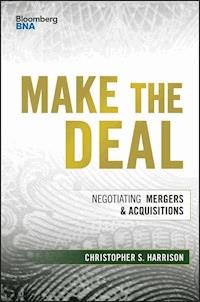
A comprehensive introduction to today's M&A strategies Make the Deal is a direct and accessible guide to striking a powerful M&A deal. Merging business, finance, and law, this insightful examination of M&A strategy is designed to help you understand M&A negotiations and the ways in which the final outcome affects your financial future. A general overview of an acquisition agreement framework segues into a more detailed discussion of different deal structures, including stock sales, mergers, asset sales, and complex structures, giving you the information you need to know when each one applies best in practice. You'll gain insight into real-world negotiations and the delicate balancing act that occurs as each party attempts to maximize value and minimize risk, and learn the potential pitfalls that can occur. Negotiation statistics and samples from actual contracts back the war stories throughout, and reinforce the idea that there's no single perfect solution. As a topic of study, M&A is constantly evolving; in practice, it changes at the speed of light. Staying ahead of the market is the single most critical element of making the best deal, and the strategy that worked for one deal most likely won't work for the next. Instead of simply providing a list of strategies that have worked in the past, this book shows you why they worked, so you can tailor your strategy specifically to your next deal. * Learn how M&A contract terms affect economic outcomes * Examine the techniques and mechanics of today's acquisition agreements * Develop a legal framework that supports your business strategy * Follow the ups and downs that arise in real-world cases A successful M&A transaction requires both attention to detail and a big picture view, combined with skill, intellect, and ingenuity. Make the Deal brings it all together to show you how to run the table and come away with a win.
Sie lesen das E-Book in den Legimi-Apps auf:
Seitenzahl: 524
Veröffentlichungsjahr: 2016
Ähnliche



















MAKE THE DEAL
Negotiating Mergers & Acquisitions
Christopher S. Harrison
Cover image: © Andrew F. Kazmierski/iStockphoto Cover design: Wiley
©2016 The Bureau of National Affairs, Inc. All rights reserved. Published by John Wiley & Sons, Inc., Hoboken, New Jersey. “The 1st edition of Make the Deal was published by Bloomberg Press in 2014.” Published simultaneously in Canada.
No part of this publication may be reproduced, stored in a retrieval system, or transmitted in any form or by any means, electronic, mechanical, photocopying, recording, scanning, or otherwise, except as permitted under Section 107 or 108 of the 1976 United States Copyright Act, without either the prior written permission of the Publisher, or authorization through payment of the appropriate per-copy fee to the Copyright Clearance Center, Inc., 222 Rosewood Drive, Danvers, MA 01923, (978) 750-8400, fax (978) 646-8600, or on the Web at www.copyright.com. Requests to the Publisher for permission should be addressed to the Permissions Department, John Wiley & Sons, Inc., 111 River Street, Hoboken, NJ 07030, (201) 748-6011, fax (201) 748-6008, or online at www.wiley.com/go/permissions.
Limit of Liability/Disclaimer of Warranty: While the publisher and author have used their best efforts in preparing this book, they make no representations or warranties with respect to the accuracy or completeness of the contents of this book and specifically disclaim any implied warranties of merchantability or fitness for a particular purpose. No warranty may be created or extended by sales representatives or written sales materials. The advice and strategies contained herein may not be suitable for your situation. You should consult with a professional where appropriate. Neither the publisher nor author shall be liable for any loss of profit or any other commercial damages, including but not limited to special, incidental, consequential, or other damages.
For general information on our other products and services or for technical support, please contact our Customer Care Department within the United States at (800) 762-2974, outside the United States at (317) 572-3993 or fax (317) 572-4002.
Wiley publishes in a variety of print and electronic formats and by print-on-demand. Some material included with standard print versions of this book may not be included in e-books or in print-on-demand. If this book refers to media such as a CD or DVD that is not included in the version you purchased, you may download this material at http://booksupport.wiley.com. For more information about Wiley products, visit www.wiley.com.
Library of Congress Cataloging-in-Publication Data:
ISBN 9781119163503 (Hardcover) ISBN 9781119163657 (ePDF) ISBN 9781119163602 (ePub)
CONTENTS
About the Author
Chapter 1: Introduction to Deal-Making: Deal-Making in Practice
War Stories
The Market
Sample Provisions
Litigation Endnotes
Chapter 2: Setting Up the Deal: Overview and Confidentiality Agreements
Overview of the Predeal Process
Confidentiality Agreements
Process Control through the Confidentiality Agreement
Litigation Endnotes
Chapter 3: Setting Up the Deal: Key Provisions and Agreements
“No-Poach” Provisions
Standstill Agreements
Exclusivity Agreements
Term Sheets
Litigation Endnotes
Chapter 4: Architecture of the Acquisition Agreement
Key Elements of the Acquisition Agreement
Solving Problems and Managing Risk: Comparing Techniques
Litigation Notes
Chapter 5: Purchase Price
Types of Consideration
Stock Deals
Closing Date Purchase Price Adjustments
Regulating Incentives
Post-Closing True-Up
Earn-Outs
Contingent Value Rights
Litigation Endnotes
Chapter 6: Representations and Warranties
Form of Representation
When Representations Are Made
Scope of Seller’s or Targets’ Representations
Buyer’s Representations and Warranties
Functions of the Representations
Qualifications to the Representations
Obligation to Update Representations
Litigation Endnotes
Chapter 7: Covenants
Covenants in M&A Negotiations
Operating Covenants
“Get the Deal Done” Covenants
Antitrust and Regulatory Approval Covenants
Access Covenants
Limits on Covenants
Other Covenants
Litigation Endnotes
Chapter 8: Closing Conditions
Overview of Closing Conditions
Shareholder Approval
Antitrust and Other Regulatory Approvals
Accuracy of Representations and Warranties
Compliance with Covenants
Receipt of Third-Party Approvals
Absence of Injunctions and Litigation
Appraisal Rights
Legal Opinions
Employment Agreements
Due Diligence
Litigation Endnotes
Chapter 9: Termination Rights
Overview of Termination Rights
Drop-Dead Date
Change in Recommendation and Fiduciary Out
Failure of Representations and Covenant Compliance
Forward-Looking Aspects of Termination Rights
Damages Following Termination
Litigation Endnotes
Chapter 10: Material Adverse Effect
Material Adverse Effect Provisions in M&A Negotiations
Interpreting Material Adverse Effect Provisions
Implementing MAE Rights
Enforcing No-MAE Protection
Quantitative MAEs
Litigation Endnotes
Chapter 11: Equity and Debt Commitment Letters
Private Equity Deal Structures
Equity Commitment Letter
Limited Fund Guarantee
Debt Commitment Letter
Litigation Endnotes
Chapter 12: Financing Risk
History of Financing Provisions
Overview of Financing Contingency Provisions
Specific Enforcement
Damages
No Recourse against Private Equity Buyer
Marketing Periods
Financing Covenants
Litigation Endnotes
Chapter 13: Topping a Public Merger
Overview of “No-Shop” Provisions
Types of Restrictions in No-Shop Provisions
Match Rights
Go-Shops
Fiduciary Out Breakup Fees
Expense Reimbursement
Litigation Endnotes
Chapter 14: Indemnities
Indemnities in M&A Negotiations
Escrow
Survival Periods
Indemnity Amounts, Limitations, and Calculations
Representations
Claims, Remedies, and Related Issues
Litigation Endnotes
Chapter 15: Dispute Resolution
Types of Dispute Resolution Provisions
Public vs. Private Company Deals
Litigation Endnotes
Chapter 16: Structuring M&A Deals
Building Blocks for Structuring an M&A Deal
Asset Purchase
Stock Purchase
Merger
Tender Offer
Tender Offer vs. Merger
Other Structural Issues
Appraisal Rights
Litigation Endnotes
Index
EULA
Guide
Cover
Table of Contents
1
Pages
vii
1
2
3
4
5
6
7
8
9
10
11
12
13
14
15
16
17
18
19
20
21
22
23
24
25
26
27
28
29
30
31
33
34
35
36
37
38
39
40
41
42
43
44
45
46
47
48
49
50
51
52
53
54
55
56
57
58
59
60
61
62
63
64
65
66
67
68
69
70
71
72
73
74
75
76
77
78
79
80
81
82
83
84
85
87
88
89
90
91
92
93
94
95
96
97
98
99
100
101
102
103
104
105
106
107
108
109
110
111
112
113
114
115
116
117
118
119
120
121
122
123
124
125
126
127
128
129
130
131
132
133
134
135
136
137
138
139
140
141
142
143
144
145
146
147
148
149
150
151
152
153
154
155
156
157
158
159
160
161
162
163
164
165
166
167
168
169
170
171
172
173
174
175
176
177
178
179
180
181
182
183
184
185
187
188
189
190
191
192
193
194
195
196
197
198
199
200
201
202
203
204
205
206
207
208
209
210
211
212
213
214
215
216
217
218
219
220
221
222
223
224
225
226
227
228
229
230
231
232
233
234
235
236
237
238
239
240
241
242
243
245
246
247
248
249
250
251
252
253
254
255
256
257
258
259
260
261
262
263
264
265
266
267
268
269
270
271
273
274
275
276
277
278
279
281
282
283
284
285
286
287
288
289
290
291
292
293
294
295
296
297
298
299
300
301
302
303
304
305
306
307
309
310
311
312
About the Author
Christopher S. Harrison currently serves as Chief Investment Officer of The Falconwood Corporation, a financial management firm and research laboratory that has incubated and operated numerous highly successful financial and technological ventures.
Having managed billions of dollars in successful investment transactions, including debt, equity, and real asset ventures, Mr. Harrison earned a reputation as a superb negotiator and business strategist. During his eight years at Cravath Swaine & Moore, one of the world’s most prestigious law firms, he handled numerous high-profile debt, equity, and M&A deals. As co-head of the market-leading asset management M&A practice at Schulte Roth & Zabel, the premier investment management law firm, he ran some of the most sophisticated public and private deals and facilitated the strategic growth of several prominent financial services and asset management businesses.
Mr. Harrison teaches popular courses at NYU School of Law on the financial and legal aspects of negotiating and investing in business transactions. He is a regular speaker at industry conferences and webinars.
He holds a JD degree, cum laude, from NYU School of Law, where he focused on law and economics.
CHAPTER 1Introduction to Deal-Making: Deal-Making in Practice
Looking back, I have come to realize that careful attention to transaction details played a critical role in the businesses I founded over the course of my career. Thinking strategically about potential outcomes—and setting the stage in the contract to navigate them in the future—was critical to my success.
—Dr. Henry G. Jarecki
My proposal turned the tables. I had conveyed it cautiously. Sound legal advice had been hard to come by. None of the lawyers I had hired could do more than follow technical instructions. As the clock was working against us, I followed my intuition on what our legal rights were. As desperate as things stood for our company, I figured that I could not possibly make things worse.
The effect was stunning. Triumphantly smug a moment before, the guys on the other side backed down. Perhaps they had known the weakness of their position all along and played hardball to get the better of us. After all, they were a large national player with a reputation for running over minor league players like us. Perchance I surprised them. Or had they not thought seriously about our side of the issue, let alone the business implications of their own legalese? At that moment, I realized how crucial legal knowledge was to running a business.
From that conference room, I took the shortest way to law school—only to find in my subsequent career that corporate practice is effective only if business judgment and legal expertise coincide.
That is the impetus of this book. It brings business, finance, and law together, showing how legal form configures the economic outlook, and how to support a business strategy with a legal framework. More specifically, it is designed as a tool for individuals in both business and law—in-house, in practice, or in training—to understand how merger and acquisition (M&A) deals are negotiated and how acquisition contract terms impact economic outcomes. It analyzes current techniques and mechanics used in acquisition agreements and shows how to design deal terms to meet the needs of your particular transaction.
In the larger scheme of things, this book may be a small step further down the road of commoditizing and quantifying legal advice. But I hope this book will also caution against overdoing it. As the review of actual deals will show, each is different. There is no “one size fits all” solution. Effectively combining different elements, applying the law to a specific situation, and calculating the economic effect of contract terms requires skill, intellect, and often a good dose of ingenuity that is not inherent in any commoditized form of legal advice.
Creativity (among other human faculties) does not come in a box. If, in that conference room, I had not been able to find a new perspective, to think outside and beyond the paradigm that the legal experts—including my own counsel—had presented me, the company I managed would have ended up like the other small fry. It is innovation that, more often than not, will give you an edge.
What makes M&A practice such a rich experience is that almost every deal is distinct in its facts, the business issues at stake, the economic trends in play, and the personalities and negotiating tactics involved. Given the number of variables, a deal can take on many different forms. It is crucial to understand that these different forms will invariably produce different legal and economic results. Structuring to solve business issues—and sorting out business issues resulting from the structure—is what M&A is all about.
The art of negotiating has been much dwelled on, but it is absolutely useless when the reasons for having a provision are not understood, when the follow-on implications of winning or not winning a point escape the players, or when they come to the negotiating table without any idea regarding their company’s or client’s backup positions. How will you know when a point is worth the fight, when to give in, and when to walk away? How will you know what to ask for in the first place? Before getting cute at the negotiating table, you have to understand your business goals and your options—including the legal terms with which to achieve them. Otherwise, your art will backfire: “In my many business negotiations, I have always been amazed that the other side will ask for something that is less advantageous to them than the deal they already have,” notes one of my clients.
This book starts by examining the various agreements that practitioners have to negotiate before actually sitting down to talk about the acquisition agreement. These include confidentiality agreements, standstill agreements, exclusivity agreements, and letters of intent or memoranda of understanding. These agreements protect the parties from economic disadvantage due to the deal process, set rules for the negotiations, and define preliminary objectives.
Separate chapters of this book show how the core elements of an acquisition agreement—that is, purchase price mechanics and adjustments, representations, covenants, conditions, material adverse effect clauses, financing contingencies and reverse breakup fees, fiduciary outs to top a public deal and indemnities—function within the context of a deal. Each chapter explains how a component is negotiated in real life with the purpose of creating value for and balancing risks between the parties. Comparing various strategies for solving business problems, some methods to provide for “rough justice” while other approaches are more refined. Transaction techniques often make a difference—and sometimes all the difference. The chapters include war stories to demonstrate potential pitfalls and bring out the relevance of certain techniques. In addition, statistics on how deal terms are negotiated in practice give an overview with regard to the prevalence of certain provisions and thus a sense for the market. Finally, sample provisions from actual contracts model the language that make a particular deal work.
This book next analyzes the overall framework of an acquisition agreement. It examines the different deal structures—that is, stock sales, mergers, asset sales, and complex structures—and lays out the criteria according to which practitioners choose (or should choose) between them.
War Stories
War stories from practice bring home the flavor of what is at stake in actual deals. Highlighting why drafting matters, the crux of each story elucidates the problems the parties grappled with, sidelined, or simply overlooked. Their successes and failures show the lessons learned. After all, to understand—and laugh at—the mistakes of others is the best way to appreciate why a point is important.
War Story
Thirty war stories reveal the workings of deal terms by way of example. The core issues at stake are conceptually “based on a true story,” but they are all works of fiction.
Each mistake and problem described in those sections has happened in practice. The stories that go with them, however, bear no relationship to actual transactions. Any correlation to any real parties or lawyers—especially those who made mistakes or ended up on the wrong side of unexpected events—is purely coincidental.
The Market
Lawyers have been slow to quantify their expertise. But with the passage of time, and the continuously improving ease with which lawyers can gather and crunch the numbers on other deals, a more quantitative mind-set is filtering into practice.
This book uses quantitative analyses to see how deals fit into observable patterns of the marketplace, while, at the same time, cautioning against a simplifying, precedent-oriented approach to deal-making. After all, a weighted-average set of terms would, in fact, suit no one. And the examination of any one deal point in a vacuum can lead the parties to overlook the interactions among deal points or the specific needs of the parties at hand.
Nevertheless, as quantitative studies of transaction terms begin to proliferate, deal-makers will more frequently be pushed by the force of precedent into standardized provisions, paving the way for majority terms to become more and more dominant. As time goes by, the average may become the norm, whether or not the average fits the facts of a particular deal. Knowledge of what constitutes “market terms” (i.e., terms that have become commonplace in transactions) has become critical to arguing a position and can be a helpful tool for convincing the other side that a position is fair.
THE MARKET
Nearly 100 “The Market” sections are culled from studies of deals in which the author participated, as well as from a variety of other publicly available studies. As such, the data represent a generalized meta-analysis derived from numerous independent sources.
Quantitative analyses vary meaningfully from study to study. Different results are generated by:
Sample size.
The smaller the sample, the more they can be influenced by outlier deals.
Sample selection.
Rarely do studies consider all available data. How they pick and choose affects the results.
Period reviewed.
Trends change, by definition. The period studied matters.
Mix of deal types.
Different deal types constitute their own market. More or less of one type skews the results.
To help avoid the illusion that quantitative analysis of deal terms is a precise science, all results in this book have been rounded to the nearest 5 percent, or to thirds or halves, depending on the context.
Sample Provisions
Sample provisions illustrate model wording and key drafting choices. Frequently, these examples represent “form” language, or wording a practitioner would use as a starting point before changing it to fit a particular deal.
Sample Provision
Over 140 “Sample Provisions” are based on formulations used by the author as well as actual public deal precedents.
[Bracketed text] usually indicates a drafting choice. It shows an issue buyers and sellers may negotiate, or a provision that is more or less aggressive. Brackets are also used to summarize missing text, in order to focus an example on the primary topic.
Underlining is used to emphasize key words or phrases.
Litigation Endnotes
Good contracts are negotiated in the shadow of litigation. Rules of contract construction tell us that the court’s primary job is to interpret the intent of the parties, who are relatively free to draft any provision they wish.
Courts do this by first giving a plain-English interpretation to the words on the page. In doing so, courts often assume the lawyers understand the underlying case law. Practitioners, in contrast, often draft as if the dictionary rather than case law provides the primary resource for giving meaning to the words they draft—and the topics they decide to avoid and be silent on. Case law provides the backdrop for lawyers to determine when silence works for them or against them, and when they should try to clarify ambiguity.
Some of the cases that elucidate these issues are interspersed throughout this book in approximately 100 litigation endnotes. They are not intended to provide a definitive statement of case law in any particular jurisdiction. Instead, they highlight the kinds of issues that must be dealt with in drafting, to avoid your client’s falling into similar litigation.
CHAPTER 2Setting Up the Deal: Overview and Confidentiality Agreements
Overview of the Predeal Process
Deals start in many different ways but progress along a relatively standard track. After one party introduces the concept of a deal to the other side, the predeal process kicks in.
If there is sufficient interest in a serious discussion, the first step is to negotiate a confidentiality agreement. This agreement protects the target’s sensitive business information, and requires the deal talks to be kept secret. A confidentiality agreement can also include other key transaction process terms. Those can include:
A “no-poach” provision (also called “no-hire” and nonsolicitation provisions) that restricts the bidder from trying to hire away the target’s best employees, and
A “standstill” that prevents the bidder from taking potentially hostile moves against a public company if a friendly deal cannot be negotiated.
If a deal is potentially worth the diligence effort, the bidder may ask for exclusivity. An exclusivity agreement prevents the target or sellers from working with competing bidders during a limited period of time. This gives the bidder breathing room and comfort that the sellers are not negotiating with another bidder in the room next door.
Lesen Sie weiter in der vollständigen Ausgabe!
Lesen Sie weiter in der vollständigen Ausgabe!
Lesen Sie weiter in der vollständigen Ausgabe!
Lesen Sie weiter in der vollständigen Ausgabe!
Lesen Sie weiter in der vollständigen Ausgabe!
Lesen Sie weiter in der vollständigen Ausgabe!
Lesen Sie weiter in der vollständigen Ausgabe!
Lesen Sie weiter in der vollständigen Ausgabe!
Lesen Sie weiter in der vollständigen Ausgabe!
Lesen Sie weiter in der vollständigen Ausgabe!
Lesen Sie weiter in der vollständigen Ausgabe!
Lesen Sie weiter in der vollständigen Ausgabe!
Lesen Sie weiter in der vollständigen Ausgabe!
Lesen Sie weiter in der vollständigen Ausgabe!
Lesen Sie weiter in der vollständigen Ausgabe!
Lesen Sie weiter in der vollständigen Ausgabe!




