


20,99 €
Mehr erfahren.
- Herausgeber: John Wiley & Sons
- Kategorie: Fachliteratur
- Sprache: Englisch
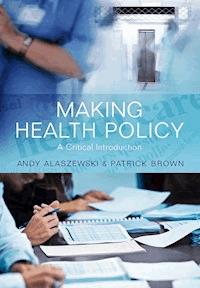
This new textbook opens up the policy-making process for students, uncovering how government decisions around health are really made. Starting from more traditional insights into how ministers and civil servants develop policy with limited knowledge and money, the book goes on to challenge the conception of policy as a rational process, revealing it to be something quite different.
Knee-jerk reactions to disasters, keeping voters satisfied, the powerful leverage of interest groups, and the skewing of debate through ideology and the media are each considered in turn. These processes render policy far from rational or at least require a much broader approach for considering policy ‘logic’, one that is open to different rationalities of values, norms and pragmatism. The book draws on historical and contemporary examples to highlight that though challenges to policy-makers may seem in some ways novel, in many senses key processes endure and indeed are rooted in historical contexts. Although the examples are drawn from UK health and social care, the book’s theory-driven approach is applicable across national contexts Ð especially for countries where uncertainty, risk and resource pressures create significant dilemmas for policy-makers.
The book’s multi-perspective, thematic approach will be especially relevant to students, as will the broad range of case study examples used. Making Health Policy will be essential reading for students of health policy, social policy, social work, and the sociology of medicine, health and illness.
Sie lesen das E-Book in den Legimi-Apps auf:
Seitenzahl: 529
Veröffentlichungsjahr: 2013
Ähnliche



















Making Health Policy
Making Health Policy
A Critical Introduction
Andy Alaszewski and Patrick Brown
polity
Copyright © Andy Alaszewski and Patrick Brown 2012
The right of Andy Alaszewski and Patrick Brown to be identified as Author of this Work has been asserted in accordance with the UK Copyright, Designs and Patents Act 1988.
First published in 2012 by Polity Press
Polity Press
65 Bridge Street
Cambridge CB2 1UR, UK
Polity Press
350 Main Street
Malden, MA 02148, USA
All rights reserved. Except for the quotation of short passages for the purpose of criticism and review, no part of this publication may be reproduced, stored in a retrieval system, or transmitted, in any form or by any means, electronic, mechanical, photocopying, recording or otherwise, without the prior permission of the publisher.
ISBN-13: 978-0-7456-8064-4
A catalogue record for this book is available from the British Library.
Cornwall
The publisher has used its best endeavours to ensure that the URLs for external websites referred to in this book are correct and active at the time of going to press. However, the publisher has no responsibility for the websites and can make no guarantee that a site will remain live or that the content is or will remain appropriate.
Every effort has been made to trace all copyright holders, but if any have been inadvertently overlooked the publisher will be pleased to include any necessary credits in any subsequent reprint or edition.
For further information on Polity, visit our website: www.politybooks.com
Contents
Preface
Introduction
1 What is health policy?
Part 1 Rationality in Policy Making
2 Managing knowledge and expertise: attempting to create rational health policy
3 The competition for money and the limits of instrumental rationality
4 Power and influence in policy making: policy communities and networks
5 The pressure of events: disasters, inquiries and the dynamics of blame
Part 2 The Limits of Rationality in Policy Making
6 Identifying policy problems: competition and claims-making
7 How does the nature of modern democracy shape the formation of health policy?
8 Ideology and policy: legitimating, bounding and framing
9 The impact of the media on health policy making
Part 3 Conclusion
10 So how and why are health policies made? Some final comments
References
Index
Preface
This text has been in gestation for over thirty years. In the early 1980s I was working in the Institute of Health Studies at the University of Hull and had the opportunity to write a critique of health policy making in the 1970s based on the Institute’s programme of research (Haywood and Alaszewski 1980). At the time there were no textbooks dealing with the overall development of health policy and therefore I made a proposal to a major publisher’s series editor for such a textbook. For reasons that are not entirely clear to me the proposal was not accepted and for me it was a missed opportunity.
I was therefore delighted when Polity Press approached me and invited me to write a textbook on health policy making. I now had a young colleague at the University of Kent, Patrick Brown, who taught policy-making modules with me and who could contribute to the writing. My own ideas had developed considerably. The book I planned to write in the 1980s would have been heavily influenced and shaped by British social and public administration, especially the work of Ron Brown, with whom I worked in Hull, and Frank Stacey, whose work I admired. It would have had a very strong historical structure focusing on the evolution and development of health policy making. I remain interested in this aspect of health policy making and in this book we draw both on historical material and on political sciences, but since successive editions of excellent textbooks by Rudolf Klein (2001) and Chris Ham (2004) cover this aspect, it is not as prominent in this book as it was in my original proposal.
In the past twenty years I have become increasingly interested in the broader social and psychological processes underlying policy making, and these interests have been reinforced through the collaboration with Patrick Brown and, as a result, this text focuses on a major tension and contradiction in the policy process. We were interested in the need for policy makers to present and justify their policies as rational – i.e. the best, most effective and beneficial response to particular issues – while at the same time managing the realities and irrationalities of everyday life such as the emotional consequences of disasters or the pressure of a critical tabloid press.
Our approach to policy making is shaped by our interest in the ways in which risk is constructed and managed in contemporary society. We are both involved in risk research and publishing as editor and deputy editor of the international journal Health, Risk and Society. There are important similarities between risk management and policy making. Both processes form part of the Enlightenment programme of managing present uncertainties and creating better futures by using scientific knowledge developed through the empirical study of past events. Both risk managers and policy makers would like to see themselves as objective experts who identify the best and most rational solutions to the threats and problems facing society, and both face the difficulties of communicating the benefits of their proposed solutions, especially to groups to individuals who do not share their perceptions and knowledge, i.e. who adopt a less rational approach.
Some issues we explore in this book are actually more clearly articulated in risk studies. The different perceptions and influences of those at the core of policy making and the wider society need to be teased out by considering the limitations imposed on core policy makers by events such as disasters or pressure from the mass media. In risk studies the difference between ‘expert’ understanding and management of risk and those of lay people is a central theme. Expert risk managers focus on the ‘objective’ measurement of hazards and use structured decision-making systems to predict and manage the future. From their perspective lay responses are irrational and need to be changed through the effective communication of risk. Individuals living in a complex world do not have the time, resources or inclinations to use time-consuming and complex processes based on technical rationality but instead tend to rely on ‘short cuts’ such as ‘common sense’, their emotions or trust, which usually work effectively (Alaszewski and Brown 2007; Alaszewski and Coxon 2008).
In both policy and risk studies, a narrow focus on key decision makers emphasises the technical aspects of the process and in particular how these decision makers access and use knowledge to inform their decisions. Risk managers and policy makers start from the position that objective measurable challenges exist and their job is to use reason and rationality to understand the nature of such challenges and to identify actions. Broadening the perspective shifts the focus to issues of framing, especially the ways in which some issues get defined as worthy of attention at a particular time whereas others equally or more challenging do not. Thus, in the context of risk, researchers have explored why, out of the myriad of potential threats facing an individual or social group, some are taken seriously and treated as risks whereas others are disregarded. In the context of policy, a similar interest is evident in studies of claims making and why core policy makers are receptive to some claims about social problems but not others. (We explore these issues more fully in chapter 6, and for a fuller discussion of these issues see Heyman et al. 2010.)
Our family, friends and colleagues have supported and contributed to this book. I would like to thank Helen Alaszewski for her continuing confidence, which has helped me through some difficult challenges in recent years, and it has been a great pleasure collaborating with her on research projects. Kirstie Coxon contributed to early discussions of the book. Adam Burgess worked with me on an editorial on risk, disasters and inquiries that influenced my thinking on chapter 5 (Alaszewski and Burgess 2007). Bob Heyman has been a close collaborator on risk and his ideas have influenced this book; and he was kind enough to read and comment on a pre-publication draft.
We both contributed to the overall development of this book and share responsibility for its content. However, I took the lead in writing chapters 1–5, 9 and 10, Patrick took the lead on chapters 6 to 8.
Andy Alaszewski
Introduction
This book focuses on the nature of health policy making in the United Kingdom. In the first part of the book we examine the importance of rationality in policy making and the ways in which core policy makers try to make their policies rational. We start by looking inside the policy process, considering the factors that shape the rationality of health policy. We start chapter 1 with a discussion of the modern conception of policy and its grounding in the Enlightenment concept of human progress and modernisation. We argue that in modern democracies policy makers need to justify their policies in terms of instrumental rationality: the measurable benefits which their policies have for citizens and the ways in which their policies will create a better future for all citizens. We consider the implications of this for health. We note that, in the United Kingdom, health is a relatively recent area of government interest, and policy making. Premodern governments lacked both the technology to improve health and an overall interest in the health of the population. In the nineteenth and early twentieth century, developments in public health and medicine provided the means for increased state intervention, and the development of social democracies with their commitment to enhancing the welfare of their citizens provided the stimulus and rationale for government involvement in health care, making health a major policy area. The formation of the NHS in 1948 can be seen as part of the ‘Enlightenment’ programme in which government has taken on responsibility for an important aspect of the welfare of its citizens and, as such, can be seen as both rational and progressive. However, we show through a discussion of the changing focus of health policy since 1948 that there have been major changes in focus, and what is considered rational has changed, reflecting the specific circumstances of the time.
In chapter 2 we start to explore how core policy makers – ministers and their advisers – seek to make policy making rational through using knowledge about the nature of health issues and the best way of addressing them. We start with the major paradox of policy making in the UK system, ministers’ knowledge deficit. Ministers are senior and usually skilful politicians but they are not expected to have special interest in or knowledge of the policies for which they are given responsibility. They overcome this deficit through the use of confidential advisers, special political advisers and civil servants. The ways in which these advisers support the making of rational policy and the continual pressure to increase access to knowledge can be seen in and through the development of ministries that support health and related policy making.
In chapter 3 we concentrate on a key aspect of policy making and one which should reflect and facilitate rationality, the allocation of resources – particularly money – to health and related programmes. Money is concrete, objective and measurable and therefore is an ideal medium for thinking about the means/ends relationship that underpins instrumental rationality. However, as we will show, the complexity of predicting the changes in the cost of programmes and changes in prices means that it is impossible to achieve rationality, which would require a review of all past decisions. There is rationality in public expenditure decisions but it is very much in the margins of overall allocations, in the decisions about which policies will receive additional or reduced funding. There are the practical limitations to full rationality – especially the limitations of time, knowledge and resources – and the pressure of external events, and core policy makers deal with these limitations by making decisions which are good enough in the circumstances, although not the best.
In chapter 4 we explore the ways in which core policy makers – Ministers and their civil servants – draw on external expertise through policy communities and networks. We examine the ways in which policy communities provide core policy makers with a cost-effective way of overcoming some of the practical problems of accessing knowledge. By building up trustworthy relationships with a range of individuals and groups with expertise in particular aspects of policy, core policy makers – especially civil servants – can expand the quantity and quality of knowledge which informs decision making. In health policy making, such trusted groups have traditionally included those closely involved in the provision of health care, such as health professionals, health authorities and drug companies. However, other groups also have expertise, for example those representing alternative practitioners or particular groups of health service users. These groups are often not perceived as trustworthy and their knowledge and beliefs may challenge those of the insider core of policy makers. Thus these outsider groups may be perceived as a threat and only involved in the policy process when there is no alternative. We note in chapter 4 that there has been a major change in the ways in which core policy makers interact with other groups. During the early period of the NHS, there was a club culture in which medical groups such as the British Medical Association (BMA) were co-opted into health policy making. As the scale, complexity and cost of health and related care increased so did the range of groups consulted. The BMA lost its privileged insider status as core policy makers moved to a more open system of consultation with an emphasis on involving patients and the public in all aspects of decision making.
In chapter 5 we move on to consider the pressure of events, especially disasters, on health policy making. Rational policy making needs time and resources for the dispassionate analysis of issues and the selection of the best policies to address them. Events such as disasters reduce the scope of rational action. They often create an emotionally charged atmosphere in which there is pressure for immediate action by core policy makers. Ministers can buy time by appointing independent inquiries but only at the cost of acknowledging that routine policy making has failed and the risk that the inquiry will recommend unacceptable policy changes. We examine the increasing importance of disasters in health and social care policy making. We note the ways in which, in the immediate post-war period, the NHS and related services were protected and, while major service failure could result in serious harm to service users and others, this harm tended to remain a private misfortune and did not become a public disaster. However, for a variety of reasons, this protection was reduced, and disasters and associated inquiries have become almost a routine part of policy making.
In the second part of the book we shift the focus of attention from the policy making process and the core policy makers to a broader societal context. This involves a move beyond rationality – i.e. the view that objective knowledge about health problems and their solutions exists independently of policy makers – to a more socially grounded perspective that acknowledges and examines the political and social processes that structure knowledge of health and related problems and their solutions. Indeed, we reconsider several of the cases from Part 1 using this perspective. Since these processes are interconnected, the structure of the second part of the book is to some extent arbitrary and the themes overlap. Thus, when we deal with the processes of claims making in ‘creating’ social problems (chapter 6), we acknowledge that the openness of social democracies facilitates the articulation of competitive claims (chapter 7), that ideologies contribute to the definition or framing of such claims (chapter 8) and that the media provide a major forum for the articulation of claims (chapter 9).
While in chapter 5 we emphasise the way in which an apparently rational bureaucratic formalism can be disrupted and ruptured by disasters and unforeseen events, chapter 6 goes on to peer into the processes by which seemingly obvious concerns for policy makers are made into ‘problems’. We draw upon claims-making and constructionist approaches to policy – to develop an account of how interested parties are involved in bringing certain issues to the attention of policy makers, as well as reasons why certain claims-makers and their claims are more successful than others. Here, notions of power become strongly evident in terms of the mechanisms by which certain interests are able to influence policy-making while other significant interests and social conditions remain ‘unarticulated’. Amidst this tension between competing interests, policy-making comes to be seen more as a disjointed amalgam of conflicting notions.
In chapter 7 we develop a broader understanding of the context of this claims-making and, more particularly, the nature of health policy within a modern democracy. Both the nature of democratic accountability and, moreover, the way this format manifests itself within late-modern environments have implications for how policy makers reach policy decisions and justify these to a diverse audience. The pragmatic policy formats which emerge in this context raise important questions regarding whether the influence of the public in the complex and highly technical business of running healthcare systems is a positive or negative phenomenon. We also draw attention to various ways in which suspicions regarding a democratic deficit have been addressed and the tensions that emerge within such schemes of public involvement.
Underlying the features covered in the first two chapters of part 2 of the book is a deeper notion of ideology. In chapter 8 we make this multifaceted and often nebulous concept more explicit – specifically addressing the role of ideology and its use in legitimating policies across diverse groups, necessarily bounding what policy makers are concerned with, and the corresponding way health issues are framed in certain terms and in relation to certain actors. Ideology, as a way of linking policy and health-care activities to particular values, is explored at a number of different levels. Dominant societal discourses and knowledge paradigms are implicit in the assumptions policy makers bring to their work, while ideologies are also invoked more explicitly to win support and make sense of the contexts of which policy is product.
Underlying many of the phenomena which we discuss in the second part of this book is one of the most important institutions of modern society, the mass media. The media are the major source of knowledge about events and activities which individuals, including core policy makers, cannot experience for themselves. They provide the main forum in which claims-makers make their claims. They are one of the key elements of an open democratic society and they are the place in which modern ideologies are articulated. The mass media are not neutral or passive. Their elements, such as newspapers, play an active role in selecting information and promoting interest, claims and ideologies. Thus in modern society core policy makers have to react to the agenda being set by the mass media and often have to make rapid decisions in order to avoid blame in emotionally charged situations.
In the concluding chapter we note that for policy makers the gap between the ideals and realities of policy making create a serious challenge, and they continually attempt to bridge this gap, often seeking technical solutions such as changes in the machinery of policy making or more and better knowledge. However, the reality for policy makers is that they have to operate within an environment that is increasingly unpredictable and uncontrollable and in which they try to demonstrate their ability to identify and control those factors that will create a better future while avoiding the blame for inevitable failures. For policy analysts, it is more interesting and fun. It is possible to identify some of the factors that influence policy outcomes. For example, it is possible to predict that participants in the policy process with veto power, the most resources, that are the most media savvy and have the best evidence to support their claims are likely to have the greatest influence on policy outcomes. However, the precise policy outcome depends on the unique circumstances of each case.
1
What is health policy?
AIMS
To consider the ways in which modern government and policy making have developed, the influence of Enlightenment thinking on the purposes of government and policy making, and the increasing importance of health as an area of policy making.
OBJECTIVES
• To consider the ways in which the role of government and the nature of policy have changed and the need for modern policy makers to justify their policies in terms of benefits to the population
• To examine how in social democracies with their commitment to enhancing the welfare of their citizens, government involvement in the provision of health care has increased and health has become a major policy area
• To review the ways in which health policy has changed since the formation of the NHS in 1948.
In this opening chapter we consider the definition and nature of government and health policy. We start by considering the modern conception of policy and its grounding in the Enlightenment concept of human progress and modernisation. This approach reflects the belief that it is possible to predict and improve the future through the rational application of knowledge. Within health, this involves the rational planning of health services to minimise disease and suffering. Given the expansion of scientific knowledge on the nature and causes of disease, this approach to health policy making emphasises the importance of technical expertise in defining health problems and in identifying, evaluating and adopting the most effective approaches to dealing with such problems.
1.1 The development of modern policy making: the importance of rationality
Policy making as the core government function
As with many important concepts, policy and policy making are often assumed to be self-evident. For example Ham and Hill (1993) in their policy textbook avoid defining policy by talking about policy analysis, citing Dye’s definition:
Policy analysis is finding out what governments do, why they do it, and what difference it makes. (Dye 1976 cited in Ham and Hill 1993: 4)
Given the difficulties in defining policy and policy making, some commentators just treat them as part of the overall process of government or governance. For example, Richards and Smith define governance as ‘a descriptive label that is used to highlight the changing nature of policy process in recent decades. In particular, it sensitizes us to the ever-increasing variety of terrains and actors involved in the making of public policy. Thus, governance demands that we consider all actors and locations beyond the “core executive” involved in the policy-making process’ (Richards and Smith 2002: 15).
Though it is clear that policy making is something that governments do, it is important to understand what it is and why they do it, and to understand this we explore the evolution of modern government and in particular the impact of the Enlightenment on the nature of government and policy making.
Influence of the Enlightenment on government and policy making
While government in the United Kingdom has evolved over a millennium, the origins of contemporary policy making are more recent and can be traced back to the eighteenth-century Enlightenment.
Box 1.1 The Enlightenment, government and policy making
The Enlightenment and modernity The eighteenth-century Enlightenment can be seen as an intellectual assault on traditional institutions, especially in France. It drew inspiration from the development of the scientific method in natural sciences and sought to apply the same methods, with the same benefits, to society and social relations. It was underpinned by a commitment to social progress and modernisation of institutions through radical change or revolution.
Implications for government Enlightenment thinkers attacked political institutions such as the absolute monarchy, and especially the religious legitimation of the French Ancien Régime based on the monarch’s claim to Divine Right. They sought to create new rational political systems based on agreement or a Social Contract between citizens and their government. In this contract the government agreed to govern with the consent of and in the interests of citizens. For example, the American colonists justified their revolution and rebellion against the British monarch, George III, in a Declaration of Independence by the thirteen United States (1776) that stated that: ‘We hold these truths to be self-evident, that all men are created equal, that they are endowed by their Creator with certain unalienable Rights, that among these are Life, Liberty and the pursuit of Happiness. — That to secure these rights, Governments are instituted among Men, deriving their just powers from the consent of the governed . . . ’ (ushistory n.d.).
Lesen Sie weiter in der vollständigen Ausgabe!
Lesen Sie weiter in der vollständigen Ausgabe!
Lesen Sie weiter in der vollständigen Ausgabe!
Lesen Sie weiter in der vollständigen Ausgabe!
Lesen Sie weiter in der vollständigen Ausgabe!
Lesen Sie weiter in der vollständigen Ausgabe!
Lesen Sie weiter in der vollständigen Ausgabe!
Lesen Sie weiter in der vollständigen Ausgabe!
Lesen Sie weiter in der vollständigen Ausgabe!
Lesen Sie weiter in der vollständigen Ausgabe!
Lesen Sie weiter in der vollständigen Ausgabe!
Lesen Sie weiter in der vollständigen Ausgabe!
Lesen Sie weiter in der vollständigen Ausgabe!
Lesen Sie weiter in der vollständigen Ausgabe!




