


4,79 €
Mehr erfahren.
- Herausgeber: New Island
- Kategorie: Geisteswissenschaft
- Sprache: Englisch
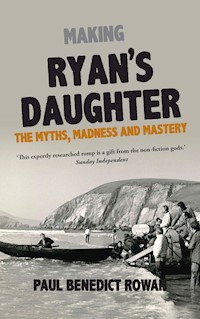
The making of Ryan's Daughter in Dingle 1969 is shrouded in myth and sensational stories. Hollywood superstars in late-1960s Ireland, the Irish climate, the studio system and one of film's greatest auteurs all combined into a troubled and fabled production. Fifty years on, Sunday Times journalist Paul Benedict Rowan reveals in fascinating detail why David Lean's behemoth holds such a unique place in movie history, bringing together exclusive interviews with cast and crew, as well as many stills photographs taken on- and off-set. Rowan pieces all into a definitive rollercoaster account of the making of one of Lean's last films.
Das E-Book können Sie in Legimi-Apps oder einer beliebigen App lesen, die das folgende Format unterstützen:
Veröffentlichungsjahr: 2020
Ähnliche




















Making Ryan’s Daughter
Paul Benedict Rowan was born in Dublin in 1963. His first book, The Team That Jack Built, was published in 1994 to considerable critical acclaim. Paul has worked for a number of newspapers in Ireland, as well as the BBC World Service, where he was a producer, reporter and presenter for eight years. He has worked for The Sunday Times since 2000, for the sport, news and travel sections. He has been travelling to Kerry since before he can remember.
MakingRyan’s Daughter
The Myths, Madnessand Mastery
Paul Benedict Rowan
MAKING RYAN’S DAUGHTER
First published in 2020 by
New Island Books
16 Priory Hall Office Park
Stillorgan
County Dublin
Republic of Ireland
www.newisland.ie
Copyright © Paul Benedict Rowan, 2020
The right of Paul Benedict Rowan to be identified as the author of this work has been asserted in accordance with the provisions of the Copyright and Related Rights Act, 2000.
Print ISBN: 978-1-84840-765-7
eBook ISBN: 978-1-84840-766-4
All rights reserved. The material in this publication is protected by copyright law. Except as may be permitted by law, no part of the material may be reproduced (including by storage in a retrieval system) or transmitted in any form or by any means; adapted; rented or lent without the written permission of the copyright owners.
All effort has been made to identify the owners of copyright material reproduced herein. Any errors or omissions are purely accidental and can be brought to the attention of the publisher in a reasonable manner.
British Library Cataloguing in Publication Data. A CIP catalogue record for this book is available from the British Library.
New Island Books is a member of Publishing Ireland.
To Marla,Will you marry me, again?
Author’s Note
This book is based on recorded interviews with more than sixty people closely involved with the making of David Lean’s 1970 film, Ryan’s Daughter. I conducted most of the interviews during a four-year period between 1999 and 2003 in Spain (where some of the crew were living), Los Angeles, south-east England and Kerry. Kevin Brownlow, David Lean’s official biographer, kindly gave me access to a wealth of unpublished material including letters and interviews. I also leaned on contemporary reports and observations from local and visiting writers who visited Dingle during that period, along with a few of my own impressions from growing up in Ireland and regular visits to Kerry. A complete list of interviewees and sources are included towards the end of the book. I’ve done my best to write this story in such a way that will give you, the reader, a feel for the cloistered conditions which the filmmakers experienced on the Dingle peninsula during the 18-month shoot and the hostile world which they returned to afterwards. My narrator is a curious conservative with catholic tastes. I hope you enjoy the story he tells.
Contents
Introduction
1. Roughneck in a Rolls
2. Passage to India
3. A bit of a fillum
4. Not waving, drowning
5. Five seasons in one day
6. Mrs Bolt
7. The Jones Gang
8. Dingle ’69
9. The bluebell wood conspiracy
10. Dangerous occupation
11. World’s first hippie
12. Bloody murder
13. The Smiling Cobra
14. Black and white
15. The storm waiters
16. Rid of the mob
17. Body in the bathroom
18. God save our Lean
Acknowledgements
Images & Quoted Text Credits
Notes on Sources
Index
Introduction
Sir John Mills won an Oscar for his role in Ryan’s Daughter and said he could have written a book about what happened during the filming of the movie on the wild west coast of Ireland from 1968 to 1970, but he probably would have told only half the story. Were he of the mind, he could have shared the whole, extraordinary lot, for he could hardly have been better placed. He played the part of the fool or village idiot, Michael, who, watching mute from the sidelines, sees everything and is first to sniff out the infidelity that forms the basis for the David Lean film. In fact, the film had been called ‘Michael’s Day’, before the title was changed to focus on the role played by Sarah Miles, whose husband Robert Bolt wrote the screenplay and was determined to make her an international star.
It’s also true that in real life Mills was at the centre of everything. He was offered his part in Rome, where Lean and Bolt wrote the film over a ten-month period, and during the filming of Ryan’s Daughter was given honorary membership of the director’s tight inner circle, known as the Dedicated Maniacs, a club normally restricted to senior crew members. When the ‘David Lean Project’, as it was also called at one point, moved to Ireland for filming, Mills was invited into Lean’s caravan regularly to discuss the day’s shooting and listen to recordings of the scene in question made for the director by Bolt. Lean even had an affectionate nickname for Mills: Nob. And Mills took Lean’s side in the director’s lengthy and damaging stand-off with Robert Mitchum, which lasted for virtually the entire eleven months that the iconoclastic American actor was trapped in Dingle.
Careful with his money, even when he was on a day off, Mills would drive to the set in his Mercedes with his wife, Mary Hayley Bell, to avail of the excellent lunch that chef Roger Jones and an army of caterers were cooking up and to catch up on all the latest news. Behind the cheery, chipper exterior, Mills missed nothing, and he had a good memory, but in a way he was too close to the action. His instincts would have been to gloss over the scandalous goings-on, which shocked and titillated even the Hollywood set that had decamped to Kerry for that crazy eighteen-month period. The actor had, after all, made light of his own near-demise when he had been concussed and almost drowned when swept out of the currach he was rowing in treacherous seas at Coumeenoole Cove, in Dunquin, at the start of filming. ‘Sue the bastards,’ the Irish actor Niall Tóibín thought. ‘Sorry for messing up the shot,’ were Mills’s instincts.
However, they clearly worked, as Mills had a survival mechanism that ensured he remembered only the good times, so that anything enjoyable or amusing remained crystal clear in his mind, whereas the unhappy events quickly became clouded. David Lean was the same. And there is no getting away from it, Ryan’s Daughter was an unhappy film.
In fact, one could quite easily ask: who was most hurt by the making of Ryan’s Daughter? David Lean went into the project as the most marketable film director in the world and emerged from it dismissed as yesterday’s man. A successful and innovative British director since the 1940s, in the ten years before the Irish venture Lean had been embraced by Hollywood and enjoyed a phenomenal run of international success, from TheBridge on the River Kwai (1957) to Lawrence of Arabia (1962) and on to Doctor Zhivago (1965). The ailing giant that was Metro-Goldwyn-Mayer Studios (MGM) had been rescued by the revenue from Doctor Zhivago, which had made Lean a personal fortune and a star in his own right. Then Ryan’s Daughter was critically mauled and ridiculed, leaving him badly wounded, as everyone had assumed he was cranking out another sure-fire winner.
Lean’s right-hand man and creative partner, Robert Bolt, was an intellectual who also had the Midas touch. Bolt had written Lawrence (along with Michael Wilson, it later emerged) and, away from Lean, had also won the Best Screenplay Oscar for A Man For All Seasons (1966), which was directed by Fred Zinnemann (another loser, as it happens, from the Ryan’s Daughter project). No wonder the contract that Lean and Bolt signed with MGM to make Ryan’s Daughter was the most expensive in movie history. However, Bolt’s career too was about to plateau on the mountains of Co. Kerry, before going into decline. His marriage to the leading lady also collapsed after he was cuckolded by a writer from Time magazine, David Whiting, who was masquerading as a white knight come to rescue the couple from the critical opprobrium that Ryan’s Daughter received. Sarah Miles even claimed that Bolt’s attempts to revive his career contributed to the stroke that so debilitated this kindly man in the last years of his life.
And where do you begin with Sarah? Carefully, for a start, for she is still very much alive and in rude health, a walking advertisement, it could be said, for the benefits of drinking one’s own urine, of which she is a practitioner and advocate. Sarah claimed that she never really wanted to be a star, and her behaviour suggested as much. This highly talented young actress had a reputation for being difficult that caught up and consumed her as the flames licked around Ryan’s Daughter. Talk about life imitating art. Bolt, a schoolteacher before he became a writer, had created a storyline where Mitchum’s character, the schoolteacher Charles Shaughnessy, dolefully accepts that his wife Rosy, Miles’s character, is having an affair with a British army officer. Six months into shooting, with the film in the doldrums because of bad weather, the irony was not lost on the restless crew when word spread that Mitchum and Miles were intimate. Sarah found it hard to resist Mitchum’s ‘bearlike proximity’ and ‘animal magnetism’ and would admit years later that she did have an affair with him, but only after Ryan’s Daughter, when she was divorced from Bolt.
The other losers? Those Irish actors who spent more than a year in Dingle earning money the likes of which they hadn’t seen before, and who drank themselves to death, literally, within a few years. At the other end of the spectrum were the money men and distributors at MGM who were relying on Ryan’s Daughter to help stave off impending bankruptcy, and whose top brass were stonewalled by Lean every time they came over to Ireland from their New York office trying to hurry him along.
Ryan’s Daughter, which was supposed to be an intimate love story, ended up being given the epic treatment even though the storyline was slight. Cheaper, edgy productions such as Medium Cool (1969) and Easy Rider (1969), the latter of which cost $360,000 to make, provided storylines modern audiences could relate to, and were far more successful. Lean was weighed down by his decision to shoot in 70mm rather than 35mm, which required a much larger technical support crew. A huge travelling circus clogged up the roads in Kerry for more than a year, sometimes even running into itself as locations were changed at the last minute and trucks and caravans U-turned on bogs and beaches.
Some fared better from Ryan’s Daughter. Lean’s right-hand man, Eddie Fowlie, found himself a young Irish wife whom he whisked away from Dingle to a life with the jet set. The producer, Anthony Havelock-Allan, fell out badly with Mitchum, but could live with that as the cheques finally started dropping through the letterbox. He did well out of it even though he was a producer in name only, there as a friend of Lean rather than the martinet needed to crack the whip and drive the production through as Lean dallied endlessly.
Disciplined, happy and healthy, Mills had a ball in Dingle with his beloved family around him, scarcely believing his luck as shooting extended months beyond his contract, and lucrative overage payments kicked in. The Oscar statuette he won for Ryan’s Daughter sat proudly on the baby grand piano in his living room when I met Sir John in 2002 at his home in Denham, West London. At that stage it was clear that he wasn’t going to be writing any book. Even talking for any great length of time had become a struggle.
The filming of Ryan’s Daughter was finished off in apartheid South Africa as Lean couldn’t get enough sun in Ireland. ‘What was South Africa like?’ I asked Mills.
‘Lovely. I seemed to have liked everything, didn’t I?’
‘Ye were an eccentric bunch, weren’t ye?’
‘Yes, there was a lot of drama offstage. David didn’t get on well with Mitchum. He could be a bit of an old aunty and Mitchum went out to shock him. And then Sarah cared for him, though perhaps I shouldn’t say that. So it was quite a hothouse of emotion.’
Our conversation was entering its twentieth minute and Mills, who was 94, was getting tired. The time had come to wind things up.
‘I’m rather boring for you because I like everything,’ Mills said, by way of a closing statement. ‘That is my trouble.’
No trouble at all, Sir John. No trouble at all. Let me be your fool.
1. Roughneck in a Rolls
Eddie Fowlie loved breaking rules, so what better time to make a move than during siesta? He had already emptied much of the contents of his caravan into his large automobile, noisily at times. Otherwise, Carboneras was silent in the early-afternoon sun, save for the lapping of the Mediterranean Sea against the shore. Fowlie ignited the straight-six engine of his Rolls-Royce Silver Cloud 1. He steered it through the whitewashed village and headed out on the road at the beginning of a journey that would take him from the southeastern tip of Spain to the most western point of Ireland and another sleepy place: the town of Dingle.
Fowlie had worked out that the journey would amount to nearly a week of hard driving over some two thousand miles, but he was relishing the prospect. Carboneras and the caravan were all very well, but he yearned for the excitement, the adventure, the challenge that came with making big motion pictures, and especially big motion pictures with David Lean.
Fowlie was Lean’s dogsbody or right-hand man, depending on who you spoke to, and was the most dedicated of the director’s Maniacs. Lean didn’t have many friends and Fowlie was probably the closest one. He was also considered to be Lean’s alter ego, with a degree of influence over the director that some others in Lean’s tight circle resented. Lean first met Fowlie in Ceylon (now Sri Lanka), on the set of TheBridge on the River Kwai. Lean was swimming in the river under the bridge when Fowlie dived in, re-emerged and exclaimed, ‘Bloody millionaire stuff’, an outlook that hugely impressed Lean at a time when most of the crew and actors were complaining about the hazards of working in Ceylon’s steaming jungle. Fowlie was Lean’s property master, special effects man and location finder, and those were just his formal roles. He was known to knock down telegraph poles when they were in the camera’s line of sight by driving into them with his Land Rover. He would locate and strangle cockerels when their crowing was disrupting filming. He was regarded as animalistic yet had an artistic side that belied his brutish manner. He was Lean’s go-to man and problem-solver, albeit one who could create new ones just as quickly.
He sometimes wondered whether he had been spoiled by David, and certainly he copied him. He shot stills using a Leica, the make of camera favoured by his employer. Fowlie had estranged himself from his children of former relationships, like David, and joined the Lean tribe that went from film to film.
As he steered the Silver Cloud past the whitewashed cottages and then entered the desert landscape of Almería, his mind drifted to what had brought him to this place – Lawrence of Arabia, curiously enough, and in particular the staging of the sacking of the city of Aqaba by Arab forces led by Lawrence. Lean’s crew had built a magnificent replica of Aqaba just outside Carboneras and afterwards Lean, his assistant John Box and Eddie himself had bought land in the area, or practically been given it by a local businessman. Box and Eddie were two of Lean’s most Dedicated Maniacs, like family even. Here, they were all going to settle in the sun, away from Britain, away from the bloody trade unions and the taxman, who the socialists at Number 10 had unleashed to bleed dry those prepared to make themselves a few quid. In the Spain ruled by General Francisco Franco, they got to keep what was rightfully theirs. They liked Spain, and all it stood for, so much so that Lean came back to film Doctor Zhivago near Madrid, even though it was the story of a Russian poet who never left his own country.
As the road to the town of Venta del Pobre straightened out, Fowlie checked his speed dial. A steady 80mph. It was good to get the Rolls on a long journey at last. He had been poking about in it since David had given it to him after Zhivago. A rare smile spread across Eddie’s face. David had been in a particularly expansive mood back then. One or two vital members of the crew had received cheques of $50,000 as a personal thank you from the director. Lean had also treated himself to a Rolls-Royce upgrade, from the Silver Cloud to a burgundy-coloured convertible Silver Shadow. Doctor Zhivago was making even more money than Lawrence, and there was no Sam Spiegel about to divert the proceeds either. Eddie wanted Lean’s Silver Cloud and had written him a cheque, which David had returned with a message scrawled across it: I always thought you’d look good in a Rolls-Royce. And Eddie did look good. Bloody good. He felt good, too. England, where he had to stop over on his way to Ireland, was an attractive prospect when you only had to spend a few days there. Things had been getting a bit too hot and heavy back at base. He’d been putting away too much booze of late and the rows with his young wife Conchita were getting worse.
Eddie thought also of Barbara Cole, the continuity girl David had met in the Jordanian desert on Lawrence and invited to share his mobile home. Barbara had put body and soul into building a magnificent house on Lean’s land in Carboneras and was awaiting Lean’s arrival, when he had scooted off with another woman. She was tough, Barbara, but Eddie couldn’t help thinking of Miss Havisham every time he looked up at the house. He had mentioned David’s name once to her in the street and she had started weeping. Yes, he could do without Carboneras for a while. It being a David Lean film, he knew it would be a long while.
Eddie’s first inkling that something was moving came when a cable arrived from Rome and was delivered to the caravan. He knew David was there and he had opened the telegram the way he had ripped open his Christmas presents as a young boy. ‘Don’t take a job,’ Lean had written. ‘Robert and I are writing a little gem. Phone.’ From the telephone box in Carboneras he had done so immediately and been summoned to Rome. There, he found David and the Robert in question, Robert Bolt, in the largest suite of the Parco dei Principi Grand Hotel behind a fog of cigarette smoke, poring over papers, with empty coffee cups and overflowing ashtrays surrounding them.
David had emerged to take him and Robert to dinner, and over Parma ham and Lobster Thermidor Lean put a proposition to him. While Robert – a Red – bolted down his food and gave out about what the Yanks were doing in Vietnam, Lean told Eddie that he wanted him not just to be property master but to find locations for his next movie. This would be a love story set in Ireland. ‘Michael’s Day’ was the working title. The following day Lean briefed him further back at the hotel and he was introduced to the producer, an old friend of David’s called Anthony Havelock-Allan, an aristocratic type of whom Eddie was immediately suspicious. Havelock-Allan handed Eddie an envelope full of Italian lire, telling him to pick up his next payment in London.
Fowlie had been told that filming would take place in Ireland, but past experience told him that Lean movies had a habit of spilling out into other countries, and Spain itself, with its variety of landscapes and abundance of technical talent and cheap labour, was one of Lean’s favourite locations. It would be just like David for the whole bloody thing to end up back here. After two days driving west through Andalucía and then north along the border with Portugal, Fowlie scouted north-western Spain, thundering along the Bay of Biscay from San Sebastián to Gijón. From what he had read of the script and from what Lean had told him, he knew that the film had a dark, moody side, and what he saw was too green and too blue. He drove on, through France, and took the ferry to Dover.
Exactly a week after he had pulled out of Carboneras, he settled into the Royal Garden Hotel in Kensington. All the while he enjoyed the stares he was getting, particularly when he had reason to speak to someone. He knew he looked and sounded like a rough-neck in a Rolls; the huge build, the large sensuous mouth, the shock of white hair. Eddie was back where it had all started, but he remained nostalgia-free. He wasn’t keen on returning to his home town of Teddington, nearby on the banks of the Thames; his priorities lay elsewhere.
Fowlie visited Bartholomew’s map shop in Charing Cross. There he bought ordnance survey maps of Ireland and took them back to the hotel, where he spread them out on his king-size bed. He had been all over the world making movies but, like so many Brits, he had never hopped across the Irish Sea to Ireland before. His brief was not so much Ireland but more the West of Ireland, facing out to the Atlantic Ocean. As he studied the maps, his eye was quickly drawn to the Dingle Peninsula. For a start, it reached far out into the Atlantic. Then there were the three little islands further offshore; the Blaskets, they were called. Just the sort of background David wanted when he was shooting. The map’s contours told him there were mountains in the area, not very big ones, but of promising shapes and sizes. The Dingle Peninsula, he decided, would be his first port of call.
On the way out of London, he collected spending money from MGM Studios at Borehamwood. Though he was itching to get to Ireland, on the way to the car ferry he scouted the coast of Wales as another alternative location. Fowlie then got the ferry to Dublin and headed west straight away. He and the Rolls crawled through village after village after town – motorways hadn’t arrived in Ireland – and the countryside in-between all looked too green and too pretty. By the time he reached the Dingle Peninsula, 200 miles on, night had fallen and he was feeling tired, but his spirits curiously began to rise as he looked about him. Driving along in the Silver Cloud, he could see the dark shapes of mountains to the right and a great flat expanse of what must be the ocean to the left, with a few lights twinkling in the distance. In the blackness he couldn’t see the water, but when he wound down his window he could smell the sea breeze and taste the salt on his tongue.
He was on the very edge of Europe, the most western point. If he’d been able to keep on driving, his next stop would have been New York. As it was, he reached Dingle close to midnight. It was late summer, but Dingle was deserted and damp, with just the odd parked car out on the street. What type of people lived here? He went into a pub called Ashe’s and ordered a whisky. The owner, Tom Ashe, had time to fill him in on some local history as the place was quiet. This was a small market town and a fishing port, but the harbour had become badly silted up so big boats now stayed away. From Dingle’s most thriving period in the sixteenth century, when it had been an important trading post, the town had gone into steady decline and had a dwindling population that relied to a large degree on handouts from the state and those who had emigrated to the United States but hadn’t forgotten their loved ones back home. Touching.
Fowlie retired to his hotel on the outskirts of the town. The Skellig Hotel was still not fully completed but had opened, was of a reasonable standard, a good size and would provide an adequate place to stay. He took that as a good omen. Although David had spent nearly a year living in a caravan in the desert in Jordan for Lawrence, Fowlie knew that the director valued his creature comforts more as an older man. That night Eddie Fowlie became one of the Skellig’s first guests. The girl behind the counter was charming and helpful, with the most delightful lilting accent. He could have stayed there all night listening to her, but instead delayed just long enough to get a name and location for the local estate agent, who could act as his guide. She recommended the local stout and after a couple of delicious, creamy pints in the hotel bar, he retired for the night.
Fowlie slept with the curtains open and daylight revealed a place sent from the heavens. The morning was bright and sunny and from the hotel window he could see what he could only guess at the night before: the dramatic, dark mountains that ran down to a vast expanse of ocean. In the blue sky hung great towering fortresses of white, fluffy clouds. Walking out of the hotel, it also dawned on him that the landscape was more brown than green, or purple where the heather covered the mountains. His senses tingled. As he continued to gaze, he noticed that the combination of water, mountains, clouds and sun was generating the most wonderful quality of light. This place was full of drama, full of atmosphere. David would love that.
At John Moore’s estate agents, he found Joe Mahoney happy to shut up shop and swap the comfort of the office for the front passenger seat of the Rolls. What Eddie saw on their journey increased his excitement. Ten miles out the road to the west he came to the wonderfully rugged Slea Head and clapped eyes on the first of the Blasket Islands, a mile or so out to sea. He was excited, not only by the sight of them but by the realisation that he had been right in his assumptions when he’d looked at the map back in London. The islands would offer depth of field and a stunning background when David needed one. Eddie could already picture David filming the blurred images of the islands held in puddles on the road. At Coumeenoole Cove there was another boon, a narrow road steeply descending to a small beach carved out of the black cliffs and battered by great Atlantic rollers. The film called for an arms landing by Irish rebels. This would be perfect, he thought. And, as a clutch of other beach scenes were called for, Mahoney directed him to Inch Strand, about thirty miles back along the peninsula, a vast promenade of golden sand and dunes stretching for miles out into Dingle Bay. At another, Banna Strand, Fowlie was in typically irascible form, ignoring ‘Private Property’ signs and Mahoney’s protestations as he found something else called for in the script that only God could create: a cliff overlooking the beach. Mahoney directed him to a plinth nearby dedicated to one Roger Casement. Turns out it was the same beach where Irish rebels had attempted to stage a landing of German arms in 1916 and in doing so had delivered Casement into the arms of the British army and the hangman.
This area had everything, he concluded, and all locations were within an hour’s drive of each other. Anything not provided by God, Fowlie knew he and his team could build. Still, he had the rest of Ireland’s west coast to scout in case there was something even better. It had been a fruitful couple of days. The one drawback was the unpredictability of the weather and the large amount of cow dung getting thrown up into the undercarriage of the Rolls. His car was plated underneath, but still. Fowlie hired a Mercedes and found a hayshed in which to stash the Rolls. Then he travelled up and down the length of Ireland’s west coast, from Cork to Donegal, not once but two or three times, almost running the rented Merc into the ground before dropping it back at Sean Moran’s garage in Dingle.
2. Passage to India
All this time, Lean had been working away on the script with Robert Bolt at the Parco Dei Principe in Rome. Also at his side was 21-year-old Sandy Hotz, who was providing not only moral support but also the creative spark for what would become Ryan’s Daughter. Lean, at the age of 60, was three times older than Sandy, and his crew were understandably curious about how the liaison had come about. Was it her looks, for she was certainly striking? Jocelyn Rickards, the costume designer on Ryan’s Daughter, who visited Lean at his hotel, spotted a pair of low-heeled black patent-leather shoes in the suite, which she reckoned must belong to his new girlfriend, and was rather struck by the young woman herself when she came into view: ‘Tall and supple, Sandy was a little like a pre-Renaissance Madonna, with pale honey-coloured hair, a high forehead and long, delicately rounded limbs. She seemed half-girl, half-woman, was utterly in love with David and fresh from her convent education, waiting for everything that he could teach her about life, filmmaking, growing up, living and loving.’
Rickards had heard all about Lean’s reputation when it came to women. When Lean met Sandy, not only was he still married to an Indian woman, Leila Matkar, but his steady lover Barbara Cole was already earmarked as the fifth Mrs David Lean. It was a Gordian knot that would take some time to cut.
Lean had met Leila on a voyage of discovery to India and then married her in Paris in July 1960. He was at the sharp end of a few difficult relationships back in London at the time, and he liked the eastern way in which Leila sat at his feet and lit his cigarettes. Leila became his fourth wife but was made what Lean called a ‘celluloid widow’ by Lawrence of Arabia and Doctor Zhivago, only appearing in her husband’s company intermittently. Living out in the middle of the desert in Jordan in a caravan, with the rest of the crew under canvas, David had embarked on an affair with Cole, who had succumbed to his ardour even though she realised that if it cooled, she could lose her job as continuity girl on the film. For Lean, it was pretty much all business. When taking on a new movie project, he found himself energised by starting a new romance. He was of the opinion that finding the right new woman could make the movie better by at least 50 per cent, though it is not quite clear how he arrived at that figure.
Lean was a handsome and virile man. Apart from directing one of the most ambitious and difficult movies in the history of the industry, he would spend his nights making love passionately to Barbara in his caravan out in the desert when his wife was elsewhere, which was most of the time. Leila suffered bouts of depression, which were a hindrance to David when he had a movie to make, as she would be slumped in a chair on her rare visits to the set while he bustled around the place. Barbara, who was in her early forties, was a highly practical New Zealander and knew her role, on and off the set, accepting that filmmaking would always be the love of Lean’s life, and that she could assist him not only in a job she loved but also filling in the gaps around it. The passion was still there when Lawrence passed and Doctor Zhivago came along. Leila was still around too, but Barbara was patient.
After making Zhivago, Lean went back to India to be with Leila, but her depression had worsened and David couldn’t bear to be near ill people, his wife included. Instead, he threw himself into researching a project he had nurtured for more than ten years: the filming of the life of Mahatma Gandhi. He planned to make this with Bolt, seeing it as the natural progression of their work after Lawrence and Zhivago. Then a letter arrived from Bolt in August 1966 that took Lean by surprise.
His brilliant cohort was having his own domestic difficulties. It was more than a year since they had last met, and in that time Bolt’s marriage had collapsed, partly, the writer would claim, because Lean had placed so many demands on his time and company on location. His wife, Jo, had found another role for a carpenter, Gordon Riddett, who had come to their house in Hampshire to install a modern kitchen unit while her husband moved up in the world.
Bolt was devastated by his wife’s adultery and concerned about their three young children, but he found love again at a dinner party in London when he met a young actress seventeen years his junior called Sarah Miles. They quickly moved in together and then briefly visited Lean in India, where Bolt was researching the Gandhi project. However, Bolt started going in a different direction, partly as a result of the critical mauling that Doctor Zhivago had received, and also because of the fresh and exciting twist in his love life.
In letters to David at that time, Bolt argued that their next collaboration should be on a smaller scale than Lawrence or Doctor Zhivago, which was based on the Boris Pasternak novel, and which Bolt said was like ‘straightening cobwebs’ when it came to adapting it for a screenplay. Bolt now made it plain that he was tired of ruthlessly condensing great literary works into two- or three-hour movies, as he had also done with Lawrence – ‘cable-ese’, as he called it. It was time to get away from the epics, Bolt argued, and do something more along the lines of the love story that had established Lean’s name, Brief Encounter (1945).
‘I’d like our next to be … what? I don’t know,’ Bolt had written in January 1966. ‘But something simpler in its mechanics, with more emphasis on atmosphere (like Brief Encounter if you like), less sheer strained ingenuity of story-telling. A simple but grand theme that could be told at lesser length.’ A month later he introduced a caveat: ‘I forget exactly what I said in my last, but I don’t mean Brief Encounter in the sense of anything as small as that; it ought to be a simple story with an important or exciting theme. Simple so as to give us room, important or exciting so as to give us impulse and energy.’
Brief Encounter – a story of suppressed love between two people who are married, though not to each other – touched a nerve in David. In recent years he had affected to despise ‘those beastly little British films’, complaining that the ‘wretched’ Brief Encounter, an intimate, restrained film that marked his breakthrough as a director, kept being revived and spoken about by critics who disliked much about his more recent films, which were strictly in epic mode. David saw an ideal opportunity to show those critics who said he couldn’t do anything on a more human scale that he still had the talent that had once produced Brief Encounter.
Norman Savage, who had edited Zhivago with Lean and would go on to do the same job on Ryan’s Daughter, was dining in Madrid with a friend, Peter Miller, who had worked on Bridge on the River Kwai as an assistant director. David was on a short visit to the city and happened to be dining in the same restaurant, so he joined them at the coffee and brandy stage and they talked into the early hours. ‘We discussed amongst other things a movie which he intended to shoot in ten weeks,’ said Miller. ‘Seeing the total disbelief in our eyes he told us very firmly that he’d done it in the past and was going to show everyone that he could do it again.’
Still, it was a struggle. As part of this change in direction, Bolt wanted to put Gandhi on the backburner and instead write a part that would catapult the 24-year-old Miss Miles to international stardom. Back in England, Bolt made an attempt at a screenplay of Jane Austen’s novel Emma, which he tore up. He then turned to Madame Bovary, by the nineteenth-century French novelist Gustave Flaubert, an account of a provincial girl who dreams of romance while trapped in marriage to a mediocre, middle-aged man.
The tone of the Bolt letter that reached Lean in India was rather breathless: ‘I’m going to do a script of Madame Bovary,’ Bolt wrote to Lean on 31 August 1966. ‘Do you know it? Besides being a “classic”, it’s an immensely disturbing account of frustrated passion and romantic longing. Very intimate, dramatic to the verge of melodrama, and yet implacably realistic. Sarah for Madame Bovary of course. It would have to be shot in France. Does it interest you? You’re the perfect director for it. If not, can you suggest who would be second best?’
Lean found it impossible to share his thoughts properly with Leila, but he was dismissive of both Bolt’s project and Miles when he wrote to Barbara, who was supervising the building of the house in Carboneras, in southern Spain, where they planned to live together. ‘Isn’t it a bugger darling?’ Lean asked in his letter of 15 September 1966.
I don’t know the book, but I bet it’s good. Dear old Robert must be in a temporary madness. Aren’t we all, from time to time? I can’t believe that Miss M has the weight for such a character and unless he gets somebody like me, I don’t think a distributor would back her little-known name in such a huge title role ... I’m afraid he must write the part for her and her character. I can also imagine what rehearsals would be like with Miss M knowing more about Robert’s intentions than anyone else, including me.
Lean didn’t share that withering assessment with Bolt, and nine months later, when Bolt’s finished script arrived in his mailbox, he was far more favourably disposed towards the idea, as his love life had taken a twist of its own. Unable to cope with Leila’s worsening depression, which now confined her to a room in an Old Delhi hotel with the curtains drawn all day, Lean had visited the Taj Mahal at Agra, which also featured in his movie-making plans. With him was the art director Alexander Trauner. Their rented car had broken down just outside Agra, and he and his friend had an extended stay there at a colonial-style hotel called Laurie’s. While at the hotel Lean had become intimate with the tall, white girl who brought him, and subsequently his afternoon tea, to his room. This was Sandy Hotz, the 20-year-old daughter of the hotel’s proprietor.
Sandy had just seen Lawrence of Arabia and had immersed herself in Western art and fashion through reading magazines and books. She was bright, cheerful and vivacious, the perfect antidote to Leila, in Lean’s view. What had been planned as an overnight stopover for Lean turned into a five-month stay.
He wrote again to Barbara on 18 November 1966, this time in full confessional mode, as though struck by temporary madness himself. ‘I have fallen in love with a young girl. In my bloody arrogance, I used to say I could never understand such a thing, that I was immune, above the common crowd. I feel almost as if I don’t understand anything any more. It’s a sort of final fall from my too arrogant pride.’
A married man thirty-seven years their daughter’s senior wasn’t what the Hotzes had in mind for Sandy, no matter how many millions of dollars Lean had, but they were powerless to stop David and Sandy from eloping to Europe just after her twenty-first birthday, in February 1967. The couple flew to Zurich, where David had business with his bank, and then on to Spain, where David picked up his new Rolls-Royce. Sandy made herself scarce while David met Barbara in Madrid, where they said their goodbyes and his now former continuity girl tried not to cry.
David was back to having just two women in his life. The lovers meandered through France and northern Italy before arriving in Naples in July 1967, from where David planned to show Sandy the island of Capri. David didn’t have a residence or even a house. In one way the Rolls-Royce was his home, with a boot containing a few shirts, a few pairs of trousers and – as Alec Guinness once noted – his Oscars.
It had been that way now for more than a decade for this air-conditioned gypsy. When he wasn’t working or travelling he took a hotel suite, usually in either Venice or Rome. David had been living the life of an international itinerant since the messy break-up of his marriage to his third wife, Ann Todd, fourteen years previously. The divorce settlement had resulted in punitive tax demands from the Inland Revenue and the loss of his splendid mansion in Kensington, West London. After being so ghastly to Barbara, he wasn’t going to kick her out of their new house in southern Spain, so he continued the life of flitting from one five-star hotel to the next in cities across the world.
He and Sandy were ensconced at the Excelsior in Naples when Bolt’s completed screenplay of Madame Bovary was delivered to their suite: ‘Even if you don’t want to do it,’ Bolt had written in an accompanying note, ‘please write and tell me what you think.’ Bolt had become an admirer of Lean’s intellect, even if others weren’t, including David himself. Lean’s insecurities stretched back to the sibling rivalry of his childhood. His younger brother, Edward, had overtaken him and gone to Cambridge University, whereas David plodded through school, regarded himself as a bit of a dud when it came to learning and always had a suspicion about ‘intellectuals’.
David’s talent emerged in an unconventional way. He had come up through the technical side of the industry, ever since, really, an uncle had presented him with a Brownie box camera as a present for his eleventh birthday. When he found himself able not only to take good pictures but to develop them in his home-made dark room, his self-confidence grew. The hobby became his all-consuming passion and reflected the two sides of his family background: art and technology. His father came from a line of academics and painters; his mother was descended from Cornish engineers. Both were Quakers, who encouraged David’s photography but banned him from the cinema, which was considered immoral. A cinema-going nanny had corrupted him with her hilarious Charlie Chaplin impressions at the kitchen table. When David finally reached the age of consent, he found the movies were a glorious escape from his drab surroundings growing up in the South London suburb of Croydon, where there was much domestic unhappiness after his parents divorced. His father, an accountant in a London firm, had got him a job in the City when he left school, but eventually admitted defeat and used his contacts to get his teenage son a job as a tea-maker in a West London film studio. Lean enjoyed escaping from the constraints of his Quaker upbringing, but always remained with his shirt buttoned up to the neck.
A love of nature and the outdoors, imbued from an early age from reading, was another blessed release for David, and he always thought of himself as a bit of a boy scout. However, his talents stretched further than that, into the intellectual sphere, even if he didn’t recognise it himself. Bolt said of Lean that, ‘Little by little he read. Here was an amazing thing: You would give him something like Madame Bovary to read and he would deliver so fine and far-reaching a critique of it and he didn’t think anything of his ability to do that.’
Lean’s latest adventure to the island of Capri with Sandy was put on hold once Bolt’s script arrived in Naples. What followed for his young girlfriend was a stark lesson in where she stood in the David Lean pecking order. She had watched while Lean sat down and read Bolt’s script with an intense concentration. When he had finished – Lean was a slow reader – he prepared a ten-page letter explaining to Bolt why he wouldn’t make the film. Still, his mind was in overdrive and he was clearly preoccupied. He then tore up the letter and started on a much longer one to Bolt. The whole process took weeks, with David only rising from his typewriter to take dinner with Sandy in the hotel dining-room – often silently – or to go to bed. Sandy hated the suite they were staying in. It had high ceilings and chandeliers but was still gloomy and reminded her of a mausoleum. While other women might have stamped their feet or packed their suitcases, she quietly accommodated her man. Sandy managed to find a bookshop in Naples that had a handful of novels in English and read François Rabelais’s Gargantua and Pantagruel over a weekend. David finally emerged after nearly a month of drafting radical changes to Bolt’s script.
Sandy was young, but she was well-educated, perceptive and a fast learner. David had told her about Robert’s relationship with Sarah Miles, and she quickly realised that David too was being drawn to Flaubert’s novel because he found much in it that mirrored his relationship with her. Rather than dismiss the Bolt project completely, Lean wanted to devise what would be presented as an entirely original story, using Madame Bovary as the source.
He had been speaking to Bolt on the telephone and then announced to Sandy that they were going to Rome to meet the writer, forthwith. Once there, Lean laid his hat at the Hotel Parco dei Principi, overlooking Rome’s botanic gardens. ‘I never did get to Capri,’ sighed Sandy, ‘but that was the start of Ryan’s Daughter.’
Bolt mourned Madame Bovary but was prepared to live with Ryan’s Daughter, particularly as Lean had accepted that Sarah would play the title role. Miles was there to stay; the couple had married months earlier and she had just given birth to their son, Tom, in October 1967. All the while Bolt beavered away, not just on Madame Bovary but on Gandhi as well, a film that Fred Zinnemann was also interested in directing, but when Bolt wrote to his other great collaborator on 29 December 1967, it was clear that all roads led to Rome and David Lean. ‘In about a fortnight’s time I expect to be working with David again on an “original”. It will be loosely based on the Bovary idea, but very loosely, bearing about the same relationship to Flaubert as Stagecoach did to Maupassant.’
MGM weren’t quite so sceptical. On the basis of an outline of the plot, Lean and Bolt secured what was potentially the most lucrative deal ever for film-makers. Under the terms of the contract signed on 23 January 1968, Lean would receive $1 million, paid into his Zurich bank account immediately, plus a massive 35 per cent of net profits and a living allowance of $1,000 a week. Bolt would get $400,000, plus 10 per cent of net profits and a similar living allowance. He had just become the highest-paid scriptwriter in the world, outstripping the likes of William Goldman and Tennessee Williams, who was paid $200,000 for Boom! (1968). MGM had purchased the hottest creative team in Hollywood and would expect plenty of bang for their buck.
Bolt and Sarah took an apartment in Rome, just to keep their distance, but Miles then injured her leg and couldn’t use the stairs, so they moved into the same hotel as Lean and Sandy, the Parco dei Principi. The director took over much of the top floor, which overlooked the zoo in Rome’s Botanic Gardens. Lean was visited in his top-floor suite by fellow director, Richard Lester. ‘You’d wake up in the night and hear these bloodcurdling sounds,’ Lester told Lean’s biographer, Kevin Brownlow, about when his sleep was disturbed by roaring lions. ‘I thought to myself, “Is this his life? A couple of green-and-white-tiled rooms on the top floor of the hotel, after all he’s achieved?”’




