


44,99 €
Mehr erfahren.
- Herausgeber: mi-Wirtschaftsbuch
- Kategorie: Fachliteratur
- Sprache: Englisch
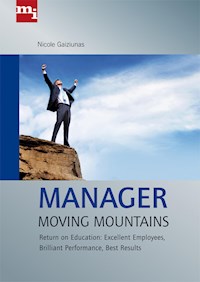
Every executive board would like to have the best in their field. Unfortunately, this undertaking has been failing extensively and categorically for years. Every year billions are spent on executive and personnel development, talent management, training and qualification, with modest results. No man-agers can move mountains like this, not to mention the range of challenges which are mounting up in this time of exogenous shocks, threatened global supply networks and dwindling raw material sources. The 'input' principle is to blame: Too much emphasis is placed on what is put in. The 'best in class' pay attention to what comes out. They work according to the principle of 'return': Training should no longer just make it possible for managers and employees to move mountains. The mountains need to be moved in the training itself. This is self-financing and profit-generating because it creates 'return projects' which are designed to increase turnover, reduce costs and/or improve efficiency. That's how mountains are moved! With this new understanding of management development and the unleashed power of developing personalities. In short, with future competence. The author spotlights twelve megatrends from business and society that managers across all industries will need to master with future competence in the next few years. They lead in to Change Management 2.0: Transformation instead of just change.
Das E-Book können Sie in Legimi-Apps oder einer beliebigen App lesen, die das folgende Format unterstützen:
Seitenzahl: 347
Veröffentlichungsjahr: 2011
Ähnliche


















Nicole Gaiziunas
Managers Moving Mountains
Return on Education: Excellent Employees, Brilliant Performance, Best Results
Deutsche Nationalbibliothek Bibliographical Information The Deutsche Nationalbibliothek lists this publication in the Deutsche Nationalbibliografie. Detailed bibliographical information is available online at http://dnb.d-nb.de
Questions and comments to:[email protected]
1st Edition 2011
© 2011 by mi-Wirtschaftsbuch, FinanzBuch Verlag GmbH, Munich, Nymphenburger Straße 86 D-80636 Munich Tel.: 089 651285-0 Fax: 089 652096
© The original edition 2011 by mi-Wirtschaftsbuch, Münchner Verlagsgruppe GmbH, Munich
All rights reserved, in particular the rights to copying, distribution and translation. No part of the publication may be reproduced in any form (by photocopying, microfilming or any other process) or stored, copied or distributed by means of electronic systems without the written consent of the publisher.
Translation: Shelley Steinhorst, Dive in Languages GmbH Editorial Office: Rainer Weber Proofreading: Rainer Weber Cover Illustrations: iStockphoto Typesetting: HJR, Jürgen Echter, Landsberg am Lech Printing: CPI-Ebner & Spiegel, Ulm
ISBN-Print 978-3-86880-123-1 ISBN-E-Book-PDF 978-3-86416-096-7
For further information on this subject:
www.mi-wirtschaftsbuch.de
We would be happy to send you a list of our current publications.
Contents
Foreword to Future Gold
1 The Only Thing That Counts
The CEO’s Leather Pants
An Example of a Cost Trap
Moving Mountains
The Unfortunate ‘Input Principle’
The ‘Return Principle’
The Enemy of Good
The Amazon Example
At a Glance: Business Impact
In the Hot Seat: Quo Vadis, Manager? An Interview with Christian Rast, CEO of BrainNet
2 Only What’s Necessary, Please!
Management by Zeus
Training to the Point of Return
Sherlock Holmes, the Trainer
The Elephant in the Living Room
Watching the Detectives!
The Purchasing of Profiles
What Can the Employee Do?
Skill Assessment
We Want the Best!
The ‘Point of Return’ Philosophy
At a Glance: Skill Assessment
In the Hot Seat: Healthy with BMW. An Interview with Harald Krüger, BMW Board Member
3 Away with the Grab Bag!
Marshmallows for Breakfast
The Complementary Principle
All the Content That’s Necessary
The Grab Bag?
No Training without Targets!
At a Glance: Train Everything!
In the Hot Seat: The Power of Siemens. An Interview with Marion Horstmann, Chief Learning Officer, Siemens
4 Life is a Project
Are You a Good Mother?
Do It Right!
Actual Practice is the Only Thing That Counts
Actual Practice Projects
The Foreign Subsidiary Problem Child
Go to a Tutor!
When the Dam Breaks
Who’s Taking Care of Your Sky-divers?
The ‘Me Too’ Warning
Make It Your Project!
At a Glance: Projects that Make a Difference
In the Hot Seat: Technical Inspection for Projects. An Interview with Dr. Thomas Aubel, Executive Vice President Mobility at TÜV Rheinland
5 Just Do What You Want!
Take the Whip if You’re on Your Way to Your Employees
Autonomous Training
Ask Mama!
The Shiny, New Learning World
Better Than a Boss
Are PCs Replacing Bosses?
Baby Steps
At a Glance: What You Want!
In the Hot Seat: Audi Excites. An Interview with Dr. Ernst-Hermann Krog, Audi Logistics
6 Get Your Coaching Here
Drive through Coaching
Trickle Down Coaching
Coaching as ‘Return’ Turbo-Charger
No Sorcerers, Please!
Common Coaching Misapprehensions
At a Glance: Better with Coaching
In the Hot Seat: How Do Managers React to Failure? An Interview with Dr. Hermann-Josef Lamberti, COO of Deutsche Bank
7 The Right School for Managers
Where Do Managers Learn to Manage?
The Real Thing
Where the Real Managers Grow
The Management Retention Side Effect
Project and Task Specificity
Your Country Needs New HR Managers!
Implementers, Not Trainers
No More Excuses
At a Glance: A Real Corporate University
In the Hot Seat: People Want More Than Products from Companies. An Interview with Prof. Dr. Michael Hüther, Director of the Institute of German Economy in Cologne (IW)
8 Super Manager
Managers’ Biggest Enemy
Tackling the Moral Deficit
Change Your Point of View!
Mentoring with a New Perspective
The Cost of Tunnel Vision
Turning Plow Horses into Lipizzaners
The Globalized Manager
At a Glance: Return on Management Development
In the Hot Seat: Managers Who Make Decisions. An Interview with Tobias Trevisan, Management Spokesperson for the German Newspaper Frankfurter Allgemeine Zeitung (FAZ)
9 Getting the Best of the Best!
The Daimler Disclaimer
Get Harvard!
How Professors Work
Put Your Geniuses to Work!
Fight the ‘Return’ Killers!
Something for Brave Managers
At a Glance: Cherry-Picking
In the Hot Seat: Better with Professors? An Interview with Prof. Dr. Dr. Ann-Christin Achleitner, KfW-Chair of the Entrepreneurial Finance Department at the Technical University in Munich
10 Games without Frontiers
International Management Development
Don’t Ask the Natives!
HR: Get Trained Before You Start Training
Learning to Put Your Ears to the Ground
Unlimited ‘Return’
At a Glance: International Management Development
In the Hot Seat: Future Competence. An Interview with Dr. Heiko von der Gracht, Managing Director of the Center for Future Research and Knowledge Management (CEFU) at the Supply Chain Management Institute (SMI) of the European Business School
11 Three Magic Bullets
Capt’n Nemo and David Beckham
Change Management 2.0
Training with Smarties
Future Competence
12 Highways of the Future
The Hot Seat
Ask Questions and You’ll Get Shot
Turning the Tables
Try It Out!
The Elite Manager
Thor’s Hammer
A Closed Mindset
The Right Kind of Miracle
Wonder Trainers
Work Wonders!
At a Glance: Three Magic Bullets
13 We Want to Make Things Happen!
Where’s Your Racket?
Competence, Not Profile
Multidisciplinarity
The New Global Manager
Transformational Leaders
Keep Developing Yourself!
Your Own Knowledge Network
Complexity: Don’t Reduce It, Navigate It!
Develop a System of Values!
Count on ‘Return’!
Being Green, and in the Black
Decision-making Strength
Moving Mountains: Siemens IT Solutions and Services
Airbus Moves Mountains
Best Practice
At a Glance: Make a Difference!
Postscript on the Triviality of Success
Acknowledgements
Index
About the Author
The Fastest Way
In 1862 Abraham Lincoln signed the Pacific Railway Act. In seven years’ time he would unite a divided America. Up until then, crossing the continent from East to West, from New York to San Francisco and back, meant undertaking a dangerous and exhausting journey, often by foot. With the construction of the transcontinental railroad, a new era in the history of the American nation had begun.
About 20,000 railway workers lay roughly 5–6 miles of tracks each day. And each day another milestone was marked on the map of their progress. Henry Stanton’s band of track layers often reached their daily target as early as late afternoon. While other groups were laboriously making their way through the deserts and mountains, the Union Pacific Railroad Company saw Harry’s squad almost flying towards the beckoning shores of the Pacific Ocean. No one could really say how ‘Big Harry’ was able to accomplish his record-breaking achievement. Not a word is mentioned about it in the history books.
It was around the campfires of the trappers who accompanied the railway construction, that you could hear the stories being told about how Big Harry was different from the other group leaders. When his team ran into a hill or a mountain he didn’t waste time or resources by laying his tracks around the mountain or trying to go over the top. Big Harry just moved the mountains out of his way. Whether he used tons of dynamite or some other means, legend doesn’t say. What remains is a single passage, passed on through the generations by word of mouth. It says more about the man, his success and his leadership abilities than any historical document ever could. When the boss of Union Pacific asked him how he managed to be so fast, Big Harry Stanton simply replied: »Moving mountains is the fastest way to the Pacific.«
Foreword to Future Gold
“When you stop trying to be better, you’ve stopped being good.”
Philip Rosenthal, Entrepreneur
“Half of our training budget is money that’s wasted. I just don’t know which half.”
Anonymous
All over the world, managers are investing billions in training, further education, qualifications, management and talent development. And what do they have to show for it? How much money was spent on nothing more than a nice memory, some interesting news, brief edutainment or a nice evening together?
Board members ask me time and again: “We don’t hold back when it comes to investing in management development, but what are we getting for it at the end of the day?” In other words: What is the ‘return’? The sarcastic office adage that half of training budgets are wasted (see above) is not that far from the truth: most training courses achieve too little, or too slowly. Some even have a negative effect – a situation that’s recognized by only a few.
It’s no wonder we believe that half of all training budgets are wasted. I don’t think it’s a cynical view point. I think ‘half’ is optimistic. In many companies it’s a lot more. There is too much training with too little result, too little transfer of what is learned into practice, too little Return on Education (RoE), too little business impact. No mountains are moved, or too few or they’re too small. But that is what training is for: it has to get something moving! Visibly, noticeably, measurably – both for the company and for the participants themselves.
Only training with proven business impact is good training, and should be invested in. For example, the participants go into training on Thursday evening and leave the seminar room on Saturday afternoon able to increase their performance at work on Monday, and able to achieve things that they had never achieved before. Good training makes things happen, ideally, it moves mountains and has a measurable, concrete, practical, real, tangible Return on Education. Sound like Utopia?
Then you’re holding the most utopian business book of the year in your hands, because the pages that follow cover this in detail. It’s not about training, it’s about moving mountains. It’s about the future of learning and the methods and concepts of management development in the next five to ten years to come, because these next five to ten years are going to be tough.
Just how tough they will be, we have all begun to sense today. The risks are immense, but so are the opportunities. There is gold to be found in the mountains of the future. How will we find it? That is the question that management development needs to be asking today.
The answers are not only obvious, they are all clearly described in this book: The gold in the future will be mined by those who upgrade their management development programs from loss-making businesses to profitable high fliers. The gold will be mined by those who can significantly speed up the roll-out of their international training programs. Gold will be his who not only understands the difference between change and transformation, but can also implement it. It will come to those who recognize and establish coaching as the long awaited missing link between training and actual practice – and who institutionalize this link, ideally, in the form of a corporate university.
The gold of the future will be gathered by those who are not taken in by the myth of complexity reduction, and are instead able to successfully navigate complexity. It is there for the taking for those who have seen that ‘multidisciplinarity’ is not just an alternative to the wide-spread ‘silo mentality’ of specialization, but a key strategic factor in a revolutionary, new understanding of general management.
It is this entirely new, forward-looking understanding of the new role that managers will take on, that will enable us to move mountains and shape the future. The following pages explain this new, mountain-moving concept of the new global leader. And the best part is, that we don’t have to wait for the future to find out how future managers will behave – we can see it today. By means of examples from executives and companies who have already arrived in the future, have moved their mountains and found their gold. They have generously offered us an extensive look at their recipes for success in the pages to follow. That is our privilege and a chance, to move even greater mountains in the future.
Are you a manager, or a mountain mover?
1 The Only Thing That Counts
“Don’t tell me what you’ve done, tell me what you’ve achieved.”
Lord Kelvin
“It’s not the strategy of the generals, but the behavior of the soldiers that wins the war.”
Julius Caesar
The CEO’s Leather Pants
Eckhard Pfeiffer is probably the only CEO in history to announce a company turnaround wearing traditional Bavarian Lederhose.
When the Texan by choice (born and raised in Nuremburg, Germany) took over Compaq in 1991, the company was making a loss of 70 million dollars. Pfeiffer immediately got down to business helping Compaq achieve a 213 million dollar profit in only a year’s time. The following year they overtook IBM as the market leader in portable computers. In January, 1995 he announced one of the most spectacular turnarounds in economic history to 16,000 frantically applauding employees and their families, wearing, of course, his Lederhose. His dream come true, if not everyone’s cup of tea.
On what would you need to concentrate to achieve a complete turnaround? Most likely on the turnaround strategy, the divisional and departmental concepts you’d derive from it, and ‘come on people let’s go’ motivational speeches. And what do you think would happen then?
Lesen Sie weiter in der vollständigen Ausgabe!
Lesen Sie weiter in der vollständigen Ausgabe!
Lesen Sie weiter in der vollständigen Ausgabe!
Lesen Sie weiter in der vollständigen Ausgabe!
Lesen Sie weiter in der vollständigen Ausgabe!
Lesen Sie weiter in der vollständigen Ausgabe!
Lesen Sie weiter in der vollständigen Ausgabe!
Lesen Sie weiter in der vollständigen Ausgabe!
Lesen Sie weiter in der vollständigen Ausgabe!
Lesen Sie weiter in der vollständigen Ausgabe!
Lesen Sie weiter in der vollständigen Ausgabe!
Lesen Sie weiter in der vollständigen Ausgabe!
Lesen Sie weiter in der vollständigen Ausgabe!
Lesen Sie weiter in der vollständigen Ausgabe!
Lesen Sie weiter in der vollständigen Ausgabe!




