


39,99 €
Mehr erfahren.
- Herausgeber: John Wiley & Sons
- Kategorie: Fachliteratur
- Sprache: Englisch
Motivate, engage, and achieve lasting success with more effective performance management
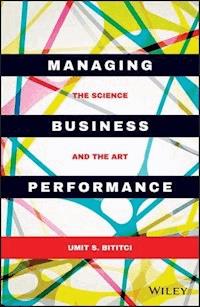
Managing Business Performance offers a unique blueprint for achieving organisational excellence through improved productivity, efficiency, engagement, and morale. With a unique approach that acknowledges the human aspect of performance management, this book combines technical and social know-how to give you a solid framework for designing, configuring, and managing performance improvement initiatives with sustainable results. You'll find practical models, techniques, and tools that take you beyond management theory into advice that you can use, with clear explanations that steer you toward the customisations that would best suit your organisation. International case studies illustrate these ideas in action, providing an intimate look at how cultural differences impact management strategies, and insight into how they can be managed.
Organisational performance tools and techniques are well established, but many organisations will never realise their full benefit. This book helps you get more out of your performance strategy by showing you how the organisation's complex social nature impacts real-world outcomes, and how it can be used to drive better performance.
- Blend technical and social management strategies
- Keep people motivated and engaged
- See better results with more staying power
- Get the very best from your organisation
Performance management strategies that fail to take people into account are counterproductive. There's no better way to de-motivate, demoralise, and disengage the people upon whom the organisation depends. Sustainable success requires a blended approach that utilizes the most effective science within the art of people management, and Managing Business Performance gives you a solid foundation for better business performance strategy.
Sie lesen das E-Book in den Legimi-Apps auf:
Seitenzahl: 397
Veröffentlichungsjahr: 2015
Ähnliche



















Where there is balance and harmony there is performance
Managing Business Performance
The Science and the Art
Umit S. Bititci
This edition first published 2015 © 2015 John Wiley & Sons, Ltd
Registered office John Wiley & Sons Ltd, The Atrium, Southern Gate, Chichester, West Sussex, PO19 8SQ, United Kingdom
For details of our global editorial offices, for customer services and for information about how to apply for permission to reuse the copyright material in this book please see our website at www.wiley.com.
All rights reserved. No part of this publication may be reproduced, stored in a retrieval system, or transmitted, in any form or by any means, electronic, mechanical, photocopying, recording or otherwise, except as permitted by the UK Copyright, Designs and Patents Act 1988, without the prior permission of the publisher.
Wiley publishes in a variety of print and electronic formats and by print-on-demand. Some material included with standard print versions of this book may not be included in e-books or in print-on-demand. If this book refers to media such as a CD or DVD that is not included in the version you purchased, you may download this material at http://booksupport.wiley.com. For more information about Wiley products, visit www.wiley.com.
Designations used by companies to distinguish their products are often claimed as trademarks. All brand names and product names used in this book are trade names, service marks, trademarks or registered trademarks of their respective owners. The publisher is not associated with any product or vendor mentioned in this book.
Limit of Liability/Disclaimer of Warranty: While the publisher and author have used their best efforts in preparing this book, they make no representations or warranties with respect to the accuracy or completeness of the contents of this book and specifically disclaim any implied warranties of merchantability or fitness for a particular purpose. It is sold on the understanding that the publisher is not engaged in rendering professional services and neither the publisher nor the author shall be liable for damages arising herefrom. If professional advice or other expert assistance is required, the services of a competent professional should be sought.
Library of Congress Cataloging-in-Publication Data
Bititci, Umit S. Managing business performance : the science and the art / Umit S. Bititci. pages cm Includes bibliographical references and index. ISBN 978-1-119-02567-2 (cloth) 1. Performance technology. 2. Performance. 3. Organizational effectiveness. 4. Management. I. Title. HF5549.5.P37.B57 2015 658.4'013—dc23
2015018007
A catalogue record for this book is available from the British Library.
ISBN 978-1-119-02567-2 (hardback) ISBN 978-1-119-02568-9 (ebk) ISBN 978-1-119-02569-6 (ebk) ISBN 978-1-119-16654-2 (obk)
Cover design: Wiley Cover image: © Irur/Shutterstock
“Not everything that can be counted counts....and not everything that counts can be counted”
Albert Einstien
Contents
Preface
Acknowledgements
About the Author
PART ONE Introduction
1 Prologue
1.1 Background to this book
1.2 Motivation and principles
1.3 Who is this book for?
1.4 Structure of the book
References
Notes
2 A Short History of Performance Measurement and Management
2.1 Beginnings
2.2 Performance measurement revolution
2.3 Performance measurement from different perspectives
2.4 Performance management
2.5 Balancing the
SCIENCE
with the
ART
2.6 Future challenges
References
Notes
PART TWO The Science
3 What Are We Managing?
3.1 Everyone has a different view
3.2 How do companies compete?
3.3 Value streams – focused business units that create value
3.4 Business processes – the universal building blocks
3.5 Managerial processes – thinking about the future
3.6 Support processes – serving to create value
3.7 Anatomy of an organisation – the universal competitive structure
3.8 Summary
References
Notes
4 Understanding and Managing Business Processes
4.1 Purpose and flow
4.2 What flows through the process?
4.3 Anatomy of a process
4.4 Understanding what affects flow
4.5 Measuring process performance
4.6 Summary
Reference
5 Measuring Performance
5.1 Do we need measures?
5.2 Developing a performance measurement system
5.3 Communicating with measures
5.4 Scorecards, cockpits, dashboards and war-rooms
5.5 Creating effective visual performance measurement and management systems
5.6 Reviewing performance
5.7 Summary
Reference
Notes
CHAPTER 6 Summary: The
Science
of Managing Business Performance
PART THREE The Art
7 Drivers of Performance
7.1 Measures of business performance
7.2 Managing performance for the short-term (up to 2 years)
7.3 Managing performance for the medium-term (2 to 5 years)
7.4 Managing performance for the long-term (5+ years)
7.5 Summary
References
Notes
8 Capabilities, Culture and Performance
8.1 UNDERSTANDING ORGANISATIONAL CAPABILITIES
8.2 HOW DO ORGANISATIONAL CAPABILITIES DEVELOP?
8.3 LEARNING TO LEARN
8.4 MANAGING ORGANISATIONAL CAPABILITIES AND CULTURE
8.5 SUMMARY
REFERENCE
9 The People Component
9.1 What kind of organisation would you like to work in?
9.2 The people component
9.3 What motivates people?
9.4 What needs to change?
9.5 Summary
References
Notes
10 Balancing Organisational Controls
10.1 What is the right balance?
10.2 What happens when we get the balance wrong?
10.3 Understanding the interplay between performance measurement and performance management
10.4 Balancing organisational controls: Do's and don'ts
10.5 Summary
References
Notes
11 Summary: The
Art
of Managing Business Performance
PART FOUR Effective Interventions
12 Designing Effective Interventions
12.1 A systems approach
12.2 The organisation as a system
12.3 Who will decide what needs to change and how?
12.4 Technical vs. social intervention
12.5 What to change?
12.6 Finding the trim-tab
12.7 Summary
References
Notes
13 Delivering Effective Interventions
13.1 Balancing short-term results with drivers of long-term sustainable performance
13.2 Planning and monitoring interventions
13.3 Joined-up thinking
13.4 Milestones: One big step at a time
13.5 Making improvement part of the day job
13.6 Summary
References
Notes
14 Epilogue
14.1 It's all about balance and harmony
14.2 Learning the right balance
14.3 Where do we start?
Reference
15 The Book in a Nutshell
15.1 Part One – Introduction
15.2 Part Two – The Science
15.3 Part Three – The Art
15.4 Part Four – Effective Interventions
15.5 Conclusions
Appendices
A Overview of Popular Performance Measurement Models and Frameworks
A.1 DuPont Model
A.2 The Performance Measurement Matrix (PMM)
A.3 The Performance Measurement Questionnaire (PMQ)
A.4 The Results and Determinants Framework
A.5 The Strategic Measurement Analysis and Reporting Technique (SMART)
A.6 The Cambridge Performance Measurement Design Process
A.7 The Pyramid of Organisational Development
A.8 Integrated Performance Measurement System (IPMS) reference model
Lesen Sie weiter in der vollständigen Ausgabe!
Lesen Sie weiter in der vollständigen Ausgabe!
Lesen Sie weiter in der vollständigen Ausgabe!
Lesen Sie weiter in der vollständigen Ausgabe!
Lesen Sie weiter in der vollständigen Ausgabe!
Lesen Sie weiter in der vollständigen Ausgabe!
Lesen Sie weiter in der vollständigen Ausgabe!
Lesen Sie weiter in der vollständigen Ausgabe!
Lesen Sie weiter in der vollständigen Ausgabe!
Lesen Sie weiter in der vollständigen Ausgabe!
Lesen Sie weiter in der vollständigen Ausgabe!
Lesen Sie weiter in der vollständigen Ausgabe!
Lesen Sie weiter in der vollständigen Ausgabe!
Lesen Sie weiter in der vollständigen Ausgabe!
Lesen Sie weiter in der vollständigen Ausgabe!
Lesen Sie weiter in der vollständigen Ausgabe!
Lesen Sie weiter in der vollständigen Ausgabe!
Lesen Sie weiter in der vollständigen Ausgabe!
Lesen Sie weiter in der vollständigen Ausgabe!
Lesen Sie weiter in der vollständigen Ausgabe!
Lesen Sie weiter in der vollständigen Ausgabe!
Lesen Sie weiter in der vollständigen Ausgabe!
Lesen Sie weiter in der vollständigen Ausgabe!
Lesen Sie weiter in der vollständigen Ausgabe!
Lesen Sie weiter in der vollständigen Ausgabe!
Lesen Sie weiter in der vollständigen Ausgabe!
Lesen Sie weiter in der vollständigen Ausgabe!




