


60,99 €
Mehr erfahren.
- Herausgeber: John Wiley & Sons
- Kategorie: Fachliteratur
- Serie: Wiley Finance Editions
- Sprache: Englisch
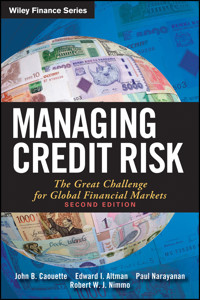
Managing Credit Risk, Second Edition opens with a detailed discussion of today’s global credit markets—touching on everything from the emergence of hedge funds as major players to the growing influence of rating agencies. After gaining a firm understanding of these issues, you’ll be introduced to some of the most effective credit risk management tools, techniques, and vehicles currently available. If you need to keep up with the constant changes in the world of credit risk management, this book will show you how.
Sie lesen das E-Book in den Legimi-Apps auf:
Seitenzahl: 1009
Veröffentlichungsjahr: 2011
Ähnliche



















Contents
About the Authors
Introduction
Chapter 1: Credit Risk
Changing Attitudes Toward Credit
More Nations Borrow
More Leverage, More Opportunity, and More Risk
The Golden Age of Banking
Credit Risk Pricing is Now Market-Driven
Credit Management is Important to the Global Economy
New Transactions, New Risks
New Lenders
New Approaches to Credit Risk
Technology to the Rescue
Chapter 2: Credit Culture
A Modern Risk Management Framework
Credit Culture at Work
Goldman Sachs: Managing Through Credit Culture
Jpmorgan: Molding a New Culture from a Grand and Varied Tradition
What Makes Credit Culture Work?
Chapter 3: Classic Industry Players
Banks and Savings Institutions
Competition, Concentration, and Change
Some Lessons were Learned
Liquidity: A Resource Unique to Banks
Insurance Companies
Finance Companies
Special Purpose Entities
Chapter 4: The Portfolio Managers
Fixed Income Portfolio Strategy
Hedge Funds
Chapter 5: Structural Hubs
Exchanges
Clearinghouses
Netting, Collateral, and Downgrade Triggers
Credit Derivative Product Companies
Limitations of Structural Hubs
Chapter 6: The Rating Agencies
Agencies Around the World
Growth in Issues Rated
The Rating Process
Ratings Performance
Ratings and Regulators
Emerging Trends
Chapter 7: Classic Credit Analysis
Credit Analysis as an Expert System
Shifting Emphasis from the Balance Sheet to Cash Flow
Credit Analysis: God is in the Details
Financial Ratios: Footprints in the Sand
Industry Analysis for Term Lending
Classic Credit Foundations Remain But Banking Practices Have Moved Ahead
You Can Have Your Cake But Only a Slice of It
Chapter 8: Asset-Based Lending and Lease Finance
Managing the Risks
Growing Respectability
Alternatives to Asset-Based Lending
Lease Finance
The Roots of Securitization and Lbos
Favorable Results
Chapter 9: Introduction to Credit Risk Models
Models—Who Needs Them?
Variety in Models
Relevance of Credit Models to the Decision Maker
Portfolio Management Models
Coming Attractions
Chapter 10: Credit Risk Models Based upon Accounting Data and Market Values
Human Expert Systems and Subjective Analysis
Accounting-Based Credit Scoring Systems
From Univariate to Multivariate Methods
Altman’s Z-Score Model (1968)
Z-Scores and Bond Ratings
Private Firm Z′-Score Model
Nonmanufacturers Z′-Score Model
Emerging Market Scoring Model and Process
Zeta® Credit Risk Model
Classification Accuracy
Group Prior Probabilities, Error Costs, and Model Efficiency
Reestimation of Coefficients
Altman and Sabato Sme Model
Riskcalc® Model By Moody’s KMV
Standard & Poor’s Creditmodel® (2003)
Bondscore® Model
Deployment of Z-Score, Zeta®, Risccalc®, Creditmodel®, Credit Risk Tracker® and Bondscore® Models
Limitations of Multivariate Models
Neural Networks
Expert Systems
Models Based on Market Risk Premiums
Mortality Models
Chapter 11: Corporate Credit Risk Models Based on Stock Price
Predecessors of Options Theory
Option Pricing
Equity is a Call Option
Debt is Like Selling a Put Option
The Edf Model
Private Company Kmv Model
Kmv and Other Approaches
Predictive Ability of Default Models
Default Prediction Results for the Kmv Model
Applications
Use of Edf in Asset Valuation: Structural Models and Reduced Form Models
Refinements to the Kmv Edf Model (1995–2006)
Concluding Remarks
Chapter 12: Consumer Finance Models
Credit Screening Models
Design of Credit Scoring Models
Tests for Model Adequacy
Out-Of-Sample Testing
Advantages and Disadvantages
Dynamic Credit Risk Management Systems
Decision Tree Models
Neural Network Models
Credit Scoring Models for Building Market Share
The Next Steps
Chapter 13: Credit Models for Small Business, Real Estate, and Financial Institutions
Small Business Models
Residential Real Estate Models
Commercial Real Estate Models
Bank Models
Exception Via Critical Ratios: Outlier/Peer Group
Multivariate or Composite Measurements
Market Value-Based Measurements
Chapter 14: Testing and Implementation of Credit Risk Models
An Intrinsic Value Approach
Ingredients of an Effective System
Work-In-Progress Issues in Credit Risk Modeling
Chapter 15: About Corporate Default Rates
High-Yield Bond Default Rates
Mortality and Cumulative Default Rates
Comparing Cumulative Default Rates
Age of Defaults
Fallen Angel Defaults
Industry Defaults
Forecasting Default Rates
Issuer-Based Default Rate Forecasts
The Mortality Dollar-Based Rate Approach
A Final Note on Forecasted Default Rates
Leverage Loan Default Rates
Structured Finance Default Rates
Chapter 16: Default Recovery Rates and LGD in Credit Risk Modeling and Practice
Introduction
First Generation Structural-Form Models: The Merton Approach
Second Generation Structural-Form Models
Reduced-Form Models
Credit Value-At-Risk Models
Recent Contributions on the Pd-Rr Relationship and Their Impact
Correlation Results’ Impact and Downturn Lgd
Some Final References
Recovery Ratings
Recovery Rates and Procyclicality
Further Empirical Evidence
Concluding Remarks
Chapter 17: Credit Risk Migration
Methods for Tracking Rating Migration
The Timeliness and Accuracy of Rating Changes
Rating Migration Results Compared
Impact on Results
Credit Risk Migration and Loan Losses
Future Directions
Chapter 18: Introduction to Portfolio Approaches
Diversification is Good, Other Things Being Equal
A Number of Small Bets Versus a Single Large Bet
Issues in Implementing the Standard Portfolio Approach to Credit Portfolios
Distribution of Returns
Holding Period
Absence of Price Discovery
Lack of Good Data
Solution for the Correlation Matrix
Current Portfolio Approaches
Expected Versus Unexpected Losses
Optimization of Capital Usage
Varying Objectives
Chapter 19: Economic Capital and Capital Allocation
Use of the Pricing Mechanism
Innovations By Bankers Trust in Capital Allocation
Value at Risk
Economic Capital and Regulatory Capital
Estimation and Optimization of Economic Capital
Chapter 20: Application of Portfolio Approaches
Mkmv’s Portfolio Manager
Optimal Portfolio and the Efficient Frontier
Risk-Neutral Pricing for Credit Valuation
Factors Driving Asset Value
Creditmetrics (1997)
Treatment of Default Correlation
Creditmetrics Implementation—Creditmanager
Comments on Creditmetrics
Mckinsey & Co./Wilson Model (1997)
Kamakura Corporation’s Default and Probability Models
Altman’s (1997) Optimization Approach
Portfolio Risk and Efficient Frontiers Using Unexpected Loss
Portfolio Risk Using Unexpected Losses
Empirical Results of Altman’s Alternative Approach
Bank Regulations (BIS II) and Portfolio Modeling
The Future of Credit Portfolio Techniques
Chapter 21: Credit Derivatives
Credit Derivatives: An Example
Structural Forms of Credit Derivatives
Features of Credit Derivatives Useful to a Risk Seller
Features of Credit Derivatives Useful to a Risk Buyer
Possible Applications of Credit Derivatives
Not Everything is Good About Credit Derivatives
The Regulatory View of Credit Derivatives
Credit Risk of Credit Derivatives
Valuation of Credit Derivatives
Current Pricing Practice
Chapter 22: Counter Party Risk
Derivative Losses
The Role of Counterparty Credit Risk
Derivative Exposure
Interest Rate Swaps
Calculation of Exposure and Expected Loss
Currency Swaps
Management of Derivative Credit Risk
Master Netting Agreements
Structured Finance Solutions to Derivative Credit Risk
Evaluating the Current Methods for Assessing Derivative Credit Risk
Combining Credit and Market Risk
Chapter 23: Country Risk Models
Historical Context
Fundamental Analysis: Key Ratios
Country Rating Systems
Challenges in Assessing Country Risk
In Every Cloud a Silver Lining
Country Risk Management
Chapter 24: Structured Finance
Uses of Securitization
Benefits for Issuers
Securitizing Mortgages
Securitizing Other Assets
Segmentation of Risk
Financing Risky Credits
The Anatomy of an Asset-Backed Security
Evaluating Asset-Backed Securities
Impact on the Banking Industry
Other Applications of Structured Finance
Perils of Securitization
Structured Finance Techniques and Investment Management
Future of Securitization
Chapter 25: New Markets, New Players, New Ways to Play
CDOs: CLOs and CBOs
A Shifting Mix of Collateral
Distressed Debt Markets
Who’s Buying?
Four Major Players That Have Made a Difference to the Way the Game is Played
Chapter 26: Market Chaos and a Reversion to the Mean
Liquidity Risk is the Next Big Challenge
The Importance of a Strong Credit Culture
Appendix
Index
Founded in 1807, John Wiley & Sons is the oldest independent publishing company in the United States. With offices in North America, Europe, Australia, and Asia, Wiley is globally committed to developing and marketing print and electronic products and services for our customers’ professional and personal knowledge and understanding.
The Wiley Finance series contains books written specifically for finance and investment professionals as well as sophisticated individual investors and their financial advisors. Book topics range from portfolio management to e-commerce, risk management, financial engineering, valuation and financial instrument analysis, as well as much more.
For a list of available titles, visit our Web site at www.WileyFinance.com.
Copyright © 2008 by John B. Caouette, Edward I. Altman, Paul Narayanan, and Robert Nimmo. All rights reserved.
Published by John Wiley & Sons, Inc., Hoboken, New Jersey.
Published simultaneously in Canada.
No part of this publication may be reproduced, stored in a retrieval system, or transmitted in any form or by any means, electronic, mechanical, photocopying, recording, scanning, or otherwise, except as permitted under Section 107 or 108 of the 1976 United States Copyright Act, without either the prior written permission of the Publisher, or authorization through payment of the appropriate per-copy fee to the Copyright Clearance Center, Inc., 222 Rosewood Drive, Danvers, MA 01923, (978) 750-8400, fax (978) 646-8600, or on the Web at www.copyright.com. Requests to the Publisher for permission should be addressed to the Permissions Department, John Wiley & Sons, Inc., 111 River Street, Hoboken, NJ 07030, (201) 748-6011, fax (201) 748-6008, or online at http://www.wiley.com/go/permissions.
Limit of Liability/Disclaimer of Warranty: While the publisher and author have used their best efforts in preparing this book, they make no representations or warranties with respect to the accuracy or completeness of the contents of this book and specifically disclaim any implied warranties of merchantability or fitness for a particular purpose. No warranty may be created or extended by sales representatives or written sales materials. The advice and strategies contained herein may not be suitable for your situation. You should consult with a professional where appropriate. Neither the publisher nor author shall be liable for any loss of profit or any other commercial damages, including but not limited to special, incidental, consequential, or other damages.
For general information on our other products and services or for technical support, please contact our Customer Care Department within the United States at (800) 762-2974, outside the United States at (317) 572-3993 or fax (317) 572-4002.
Wiley also publishes its books in a variety of electronic formats. Some content that appears in print may not be available in electronic formats. For more information about Wiley products, visit our Web site at www.wiley.com.
Library of Congress Cataloging-in-Publication Data:
Managing credit risk : the great challenge for global financial markets / John B. Caouette ... [et al.]. – 2nd ed.
p. cm. - (Wiley finance series)
Rev. ed. of: Managing credit risk / John B. Caouette, Edward I. Altman, Paul Narayanan. c1998.
Includes bibliographical references and index.
ISBN 978-0-470-11872-6 (cloth)
1. Credit–Management. 2. Risk management. 3. Derivative securities. I. Caouette, John B., 1944- II. Caouette, John B., 1944- Managing credit risk.
HG3751.C32 2008
332.7–dc22 2007047647
We dedicate this book to our wives, Judy Caouette, Elaine Altman, Vasantha Narayanan, and Linda Jensen.
About the Authors
John B. Caouette is Chairman of Channel Capital Group, a European-based credit derivative products company. He is also a nonexecutive director of Picture Financial Group, a specialty finance company based in Wales.
He was Founder, Chairman, President, and CEO of CapMAC Holdings and its principal subsidiary, Capital Markets Assurance Corporation, a triple-A rated financial guarantor that focused on the global market for structured finance.
He was an independent director of LCH Clearnet Group, Ltd., a British/ French central clearinghouse, and non-executive chairman of Asia Ltd. Singapore, a consortium owned by Asian Financial Guarantee Company.
He was Vice Chairman of MBIA Insurance Corporation, where he oversaw the company’s international financial guarantee business and new business development from London. He was also Senior Vice President and General Manager at Foreign Exchange & Money Market Division, Continental Grain Company; and with Citibank for many years, serving in a variety of capacities including Executive Director of the Asia Pacific Capital Corporation in Hong Kong, and Vice President and General Manager in the Swaps and Eurosecurities Department in New York.
Mr. Caouette is an advisory board member to the Haas School of Business, University of California at Berkeley, where he teaches corporate entrepreneurship in the graduate school.
Edward I. Altman is the Max L. Heine Professor of Finance at the Stern School of Business, New York University, and Director of the Credit and Fixed Income Research Program at the NYU Salomon Center.
Dr. Altman has an international reputation as an expert on corporate bankruptcy, high-yield bonds, distressed debt and credit risk analysis. He was named Laureate 1984 by the Hautes Etudes Commerciales Foundation in Paris for his accumulated works on corporate distress prediction models and procedures for firm financial rehabilitation and awarded the Graham & Dodd Scroll for 1985 by the Financial Analysts Federation for his work on default rates and high-yield corporate debt.
He was inducted into the Fixed Income Analysts Society Hall of Fame in 2001 and elected President of the Financial Management Association (2003) and a Fellow of the FMA in 2004.
In 2005, Dr. Altman was named one of the “100 Most Influential People in Finance” by Treasury & Risk Management magazine.
Dr. Altman is an advisor to many financial institutions, including Citi, Concordia Advisors, Equinox (Italy), Investcorp, KPMG, Miller-Mathis, and SERASA (Brasil). He serves on the Board of Trustees of Franklin Mutual Series Funds and was on the Investment Advisory Committee of the New York State Common Retirement Fund and on the Board of Automated Trading Desk. He is also Chairman of the Academic Advisory Council of the Turnaround Management Association and serves as an Associate Editor of several risk-related scholarly and practitioner journals.
Paul Narayanan is Director of Credit Portfolio Analytics at American International Group, Inc., New York. His responsibilities include credit portfolio risk issues, structured finance, reinsurance credit risk, measurement and management of exposure and limits, and the development of an economic capital allocation system for the firm. Previously, he was the principal algorithm architect for trade credit insurance in the development and deployment of a system that underwrites and sets credit limits for any public or private enterprise in 18 countries by utilizing credit information from a variety of sources.
Narayanan has been involved credit risk management for more than two decades and in the development of analytical solutions for credit issues as an executive in major institutions, which have included the predecessors of JPMorgan Chase, Bank of America, and Mellon Bank. His work has included failure prediction models of which ZETA (Z-score) model is the best known. He helped build ZETA with Dr. Edward Altman. He has developed and implemented credit and portfolio models in the entire asset spectrum—corporate debtors, residential real estate, financial institutions, and consumer loans.
For several years he was consultant to banks and insurance companies on credit and portfolio management. His clients have included Zeta Services, CASA, Citigroup, Enhance Financial Services, Asian Development Bank, and Banco Provincia de Buenos Aires. Paul has published, taught, and delivered talks on credit and portfolio risk in many forums, including the Society of Actuaries, the Wharton School of the University of Pennsylvania, NYU Stern School, Drexel University, Fundacao Getulio Vargas, IACPM, and the Central Bank of Argentina.
Robert W. J. Nimmo has enjoyed a 37-year-long international banking career in a number of different roles and countries. He started with 24 years at Citigroup, serving in both line and risk management. He was a member of the Groupwide Credit Policy Committee, based in Tokyo, and served with Citigroup in the United States, Hong Kong, the Philippines, and Japan.
Later he was with Westpac Banking Corporation in Sydney, Wachovia NA in Charlotte, North Carolina, and Barclays Bank in London. In all three companies he was the Group Chief Risk Officer.
Mr. Nimmo is a graduate of Stanford University and the Thunderbird School of International Management. He was born in Brisbane, Australia and currently resides with his wife in Portland, Oregon.
ABOUT THE ASSISTANTS
Elizabeth Jacobs kept the authors on their writing schedules and organized delivery of the manuscript to the publisher. Elizabeth has been administrative secretary to John Caouette for nearly two decades.
Jaime Pozuelo-Monfort graduated from Universidad Politecnica de Madrid in 2000 with a master’s and a bachelor’s in telecommunications engineering. Subsequently, he earned master’s degrees in business administration from Collège des Ingénieurs in Paris, in financial economics from Universi-dad Carlos III de Madrid, in financial engineering from the University of California at Berkeley, and in economic development from the London School of Economics. He currently pursues a master’s in public administration at Columbia University. He has worked in the technology sector in Madrid, Stuttgart, and Paris, and in the financial industry in New York City and London. His interests lie in the interaction between financial economics and economic development.
Introduction
Credit risk is the oldest form of risk in the financial markets. If credit can be defined as “nothing but the expectation of a sum of money within some limited time,” then credit risk is the chance that this expectation will not be met. Credit risk is as old as lending itself, which means that it dates back as far as 1800 BCE.1 It is essentially unchanged from ancient Egyptian times. Now as then, there is always an element of uncertainty as to whether a given borrower will repay a particular loan. This book is about how financial institutions are using new tools and techniques to reshape, price, and distribute this ancient form of financial risk.
Ever since banks as we know them were organized in Florence 700 years ago, they have been society’s primary lending institutions.2Managing Credit Risk has formed the core of their expertise. Traditionally, bankers and other lenders have handled credit evaluation in much the same that tailors approach the creation of a custom-made suit—by carefully measuring the customer’s needs and capacities to make sure the financing is a good fit. When we originally wrote this book in the late 1990s, it was accurate to say that the approaches taken then did not differ fundamentally from the one used by the earliest banks. This is not necessarily the case today, although the changes we will comment on later in the book still vary from institution to institution, and certainly there are major differences between money center institutions, regional banks and banks in emerging markets. Meanwhile the first decade of the twenty-first century has seen the credit markets become the focus of a whole new category of lender including hedge funds, private equity firms, and other institutional players who are bypassing the traditional credit methodologies in favor of the new ways of credit risk management. Thanks to the creation of credit derivative products, market participants can take or shed credit risk on any entity anonymously, that is, without entering into any legal credit arrangement with that entity or lending to it. This is one of the reasons you find a bank in Germany taking credit risk on a subprime home mortgage in Kansas without ever seeing either the borrower or the property. This used to be the preserve of the local Kansas bank.
It is easier to design a suit for a customer you already know. Because of the very nature of this approach, banks historically have been drawn to relationship banking. This led to a pattern where they were more concerned about their relationship with a customer than they were about the profitability of a specific loan or about the effect a given transaction may have on their overall loan portfolio. As long as a borrower met the credit criteria, the bank did not pay much attention to concentrations that were building up. Citibank’s buildup of construction loans and the effect they had on the institution when these loans went sour in the late 1980s is a case in point. At the time of the publication of the first edition of Managing Credit Risk, the banking industry had begun to recover from a crisis that had emerged nearly a decade earlier. There was widespread recognition within the industry that the traditional approach to lending had led to unacceptable results and that banks had done a rather poor job of pricing and Managing Credit Risk.
In some ways the banking crisis of the day was just what you would expect from an industry that was adapting to a more limited role in the provision of credit. In other ways, it reflected an evaluation that the traditional banker/client roles needed some updating if not revolutionary change. Those who read our first edition would not have had to look hard to find a decidedly negative view of how banks were dealing with credit risk at the turn of the century. Less than a decade later, things look a lot different. Later in this introduction, we list the 10 major changes that are shaping the management of all risk, credit included. Those changes are significant and banks are at the cutting edge of the change. So we take a more generous view of the way banks are managing credit and portfolio risk and in many places you will see us holding many of them up as examples of excellence in the management of this risk. They are better, but as we can now see in the subprime mortgage crisis at the end of 2007, they are still capable of major missteps.
The first decade of the twenty-first century has seen the credit markets transformed by several institutional developments. First, the markets mirror their environment: They have become global, highly innovative, and of critical importance to the global economy. The top market players have developed into universal megabanks. There are a handful of such organizations, which were formed from the top ranks of what was once the top tier of commercial or investment banks. Now they do both investment and commercial banking as well as many other types of investment related services and lending. The names are familiar—-Citicorp, JPMorgan Chase, Goldman Sachs, Morgan Stanley, UBS, Merrill Lynch, Deutsche Bank, Credit Suisse, Bank of America, and so on. These organizations are on the cutting edge of credit risk management and are a proving ground for “best practices” within the industry. Secondly, real credit risk has been embraced by the capital markets and this has fueled the development of whole new categories of lenders including structured finance lenders, hedge funds, private equity firms, and others who, for the most part, are finding new ways to approach credit risk management. Thirdly, credit risk management has evolved into total enterprise risk management. Best practice for the major players is to include market, operational, and reputation risk alongside the management of credit. Finally, the shape and day-to-day operations of the credit risk markets in this new millennium are heavily influenced by regulators who are setting the rules (e.g., Basel II and Solvency II) for most of the players in a much more sophisticated way, and by the rating agencies whose rating practices have set the market standard of credit risk measurement—especially with respect to securitized products.
The counterpart to credit risk is market risk—the chance that an investment’s value will change in price as a result of marketplace forces such as interest rates, commodity prices, and currency levels. Market risk has affected financial institutions ever since markets were created. Techniques for managing market risk have undergone a radical change. Anyone who tours a large trading floor at a bank or an investment bank can see that the management of market risk has been the focus of tremendous technological development. Major breakthroughs have turned this aspect of risk management into something of a science—one that is applied to both equities and debt instruments. Market risk developments were an important precedent for our focus on credit risk management. Some have commented that the 1980s were a period when market participants focused on how to manage market risk. This led to the Basel Committee introduction in 1995 of a system that allowed banking institutions to set capital requirements based on market risk levels calculations using the models the banks had developed. This focus on models and other mathematical analysis by the Basel Committee continued as they turned to the management of credit risk in Basel I and II.
This is not to suggest that market risk has been eliminated. In the case of America’s savings and loan associations, for example, an entire industry quaked because of bad bets made on commercial real estate asset values during a period when deregulation was increasing the risks in the financial markets. Periodically, we learn of major losses experienced by trading firms that are the result of “rogue traders” who are identified—after the fact and accused of misappropriating the firm’s capital. Sometimes the problem is that a firm does not really understand what it is doing (despite a great pedigree such as with Long Term Capital Management) and bets the ranch on a losing idea.
Despite its shortcomings in anticipating systemic events and overcoming the actions of some individuals, the science of managing market risk does nevertheless reflect late twentieth-century knowledge and technology. For example, banks have adopted the concepts of gap management, duration, and even the theory of contingent claims. Major banks have created huge markets for interest rate and currency swaps.
By contrast, in 1998, when we first published Managing Credit Risk, the management of credit risk at banks was, to a substantial degree, a kind of cottage industry in which individual leading decisions were made to order. As befitted a cottage industry, there was, for the most part, no common credit language. Practitioners, academics, and regulators heatedly debated fundamental measurements such as default timing, default events, workout costs, and recoveries. There was a dearth of reliable quantitative data on financial and nonfinancial variables as well as on recovery rates following failure. There was, however, at the time, a considerable effort underway to improve the situation. Many studies were initiated by Edward Altman and the rating agencies on default levels and recovery rates, but they were all a work in progress and not yet internalized by many leading institutions. Ten years later things look a lot different. Credit risk is still a tougher risk to master than market risk. There are many more variables to consider. However, we now have many more tools, much more information and some important new players who are willing to take credit risk, expect to be fairly compensated for it, and are demanding more transparent market pricing.
TOP 10 CHANGES IN THE CREDIT MARKETS IN THE LAST DECADE
New product innovations, particularly in the credit derivative and structured finance areas and the standardization of older innovations.The growing sophistication of the major players in the credit markets in terms of techniques and strategies.The increased use of scientific and mathematical models (e.g., credit scoring models for residential mortgage lending and correlation models to price basket credit default swaps).The New Basel accords, which have directly shaped the banking markets and indirectly influenced market participants in general (often called regulatory capital arbitrage).The ready availability and easy delivery of reliable credit information on a global basis, 24/7 through the Worldwide Web.The phenomenal growth in technology and systems capabilities at affordable prices leading to better reporting and modeling.Huge changes in the markets themselves, in terms of size, liquidity, and globality.The emergence of hedge funds as major investors in the markets.The growing influence of the rating agencies.Lower levels of loss and higher levels of liquidity led to constantly reducing credit spreads, which reached their historical lows in June 2007. This market frenzy was a vortex dragging more people into what turned out to be poor credit choices.Creating this list was the first thing we did after deciding upon a revision of this book. We knew that many changes have taken place over the past decade, and it seemed like an important first step to try to capture them in a list that we could agree on and refer to as we made changes. Everyone might not agree with our 10 and certainly others might wish to emphasize or describe things somewhat differently. However, we doubt that we would have a substantially different list if we polled everyone who is working in the credit markets of Europe and the United States. Nevertheless, the list is our own and forms the basis for all the changes that will appear in the second edition of Managing Credit Risk.
EVOLUTION OF CREDIT RISK IN THE ECONOMY
Credit risk is a consequence of contracted and/or contingent financial transactions between the providers and users of funds. To understand how it has evolved in modern times, we have to look at the private corporation as the vehicle of economic growth. In precapitalist societies, family and sovereign wealth were the primary bearers of credit risk. Subsequently, the formation of joint stock corporations created entities that were able to pool resources, bear economic risk, borrow money, and exist beyond the natural lives of the owners. Financial intermediaries were created to pool savings and provide them to the users of funds. Even before interest expenses were given preferential tax treatment, corporations (for example, railroads and utilities) used the debt market to raise funds from distant investors, using corporate assets or a government guarantee to secure their borrowing. The bond markets and banks were the dominant providers of debt capital (see Baskin and Miranti 1997).
As markets grew, other providers of funds gradually took market share away from banks. Junk bonds, asset-based securities, and commercial paper displaced conventional bank financing to a significant extent. A primary reason for this was economics. According to Bryan (1993), the total cost of intermediating a security over the life of an asset is under 50 basis points, whereas the cost of bank intermediation is well over 200 basis points.
A NASCENT SCIENCE OF CREDIT RISK MANAGEMENT
In the mid-1980s and early 1990s, the United States experienced record defaults on bank loans and corporate bonds. When junk bond defaults jumped to over 10 percent in the years 1990 and 1991, many observers argued that both junk bond and the leveraged bank lending markets were likely to disappear. The high-yield bond markets recovered, however, and reached record volumes later in the decade.
Prompted in large part by very poor performance in their portfolios in the mid-1980s, practitioners of credit risk management became increasingly interested in new techniques. However, the heightened concern about credit management that emerged did not evolve into a pervasive drive to create and deploy new evaluation techniques. Nor did banks embrace portfolio management, believed to be much needed for them. Instead, this period saw the development of a few standalone models, continued refinement of some relevant default databases (first established in the late 1980s), and a spate of surveys be regulators and consultants on existing techniques. The latter invariably reached the conclusion that in most financial institutions, credit culture and lending strategies needed to be rethought and possibly redesigned (for example, see Bryan 1988).
Paradoxically, interest in new approaches to credit risk management exploded during a period when the credit markets themselves were exceptionally benign. Although same economists are now predicting a recession for the United States in early 2008, the U.S. economy has been strong for much of the last decade and most of the world’s stock markets have been booming for a substantial period, reflecting impressive corporate growth and low interest rates. With a few conspicuous exceptions such as Argentina, Japan, Indonesia, Thailand, Malaysia, and South Korea, credit markets in most parts of the world have been well behaved. Indeed, for the last seven years (2000–2006), well under 1 percent of total bank loans have been non-performing, compared to an average of close to 4 percent in 1988 through 1993. Default rates on leveraged loans and junk bonds were likewise well under 2 percent for the last three years, in contrast to the 4.2 percent average for junk bonds in 1991 through 2006. Given these positive credit market statistics, the surge of interest in new techniques for managing credit risk during the early years of the new millenium is surprising. Even more surprising was how little this seems to have helped avert the latest credit crisis—and worse yet, may have contributed to its creation. What is the reason behind the renewed focus on credit?
The answer, we believe, may be found in the changes that have occurred in both the lending institutions and others such as hedge funds which have fueled a huge increase in market liquidity. Lending institutions have reached a stage of development where they no longer want or need to make (buy) a loan and hold it to the end of its natural life (maturity, payoff, or charge-off). The reasons undoubtedly include pressures from regulators, the emergence of dynamic trading markets for loans, and the pursuit of internal objectives for return on equity. Today, banks are increasingly willing to consider shifting their credit exposure through transactions with counterparties. The markets in which banks can sell their credit assets (other than residential mortgages and consumer loans) are still fairly small and illiquid, and they are inefficient in comparison, say, with the Treasury market. Nevertheless, the market for bank loans has grown in size and liquidity. Consequently, banks and their counterparties are invested heavily in processes for gathering credit information and the analytical foundation necessary to value bank loans by a meaningful risk/return standard. Increased competition, the drive for diversification and liquidity, and regulatory changes such as risk-based capital requirements created by Basel I and II have thus stimulated the development of many innovative ways to manage credit risk. Banks realized (yet again) from the real estate default experience of 1989 to 1991 that concentration was a critical issue. Out of this realization arose portfolio management. The contagion of the financial crisis in the Asian economies in 1997 signaled that credit risk correlation, if anything, was yet to be well understood.
Around the world, the experiences in the U.S. banking system are being repeated. European countries such as Switzerland and Sweden have gone through a similar real estate crisis. European and Japanese banks have been hurt more than the U.S. banks by concentration in lending to the Asian economies. Domestic financial institutions in the damaged Asian economies, including Japan, are looking to improve their systems for managing credit by building a new credit culture and moving toward an improved market-driven discipline. Thus, just as portfolio management appears to have arrived in U.S. and European banks, the need for credit culture is being acutely felt in the emerging economies.
INNOVATIVE PRODUCTS AND STRUCTURES
Many innovative products and structures have been developed to manage credit risk. The following are some important examples:
Structured finance transactions such as collateralized mortgage obligations and asset-backed securities. These instruments pool assets and transfer all or part of the credit risk borne by the originator to new investors and, in some cases, to one or more guarantors as well. By means of the secondary market, investors can, if necessary, transfer the risk to yet any other party.3Exchanges and clearinghouses. By introducing a structural hub, these entities minimize the need for every pair of contracting parties to create a separate mechanism for managing their counterparty credit risk exposure.Credit derivatives, which can be layered to modify the credit risk profile of an underlying asset. Although it is still young and currently being challenged, the credit derivative market is growing at an explosive pace. A lender who does not want to continue to assume the credit risk from an asset no longer has to sell the asset outright. Financial instruments are being devised—some simple and some complex—that create a kind of insurance mechanism for transferring the risk of default, and, in some instances, of credit migration. For the first time ever, it is now possible to go short on credit. Furthermore, the credit risk to be bought or sold may be tailored as to amount, period, and the type of credit event. The credit derivative market will transform the business of borrowing and lending in a way that was quite inconceivable just a few years back.CREDIT RISK IS LIKE MILK
As financial innovation has progressed, credit risk has changed in many ways. In the case of senior/subordinated securities, for example, credit risk has been segmented and redistributed. To avoid the possibility that an entire issue will be downgraded because of poor performance in an isolated segment, these structures are partitioned into separate classes (Myerberg 1996). In the dairy, milk from a cow is first separated into components and then reconstituted into various grades to suit the consumer tastes: low fat, high fat, light cream, and so on. Similarly, financial innovation has decomposed risk and repackaged it into parts that appeal to different types of investors. In this way, a single issue can attract multiple investor classes. This approach to credit risk has turned it from a defensive concern to an offensive opportunity—understanding the credit risk has made it possible to open up new channels of funds flow. The new generation of finance companies that are funded by asset-backed commercial paper are a prime example of this trend. Debt obligations are pooled and recast as super-senior, senior, mezzanine, and equity tranches. The mezzanines themselves are later pooled to create what has come to be called CDO-squared. Similar structures have been created in the synthetic space, where there are no cash flows per se, but the holder of a synthetic tranche will get a credit spread income. In exchange, this layer will absorb credit loss caused by the default of an entity in the underlying pool.
The number of entities participating in a credit-related transaction has grown. A structured finance transaction, for example, may include an originator, a seller/servicer, a trustee, and a guarantor. Each of these entities faces exposure from or represents exposure to some other participant. This does not mean total credit risk has increased. However, because multiple parties are involved, it does mean that credit risk must now be assessed from more than one perspective. Credit risk of the underlying obligor has now been exchanged for counterparty financial institution risk and, in many instances, for market risk.
Financial engineering has created instruments with various embedded options and dependencies, each of which may expose participants to both market risk and credit risk. In the case of an interest rate swap, for example, potential counterparty exposure is not fixed. In some cases, it begins at zero, then increases over time, then gradually returns to zero at the maturity of the swap. Derivative transactions such as swaps require new forms of financial disclosure and accounting, and they also raise legal issues regarding enforceability. On one pretext or another, some counterparties may simply refuse to honor contractual commitments. For these reasons, rapid growth in the derivatives markets means an overall increase in credit risk.
THE GLOBAL RATE OF CHANGE IS TRULY UNPRECENDENTED
Credit risk has grown exponentially against the backdrop of dramatic economic, political, and technological change around the world. In decades past, geopolitical boundaries and government regulation restricted the mobility of capital. Ever since exchange rates were allowed to float in the early 1970s, financial markets have witnessed a steady progression of deregulation. This has led to increased competition between financial institutions and a blurring of the boundaries separating banks, investment banks, insurance companies, and investment companies. There have been major changes in the geopolitical arena as well: the breakup of the USSR, the reunification of Germany, and the introduction of free-market approaches in China and the Eastern European countries. The bipolar tension between capitalism and communism has faded and with it much of the pressure for oversized military budgets. However, geopolitical issues continue, in the form of nuclear proliferation, terrorism, and world poverty. The spotlight is today, however, on economic growth and an improved standard of living. China and India are leading examples of this paradigm shift.
Around the world, liquidity has increased. This represents an opportunity in the sense that new sources of capital have appeared. It represents a challenge, too, because new uses and users of this capital have emerged around the globe as well. Transactions take place involving currencies and entities of unprecedented variety. In many instances, credit risk must now be analyzed where parties have little or no credit history. In all, credit risk has grown more complex. At the same time, the ability of governments to guarantee and offer bailouts has diminished and the velocity with which a major credit crisis can cast its shadow globally has increased.
Superimposed on these geopolitical developments is the powerful force of information technology. Today, it is easier than ever before to gather, pool, and retrieve data from far-flung regions of the globe. Techniques such as genetic algorithms, neural networks, and optimization models are within reach of any analyst equipped with a personal computer. Newer models and databases are leading to a better understanding of the expected financial behavior of any particular asset and its relationship to other assets. This improved knowledge may well further increase the importance of securities markets at the expense of banks. However, markets do not have the same commitment to a credit relationship that a bank may have: When the source of funds dries up overnight, a borrower cannot renegotiate the terms of the loan as easily as with a bank. Borrowers will have to manage financing sources as a portfolio of choices, each with a different price-availability profile, and learn to tolerate greater volatility in the financing arena.
Many of the techniques developed to measure and control market price risk are being applied to credit risk. But as in the case of market risk, tools for Managing Credit Risk will not, by themselves, make the world a safer place. Any analytical tool is a child of the human intellect attempting to model the real world through a limited set of variables. These tools employ estimation and optimization techniques that are also inventions of the human mind. A model may capture a large proportion of the reality being modeled, but it must nonetheless omit some important aspects of it. Furthermore, a model’s very existence may alter market behavior over time, rendering it less and less useful. For these reasons, participants in the financial markets will need to pay great attention to the issue of model risk. It appears that model risk of this type was one of the causes of the subprime crisis.
As we explain in the chapters that follow, the new financial tools are, in themselves, works in progress—useful but still imperfect. If they are accorded unwarranted authority or if they are handled without proper care and judgment, they can actually amplify and not minimize an institution’s exposure to credit risk. In the end, the effectiveness of these tools depends absolutely upon the skills, motivations, and attitudes of the people using them. That is why participants in the credit markets must pay close attention to the selection and training of their professionals, to the incentives they create for them, and to the attitudes that pervade their organizations. All of these are critical elements of a firm’s risk culture. Over the coming decades, success will go to those firms that employ the right tools and create the right kind of culture. So is there still a challenge in the management of credit risk? The answer is, yes. But it is a very different kind of challenge. Our skills as an industry are much better and we have many more tools to work with, but the environment and the scale of things all have changed and have created new challenges to manage. The market is much more fragmented. A world where derivatives outweigh physicals by a factor of 10 or more will create unintended consequences that we are only now just beginning to understand.
When we wrote the first edition of Managing Credit Risk, the challenge we saw was quite different from what it looks like only 10 years later. In the late 1990s, banks were still struggling to move past the credit problems that emerged a decade earlier. Most of the new tools, innovations, and methods for managing credit risk had been developed at that time, but it was not clear then whether a lot of these new ideas would come into practical use in banks. Ten years later, the outcome is clear. Motivated by a strong survival instinct and some direction from regulators, the world’s banking industries are now much better at managing risk and they have incorporated most of the concepts we discuss into their risk management systems. So what are the challenges today? Today’s challenges arise from the growing sophistication of the markets. The megabanks we discussed earlier in this introduction and are now the central core of the credit markets have successfully turned themselves into experts in managing, packaging and selling off risks to the global financial markets. The challenge now is whether the full range of players in the system has the intellectual foundations and proper risk capitalization to handle the range of risks that are now routinely moved around the globe. If they do not, the cost to the global economy could be high.
The first six chapters of this book describe the institutional setting for credit risk: banks, insurance companies, pension funds, exchanges, clearinghouses, and rating agencies. The chapters that follow introduce and discuss the tools, techniques, and vehicles available today for managing credit risk. The concluding chapters integrate the emerging trends in the financial markets and the new tools and techniques in the context of credit culture. Throughout the book, we place our primary emphasis on practice, introducing insights provided by theory as needed. Our goal is to present state-of-the-art credit risk solutions along with the perspectives of leading experts in the field who have successfully implemented them. The appendix lists the sources of hard copy and electronic information on credit risk available to the practitioner.
REFERENCES
Altman, E. I. 2007. Global Debt Markets in 2007: New Paradigm or the Great Credit Bubble?, Journal of Applied Corporate Finance 19, no. 3, Summer 2007.
Altman, E. I., and S. Ramayanam. 2007. The High-Yield Bond Default and Return Report: Third-Quarter 2006 Review, NYU Salomon Center Special Report.
Baskin, J. B., and P. J. Miranti, Jr. 1997. A History of Corporate Finance. New York: Cambridge University Press.
Bryan, L. L. 1988. Breaking up the Bank: Rethinking an Industry Under Siege. Homewood, Ill.: Dow Jones-Irwin.
———. 1993. The Forces Reshaping Global Banking. McKinsey Quarterly 2:59–91.
de Roover, R. 1963. The Rise and Decline of the Medici Bank. Cambridge, Mass.: Harvard University Press.
Guttmann, R. 1994. How Credit-Money Shapes the Economy: The United States in a Global System. Armonk, N.Y.: M. E. Sharpe.
Homer, S., and R. Sylla. 1996. A History of Interest Rates, 3d ed. New Brunswick, N. J.: Rutgers University Press.
International Monetary Fund. 1997. World Economic Outlook: Interim Assessment. Washington, D.C.: International Monetary Fund.
Myerberg, M. 1996. The Use of Securitization in International Markets. In A Primer on Securitization, edited by L. T. Kendall and M. T. Fishman. Cambridge, Mass.: MIT Press.
Sasson, J. M., ed. 1995. Civilizations of the Ancient Near East. New York: Charles Scribner’s Sons.
1. Hammurabi’s Code, circa 1800 BCE is said to include many sections relating to the regulation of credit in Babylon (see Homer and Sylla 1996). There is evidence that the Indus Valley Civilization, a riverine civilization possibly of greater antiquity than Babylonia, had trade contact with it through neighboring Melukha (see Sasson 1995). So it is possible that concerns about credit risk go even further back history than 1800 BCE.
2. Sienna and Piacenza are credited with being the main banking centers of Europe, preceding Florence by as many as 75 years. The Bardi, the Peruzzi, and the Acciaiulli families dominated the banking scene between 1300 and 1345. All of them collapsed due to the overextension of credit, probably the first victims of cross-border lending. Their place was eventually taken over by the Medici, the Pazzi, and others, of which the Medici of Florence are the best remembered (see de Roover 1963).
3. Municipal bond insurance and municipal bond banks have existed for many years, reducing credit risk through pooling and guarantees.
CHAPTER 1
Credit Risk
The Great Challenge For The Global Economy
Moderate leverage undoubtedly boosts the capital stock and the level of output . . . the greater the degree of leverage in any economy, the greater its vulnerability to unexpected shortfalls in demand and mistakes.
—Alan Greenspan, Board of Governors of the Federal Reserve System, 2002
In recent decades, credit risk has become pervasive in the United States and throughout the world. The U.S. Treasury borrows to keep the federal government afloat, and local water districts borrow to construct new treatment plants. Corporations borrow to make acquisitions and to grow, small businesses borrow to expand their capacity, and millions of individuals use credit to buy homes, cars, boats, clothing, and food. The dramatic growth in U.S. borrowing by all segments of the society is illustrated in Figure 1.1, which suggests the scale of this credit explosion.
FIGURE 1.1 Revolving Debt in the United States, 1968–2006
Source: Federal Deposit Insurance Corporation (2006).
Lesen Sie weiter in der vollständigen Ausgabe!
Lesen Sie weiter in der vollständigen Ausgabe!
Lesen Sie weiter in der vollständigen Ausgabe!
Lesen Sie weiter in der vollständigen Ausgabe!
Lesen Sie weiter in der vollständigen Ausgabe!
Lesen Sie weiter in der vollständigen Ausgabe!
Lesen Sie weiter in der vollständigen Ausgabe!
Lesen Sie weiter in der vollständigen Ausgabe!
Lesen Sie weiter in der vollständigen Ausgabe!
Lesen Sie weiter in der vollständigen Ausgabe!
Lesen Sie weiter in der vollständigen Ausgabe!
Lesen Sie weiter in der vollständigen Ausgabe!
Lesen Sie weiter in der vollständigen Ausgabe!
Lesen Sie weiter in der vollständigen Ausgabe!
Lesen Sie weiter in der vollständigen Ausgabe!
Lesen Sie weiter in der vollständigen Ausgabe!
Lesen Sie weiter in der vollständigen Ausgabe!
Lesen Sie weiter in der vollständigen Ausgabe!
Lesen Sie weiter in der vollständigen Ausgabe!
Lesen Sie weiter in der vollständigen Ausgabe!
Lesen Sie weiter in der vollständigen Ausgabe!
Lesen Sie weiter in der vollständigen Ausgabe!
Lesen Sie weiter in der vollständigen Ausgabe!
Lesen Sie weiter in der vollständigen Ausgabe!
Lesen Sie weiter in der vollständigen Ausgabe!
Lesen Sie weiter in der vollständigen Ausgabe!
Lesen Sie weiter in der vollständigen Ausgabe!




