



Erhalten Sie Zugang zu diesem und mehr als 300000 Büchern ab EUR 5,99 monatlich.
- Herausgeber: Plataforma
- Kategorie: Fachliteratur
- Sprache: Englisch
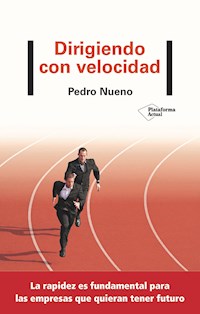
Strategy and speed are two key characteristics of companies that want to survive in an environment as demanding as the current one. After the international standstill caused by the covid-19 pandemic, the business world needs to go faster, and this requires a constant incorporation of technologies and innovation in all areas of the company, capable and motivated staff and financial resources enough to face the crisis, among many other things. In these pages, Professor Nueno exposes the fundamental tools that business organizations and managers must consider to adapt to new demands. Managing with Speed is a book to read slowly and understand that speed is the key to success today.
Sie lesen das E-Book in den Legimi-Apps auf:
Seitenzahl: 95
Veröffentlichungsjahr: 2020
Das E-Book (TTS) können Sie hören im Abo „Legimi Premium” in Legimi-Apps auf:
Ähnliche
















Managing with Speed
Pedro Nueno
First edition in this collection: February 2021
© Pedro Nueno, 2021
© for this edition: Plataforma Editorial, 2021
Plataforma Editorial
c/ Muntaner, 269, entlo. 1ª – 08021 Barcelona
Tel.: (+34) 93 494 79 99
www.plataformaeditorial.com
ISBN: 978-84-18582-20-2
Cover design and photocomposition: Grafime
All rights reserved. Copying of this work or any part there of by any means or procedure, including reprography and computer processing, and distribution of copies by public lending without the written consent of the copyright holders, is strictly prohibited and subject to penalties under the law. If you need to photocopy or otherwise reproduce any part of this work, please write to the publisher or to CEDRO (www.cedro.org).
Contents
Acknowledgements1. Gaining speed2. What does it mean to move quickly?The growth of geographic marketsSelling moreLaunching productsBuying businesses3. Moving forward towards a bigger, stronger future4. New markets?5. Entrepreneurship is essentialWhat is entrepreneurship?Can you be an entrepreneurial manager?6. Are there fast people and slow people?7. Speed, soundness and sustainability8. Bureaucracy and speed9. Are there any opportunities left?Geographical opportunitiesElectronic opportunitiesLife expectancyHealthcareConclusionsAnnex. Possible business plan indexAcknowledgements
When I think of giving thanks, it strikes me that this should be the book’s largest content because so many people come to mind who have encouraged me to move quickly and in many projects we have achieved it thanks to their help.
The IESE environment has been my great support and ongoing stimulus in enabling projects as innovative as creating a venture capital fund at the school, Finaves, to facilitate the entrepreneurial initiative of the school’s alumni. From the school I could mention professors such as Lorenzo Dionis and Miguel Ángel Gallo, who brought me into IESE, and, upon my return from the doctoral program at Harvard Business School, Juan Antonio Pérez López, Fernando Pereira, Carlos Cavallé and Jordi Canals.
I always had a great relationship with Harvard and organized many projects and programs. Richard Dooley, Robert Stobaugh, Wickham Skinner and, more recently, Krishna Palepu and Dean Nitin Nohria were major supporters. They were very helpful in the projects I took part in with IESE colleagues and entrepreneurial teachers from other countries and in the launch of several schools in Latin America, Portugal, Eastern Europe and, finally, China.
The China project, the China Europe International Business School, was a project of interest to the European Foundation for Management Development (EFMD), to the European Union and to the Chinese Government. The support of Jan Borgonjon, who would later launch his consultancy company InterChina, was essential, as was the support of the first appointments by the Shanghai Government, Co-Dean Zhang Guohua and, above all, Co-Dean Zhang Weijiong, who is still in his post, and of Chinese and European deans such as Li Jiahao, Zhu Xiaoming, Rolf Cremer, Hellmut Schütte, Alfredo Pastor and John Quelch, and the great help in the early days of the Spanish ambassador to China, Eugenio Bregolat, and Professor Jaume Ribera, and surely many more I have left out.
In the business sector, I started to learn what it is to be a great entrepreneur when collaborating with brothers Francisco and José María Rubiralta in the launch of their companies CELSA and Izasa. I was then able to experience the entrepreneurial initiative of many businesspeople such as José Felipe Bertrán, the Pont brothers of Borges and Pere Botet of Caprabo, and later, many entrepreneurial projects to have emerged from IESE: Félix Revuelta, of Naturhouse; Helmut Schaeidt, of Morchem; Marc Puig, of Puig; Tomás Pascual, of Pascual; Luis Hernández, of Renta Corporación; Marc Subirats and Carlos Nueno, of Advance Medical; Eric Li, of Chengwei Ventures; Yang Lan, of Sun Media; and many more.
In recent years, I have received the support of the director of the IESE Entrepreneurship Initiative Department, Professor Julia Prats, and, above all, of Denise Clerc, who has supported me in all my teaching and research work, in responding to countless contacts of former students who have embarked or will embark on entrepreneurial initiatives, and in relations with Harvard Business School and CEIBS in China as well as companies in which I have professional responsibilities.
1.Gaining speed
I have followed a number of companies with whom I have a good relationship and some have gladly accepted my advice to go faster.
The business world needs to move faster every day and this requires innovation, globalization, capable and motivated staff, financial resources and much more. If we think about what has happened in the automotive industry in the last ten years, we see the emergence of hybrids and electric vehicles, the growth of the Chinese market, the connection of cars to their surroundings through information technologies and new materials. It has always been a pioneering sector in introducing technologies and management models (remember the just-in-time of the 1980s), but there were certainly more changes between 2010 and 2020 than between 2000 and 2010, which we can interpret as an increase in speed.
The emergence of the coronavirus in 2020 will undoubtedly have an impact on the pharmaceutical and medical supply sectors over the next few years. But the need to prevent contagion that has led people to stay at home around the world has stimulated the digitization of life: more online training in schools, universities and colleges; more teleworking, carrying out many transactions from home, but also holding work meetings; more telemedicine; moving online many international events planned for dates when travel and meetings were not possible, and also an increase in sales.
The need to isolate oneself and the availability of mobile phones with high digital capacity, computers, iPads and the large number of instruments and equipment capable of connecting to these media have led many people to learn how to better engage with the digital environment, and this has had an impact on the business world that has again contributed to increase the speed of businesses.
We will try to examine more in depth what this means and how to facilitate it.
2.What does it mean to move quickly?
Let’s start by thinking about what it means to stand still, something we can see if we think about a case.
I have often explained that when I was a student in the doctoral program at Harvard Business School, I was assigned a prestigious professor to supervise me, but I suppose I was also expected to work for him on business matters of academic interest. One of the most successful companies in the world at the time was Kodak, a North American company based in Rochester, upstate New York, and a world leader in photography. The company was enjoying rapid worldwide growth, and the professor supervising me charged me with writing up a case on that success and the reasons for it. He told me that he had spoken with the chairman, who had told him that he would meet me and answer my questions.
I read as much as I could about Kodak and its industry and called the chairman’s office to ask for an appointment whenever it suited him. Shortly after, the secretary of the big boss called and asked me: “Could you be at LaGuardia airport in New York tomorrow at twelve?” I replied: “Yes, of course”. I could not run the risk of the big boss of Kodak shutting me out forever. I arranged with his secretary the exact spot where I should find him. There I was before midday (after flying very early from Boston, where Harvard is located), standing, waiting by a door that seemed to be an exit to where the aeroplanes parked.
After a while, a gentleman came running, followed by two others who were obviously in his service. He said to me: “I am the Kodak chairman, are you from Harvard?” I replied that I was and he said: “Follow me”. We went out that door to a small aircraft nearby. The big boss said: “I can only attend to you during the trip, you can ask me any questions you have”. I thought: “Oh my God. Where can this man be going and what will I do when I get there?” He was returning to Kodak in his private plane. The truth is that during the trip he was very kind to me and answered my questions fully. But when we got to Rochester airport, we came off the plane and he said: “Send me the case when you’ve written it up; good afternoon”. And he went towards a waiting car near where his plane had parked. I went into the airport, started searching and managed to find a flight to Boston early next day. I spent the afternoon and night in the airport, writing.
From what this man explained to me, he followed closely what was happening in the photography industry with international deployment. Photography was then chemical and Kodak’s goal was to improve the plastic rolls with a chemical treatment sensitive to images captured by the camera. The rolls then had to be “developed” to transform their content into photographs. It was very important for him to follow closely any small innovative differences that appeared on the market and find a way to quickly incorporate them into his company, which benefited from its capability to exploit that global innovation. This required buying up small companies, patents or even taking others’ innovations and developing them further to improve them. Of course innovation was hugely important to him and he felt he had the best team in the world. The company grew at great speed, but once the entire market was covered, the speed gradually decreased. Kodak diversified into chemicals, but without much success. The company slowly faded without going into electronic photography and finally collapsed.
Kodak is an example of a company that managed to go very fast but failed to sustain speed and ended up stopping altogether. Its industry underwent a major technological change that one could see coming, it slowly made its way into the business and ultimately dominated it, but the company certainly deluded itself and kept to something that was fated to disappear instead of trying to lead in the new technology by leveraging its brand and its global rollout.
The company tried to diversify, but its power in the photography industry probably made it difficult to devote senior management time to different fields. What to do with people engaged in R&D, for example? Fire them? If we go into pharmaceuticals, could our commercial organization go from one field to one that is very different? An industry’s decline usually takes time, but from the moment it is perceived that this will happen, we must find alternatives with which to maintain sales growth and results. There are many companies in the world that have been able to maintain periods of rapid growth and have had the ability to switch from one market to another, sustaining the company for more than a hundred years.




