


Erhalten Sie Zugang zu diesem und mehr als 300000 Büchern ab EUR 5,99 monatlich.
- Herausgeber: The History Press
- Kategorie: Geisteswissenschaft
- Sprache: Englisch
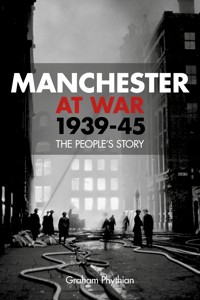
This new book is a remarkable and moving account of life on the home front in Manchester during the Second World War. Based on transcripts of recorded interviews with senior civilians and former members of the Armed Services, this is an invaluable first-hand record of what it was like to live under the shadow of war. The everyday hardships and heroism are recalled: the Blitz, rationing, the Home Guard, evacuees, war work, and the American presence prior to D-Day. Despite all the tragedy and difficulties, the Mancunian spirit shines through with frequent dashes of unquenchable humour. Richly illustrated, and filled with true narratives of the courage and unbreakable spirit of the people of Manchester during those tumultuous years, this book looks at how the city fared during the Second World War, played her part in victory, and how the day-to-day life of her people was affected.
Sie lesen das E-Book in den Legimi-Apps auf:
Seitenzahl: 254
Veröffentlichungsjahr: 2014
Das E-Book (TTS) können Sie hören im Abo „Legimi Premium” in Legimi-Apps auf:
Ähnliche



















This book is dedicated to the memory of my mother and father … promises fulfilled.
Instinctively, one recognised the calibre of these people. An intense sense of unity has been created.
If Hitler visualised these folk as shrieking and tearing their hair and cowering before his rage he had another guess coming.
When I penetrated to where the rivers of water ran through shattered glass and snuffed the tang of smoke and saw little flames flicker onto the skeletons of buildings … and grimy and weary firemen and ruddy-cheeked soldiers with fixed bayonets … I knew that I loved Manchester. Its dear smoky streets, its kindly, comradely folk, the very nooks and alleys of it – I loved it.
If this be the battle of Manchester then Hitler has lost it.
Manchester City News, 28 December 1940
I see the damage done by the enemy attacks; but I also see, side by side with the devastation and amid the ruins, quiet, confident, bright and smiling eyes, beaming with a consciousness of being associated with a cause far higher and wider than any human or personal issue. I see the spirit of an unconquerable people.
Winston Churchill, April 1941
ACKNOWLEDGEMENTS
With thanks to: Andrew Schofield of the North West Sound Archive; Arthur Davenport, Dennis Wood and Duncan Broady of the Greater Manchester Police Museum and Archives; Peter Turner for access to Salford Oral Heritage Archives; Prestwich and Whitefield Heritage Society; Jill Cronin for liaison with Denton Local History Society; Helen Hibberd and Bernard Leach for liaison with Chorlton Good Neighbours; Duncan O’Reilly for loan of extracts from his mother’s autobiography (Jeanne Herring); Philip Lloyd for loan of extracts from his mother’s wartime diary (Mary Lloyd); James Gilmour for hospitality, access to his personal museum and archive, and liaison; Bob Potts, Diana Leitch and Greg Forster for liaison; Bernard Leach for permission to use extracts from his interview with Mickie Mitchell; Phil Blinston for art work and liaison; Bryant Anthony Hill, Dave Kierman, Bob Potts, Walter Jackson and Norman Williamson for loan of publications; the Manchester Evening News; the staff of Manchester Central Library Local Studies, the Imperial War Museum North, Stockport Air Raid Shelters Museum, Stockport Heritage and Archives, Salford Local Studies Library Museum and Archives, Prestwich Library, Tameside Local History Library, and Trafford Local Studies Library.
CONTENTS
Title page
Dedication
Epigraph A
Epigraph B
Acknowledgements
Preface
1 Evacuees’ Stories
2 Under Attack
3 Defensive Measures
4 Wartime Work and Play
5 Rationing
6 Yanks
7 Coming Home
8 Celebrating Peace
Contributors
Bibliography and Sources
Copyright
PREFACE
It was during the Second World War, for the first significant time in history, that the civilian populace was regarded as fair game as a military target. Post-Battle of Britain, it was Hitler’s policy to carry out aerial attacks on British cultural and industrial centres, with destruction of nearby residential areas and the killing of non-military men, women and children regarded as justifiable collateral damage.
This book is a collection of memories of those brave and fortunate survivors of the Home Front in Manchester. But it is not just about the Blitz: naturally I include the testimony of those many Mancunians who exemplified the everyday courage of the ‘Keep Calm and Carry On’ variety. Dealing with the less immediately violent disruptions of evacuation, sundered families, rationing and the constant underlying fear of not knowing whether one’s person, family, workplace or home would survive the next twenty-four hours, deserves commemorating just as much as front-line heroism. ‘We just got on with the job’ is a frequently recurring theme in these pages.
The story goes that Hitler’s plans for Manchester included his personal use of the Midland Hotel on Peter Street, as it reminded him of a medieval castle. This is allegedly why the hotel and nearby streets remained untouched by bombs throughout the war. (Apparently any Luftwaffe pilot careless enough to allow the Midland to be hit would have had to attend a private audience with the Führer. One can imagine that this would not have consisted of a cosy chat over Kaffee und Kuchen.) Local tradition has it that Hitler, who by all accounts fancied himself as an architecture buff, had his eye on Rochdale Town Hall too, for similar reasons.
As the reader will soon discover, the definition of ‘Manchester’ in this book is elastic, stretching to cover the area roughly corresponding to the conurbation once known in council chambers as Greater Manchester County. The stories presented here, besides naturally having relevance to the city itself, not only stray into neighbouring Metropolitan boroughs, but also raise the local flag a few miles into south Lancashire and north Cheshire. It was, after all, one huge Luftwaffe target, for which I use ‘Manchester’ as a shorthand term.
Firemen at work in Portland Street during the Christmas Blitz 1940. (Manchester Evening News)
So apologies to non-Mancunians, but a title such as ‘Stretford, Chadderton, Flixton, Rochdale, Sale, Denton, Stockport, Salford, Ramsbottom, Urmston, Marple, Worsley, Prestwich, Audenshaw and Manchester at War’ would not have made it past the editor.
I am also using this preface to justify the inclusion of an abridged version of my late father’s account of his escape from a POW camp in Poland, and his journey across occupied Europe back home to Hulme, Manchester. This seems to be loosening the geographical boundaries to an unreasonable degree, but I have included the story not purely out of nepotism, but because firstly it’s a grand yarn in itself, and secondly it’s about how a Mancunian showed wartime qualities of ingenuity, courage and dogged persistence in another context. Besides, my father does not have the ‘Coming Home’ chapter all to himself.
I wish to thank all the contributors and their families who welcomed me into their home to conduct the taped interviews. The compilation of this book has been a fascinating learning experience for me, and in several instances, deeply moving. The full list of individual contributors is given at the end of the book.
My text sources were:
1. Transcripts of tape-recorded interviews made by me
2. Transcripts of recordings from the North West Sound Archive, Clitheroe
3. Written diaries and memoirs, used by permission
4. Manchester Evening News articles, cartoons, correspondence and adverts from 1939, 1941–42, 1945, 1989, and 2010
5. Manchester Evening Chronicle correspondence and articles from 1940 and 1945
6. Manchester City News items from 1940–45
7. Oral history passages, used by permission, from other books on the topic, a list of which is given in the bibliography at the end of the book
8. Extracts from two booklets published by the North West Sound Archive: Recollections: Heaton Park and Ramsbottom. ‘Anon.’ usually indicates a passage taken from one of these publications, in which names of contributors, although given in a generic list, are not attached to specific portions of text.
I have changed nothing from the original wording of the transcripts or text, except for the very occasional deletion of a repetition, or an even more occasional (and slight) rearranging of the order of words for clarity’s sake. Items in square brackets that were not in the original transcript or text are my additions, and render the odd explanation, modern reference, or precise location of a detail supplied by the contributor.
Every reasonable effort has been made to trace the copyright owners of material, both textual and visual, used herein. Notice of any omissions or oversights should be sent in writing to the author, c/o The History Press.
Graham Phythian, 2014
ONE
EVACUEES’ STORIES
The government had been planning the evacuation of children and some adults from major cities from August 1939. Two days before war was declared on 3 September, a total of 172,000 children and 23,000 adults were moved from Manchester into mostly private accommodation in the surrounding countryside. The evacuation took three days.
IVY CORRIGAN
When the war started we were evacuated to Poulton-le-Fylde, near Blackpool. I went to a school that was just a girls’ school, St Simon’s School. They were supposed to be just going to try it out for the weekend, and we went on the Friday and all the children were at the station. We had a pillowcase with just bits and pieces in that would last over the weekend, clothes for the weekend, all had a label on us with our names and addresses of the schools we came from, and piled into trains, and couldn’t understand why all our mothers and fathers that were there at the station were weeping and looking really upset if it was only for the weekend. It was a bit of an adventure. I was nine then. And then during that weekend war was declared and so we were stuck there.
Going on the train was quite an adventure, but then when we got there we were taken to a school, and we were all sort of huddled around in the school hall and in the playground there, and people were coming up and saying, ‘I’ll have one boy,’ or ‘I’ll have one girl,’ or ‘I’ll take two children.’ And that was a bit soul-destroying, really, because you had to stand there looking as if you were selling yourself! That was a bit hard.
(Courtesy of Life Times Oral History Collection, Salford Museum and Art Gallery)
ARTHUR ROBERT DAVENPORT
My parents decided when it was time for me to attend school in September 1939 I would be evacuated to Rose Hill, Marple, to live with an honorary uncle and aunt, Harold and Margaret Miller, with their two daughters at No. 1 Weatherley Drive. My parents and I travelled by bus from Culcheth Lane [Newton Heath] to London Road railway station [now Piccadilly station] and caught a steam engine – always a thrill – to Rose Hill station. Rose Hill in those days was mostly countryside with rabbits running in the fields. There were lots of wildlife, different trees and fields with long hedgerows. There was even a blacksmith on the road from Rose Hill to Marple. A great change from sooty Newton Heath.
The school I attended in Rose Hill was a nearby private school. I only attended for the first term and then I returned home, as my parents thought as there had been very little to worry about it was fairly safe, and if the worst came to the worst – if we were going to die – we would all die together.
JEANNE HERRING
In line with many other schools, Whalley Range evacuated its pupils. We went to Stacksteads, near Bacup in the Rossendale Valley. My sister Sylvia was on holiday with her aunt in Nottingham when war was declared, so she stayed there as she was fourteen and able to leave school. People were called up to do war work and Sylvia worked in a munitions factory during the war.
I can remember elder sister Kathleen coming to the house the morning I left for (at that time) an unknown destination. She had bought me a black patent leather case for my gas mask and a silver identity bracelet. Mother asked why I needed a bracelet and I said, ‘it is in case I get bombed or burned, you will recognise my body.’ Mother burst into tears and I got a strong ticking off from Kathleen.
I don’t remember much about leaving Manchester. I think it was from Chorlton station, but I do recall arriving in Bacup with my suitcase, gas mask in its posh case and a leather school satchel on my back. We were taken to a church hall and divided into groups, each of us having a label tied to a coat button. We were issued with a brown carrier bag containing a tin of corned beef, a tin of sardines and a tin of fruit with evaporated milk. The word ‘evaporated’ always intrigued me, for it wasn’t evaporated.
A woman in WRVS uniform, armed with a clipboard, marched us up a narrow street of terraced houses, dropping off pupils on the way. I was the only one left and could see no more houses, but further up the lane we came to a small farmhouse with an elderly couple waiting at the front door. Their names were Polly and Johnny Lord, and I was to spend the next four months with them.
Evacuees boarding the train at the old Chorlton-cum-Hardy station, the day before the declaration of war on 3 September 1939. The train’s destination was the Derbyshire Peak District. (Manchester Central Library Local Images Collection: M09913)
I really missed my family, but the couple were so good and kind to me that overall I quite enjoyed the experience.
It was only a small farm, with seven cows, a horse for pulling the milk float, hens in a shed behind the house, and a couple of fields. The government made a small contribution to Polly and Johnny for my upkeep.
The arrangement for our continued education was that we attended Bacup and Rawtenstall Grammar School in the mornings and their pupils went in the afternoon. We didn’t see much of them and I was never aware of any trouble between the two schools. Any we did meet were friendly and curious and a little bit sorry for us because we had had to leave our homes.
I enjoyed helping Polly around the house, collecting eggs and occasionally going round with Johnny on the cart delivering milk to the nearby houses. I used to balance the churn on my knee and tip the milk into a ladle and then into the customer’s jug.
Polly rooted out a pair of clogs for me to wear in the shippen [cattle shed]. She told me that they had belonged to her daughter who had died of meningitis when she was thirteen. I asked her whether my arrival had brought back sad memories but she said, ‘Memories, but not sad, it’s lovely having you.’ I felt very privileged. Talking of the cowshed, I did try my hand at milking, but with little success.
The couple had occasional help from John, a farm labourer who invited friends, teachers and me to a moonlight walk on the moors. I remember it well. The clear sky, the silvery look of the streams running down the hillside and the boggy moss and grass underfoot – all quite exciting for us city folk.
Another time I went with Johnny to fetch the horse from the field and was invited to sit on her back for the journey home. I’d never sat on a horse before and imagined a gentle trot, but Johnny slapped the horse’s rump and shouted, ‘Home, lass.’ The horse shot forward with me clinging to her mane, shaking with fright. It was probably only half a mile to the farm but it felt like forever.
The food on the farm was good; plenty of dairy products, chicken and good casserole stews cooked in the oven on the open kitchen range, better in fact than rations in Manchester.
NORMAN WILLIAMSON
I went to Central High School in town, and we were evacuated to Blackpool. Most of the boys went into boarding houses in big batches, ten or twenty, but I was picked out by a family that lived inland, maybe two miles inland. They were very nice people, but I couldn’t really settle there. She had a son, he wasn’t doing very well at school and I think they wanted me to try and help him out, and I did. I used to do his homework for him, but he was finally caught out when he went to school and he was the only one in the class that got his homework right. So he was supposed to go out and show them how he did it, but he couldn’t! He was a bit of a spoilt brat, really.
So I thought, I’ll make my escape! They were watching the bus station and the railway station, but I thought, I’ll make my escape, go back home and get a job, as I was fourteen. I’ll mingle in with the crowds at the bus station or the railway station, and get on a bus or train unnoticed. I got my plans all drawn up, however, just as my well-laid escape plans were about to be put into action, my mother turned up! I said, ‘I can’t stay here, I’m coming home.’ Anyway, we had a long talk, and I said, ‘I don’t care, I’m not staying!’ So she had a word with this lady, and she brought me home.
If I’d been with the lads on the coast, I’d have been happier. I remember a ship had been sunk out at sea, and there were oranges all over the beach! [laughs]
I did go down to see them. I remember the RAF bombers sort of skimming over the piers, very low.
HELEN SEPHTON
I was an early evacuee, because I was only one year of age when the war started. I think it was a matter of seeing as how a bomb hit the next street where we were on – Abbey Hey Lane [Gorton] – and flattened it. I think my parents then realised it was a matter of urgency to get the children all out of the way. My father then – he didn’t have to do – but he joined the Royal Marines, the submarines, and my mother was away nursing people at Crumpsall Hospital. So they both had these respective careers.
My brothers had been sent to a farm in Norfolk, but they wanted a different place for me. I don’t know how they came across these people’s name, address [a farm in Glossop] or what-have-you, but they were called Flaherty. I never knew her first name, but I called him ‘Uncle Jimmy’, and I must have gone to them when I was around two, just a tot, and I think I was about three years with them.
I remember snippets of it, you know, things jump out at me, but I was only young. ‘Auntie Flaherty’ as I called her, she was the stern one, she was the disciplinarian. I could twist Uncle Jimmy round my finger. I remember sitting on a pig and thinking I could go cowboy style, you know, round the farm, which didn’t work out as I remember falling off, and I remember the chastisement I got off Auntie Flaherty [laughs] as a result of it. I remember sitting with little fluffy chickens on my shoulders and jumping when I saw her appear you know, [laughs] a couple of them fell off, I was absolutely mortified when these little chickens fell to the floor.
The kitchen had a long sink made of stone, and just the one tap, which was cold. My job was, I wiped the eggs clean, and I can’t remember ever dropping one. I think I would have remembered that! I love eggs to this day, but I swear I had egg for breakfast, dinner and tea when I was on the farm, all done in different ways.
I had a free run of the farm. I don’t know how I didn’t get into serious trouble, because farms are a dangerous place. I remember seeing Uncle Jimmy in the field, you know, on a tractor, and not realising at that time that tractors have a blind spot; the driver can’t see little things below in front of them because of these big wheels and things going round. I remember running in front, running up to the tractor and shouting, ‘Uncle Jimmy! Uncle Jimmy!’ but of course he couldn’t hear me because of the sound of the tractor, and he couldn’t see me, because I was only a tot, and he was coming straight towards me. And I don’t know how I got out of the way, I really don’t, but well I must have done. And I was horrified, I thought, ‘Why is he coming towards me and not turning round?’ I was probably about four, something like that.
EVELYN SEYMOUR
I was brought up in Salford. I was evacuated to Accrington when I was six years old, and because I was so young my sister came with me. She should have gone to Lancaster, but stayed with this lady in Accrington. She looked after us very well: I had my seventh birthday there, and she let me have half a dozen children from school, and we nearly wrecked the place! But she was quite happy, she loved children.
I only stayed in Accrington from the September until the Christmas, 1939. My mother used to come up every weekend to see us, and she found out it was too expensive. She decided she just couldn’t afford it, and wages were not very high in those days. My father was working, but with three children, we found it very difficult.
MARGARET GREAVES
I was fourteen – well, fourteen-and-a-half really – as the war broke out in the September. I went to Fallowfield Technical High School for Girls, having passed my eleven plus, and I was evacuated to Macclesfield. The week before, I’d been on holiday at my aunt’s in Kendal, and she said, ‘Let’s go to Morecambe for the day.’ So my cousin and I went to Morecambe. And then my mother suddenly appeared from Manchester, she said, ‘You’ve got to come home! You’ve got to be evacuated.’ That was the Thursday or Friday before September 3rd, then I was evacuated to Macclesfield with the school. I was billeted in Broken Cross with a very nice family with two little girls; he was the manager of one of the silk mills.
We had part-time education: one week we’d go in mornings, and the next week we’d go in afternoons. And this continued from the September to the December, and nothing happened. There was no war, I mean, it was just like being on holiday in a way, part-time school, you know, which I didn’t enjoy very much.
I was a singer, I’ve always been a singer, and the Christmas of that year, 1939, we had a carol service in Macclesfield Parish Church, and I was singing two solos out of the Messiah. There’s a story attached to that, because when a lady who was in the congregation and who belonged to our church – don’t ask me why she was in Macclesfield at that time, I’ve no idea – she came back and said, ‘How is it that Margaret Lord’ – my maiden name was Lord – ‘can sing in Macclesfield, and she can’t sing in our church?’ Ladies were not considered to be part of the choir, you see, they used to sit at the back of the choir stalls. But then, of course, the ladies were much in demand, because the young men were at war.
So my parents said that as nothing had happened, I came home for Christmas, and then went back to Macclesfield. The girl I was billeted with was called Audrey Long, she was a very tall girl, and she was good at long jumping [laughs], I can remember, and I often wonder what’s happened to her, because I’ve had no contact with her. The lady became ill, and we both had to separate then, and I was put with a young couple who had no idea how to cope with a teenager – by this time I was nearly fifteen – I wouldn’t say I was unhappy, but I was uncomfortable. This was still in Broken Cross. Anyway my parents decided that nothing had happened, so I could go back home.
RUTH PALMER
I was only six when they gave me a gas mask, put a label round my neck like Paddington Bear and took me to a big posh house in Chapel-en-le-Frith, Derbyshire. And I hated it.
They had a nanny for their little girl, and a rose garden and a swing, which I thought was very posh. They also had a breakfast room and I couldn’t imagine anyone having a special room just to have their breakfast in.
The nanny used to scrub and scrub my back in the bath every night. It was all very different and I wanted my Mam, and when she came for me I was glad and I think the posh family were too. My mother was staying in an ordinary house at the other end of the village with my younger sister and the three of us all slept in one bed and I was happy again.
(Manchester Evening News supplement, 5 September 1989)
HILDA MASON
My two brothers were evacuated, to Knutsford, where they lived with a family. I wasn’t, because I’d just started work. They got on very well with the family, because the family they stayed with was connected with Tatton Park. He used to be a gamekeeper there, and he used to take my brothers round the Park. We used to go and visit them at weekends, and we used to play on the heath – football – with them, and they were there a couple of years.
ROSA SLATER
Well, I was evacuated first with the school to a place called Wilpshire [north of Blackburn], with a ‘P’ in the middle. I don’t know where it is, somewhere up north, and we were in a schoolroom and people picked you and took you.
I got picked by this lady and she had quite a posh house, and she put me in the attic on a camp bed – which I didn’t mind, you know, and then she told me to come downstairs and she told me I would not be eating with her daughter or her, I would be eating in the back room with the maidservant or whoever it was, you know, and then I would have certain chores to do before I went to school and certain chores to do when I came back. One of them was black-lead this grate in this pantry affair, which took me all of three or four nights. I mean, I was big and boisterous you know, I had plenty of energy then, but I mean it was such a huge thing – it was ridiculous. And then the food was dreadful.
Extracts from the evacuation leaflet disseminated in Manchester in the summer of 1939. (Philip Lloyd)
And then I wrote to my mum, I gave them to the lady to post and she never posted them. And my mother got worried because she never heard from me, and she wrote to the woman, who wrote back and said I’d not wrote. Something like that. Anyway, my mother came and got me. I told her I had written every week, twice a week, and I wasn’t happy and that. So she told her what to do with her fancy house and whatever, so she brought me home.
I was home [in Cheetham Hill] for about a week I think, and then she took me to my auntie’s in Newton in Montgomeryshire then, I think it’s Powys now. I was there for about a year – I can’t remember just how long – and I went to Penygloddfa Council School and it was lovely.
(North West Sound Archive)
ANON.
I went to St Joseph’s School [Ramsbottom]. We had a class of pupils from one of the Manchester Catholic schools, St Bridgit’s. We all tended to get on well together and mixed in, though they were kept in a class of their own. One of their teachers came with them and taught them all together. There was a spare classroom at St Joseph’s and they used that.
(North West Sound Archive)
ROY MATHER
Where I lived was at Glossop, Derbyshire, and in the evacuation they brought schools from Higher Openshaw, round that area, West Gorton. The children came on the train with their labels and everything else, the gas mask box, and they had a sort of a rucksack thing. They got off the train at Glossop, which is only ten miles from Openshaw, and the local education people from the council took these children to where they’d had a response, where they’d said they’d take the children. The problem, what happened if there was a brother and sister, or two sisters, they separated them, and that didn’t go down well.
Manchester Education Committee granted 1 shilling [5p] a head for Christmas treats to evacuated children. Number has dropped from 20,000 last Christmas to 5,000.
(Manchester City News, 14 December 1940)
What happened was, we went in our own classes, one week we went in a morning, the next week in the afternoon, and while we was in school they was out. And then eventually the phoney war was on, and they all filtered back home again, because there was nothing happening. It didn’t happen until 1940, and this is 1939 we’re talking about.
PHILIP LLOYD
Because my sister was under five years old, of course she wasn’t going to school, so we were able to make our own arrangements and I was able to go along with my mother and younger sister. So we went to our grandmother’s sister’s in Wilmslow – Lacey Green – and I went to a little village school, a little stone-built school at the end of the road, for a term or two. It’s been knocked down, and the Community Centre is there now.
Things were quiet in Manchester, so we came back here, and in fact we were here just in time for the Manchester Blitz! We were in our own shelter in the cellar, underneath the post office in Upper Chorlton Road. We’d had it strengthened, and my sister and I used to sleep down there during the worst of the Blitz. I can remember feeling the bombs dropping, the blast from them, I think one fell in the road just outside, and one of the shop windows was put through. It couldn’t be replaced at the time, and had to be boarded up.
TWO
UNDER ATTACK
Piccadilly warehouses ablaze during the December 1940 Blitz. The Fire Service was temporarily understaffed, as many regular firemen had been called over to Liverpool to combat the results of the bombing there. (Manchester Evening News)




