


Erhalten Sie Zugang zu diesem und mehr als 300000 Büchern ab EUR 5,99 monatlich.
- Herausgeber: Darolt Books
- Kategorie: Religion und Spiritualität
- Sprache: Englisch
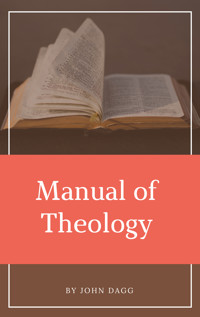
This volume is designed for the use of those who have neither the time nor the opportunity to study larger works on theology. In preparing it, my aim has been to present the system of Christian doctrine with plainness and brevity and to demonstrate, at every point, its truth, and its tendency to sanctify the heart. Men who have inclination and talent for deep research, will prefer more elaborate discussions than mine; but if the novice in religion shall be assisted in determining what is truth, and what the proper use to be made of it then the chief end for which I have written will have been attained. In delineating divine truth, we may exhibit it in different aspects and relations. We may view it as coming forth from God, with supreme authority. Or we may exhibit it as a system revealed by Jesus Christ, all the parts of which beautifully harmonize with each other, and cluster around the doctrine of the cross, the central point of the system. Or we may exhibit it as entering the human heart by the agency of the Holy Spirit, and transforming it into the image of God. This last view I have labored to render prominent in these pages. The moral and religious principle in man needs a suitable influence for its development and perfection and such influence, this book finds in the truths here presented. The adaptedness of a doctrine to produce this effect it regards as a proof of its truth and divine origin; and it accordingly deduces the articles of faith, to a great extent, from the inward exercises of piety. But this is not the only method relied on for demonstrating their truth. Other sources of religious knowledge have been examined, and especially the holy Scriptures in which the truth of God is directly made known. To this holy book, as the highest standard, the last appeal is always made; and the harmony of its decisions, with the deductions from our inward experience is carefully observed for the confirmation of our faith.
Sie lesen das E-Book in den Legimi-Apps auf:
Seitenzahl: 728
Veröffentlichungsjahr: 2020
Das E-Book (TTS) können Sie hören im Abo „Legimi Premium” in Legimi-Apps auf:
Ähnliche















PREFACE
This volume is designed for the use of those who have neither the time nor the opportunity to study larger works on theology. In preparing it, my aim has been to present the system of Christian doctrine with plainness and brevity and to demonstrate, at every point, its truth, and its tendency to sanctify the heart. Men who have inclination and talent for deep research, will prefer more elaborate discussions than mine; but if the novice in religion shall be assisted in determining what is truth, and what the proper use to be made of it then the chief end for which I have written will have been attained.
In delineating divine truth, we may exhibit it in different aspects and relations. We may view it as coming forth from God, with supreme authority. Or we may exhibit it as a system revealed by Jesus Christ, all the parts of which beautifully harmonize with each other, and cluster around the doctrine of the cross, the central point of the system. Or we may exhibit it as entering the human heart by the agency of the Holy Spirit, and transforming it into the image of God. This last view I have labored to render prominent in these pages.
The moral and religious principle in man needs a suitable influence for its development and perfection and such influence, this book finds in the truths here presented. The adaptedness of a doctrine to produce this effect it regards as a proof of its truth and divine origin; and it accordingly deduces the articles of faith, to a great extent, from the inward exercises of piety. But this is not the only method relied on for demonstrating their truth. Other sources of religious knowledge have been examined, and especially the holy Scriptures in which the truth of God is directly made known. To this holy book, as the highest standard, the last appeal is always made; and the harmony of its decisions, with the deductions from our inward experience is carefully observed for the confirmation of our faith.
While the system has been viewed as emanating from God, and as operating on man attention has not been directed exclusively to its origin, or its termination. The convergence of all its lines in the glorious center, the cross of Christ, has not been overlooked. The reader will, I hope, find proof in these pages, that the doctrine of the cross is the doctrine according to godliness.
It has been no part of my design, to lead the humble inquirer into the thorny region of polemic theology. To avoid everything that has been a subject of controversy, was impossible; for every part of divine truth has been assailed. But it has been my plan to pursue our course of investigation, affected as little as possible by the strife of religious disputants and to know no controversy, but with the unbelief of our own hearts. The questions which are most likely to perplex sincere inquirers have been examined; and, if they have not been thoroughly elucidated, and fully answered then I hope they have been so disposed of as to leave the mind at rest, peacefully reposing on truth clearly revealed in Scripture, and patiently waiting for the light of eternity to dispel all remaining darkness.
In religion, men appear naturally fond of the difficult and the obscure; perhaps, because they there find escape from the disquieting light of clearly revealed truth. Even the novice, leaving the subjects that are plain plunges into deep investigations, and abstruse reasonings, which the skillful theologian thinks it wiser to avoid. Hence arises a necessity of frequently reminding the inquirer, that there are subjects which extend far beyond the limits of his vision; and that, in laboring to explore them further than he is guided by Scripture revelation he is in danger of mistaking mere conjecture, and the deductions of fallacious reasoning for the truth of God. Theories may be lawfully admitted for the removal of objections if it is remembered that it is only theory. Abstruse reasoning must be allowed, when it becomes needful to go into its labyrinth, for the purpose of extricating those who have lost themselves therein. But, for direct proof of all the articles of faith, this book relies on express declarations of God's Word, or such deductions as are adapted to plain and practical minds.
Anyone who may desire to see a history of religious opinions, will not find it in this work. Religion is an affair between every man and his God; and every man should seek to know the truth for himself, whatever may be the opinions of others respecting it. It has been my aim to lead the mind of the reader directly to the sources of religious knowledge, and incite him to investigate them for himself, without respect to human reasoning and authority. He may learn, from the help which I am offering him, what my views are but I will here give him the caution, once for all, not to adopt any opinion which I may advance, any farther than it is well sustained by the word of God. Had I wished him to fix his faith on human authority I would have adduced quotations from writers of celebrity in support of my opinions; but I have chosen not to do so. It is my desire that the reader should see, in the doctrine here presented, so far as respects human authority nothing but the mere opinion of a fallible worm; but that so far as it is sustained by the Word of God he should receive it as the truth of God.
This volume contains nothing respecting the externals of religion. The form of godliness is important as well as its power, and the doctrine respecting it is a component part of the Christian system; but I have chosen not to include it in the present work.
If this humble attempt to benefit others should be unsuccessful it has not been useless to myself. In the near prospect of eternity, I have found it good to examine again the foundation on which my faith rests. If the perusal of these pages give as much profit and pleasure to the reader, as the preparing of them has given to the writer then we may find reason in the eternal world to rejoice together, that Christian friends have called for this little service to the cause of the Redeemer.
Section 1. STUDY OF RELIGIOUS TRUTH
Chapter 1. The Obligation
The study of religious truth ought to be undertaken and prosecuted from a sense of duty, and with a view to the improvement of the heart. When learned, it ought not to be laid on the shelf, as an object of speculation; but it should be deposited deep in the heart, where its sanctifying power ought to be felt. To study theology, for the purpose of gratifying curiosity, or preparing for a profession, is an abuse and profanation of what ought to be regarded as most holy. To learn things pertaining to God, merely for the sake of amusement, or secular advantage, or to gratify the mere love of knowledge, is to treat the Most High with contempt.
Our external interests are involved in the subject of religion, and we should study it with a view to these interests. A farmer should study agriculture, with a view to the increase of his crop; but if, instead of this he exhausts himself in inquiring how plants propagate their like, and how the different soils were originally produced, his grounds will be overrun with briers and thorns, and his barns will be empty. Equally unprofitable will be that study of religious doctrine which is directed to the mere purpose of speculation. It is as if the food necessary for the sustenance of the body, instead of being eaten and digested, were merely set out in such order as to gratify the sight. In this case, the body would certainly perish with hunger; and, with equal certainty will the soul famish if it feed not on divine truth.
When religious doctrine is regarded merely as an object of speculation, the mind is not content with the simple truth as it is in Jesus, but wanders after unprofitable questions, and becomes entangled in difficulties, from which it is unable to extricate itself. Hence arises the skepticism of many. Truth, which would sanctify and save the soul, they willfully reject, because it will not gratify all their curiosity, and solve all their perplexities. They act as the gardener would, who should reject the whole science of agriculture, and refuse to cultivate his grounds, because there are many mysteries in the growth of plants, which he cannot explain.
If we set out, in our search for religious truth, from a sense of duty, and with the purpose of making the best possible use of it, we may hope for success. The Lord will bless our efforts; for he has promised, "If any man will do his will, he shall know of the doctrine" (John 7:17). As we advance, we shall find out all that is necessary for any practical purpose; and the sense of duty, under which we proceed, will not drive us beyond this point.
The sense of religious obligation which moves us to seek the knowledge of the truth, though disregarded by a large part of mankind, belongs to the constitution of human nature. Man was originally designed for religion, as certainly as the eye was formed for the purpose of vision. It will be advantageous to consider well this fact, at the outset of our inquires. We shall then feel that we are proceeding according to the best dictates of human nature.
The various parts of the world which we inhabit, are admirably adapted to each other. Many of these adaptations present themselves to our most careless observation; and, if we search for them with diligence, they multiply to our view beyond number. The seed falls to the ground from its parent stalk, like a grain of sand; but, unlike the sand, it contains in its minute dimensions, a wonderful provision for the production of a future plant. This provision, however, would prove unavailing, if it did not find a soil adapted to give nourishment to the young germ. Moisture is also needed: and the vapor, rising from a distant sea, is wafted to the place by the wind, and, condensed in the atmosphere, descends in the fertilizing shower. But all these adaptations are insufficient, if warmth is not supplied; and, to complete the process, the sun at the distance of ninety-five millions of miles, sends forth his enlivening beams. Such complications of arrangements abound in all the works of nature.
The purposes which these adaptations accomplish, are often perfectly obvious. In plants and animals, they provide for the life of the individual and the continuance of the species. Plants are adapted to become food for animals; and plants and animals render important benefits to man. But man, too, has his adaptations; and, from a consideration of these, his proper place in the great system of the universe may be inferred.
Like other animals, man is so constituted, that provision is made for the continuance of his life, and of the race. Were there no higher indications in his constitution, he might eat and drink, like other animals; and the indulgence of his natural appetites and propensities might be the highest end of his being. But, for human beings so to brutalize themselves, is a manifest degradation of their nature. They possess endowments, which, as every one feels, fit them for far nobler purposes.
The high intellectual powers of man, call for appropriate exercise. His knowledge is not confined to objects near at hand, nor to such relations and properties of things as are immediately perceived by the senses; but his reason traces remote relations, and follows the chain of cause and effect through long successions. From the present moment he looks back through past history, and connects events in their proper order of dependence. By his knowledge of the past he is able to anticipate and prepare for the future. In the causes now existing, he can discover the effects which will be developed long hereafter. Such endowments agree well with the opinion that he is an immortal being, and that the present transitory life is preparatory to another which will never end; but they, by no means, accord with the supposition, that he dies as the brute. No one imagines that the ox, or the donkey, is concerned with the question whether an immortality awaits him, for which it is important that he should prepare; but the idea of a future state has had a place in the human mind in all ages, and under all forms of religion. The bee and the ant provide for the approaching winter; and the winter, for which their instincts lead them to prepare, comes upon them. If the future life, which men have so generally looked for, which their minds are so fitted to expect, and for which many have labored to prepare, with unceasing care, should never be realized, the case would violate all analogy, and be discordant with the harmony of universal nature.
The human mind is fitted for continued progress in knowledge; and, therefore for a state of immortality. This adaptation includes an insatiable desire of knowledge, and an ability to acquire it. The little chicken, not many hours after it has left the shell in which its feeble existence commences, is able to select its food, to roam abroad in search of it, and to return to its mother's wing for protection. Man is born into the world, the most helpless of animals. Tedious weeks pass away before the development of his intellectual powers begins to appear. The progress is slow, and many months of gradual improvement pass, before he becomes equal in ability for self-preservation, to many other creatures that have lived a few hours. These animals, however, stop at a point beyond which, it may be said, they never go. The birds of the present age build their nests just as they were built five thousand years ago; and the admirable social arrangements found among bees and ants have undergone no improvements. But no point, no line, bounds the progress of the human mind. Though we are now familiar with the great improvements which have been made in arts and sciences, we contemplate them with admiration and astonishment; and we feel that a boundless career is open before the intellect of man, inviting the efforts which he finds himself internally prompted to make. But, as far as each individual of the race is concerned, the vast fields of knowledge open before him in vain, his power to explore them exists in vain, and the desire to explore burns in vain in his breast, if the present life, which flies as the weaver's shuttle, is the only opportunity granted, and if all his hopes and aspirations are to be forever buried in the grave.
The moral faculties with which man is endowed, adapt him to a state of subjection to moral government. Our minds are so constituted, that we are capable of perceiving a moral quality in actions, and of approving or disapproving them. A consciousness of having done what is right, affords us one of our highest pleasures; and the anguish of remorse for evil deeds, is as intolerable as any suffering of which the human heart is susceptible. Our conscience exercises a moral government within us, and rewards or punishes us for actions according to their moral character. Much of our happiness depends on the approbation of those with whom we associate. Hence, we find moral government without, as well as within; and at every point, in our relations to intelligent beings, we feel its restraints. Where are the bounds of this moral government? It must be as extensive as our relations to moral beings, and as lasting as our existence.
That men are immortal and under a moral government, by which their future state will be made happy or miserable, according to their conduct in the present life, are fundamental truths of religion. Man is a religious animal; because a persuasion of his immortality and an expectation of future retribution so readily find a place in his mind. No one imagines that such thoughts were ever entertained for a moment, by any one of the innumerable brute animals that have trodden the earth. But in the human race, such thoughts have been prevalent in all nations and ages; have mingled with the cogitations of the learned and the unlearned, the wise and the unwise; and have blended religion thoroughly with the history of mankind.
The considerations which have been presented, establish the claim of religious truth to our highest respect and most diligent investigation. He who disregards its claim acts contrary to his own nature, and degrades himself to the level of the beast that perishes. That men do so degrade themselves, is a fact which correct views of religious truth cannot overlook: "The ox knows his owner, and the donkey his master's crib; but Israel does not know, my people does not consider" (Isa 1:3). It is a peculiar glory and excellence of the Christian revelation, that it is adapted to this fallen condition of mankind; and that it has power to effect a restoration. It is medicine for the sick, as well as food for the healthy. A healthy appetite calls for food; and the food, when received, administers needed nourishment; so that between the healthy stomach and the nutritious food, the adaptation is reciprocal. But in sickness the stomach loathes food, and rejects the medicine which is needed to effect a cure: yet the adaptation of the medicine to the condition of the sick man still remains. Just so it is with respect to the gospel of Christ. Though rejected by men, it is "worthy of all acceptance," because it is a remedy, precisely adapted to our depraved state. Thousands of thousands have experienced its restoring power, and unite in recommending its efficacy to the multitudes who are unwilling to make trial of it.
In contemplating the truths of religion, we may view them in various aspects. We may consider them as proceeding from God; as demonstrated by abundant proof; as harmonizing with one another; and as tending to the glory of God. It is interesting and instructive to view them in immediate contact with the human heart, and, like the Spirit of God, brooding over the original chaos, bringing order out of confusion, and infusing light and life where darkness and death had previously reigned. In exerting this new-creating power, the divinity of Christian truth appears; and the demonstration of it is the more satisfactory, because practical, and leveled to the capacity of all.
As religious beings, let us seek to understand the truths of religion. As immortal beings, let us strive to make ourselves acquainted with the doctrine on which our everlasting happiness depends. And let us be careful that we do not merely receive it coldly into our understanding, but that its renewing power is ever operative in our hearts.
Chapter 2. Sources Of Knowledge
We find ourselves in a world where we have no continuing abode. Within us, and without us, we have proofs and admonitions that our chief interests lie in another world, and that our chief business in this is to prepare for the future state, into which we shall very soon enter. We need information respecting that unseen world and the right method of preparing for it, and no other knowledge can be so important to us as this. Can it be that we have no means of acquiring it? For our guidance in the things of this world, every necessary provision has been made. We possess eyes; and the world in which we are placed affords the light that is needed to tender them useful in directing our steps. We possess understanding; and means of knowledge from without are presented, by which we may select the objects of our pursuits, and the best methods of gaining them. We may hence infer that some means of knowledge respecting our highest interests must exist. The sources from which this knowledge may be obtained, are the following:
1. Our moral and religious feelings. Brute animals have instincts by which they are guided; and in man, also, instinctive propensities exist, adapted to his nature and the condition and circumstances of his being. Maternal affection is not confined to brutes as an instinct peculiar to them, but it is found in the highest degree in the human mother; and in her breast, mingles with moral and religious feelings peculiar to human nature and inseparable from it. The human mother feels the moral obligation to take care of her child, antecedent to all reasoning on the subject. When we determine what is right or wrong by a process of reasoning, we judge according to some law, or rule of right; but, in this case, the mother is a law to herself. She needs no teaching from without, to inform her that it is her duty to take care of her offspring. Sin may so debase human nature, that mothers may evince no moral feeling; but, however it may be buried under our corruptions, the moral principle is an element of our nature. Because of it, even the heathen are a law unto themselves, and show the work of the law written in their hearts. The moral feeling which at first co-operates with the mother's instinctive affection to induce her to take care of her child, co-operates afterwards with her reason in devising the best method of promoting its good.
When it was to be determined which of two women was the mother of a living child claimed by both, the wisdom of Solomon decided, that the maternal relation existed where maternal affection existed. On the same principle we may, from our moral and religious feelings, infer our relation to moral government and to the Supreme Ruler. From this law, written in the heart, we might obtain much religious knowledge, if the fall of man had not obscured the writing.
2. The moral and religious feelings of our fellow-men. We are formed for society, and are capable of benefitting each other in the things of this life, and of that which is to come. The judgments of others assist our judgments; and their moral and religious feelings may, in like manner, assist ours. In the approbation or disapprobation of mankind, we may find an important means of knowing what is right or wrong. Hence, it is a rule of duty to do those things which are "of good report."
If an ancient writing is transmitted to us in numerous copies, all of which are mutilated and greatly effaced, the probability of ascertaining what the original was is far greater, when we compare many copies with each other, than it would be, if we possessed one copy only. For the same reason, the moral and religious feeling of mankind generally, is a source of knowledge more to be relied on, than that which is opened for our examination in the moral nature of a single individual. A hardened transgressor's own conscience may fail to reprove him, when his crimes shock the moral sense of the whole company; and, from their disapprobation, he might learn the iniquity of his conduct, though all moral feeling were extinguished in his own breast.
In examining this second source of knowledge, we observe the common consent of mankind, that there is a God; that he ought to be worshiped; that there is a difference between virtue and vice; that a moral government exists, which is partly administered in this life by Divine Providence; that the soul of man is immortal; and that a future retribution awaits all men after death. These truths of religion appear in the history of mankind, through all the corruptions which have covered and obscured them.
3. The course of Nature. Things are so arranged by the Creator and Ruler of the world, that some actions tend to promote, and others to destroy, the happiness of the individual and of society. By observing the tendency of actions, we may learn what to do and what to avoid. God has established the nature of things, and the voice of Nature is the voice of God. Conscience is God speaking within us, but, because of man's apostasy from God, it often delivers false oracles. Hence, we do well to turn our ear to the voice of God, speaking in universal Nature.
The tendency of vice to produce misery, is obvious to every one who observes the curse of things around him. Drunkards and gamblers, impoverish themselves, ruin their families, waste their health, and bring themselves to an untimely grave, frequently by violent, and sometimes, by suicidal hands. In ten thousand ways, crime of every species exhibits its pernicious tendency, and, in this arrangement of things, the moral government of God is clearly seen, and the conduct which he approves, is pointed out by the finger of his Providence. Enough of God's moral government appears in the present life, to demonstrate its existence; and the imperfection which is manifest in its present administration, furnishes satisfactory proof that it extends beyond the present life, and is perfected in the world to come.
The religious knowledge which may be obtained from the three sources which have been enumerated, constitutes what is called Natural Religion. Though insufficient to meet the wants of man in his fallen condition, it teaches the fundamental truths on which all religion is based, and leads to the higher source of knowledge by which we may become wise to salvation. That is
4. Divine Revelation. Because all other means of knowledge are insufficient to bring men to holiness and happiness, God has been pleased, in pity to our race, to make known his will by special revelation. Besides his voice in conscience and in Nature, he utters his voice from Heaven. This revelation was anciently made by prophets, who were commissioned to speak to men in his name, and afterwards by his Son from Heaven. To us, in this latter days, he speaks in his written word, the Bible, which is the perfect source of religious knowledge, and the infallible standard of religious truth.
The Bible consists of two parts:
1. The Old Testament, or Hebrew Scriptures. This is the book very carefully preserved by the Jews throughout the world, and held sacred by them as a revelation from God.
2. The New Testament. This consists of various writings, which have been carefully preserved by the Christians of past ages, and are now regarded by them as a revelation from God, made through the immediate followers of Jesus Christ.
We shall here assume that the Bible is a revelation from God. If the reader has any doubts on this point, he may study, to advantage, any of the numerous works extant on the Evidences of Christianity; or, in the absence of more elaborate productions, he may read a small tract by the Author, entitled The Origin and Authority of the Bible. [This Tract has been introduced into the present work as an Appendix, people. 26-42.]
Inspiration and transmission of the Scriptures. The Bible, though a revelation from God, does not come immediately from him to us who read it, but is received through the medium of human agency. It is an important question, whether its truth and authority are impaired by passing through this medium. Human authority was employed in the first writing of the Scriptures, and agency was employed in the first writing of the Scriptures, and afterwards in transmitting them, by means of copies and translations, to distant places, and succeeding generations.
The men who originally wrote the Holy Scriptures, performed the work under the influence of the Holy Spirit. Such was the extent of this influence, that the writing, when it came forth from their hands, was said to be given by inspiration of God. So Paul said, with special reference to the Old Testament: "All Scripture is given by inspiration of God, and is profitable . . . that the man of God may be perfect, thoroughly furnished unto good works." (2Tim 3:16) Though Moses and the prophets executed the writing, it is said to have been given by God, and the perfection attributed to it demonstrates that it had not suffered by the instrumentality which he had chosen to employ. Christ referred to the Hebrew Scriptures, as the word of God (Mk 7:13). Paul represents what was spoken by the prophets, as spoken by God (Heb 1:1). Peter attributes to the writings of Paul equal authority with that of the Old Testament Scriptures (2Pet 3:16). Paul also claims equal authority for what he spoke and wrote (1Cor 14:37). Christ promised to his apostles, after his departure, the gift of the Holy Spirit, and described the effect of his influence on them in these words: "It is not you that speak, but the Spirit of your father which speaks in you." (Mt 10:20) This gift of the Holy Spirit was poured out upon them on the day of Pentecost; and their possession of it was proved by their power to speak with tongues, and work miracles. From all this, we learn that what was spoken and written by inspiration, came with as high authority as if it had proceeded from God without the use of human instrumentality. While Peter said to the lame man, "In the name of Jesus Christ of Nazareth, rise up, and walk," (Acts 3:6) the voice which spoke was Peter's, but the power which restored the ankle bones was God's. The words, though Peter's, were spoken under divine influence, or the divine power would not have accompanied them. So the gospel, received from the lips of the apostles, was received, "not as the word of men, but as it is in truth the word of God." (1 Thessalonians 2:13) The men who spoke and wrote as they were moved by the Holy Spirit, were the instruments that God used to speak and write his word. Their peculiarities of thought, feeling, and style, had no more effect to prevent what they spoke and wrote from being the word of God, than their peculiarities of voice or of chirography.
The question, whether inspiration extended to the very words of revelation, as well as to the thoughts and reasonings, is answered by Paul: "We preach, not in the words which man's wisdom teaches, but which the Holy Spirit teaches." (1Cor 2:13) The thoughts and reasonings in the minds of the inspired writers, were not a revelation to others until they were expressed in words; and if the Holy Spirit's influence ceased before expression was given to these thoughts and reasonings, he has not made a revelation to mankind. On this supposition, we cannot read the Bible as the word of God, but as the word of men; of good and honest men, it is true, but nevertheless of fallible men. The opinion that the expression is merely human, undermines the confidence with which the word of God deserves to be regarded; because we know not when, or how far, that expression may fail to convey the meaning of the Holy Spirit. It can no longer be said, that the Scriptures are "a more sure word of prophecy," (2Pet 1:19) that "they cannot be broken," (In 10:35) and that the things written "are the commandments of the Lord." (1Cor 14:37).
The doctrine of plenary inspiration, if properly understood, does not imply that the Holy Spirit employed the writer as an unconscious instrument. It maintains that his memory, and other mental powers, were employed in the execution of the work, as truly as his hand; but it insists that the latter was as certainly controlled by the unerring guide as the former. Nor does the doctrine imply, that the Holy Spirit is the original author of every word contained in the sacred volume. It records the speeches of Satan, and of the Orator Tertullus, and records them faithfully; but the Holy Spirit was not the author of these speeches.
In 1 Cor 7, Paul distinguishes between what he delivered, as a commandment of the Lord, and what he spoke without such commandment. It may appear, at first view, that he disclaims inspiration with regard to the things of the last kind. But if it be admitted, that these things were matters of human advice with out divine authority, it does not follow, that the writing which contains his advice, is uninspired. The inspired word which records the speeches of Satan and Tertullus, may record the prudent counsel of a wise apostle, even when that counsel does not come with the full sanction of divine authority. But, in giving this counsel, Paul says, "I think that I have the Spirit of God," v. 40; and, if he thought that he gave it by the Spirit, it would be rash in us to think otherwise. We are not to understand the word "think," as implying doubt in Paul's mind, and we need have no doubt that the counsel which he gave, was by the wisdom from above.
Although the Scriptures were originally penned under the unerring guidance of the Holy Spirit, it does not follow, that a continued miracle has been wrought to preserve them from all error in transcribing. On the contrary, we know that manuscripts differ from each other; and where readings are various, but one of them can be correct. A miracle was needed in the original production of the Scriptures; and, accordingly , a miracle was wrought; but the preservation of the inspired word, in as much perfection as was necessary to answer the purpose for which it was given, did not require a miracle, and accordingly it was committed to the providence of God. Yet the providence which has preserved the divine oracles, has been special and remarkable. They were at first committed to the Jews, who exercised the utmost care in their preservation and correct transmission. After the Christian Scriptures were added, manuscript copies were greatly multiplied; many versions were prepared in other languages; innumerable quotations were made by the early fathers; and sects arose which, in their controversies with each other, appealed to the sacred writings, and guarded their purity with incessant vigilance. The consequence is, that, although the various readings found in the existing manuscripts, are numerous, we are able, in every case, to determine the correct reading, so far as is necessary for the establishment of our faith, or the direction of our practice in every important particular. So little, after all, do the copies differ from each other, that these minute differences, when in contrast with their agreement, render the fact of that agreement the more impressive, and may be said to serve practically, rather to increase, than impair our confidence in their general correctness. Their utmost deviations do not change the direction of the line of truth; and if they seem in some points to widen that line a very little, the path that lies between their widest boundaries, is too narrow to permit us to stray. As copies of the Holy Scriptures, though made by fallible hands, are sufficient for our guidance in the study of divine truth; so translations, though made with uninspired human skill, are sufficient for those who have not access to the inspired original. Unlearned men will not be held accountable for a degree of light beyond what is granted to them; and the benevolence of God in making revelation, has not endowed all with the gifts of interpreting tongues. When this gift was miraculously bestowed in ancient times, it was for the edification of all: and now, when conferred in the ordinary course of providence, the purpose of conferring it is the same. God has seen it wiser and better to leave the members of Christ to feel the necessity of mutual sympathy and dependence, than to bestow every gift on every individual. He has bestowed the knowledge necessary for the translations with which the common people are favored, is full of divine truth, and able to make wise to salvation.
A full conviction that the Bible is the word of God, is necessary to give us confidence in its teachings, and with respect for its decisions. With this conviction pervading the mind when we read the sacred pages, we realize that God is speaking to us, and when we feel the truth take hold of our hearts, we know that it is God which whom we have to do. When we study its precepts, all our powers bow to them, as the undoubted will of our sovereign Lord; and when we are cheered and sustained by its consolations, we receive them as blessings poured down from the eternal throne. Nature and science offer no light that can guide us in our search for immortal bliss; but God has given us the Bible, as a lamp to our feet, and a light to our path. Let us receive the gift with gratitude and commit ourselves to its guidance.
Appendix. Origin And Authority Of The Bible
1. Origin.
We are rational beings; and, as such, the desire of knowledge is natural to us. In early childhood, as each new object of interest comes under our notice, we ask, who made it; and as we advance in years, the same inquisitiveness attends us, and prompts us to investigate the sources of knowledge which are ever opening before us. Brutes may look with indifference on the works of God, and tread under foot the productions of human ingenuity, without inquiry into their origin; but rational men cannot act thus without violence to the first principles of their nature. Among the objects which have occupied a large space in human thought, and which claim our consideration, the BIBLE stands conspicuous. Its antiquity; the veneration in which it has been held, and continues to be held, by a large part of mankind; and the influence which it has manifestly exerted on their conduct and happiness, are sufficient, if not to awaken higher emotions, at least to attract our curiosity, and excite a desire to know its origin and true character.
We are moral beings. The Bible comes to us as a rule of conduct. The claim which is set up for it is, that it is the highest standard of morals, admitting no appeal from its decisions. We are, therefore, under the strongest obligations to examine the foundation of this claim.
We are, if the Bible is true, immortal beings. Heathen philosophers have conjectured that man may be immortal; and infidels have professed to believe it; but, if we exclude the Bible, we have no means of certain knowledge on this point. Yet it is a matter of the utmost importance. If we are immortal, we have interests beyond the grave which infinitely transcend all our interests in the present life. What folly, then, it is, to reject the only source of information on this momentous subject! Besides if we have such interests in a future world, we have no means of knowing how to secure them, except from the Bible. Shall we throw this book from us, and trust to vain conjecture, on questions in which our all is involved? It would be folly and madness.
Let us then inquire, whence came the Bible? Is it from Heaven, or from men ? If it is from men, is it the work of good men, or of bad men?
If bad men had been the authors of the Bible, they would have made it to their liking. If made to please them, it would please other men of like character. But it is not a book in which bad men delight. They hate it. Its precepts are too holy; its doctrines too pure; its denunciations against all manner of iniquity too terrible. It is not at all written according to the taste of such men. There are men who prize the Bible; who pore over its pages with delight; who have recourse to it in all their perplexities and sorrows; who seek its counsels to guide them, and its instructions to make them wise; who esteem its words more than gold, and feast on them as their sweetest food. But who are these men? They are those who detest all deceit and falsehood, and whom this very book has transformed, from men of iniquity and vice, to men of purity and holiness. It is impossible, therefore, that the Bible should be the work of bad men.
It remains that the Bible must be either from Heaven or from good men. So pure a stream cannot proceed from a corrupt fountain. If it be from good men, they will not willfully deceive us. Let us, then, look to the account which they have given of its origin: "All Scripture is given by inspiration of God." (2Tim 3:16) "The things that I write unto you are the commandments of the Lord." (1Cor 14:37) "And so we have the prophetic word more firm, to which you do well to take heed, as to a lamp shining in a dark place, until the day dawn, and the morning star arise in your hearts; knowing this first, that no prophecy of Scripture is of private invention. For never, at any time, was prophecy brought by the will of man, but the holy men of God spoke, being moved by the Holy Spirit." (2Pet 1:19; Macknight's Translation).
It may, perhaps, be objected to the use of these quotations, that we permit the Bible to speak for itself; but this is no unprecedented procedure. If a stranger were passing through our neighborhood, and we were desirous to know whence he came, it would not be unnatural to propose the inquiry to the man himself. If there were about him marks of honesty and simplicity of character, and if, after our most careful investigations, it should appear that he has no evil design to accomplish, and no interest to promote by deceiving us, we should rely on the information we derive from him. Such a stranger is the Bible; and why may we not rely on its testimony concerning itself? Nay, it is not a stranger. Though claiming a heavenly origin, it has long dwelt on earth, and gone in and out among us, a familiar companion. We have been accustomed to hear its words; and have known them to be tried with every suspicion, and every scrutiny, and no falsehood has been detected. More, it has been among us as a teacher of truth and sincerity; and truth and sincerity have abounded just in proportion as its teachings have been heeded. Old men of deceit have shrunk from its probings, and trembled at its threatenings; and young men have been taught by it to put away all lying and hypocrisy. Can it be that the Bible itself is a deceiver and impostor? Impossible! It must be, what it claims to be, a book from heaven the Book of God.
The truth that the Bible is from God, is not only testified by the inspired men who wrote it, but it is established by many other decisive proofs, some of which we shall proceed to consider.
The Divine origin of the Bible is proved by the CHARACTER OF THE REVELATION which it contains.
The character of God, as exhibited in the Bible, cannot be of human origin. We know what sort of gods men make; for they have multiplied them without number. They carve deities from blocks of wood and stone, and worship them with stupid adoration; but this is not the most debasing and abominable idolatry of which they are guilty. Their vain imaginations fashion gods more vile than these. The blocks of wood or stone may take the form of birds, four-footed beasts, and creeping things; but the deities which derive their origin from the imaginations of men have passions and propensities that are beastly, and even worse than beastly. Such are the objects which they worship with laborious and costly devotion. Let any man visit the temples of the heathen, observe their horrid ceremonies, and study the character of their gods; and then let him say whether these gods, and the God of the Bible, are from one common origin.
Some objectors may allege that the deities to which we have referred are those of uncivilized tribes. What then? Were the gods of the most civilized nations better than these? What were the divinities which were worshiped by the ancient Greeks and Romans, even by their sages and philosophers, whose talents and genius have been admired in every age? Jupiter, their Optimus Maximus, best and greatest, was a monster of crime; and Venus, Bacchus, Mercury, Mars, and the rest of their deities, were his fit companions. They were patrons and examples of vice. The infidel Rousseau has drawn their character correctly. "Cast your eyes over all the nations of the world, and all the histories of nations. Amid so many inhuman and absurd superstitions, amid that prodigious diversity of manners and characters, you will find everywhere the same principles and distinctions of moral good and evil. The paganism of the ancient world produced, indeed, abominable gods, who on earth would have been shunned or punished as monsters, and who offered as a picture of supreme happiness only crimes to commit and passions to satiate. But vice, armed with this sacred authority, descended in vain from the eternal abode; she found, in the heart of man, a moral instinct to repel her. The continence of Xenocrates was admired by those who celebrated the debaucheries of Jupiter the chaste Lucretia adored the unchaste Venus the most intrepid Roman sacrificed to Fear. He invoked the God who dethroned his father, and he died without a murmur by the hand of his own. The most contemptible divinities were served by the greatest men. The holy voice of Nature, stronger than that of the gods, made itself heard, and respected, and obeyed on earth, and seemed to banish as it were to the confinement of Heaven, guilt, and the guilty.''
Go now to the Pantheon, and study the character and works of Rome's innumerable deities. After infidelity has acknowledged that they are monsters, more wicked than men, and sending forth a corrupting influence into human society, invite her to study the character of Jehovah, the God of the Bible, a Spirit, whose form cannot be represented; a Being whose eyes cannot behold iniquity, who is glorious in holiness, fearful in praises, and doing wonders; and who requires to be worshiped in the beauty of holiness. Let her stand with Moses in the cleft of the rock, and hear the Lord proclaim his name: "The LORD, the LORD God, merciful and gracious, long-suffering and abundant in goodness and truth, keeping mercy for thousands, forgiving iniquity, and transgression, and sin, and that will by no means clear the guilty.'' (Ex 34:6) Surely she will bow her head with reverence, and confess, this is the voice of God.
The account of the life and character of Christ given in the gospels, is not a fiction of human invention. The introduction of Christianity, its existence in the world, the persecutions which it has encountered, its spread in spite of opposition, and the influence which it has exerted on nations and governments, are all so interwoven with the history of the last eighteen hundred years, that all history must be doubted, if these are fables. The evidence that there were such men as Alexander and Julius Caesar, is not so abundant and indisputable as that Jesus Christ appeared at the time and place stated in the gospels. The accounts of his life, sufferings, and death, given by Matthew, Mark, Luke, and John, come down to us with all the marks of authentic history. No signs of fraud can be detected in the narratives. The admirable simplicity of the writers, their ingenuousness in relating the faults and weaknesses of their own characters, their artlessness in depicting the sublime virtues of their Master, and recording his stupendous works, and the unimpassioned manner in which they described the cruel treatment he received from his persecutors and murderers; all these considerations place the truth of their narratives beyond question. Add to all this, that they had sufficient means of knowing the truth of the facts which they have recorded; that they attested the sincerity of their faith in them by enduring tortures and death; and that those who received their testimony, and transmitted it to us, testified their faith in it by like endurance. No other facts in the history of the world have evidence so strong. But if this evidence can be rejected, an insuperable difficulty still remains. It is impossible to account for the existence of the gospels on any other supposition, than that they are what they profess to be, true delineations of a real character. The authors were incapable of conceiving such a fiction. Even such men as Virgil and Homer were incapable of such an effort. They could conceive and describe such characters as Aeneas and Ulysses, but not such a character as Jesus Christ. Besides, the learning of the world was arrayed against Christianity; and to the unlearned and humble fishermen of Galilee the task was assigned of recording the life and works of Jesus of Nazareth. That such men should have transmitted to succeeding ages a fiction such as this, is incredible impossible.
Another quotation from Rousseau will show the overpowering influence of these considerations on the mind of an infidel: "I will confess to you further, that the majesty of the Scripture strikes me with admiration, as the purity of the gospel has its influence on my heart. Peruse the works of our philosophers, with all their pomp of diction how mean how contemptible are they, compared with the Scripture! Is it possible, that a book at once so simple and sublime should be merely the work of man? Is it possible that the sacred personage whose history it contains should be himself a mere man? Do we find that he assumed the air of an enthusiast or ambitious sectary? What sweetness, what purity in his manner! What an affecting gracefulness in his delivery! What sublimity in his maxims! What profound wisdom in his discourses! What presence of mind! What subtlety. What truth in his replies! How great the command over his passions! Where is the man, where the philosopher, who could so live and die, without weakness and without ostentation? Shall we suppose the Evangelic History a mere fiction? Indeed, my friend, it bears not the marks of fiction. On the contrary, the history of Socrates, which nobody presumes to doubt, is not so well attested as that of Jesus Christ. The Jewish authors were incapable of the diction, and strangers to the morality contained in the gospels; the marks of whose truth are so striking and invincible, that the inventor would be a more astonishing character than the hero."
If the gospels give a true account of Jesus Christ, he was a teacher from Heaven; and both the doctrine which he taught, and the Scriptures, to which he often appealed as of divine authority, are from God.
The method of salvation revealed in the Bible is not a human device. The preaching of Christ crucified was to the Jews a stumbling-block, and to the Greeks foolishness, yet salvation by the Cross is the grand peculiarity of the gospel. Were Christianity a cunningly-devised fable, a doctrine so offensive to mankind would not have been made prominent in the scheme. To this day, men of proud intellect and corrupt heart reject the doctrine of salvation by the obedience and sufferings of another. To the humble and contrite, oppressed with a sense of sin, and seeking, from the borders of despair, some divine method of escape from the wrath to come, this doctrine is thrice welcome; but the humble and contrite are not the men to cheat the world with a forged system of religion.
The BLESSINGS which the Bible confers on mankind have their origin in infinite Benevolence.
Compare the condition of those nations where Paganism reigns with that of the nations where the most corrupt forms of Christianity exist, and you will find the latter preferable. Institute another comparison between these, and the lands where a purer Christianity prevails, and where the Bible, instead of being withheld from the common people, is open to the reading of all, and you will perceive a far better state of human society, where the Sacred Volume is best known. Compare, again, in these most favored lands, the families where the Bible is least regarded, with those in which its doctrines are revered and its precepts obeyed and you will be sensible that a heavenly influence pervades the latter. But even in such families as these, the individual members often differ widely from each other. Though they may all worship at the same altar, and read the same Bible, some have the word of truth on their lips only, while others treasure it up deep in their hearts, and find it sweeter to their taste than honey and the honeycomb. What elevation of character, what pure and unsullied bliss do the latter enjoy! Take, lastly, an individual of the last most favored class, and compare the different moments of his life those in which the Bible is least regarded, with those in which he feasts on its truths and promises, and experiences joy unspeakable and full of glory, while he receives the divine word into his heart; and you will have a full view of the blessed influence which the Bible can impart. We know that the sun is a source of light and heat, because all is dark and cold when his beams are absent; and light and heat are found to increase in proportion as we draw nearer to him. Precisely so it is with the Bible. From Paganism, cold and dark, where the Bible is unknown, to the saint in his most rapturous devotions, when he has the sweetest foretaste of Heaven which mortals on earth can enjoy; the light of truth which fills the understanding, and the warmth of love which glows in the heart, bear an exact proportion to the proximity of the Bible. If the sun, which enlightens the material world, is the work of a benevolent Creator, much more may we ascribe to the same benevolence the authorship of the Bible, the source of spiritual illumination.
Having compared the Bible to the sun, it may be a fit occasion to remark that both these lights have their darknesses the Bible its obscurities, and the sun its spots. The Deist may cavil at the one, and the Atheist at the other; but the cavils of both are alike absurd and unavailing. Because there are spots in the sun, shall we conclude that God did not make it, or that it is not a blessing to mankind? Yet this conclusion would not be more irrational than to deny that God is the author of the Bible, or that the Bible is a blessing to the world, because there are obscurities found in its pages. Suppose it be admitted that the spots in the sun, and the obscurities in the Bible are imperfections, is God the author of nothing in which imperfections exist? If everything material, and everything human, be marked with imperfection, may not God nevertheless glorify himself by things material and human? The new Jerusalem has no need of a material sun to enlighten it, because the glory of God and the Lamb is the light thereof; but God has fixed the sun in the firmament to enlighten this world of matter; and the sun in the firmament, notwithstanding its spots, declares its Maker's glory. So God may make revelation of Himself to the pure intelligences of Heaven in language free from human imperfection; but when He speaks to mortals on earth, He uses the language of mortals; and whatever may be the imperfection of the medium, this revelation of God displays his glory in the brightest light in which human eyes can behold it.
But are the spots in the sun and the obscurities in the Bible to be accounted imperfections? The light of the sun is pure and abundant; and, if it were deficient, the deficiency might be supplied, as well by enlarging the sun, as by removing its spots. It would, therefore, be as rational to complain that the sun is not larger, as to complain that there are spots in its disc. In like manner, the light of God's Word is pure, and sufficient to make men wise to salvation; and we might as well complain that the Bible is not larger, as that it contains obscurities. Besides, the obscurities of the Bible may have a beneficial use. If, as some astronomers suppose, the solar spots are the body of the sun, seen through the partings of its luminous atmosphere, they can scarcely be deemed imperfections; much less can they be so regarded, if they are streams of gas rising in the sun's atmosphere, and diffusing itself to become fuel for the lamp of day. According to the latter hypothesis, the spots are as far from being imperfections, as are the clouds that sometimes darken our sky, but which are the rich sources of the earth's fertility, and the granaries of our bread. So, some of the obscurities of the Bible are the deep things of God, seen through; the light of revelation the inscrutable mystery of the divine nature appearing through the light with which He has clothed Himself. Other mysteries are, in process of time, dissipated; and, like clouds which burst, pour out a blessing. It was a mystery "that the Gentiles should be fellow-heirs and partakers of the promise of Christ by the gospel;" but in due time this mystery was explained, and the bursting cloud poured the richest blessing on all the Gentile world.
The Old Testament dispensation was dark, abounding with shadows of good things to come; but since the Sun of Righteousness has arisen, the dark places have been illuminated, and are full of instruction. Prophecies have been delivered in obscure language; but their fulfillment has interpreted them. Some obscurities have given occasion to the infidel to charge the Bible with contradictions; but a careful examination of the inspired word has not only served to repel the charge by reconciling the apparent discrepancies, but it has added new proof that the Scriptures were written by undesigning and honest men, without any collusion; and that there is perfect harmony in their statements, even when apparently most discordant. Men of superior intellect may find a pleasant and profitable exercise of their powers in investigating those parts of the Bible which are less clear; while its plainest truths are adapted to men of least capacity, and are sufficient for their necessities. Here are waters in which "a lamb may wade," and in which "an elephant may swim." There is yet another use of Bible obscurities. When God gave a law to mankind, he did not give one which it was impossible to violate, but one which men, as free agents, might violate, and by violating bring ruin on their souls. So, when he gave a revelation to mankind, he did not give one which could not be caviled at, but one at which men might cavil, and, by caviling, bring wrath upon themselves. The obscurities of the Bible serve for this use; for the Bible itself declares, that it contains "some things hard to be understood, which they that are unlearned and unstable wrest unto their own destruction." Let those who choose rather to cavil at the obscurities of the Bible, than to walk in its light, read this declaration, and fear and tremble.




