


Erhalten Sie Zugang zu diesem und mehr als 300000 Büchern ab EUR 5,99 monatlich.
- Herausgeber: Quintessence Publishing Co, Inc
- Kategorie: Fachliteratur
- Sprache: Englisch
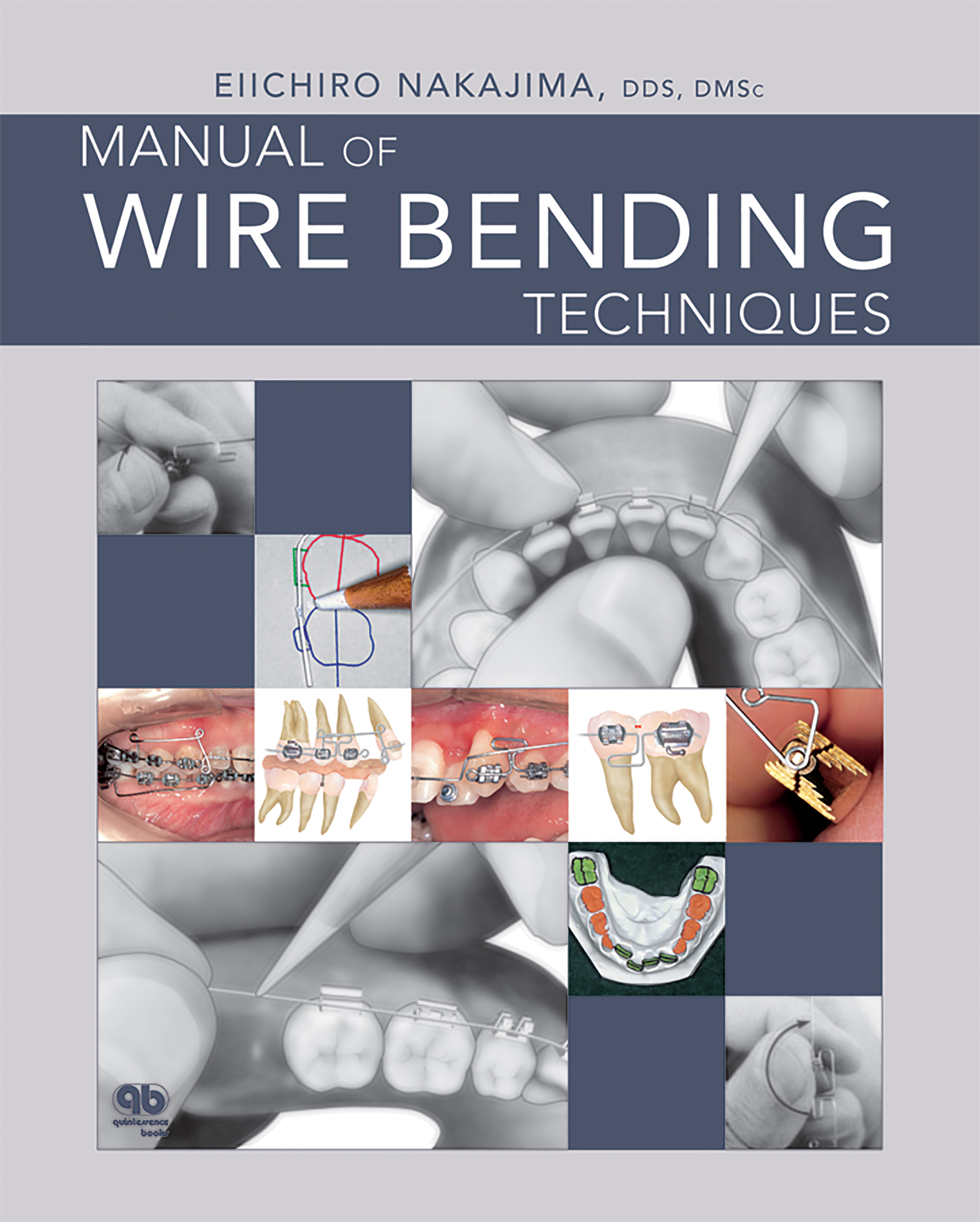
Effective wire bending techniques that are customized to each individual patient make orthodontic treatment more efficient and can reduce treatment time. the author of this manual promotes precise, intuitive bending and presents the essential componoents and techniques of customized wire bending step-by-step, including trimming of casts; selection and proper manipulation of pliers; the first-order bends (in or out), second-order bends (up or down), and third-order bends (torque); and optimal methods of adjustment to be used during orthodontic treatment. Technical images and case presentations illustrate each step of the process to ensure maximum comprehension. A must-have guide for orthodontic residents and practitioners alike.
Sie lesen das E-Book in den Legimi-Apps auf:
Seitenzahl: 41
Veröffentlichungsjahr: 2019
Das E-Book (TTS) können Sie hören im Abo „Legimi Premium” in Legimi-Apps auf:
Ähnliche



















Eiichiro Nakajima, DDS, DMSCPrivate PracticeTokyo, Japan
Library of Congress Cataloging-in-Publication Data
Nakajima, Eiichiro. Manual of wire bending techniques / Eiichiro Nakajima. p. ; cm. ISBN 978-0-86715-495-5eISBN 978-0-86715-927-1 1. Orthodontic appliances--Design and construction. 2. Wire. 3. Bending.I. Title. [DNLM: 1. Orthodontics, Corrective--methods--Atlases. 2. OrthodonticAppliances--Atlases. 3. Orthodontic Wires--Atlases. WU 417 N163m 2010] RK527.N35 2010 617.6'43--dc22 2010010905
©2010 Quintessence Publishing Co, Inc
Quintessence Publishing Co Inc4350 Chandler DriveHanover Park, IL 60133www.quintpub.com
All rights reserved. This book or any part thereof may not be reproduced, stored in a retrieval system, or transmitted in any form or by any means, electronic, mechanical, photocopying, or otherwise, without prior written permission of the publisher.
Editor: Bryn Goates GrishamDesign: Gina RuffoloProduction: Angelina Sanchez
Printed in China
Table of Contents
Preface
1Mastering the Fourth-Order Bend
2Trimming Casts
3Basic Wire Bending
Selection of Pliers
How to Hold Pliers
Wire Bending Procedures
Vertical open loop
Vertical helical closing loop
Horizontal “L” open boot loop
Horizontal “T” open boot loop
Vertical approximated helical closing loop
Helical loop
Straight section (mandibular left)
Retraction section (maxillary left)
Retraction section (mandibular left)
Stabilizing helical section (maxillary left)
Mandibular utility arch
Maxillary closing utility arch
Mandibular ideal arch: Second premolar to second premolar (.016 × .022 wire)
Mandibular ideal arch: First molar to first molar (.016 × .022 wire)
Ideal arch coordination
4Corrective Techniques: Clinical Cases
Rotation of the Mandibular Anterior Teeth
Rotation of the Mandibular Right Second Premolar
Rotation of the Maxillary Central Incisors
Correction of Ectopic Eruption of the Maxillary Canines
Treatment of Lateral Open Bite
Treatment of First Molar Crossbite
Correction of a Step Between the Mandibular Second Premolar and First Molar
Correction of Class II, Division 2 Deep Bite in Adults
Correction of Class II, Division 2 Deep Bite During the Growth Period
Mandibular Dental Arch Expansion for Class II, Division 1 Occlusion
Finishing a Case in Class II, Division 1 Occlusion
Preface
Many people believe that we are in the age of straight archwires and that wire bending is no longer necessary. However, the straight wire technique, in which a thin elastic straight wire is inserted and replaced by increasingly thicker wires, does not allow adjustments according to the unique skeletal morphology, dysfunction, tooth size, and dentition of each patient as well as the patient’s age, sex, and wishes. If such adjustments are not necessary, treatment results should be the same in all cases, but this is not reality. Nevertheless, it is true that recent advances in wire properties have changed clinical techniques, and the development of wire with high resilience has reduced (but not eliminated) the necessity of bending.
Another consideration is bracket design. The force of wire is transmitted to the periodontal tissue and alveolar bone via the brackets attached to the teeth, and the morphology and size of brackets differ according to the developer of each technique and among manufacturers. Though each bracket has torque, angulation, in/out, and morphology based on its original design, it is strange that only one type is used for most techniques, without alteration for the unique needs of each patient. There are only some brackets in which angulation and torque differ depending on whether or not tooth extraction is included in the treatment plan. Setting the skeletal morphology and function of each patient aside, there should be at least some accommodation for different shapes and sizes of the crown and root. In manufacturing, original criteria used in the research and statistical calculation performed by the developers of each technique are used as the basis for the design of brackets. For example, some years ago, brackets marketed as being specially designed for Asian and Hispanic patients became commercially available but were developed based only on samples of Japanese, Korean, Chinese, and Mexican populations. One could reasonably question why these specific nationalities were selected and on what basis these ethnicities were combined.
If a retail store offered shoes or clothing in only one size, no one would shop there. This absurd situation is analogous to the current state of the orthodontic market. Bringing straight wires to market merely to increase sales represents a misplacement of priorities. There are many brackets and straight wire techniques based only on the morphologic statistics of specific population groups without consideration for biology or individual differences.
The author considers any bracket or wire acceptable if it is easy to use, prefers techniques that are as effective and efficient as possible, and uses only biologically compatible wires and brackets. Overly complicated wire bending is not necessary. This book was written with this perspective in mind and for the purpose of serving as a guide for good clinical practice.




