


9,99 €
Mehr erfahren.
- Herausgeber: 50Minutes.com
- Kategorie: Sachliteratur, Reportagen, Biografien
- Serie: History
- Sprache: Englisch
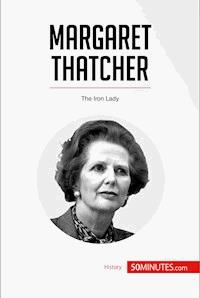
Keen to learn but short on time? Get to grips with the life of Margaret Thatcher in next to no time with this concise guide.
50Minutes.com provides a clear and engaging analysis of Margaret Thatcher. In the 1970s, the United Kingdom was struggling economically in comparison with its stronger European counterparts. Thatcher, the country’s first female Prime Minister, recognised the need for drastic economic reform, despite its potential to cause social upheaval. Known for her inflexible and unemotional stance in the face of strikes, the deaths of IRA prisoners, a violent war in the Falklands and even a narrow escape from a bomb in her bedroom, Thatcher remains a divisive figure in politics.
In just 50 minutes you will:
• Learn about the background of the United Kingdom’s famous first female Prime Minister, the Iron Lady
• Gain a deeper understanding of Thatcherism, the collective name for Thatcher’s economic and social reform policies
• Discover the measures taken by Thatcher during her time in power in both domestic and foreign policy
ABOUT 50MINUTES.COM | History & Culture
50MINUTES.COM will enable you to quickly understand the main events, people, conflicts and discoveries from world history that have shaped the world we live in today. Our publications present the key information on a wide variety of topics in a quick and accessible way that is guaranteed to save you time on your journey of discovery.
Das E-Book können Sie in Legimi-Apps oder einer beliebigen App lesen, die das folgende Format unterstützen:
Seitenzahl: 30
Veröffentlichungsjahr: 2017
Ähnliche







Margaret Thatcher
Key information
Born: 13 October 1925 in Grantham (Lincolnshire).Died: 8 April 2013 in London.Political party: the Conservative Party.Main achievements: Thatcherism (name given to the economic and political measures taken by Margaret Thatcher) and the United Kingdom’s economic recovery.Introduction
Idolised by some, condemned by others, Margaret Thatcher was a key political figure of the 20th century. Known for her shock declarations, her bushy hair and her pearl earrings, she was described by François Mitterand (French statesman, 1916-1996) as having “the mouth of Marilyn Monroe and the eyes of Caligula”.
British Prime Minister from 1979 to 1990, she was the first woman to hold the position and to keep it for such a long time. Nicknamed the Iron Lady following her 1976 speech against the Soviet Union, Margaret Thatcher demonstrated a fierce inflexibility and unusual stubbornness throughout her career. At the same time, she implemented strict economic policies, which are more commonly known as Thatcherism. They included the privatisation of state-owned companies, limiting the power of trade unions and lower taxation for higher incomes. These measures were certainly favourable to economic growth, but on a social level were catastrophic. Two events in particularly stand out for this controversial figure: the hunger strike by Irish Republicans (March 1981), aborted after 172 days because of Thatcher’s unfazed silence, and the Falklands War (April-June 1982), which ensured her a political victory but is also sadly remembered for its heavy death toll. But who really was Margaret Thatcher?
Biography
Portrait of Margaret Thatcher, dated 1983.
A strict upbringing
Margaret Hilda Roberts was born on 13 October 1925 in her father’s small grocery in Grantham. Throughout her life, she would admire this man for his personal success, which he owed only to himself. Thanks to his teaching, she learned perseverance, a refusal to quit and integrity. She had, however, a very different relationship with her mother, Beatrice. Alongside her older sister, she had a childhood structured around Methodism, piano lessons, private schools and Sunday church services.
Methodism
Methodism is a religious movement that began in England in the 18th century with the preacher and theologian John Wesley (1703-1791). Devotion to Christianity, doing good deeds and preaching the good news are its key principles.
The beginnings of a vocation
It was thanks to her father that Thatcher became interested in politics. He in fact became a local councillor in 1936, and his main aim was defending small businesses. As his campaign resonated with the general public, he was elected mayor of Grantham in 1945. In the meantime, the young girl focused on her studies and gained a scholarship to Somerville College, Oxford, where she earned a degree in chemistry. Curious and eager to learn, she was particularly struck by Friedrich Hayek’s book The Road to Serfdom, which was based on economic neoliberalism, something she would get many of her ideas from.
From her political beginnings to the creation of an icon
Thatcher entered Parliament in 1959, the year the Conservatives returned to power. These favourable circumstances led her to gain the position of Education Secretary in 1970. Her moment of glory arrived when she replaced Edward Heath (1916-2005) as leader of the Conservative Party in 1975. She progressed and caused a stir within her own party when she questioned some of its main principles: indulging trade unions, Europhilia (a favourable view of the European Union) and egalitarianism.
Photo of Margaret Thatcher in September 1975.




