


17,99 €
Mehr erfahren.
- Herausgeber: John Wiley & Sons
- Kategorie: Fachliteratur
- Sprache: Englisch
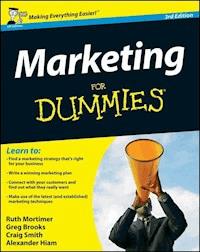
Smart marketing techniques to get your business noticed.
Plan a successful marketing campaign and move your business forward with this fully updated edition of an established bestseller. Packed with practical advice from a team of industry experts, this readable guide features all the latest tools and techniques to help you connect with new customers and retain existing ones. From choosing the right strategy and preparing a marketing plan, to igniting your imagination and producing compelling advertising, you'll be creating a buzz and increasing profits in no time.
Sie lesen das E-Book in den Legimi-Apps auf:
Seitenzahl: 723
Veröffentlichungsjahr: 2012
Ähnliche



















Marketing For Dummies®, 3rd Edition
Visit www.dummies.com/cheatsheet/marketinguk to view this book's cheat sheet.
Table of Contents
Marketing For Dummies®, 3rd Edition
by Ruth Mortimer, Greg Brooks, Craig Smith and Alexander Hiam
Marketing For Dummies®, 3rd Edition
Published byJohn Wiley & Sons, LtdThe AtriumSouthern Gate Chichester West Sussex PO19 8SQ England www.wiley.com
Copyright © 2012 John Wiley & Sons, Ltd, Chichester, West Sussex, England
Published by John Wiley & Sons, Ltd, Chichester, West Sussex
All Rights Reserved. No part of this publication may be reproduced, stored in a retrieval system or transmitted in any form or by any means, electronic, mechanical, photocopying, recording, scanning or otherwise, except under the terms of the Copyright, Designs and Patents Act 1988 or under the terms of a licence issued by the Copyright Licensing Agency Ltd, Saffron House, 6-10 Kirby Street, London EC1N 8TS, UK, without the permission in writing of the Publisher. Requests to the Publisher for permission should be addressed to the Permissions Department, John Wiley & Sons, Ltd, The Atrium, Southern Gate, Chichester, West Sussex, PO19 8SQ, England, or emailed to [email protected], or faxed to (44) 1243 770620.
Trademarks: Wiley, the Wiley logo, For Dummies, the Dummies Man logo, A Reference for the Rest of Us!, The Dummies Way, Dummies Daily, The Fun and Easy Way, Dummies.com, Making Everything Easier, and related trade dress are trademarks or registered trademarks of John Wiley & Sons, Inc., and/or its affiliates in the United States and other countries, and may not be used without written permission. All other trademarks are the property of their respective owners. John Wiley & Sons, Inc., is not associated with any product or vendor mentioned in this book.
Limit of Liability/Disclaimer of Warranty: The publisher and the author make no representations or warranties with respect to the accuracy or completeness of the contents of this work and specifically disclaim all warranties, including without limitation warranties of fitness for a particular purpose. No warranty may be created or extended by sales or promotional materials. The advice and strategies contained herein may not be suitable for every situation. This work is sold with the understanding that the publisher is not engaged in rendering legal, accounting, or other professional services. If professional assistance is required, the services of a competent professional person should be sought. Neither the publisher nor the author shall be liable for damages arising herefrom. The fact that an organization or Website is referred to in this work as a citation and/or a potential source of further information does not mean that the author or the publisher endorses the information the organization or Website may provide or recommendations it may make. Further, readers should be aware that Internet Websites listed in this work may have changed or disappeared between when this work was written and when it is read.
For general information on our other products and services, please contact our Customer Care Department within the U.S. at 877-762-2974, outside the U.S. at 317-572-3993, or fax 317-572-4002.
For technical support, please visit www.wiley.com/techsupport.
Wiley publishes in a variety of print and electronic formats and by print-on-demand. Some material included with standard print versions of this book may not be included in e-books or in print-on-demand. If this book refers to media such as a CD or DVD that is not included in the version you purchased, you may download this material at http://booksupport.wiley.com. For more information about Wiley products, visit www.wiley.com.
British Library Cataloguing in Publication Data: A catalogue record for this book is available from the British Library
ISBN 978-1-119-96516-9 (pbk); ISBN 978-1-119-96649-4 (ebk); ISBN 978-1-119-96651-7 (ebk); ISBN 978-1-119-96650-0 (ebk)
Printed and bound in Great Britain by TJ International, Padstow, UK.
10 9 8 7 6 5 4 3 2 1
About the Authors
Ruth Mortimer is editor of Marketing Week magazine, which is the leading business magazine in its sector. She also appears regularly in national press titles such as The Independent and the Daily Express, discussing issues relating to business, marketing and branding. She also appears on TV and radio as an expert commentator in this field for multiple programmes, including several on the BBC and Sky. She has contributed to a number of For Dummies titles on marketing.
Before joining Marketing Week, Ruth was editor of global business title Brand Strategy, as well as a freelance journalist. She wrote for Channel 4’s ‘4talent’ service, among others, letting young people know about new talents in music, design, arts and digital techniques. Before writing about marketing for a living, Ruth was an archaeologist, working mainly in the Middle East.
Greg Brooks is Global Marketing Director at Mindshare, the global media network which works with some of the biggest advertisers in the world, such as Unilever and Nike. Previously he was Content Strategy Director at C Squared, producer of the Festival of Media, a freelance journalist and a digital media consultant with over ten years experience covering the global digital industry. He has been a regular contributor on marketing issues to titles such as Marketing, New Media Age, Brand Strategy, Broadcast, Future Media, The Guardian and Channel 4’s 4Talent online portal. He is also co-author of Digital Marketing For Dummies. He has worked with Sky, McDonald’s, News International, BT, Red Bull, Camelot (UK Lottery operator), EnergyWatch, Visit Britain and Ofcom (UK communications regulator), advising on the future strategic use of digital media.
Craig Smith is the former editor of Marketing, the UK’s highest circulation weekly magazine, and PPA Weekly Business Magazine of the Year, serving the marketing and advertising industries. He has worked as a business journalist for many years and is a regular commentator on marketing issues to the national press and broadcast media.
Craig works closely with industry trade bodies the Association of Publishing Agencies and Business in the Community to promote best practice in the areas of customer magazines and cause related marketing.
Alex Hiam is a consultant, corporate trainer, and public speaker with 20 years of experience in marketing, sales, and corporate communications. He is the director of Insights, which includes a division called Insights for Marketing that offers a wide range of services for supporting and training in sales, customer service, planning, and management. His firm is also active in developing the next generation of leaders in the workplace through its Insights for Training & Development. Alex has an MBA in marketing and strategic planning from the Haas School at U.C. Berkeley and an undergraduate degree from Harvard. He has worked as marketing manager for both smaller high-tech firms and a Fortune 100 company, and did a stint as a professor of marketing at the business school at U. Mass. Amherst.
Alex is the co-author of the best-seller, The Portable MBA in Marketing (Wiley) as well as The Vest-Pocket CEO and numerous other books and training programmes. He has consulted to a wide range of companies and not- for-profit and government agencies, from General Motors and Volvo to HeathEast and the U.S. Army (a fuller list of clients is posted at www.insightsformarketing.com).
Alex is also the author of a companion volume to this book, the Marketing Kit For Dummies (Wiley), which includes more detailed coverage of many of the hands-on topics involved in creating great advertising, direct mail letters, Web sites, publicity campaigns, and marketing plans. On the CD that comes with the Marketing Kit For Dummies, you’ll find forms, checklists, and templates that may be of use to you. Also, Alex maintains an extensive website of resources that he organised to support each of the chapters in the book.
Dedications
For my family and my friends who have seen much less of me because of this project and to Ruth, who has had to see much more of me as a result.
– Greg Brooks
To all my friends, family and workmates who have put up with me spreading myself too thin over the last year, thank you all. Also to Greg, who is never slow to spot a good idea.
– Ruth Mortimer
For my partner Amanda and children, Leon and Bibi, who graciously forgave me my absence while working on this project.
– Craig Smith
Authors’ Acknowledgements
From Greg and Ruth:
To the Wiley team, never slow to help us along the way if we needed a prod, or a helping hand. As always you have been a perfect foil and vital reality check, to ensure this book is as useful as possible.
Thanks to everyone for their input on this project, be you a creative, online or media agency, a brand, social network, research company or one of our valuable contacts. This book wouldn’t exist without your help.
Publisher’s Acknowledgements
We’re proud of this book; please send us your comments at http://dummies.custhelp.com. For other comments, please contact our Customer Care Department within the U.S. at 877-762-2974, outside the U.S. at 317-572-3993, or fax 317-572-4002.
Some of the people who helped bring this book to market include the following:
Acquisitions, Editorial, and Vertical Websites
Project Editor: Simon Bell
(Previous Edition: Tracy Barr)
Commissioning Editor: Claire Ruston
(Previous Edition: Samantha Spickernell)
Assistant Editor: Ben Kemble
Development Editor: Kate O’Leary
Technical Editor: John Bills
Proofreader: Helen Heyes
Production Manager: Dan Mersey
Publisher: David Palmer
Cover Photos: © iStockphoto.com/Lise Gagne
Cartoons: Ed McLachlan
Composition Services
Senior Project Coordinator: Kristie Rees
Layout and Graphics: Jennifer Creasey, Corrie Niehaus
Proofreader: Bryan Coyle
Indexer: Slivoskey Indexing Services
Publishing and Editorial for Consumer Dummies
Kathleen Nebenhaus, Vice President and Executive Publisher
Kristin Ferguson-Wagstaffe, Product Development Director
Ensley Eikenburg, Associate Publisher, Travel
Kelly Regan, Editorial Director, Travel
Publishing for Technology Dummies
Andy Cummings, Vice President and Publisher
Composition Services
Debbie Stailey, Director of Composition Services
Introduction
Marketing is the most important thing that you can do in business today, even if your job title doesn’t have the word marketing in it. Marketing, in all its varied forms, focuses on attracting customers, getting them to buy and making sure that they’re happy enough with their purchase that they come back for more. What could be more important? Ever try to run a business without customers?
About This Book
We wrote this book to help you do that critical job of marketing as well as you possibly can. We wrote with a variety of marketers in mind, including small business owners and entrepreneurs who wear the marketing and sales hat along with several other hats. We also wrote for managers and staff of larger organisations who work on marketing plans, product launches, ad campaigns, printed materials, websites and other elements of their organisation’s outreach to customers and prospects.
We kept in mind that some of our readers market consumer products, others sell to businesses, some market physical products and others offer services. The different types of organisations have many important distinctions, but good marketing techniques can work wonders anywhere.
Marketing can be a great deal of fun – it is, after all, the most creative area of most businesses. In the long run, however, marketing is all about the bottom line; if it doesn’t have the potential to translate into profits somewhere down the line, you shouldn’t be doing it. So, although we had fun writing this book, and we think you can enjoy using it, we take the subject matter very seriously. Any task that brings you to this book is vitally important, and we want to make sure that the advice you get here helps you perform especially well.
Conventions Used in This Book
We refer to any organised, coordinated use of product development, price, promotion, distribution and sales as your marketing plan. An important distinction exists between a marketing plan and your marketing campaign – some people start off down the campaign route thinking that marketing is all about advertising and promotion. It isn’t. We want you to have a marketing plan. Creating a plan means avoiding random or disconnected activities. It also means thinking about how everything the customer sees, whether that be your prices, premises or staff, interlinks and contributes to achieving your marketing goals. Whether you work in a large organisation or own a small business, you need a coherent, well-thought-out marketing plan!
We refer to whoever buys what you sell as the customer. This customer can be a person, a household, a business, a government department, a school or even a voter. We still call them your customers, and the rules of sound marketing still apply to them.
What you sell or offer to customers we refer to as your product, whether it’s a good, service, idea or even a person (such as a political candidate or a celebrity). Your product can be animate or inanimate, tangible or intangible. But if you offer it, it’s a product in marketing jargon, and using just one term for whatever the reader wants to sell saves us all a lot of time and wasted printer’s ink.
We also treat person-to-person sales as one of the many possible activities under the marketing umbrella. You need to integrate selling, which is its own highly sophisticated and involved field, into the broader range of activities designed to help bring about sales and satisfy customers. We address ways of managing sales better as part of our overall efforts to make all your marketing activities more effective.
Foolish Assumptions
In writing this book, we made a few assumptions about you:
You’re clever, caring and persistent, but you don’t have all the technical knowledge that you may need to do great marketing. Not yet, anyway.
You’re willing to try new ideas in order to improve sales results and grow your organisation. Marketing is challenging, after all, and requires an open mind and a willingness to experiment and try new ideas and techniques.
You’re willing and able to switch from being imaginative and creative one moment to being analytical and rigorous the next. Marketing has to take both approaches. Sometimes, we ask you to run the numbers and do sales projections. Other times, we ask you to dream up a clever way to catch a reader’s eye and communicate a benefit to them. These demands pull you in opposite directions. If you can assemble a team of varied people, some of them numbers orientated and some of them artistic, you can cover all the marketing bases more easily. But if you have a small business, you may be all you have, and you need to wear each hat in turn. At least you’ll never get bored as you tackle the varied challenges of marketing!
You have an active interest in generating new sales and maximising the satisfaction of existing customers. This sales orientation needs to underlie everything you do in marketing. Keep in mind that the broader purpose on every page of this book is to try to help you make more and better sales happen!
How This Book Is Organised
This book is organised into parts that we describe in the following sections. Check out the Table of Contents for more information on the topics of the chapters within each part.
Part I: Where You Are, Where You’re Going
Military strategists know that great battles must be won first in the general’s tent, with carefully considered plans and accurate maps, before the general commits any troops to action on the field of battle. In marketing, you don’t have any lives at stake, but you may hold the future success of your organisation in your hands! We advocate just as careful an approach to analysis and planning as if you were a general preparing on the eve of battle.
In this part, we show you how to make the most of your marketing by focusing on your customers and what your organisation delivers to them and give you strong, aggressive marketing strategies that can maximise your chances of sales and success. You’ll also get the help you need to put a plan of action together that you can be reasonably confident will actually work.
Part II: Creating Thinking, Powerful Marketing
Great marketing requires a wide range of special skills. If you don’t already have all of them, this part shores up any gaps and helps you take advantage of specialised tools and techniques.
We cover an essential marketing skill: how to find out what you need to know in order to develop better strategies and design better ads and other elements of your marketing activity. Where can you find the best customers? What do they respond to? What is the competition up to? Imagining, communicating and researching make up the power skills of great marketers, and we want to make their insights available to you!
We share with you that most precious and hard-to-capture of marketing skills: the marketing imagination. When marketers can bottle up a little of this magic and work it into their marketing plans, good things begin to happen. We also address another fundamental marketing skill: communicating with customers. Good ideas plus clear, interesting communications add up to better marketing.
Part III: Advertising Everyone Can Do
Advertising is the traditional cornerstone of marketing. Back in the early days of marketing, firms combined advertisements with sales calls and great things happened to their revenues. In this part, we show you how to create compelling, effective ads, brochures and fliers on paper – the traditional medium of marketing. You can run full-page, colour ads in national magazines if you have a big budget, or you can place small, cheap black-and-whites in a local newspaper – and either one may prove effective with the right creativity and design. Everyone can access radio and TV these days, too, regardless of budget, if you know how to use these media economically and well. However, you may also want to use perhaps the simplest – and most powerful – form of advertising: the simple sign – from signs on buildings, vehicles and doors to posters at airports and advertising hoardings next to main roads. You can put advertising to good use in your business in so many different ways.
Part IV: Powerful Alternatives to Advertising
Digital marketing – search, display, social media and mobile – is becoming more important in a global economy, so we cover the basics in this section. We offer advice on getting your company website to appear when people search online for your product or similar ones, ensure that you always reach the right customers with powerful emails and even give you some tips on social marketing using social networks. Many marketers also value the power of publicity and we discuss how to help the media cover your stories to get more exposure at far less cost than if you’d advertised. Special events also provide you with a powerful alternative or supplement to ad campaigns and can bring you high-quality sales leads.
Part V: Connecting With Your Customers
The classic marketing plan has seven components (the 7 Ps – see Chapter 1), but much of what marketers do (and what is covered throughout Parts II to IV) falls into the fourth P: promotion. In this part, we go deeper into the other Ps: product design and branding, pricing and discounting to create incentives for purchase; the aggressive use of distribution strategies to place your product in front of consumers when and where they’re most likely to buy; and selling and servicing customers. We draw your attention to the all-important product and make sure yours is naturally brilliant enough to shine out and beckon customers to you. We also encourage you to examine your distribution, sales and service because these can make or break a marketing plan (and a business), too.
Part VI: The Part of Tens
The Part of Tens is a traditional element of For Dummies books, and it communicates brief but essential tips that didn’t fit easily into the other parts. We recommend that you look at this part whenever you need insights or ideas because it encapsulates much of the essential philosophy and strategies of good marketing practice. And reading this part also helps you avoid some of the dead ends and traps that await the unwary marketer.
Icons Used in This Book
Look for these symbols to help you find valuable stuff throughout the text:
This icon flags specific advice that you can try out in your marketing plan straight away. The icon uses a pound sign for the filament of the light bulb because the acid test of any great idea in business rests in whether it can make you some money.
Sometimes, you need the right perspective on a problem to reach success, so this icon also flags brief discussions of how to think about the task at hand. Often, a basic principle of marketing pops up at this icon to help you handle important decisions.
All marketing is real-world marketing, but this icon means that you can find an actual example of something that worked (or didn’t work) in the real world for another marketer.
In marketing, lone rangers don’t last long. Successful marketers use a great many supporting services and often bring in graphic artists, ad agencies, digital agencies, research firms, package designers, retail display designers, publicists and many other specialists. You can’t do it all. Sometimes, the best advice we can give you is to pick up the phone and make a call. And this icon marks a spot where we give you leads and contacts.
You can easily run into trouble in marketing because so many mines are just waiting for you to step on them. That’s why we’ve marked them all with this symbol.
When we want to remind you of essential or critical information you need to know in order to succeed, we mark it with this icon. Don’t forget!
Where to Go from Here
If you read only one chapter in one business book this year, please make it Chapter 1 of this book. We’ve made this chapter stand alone as a powerful way to make the most of your marketing by upgrading or enhancing the things that you do to make profitable sales. We’ve packed the rest of the book with good tips and techniques, and it all deserves attention. But whatever else you do or don’t get around to, read the first chapter with a pen and action- list at hand!
Or maybe you have a pressing need in one of the more specific areas covered by the book. If fixing your website is the top item on your to-do list, go to Chapter 10 first. If you need to increase the effectiveness of your sales force, try Chapter 20 instead. Or are you working on a letter to customers? Then Chapters 6 and 14 on marketing communications and direct mail can really help out your project. Whatever you’re doing, we have a feeling that this book has a chapter or two to help you out. So don’t let us slow you down. Get going! It’s never too early (or too late) to do a little marketing.
Part I
Where You Are, Where You’re Going
In this part . . .
Management’s job is to see the company not as it is, but as it can be. Helping you recognise that vision is the purpose of this part. Whatever your current business or service is and does, this part helps you to imagine and plan what it may be best become in the next quarter and year. How do you do that?
You need, first, to understand your marketing programme – the integrated ways in which you reach out to motivate customers and win their loyal support. Next, we highly recommend that you come to grips with the big strategy questions in a marketer’s life – who are we and what makes us so special that our sales and profits deserve to grow? Finally, we also recommend that you write down your big picture insights to help organise and simplify later decisions about the details of marketing. A plan, even a simple one-page plan, can help you a lot as you make marketing decisions throughout the coming year.
Chapter 1
Making the Most of Your Marketing
In This Chapter
Focusing your marketing by understanding your customers
Clarifying what your marketing is trying to achieve
Leveraging your marketing with focus and control
Lesen Sie weiter in der vollständigen Ausgabe!
Lesen Sie weiter in der vollständigen Ausgabe!
Lesen Sie weiter in der vollständigen Ausgabe!
Lesen Sie weiter in der vollständigen Ausgabe!
Lesen Sie weiter in der vollständigen Ausgabe!
Lesen Sie weiter in der vollständigen Ausgabe!
Lesen Sie weiter in der vollständigen Ausgabe!
Lesen Sie weiter in der vollständigen Ausgabe!
Lesen Sie weiter in der vollständigen Ausgabe!
Lesen Sie weiter in der vollständigen Ausgabe!
Lesen Sie weiter in der vollständigen Ausgabe!
Lesen Sie weiter in der vollständigen Ausgabe!
Lesen Sie weiter in der vollständigen Ausgabe!
Lesen Sie weiter in der vollständigen Ausgabe!
Lesen Sie weiter in der vollständigen Ausgabe!
Lesen Sie weiter in der vollständigen Ausgabe!
Lesen Sie weiter in der vollständigen Ausgabe!
Lesen Sie weiter in der vollständigen Ausgabe!
Lesen Sie weiter in der vollständigen Ausgabe!
Lesen Sie weiter in der vollständigen Ausgabe!
Lesen Sie weiter in der vollständigen Ausgabe!
Lesen Sie weiter in der vollständigen Ausgabe!
Lesen Sie weiter in der vollständigen Ausgabe!
Lesen Sie weiter in der vollständigen Ausgabe!
Lesen Sie weiter in der vollständigen Ausgabe!
Lesen Sie weiter in der vollständigen Ausgabe!
Lesen Sie weiter in der vollständigen Ausgabe!
Lesen Sie weiter in der vollständigen Ausgabe!




