


40,99 €
Mehr erfahren.
- Herausgeber: John Wiley & Sons
- Kategorie: Fachliteratur
- Sprache: Englisch
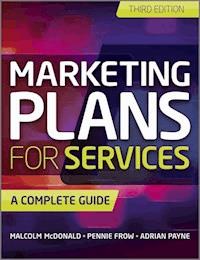
Marketing Plans for Services, Third Edition is written in a pragmatic, action-orientated style and each chapter has examples of marketing planning in practice. The authors highlight key misunderstandings about marketing and the nature of services and relationship marketing.
The marketer is taken step-by-step through the key phases of the marketing planning process and alerted to the barriers that can prevent a service organization being successful in introducing marketing planning. Practical frameworks and techniques are suggested for undertaking the marketing planning process and implementing the principles covered.
The world renowned authors also tackle key organizational aspects relating to marketing planning which can have a profound impact on its ultimate effectiveness. These include: marketing intelligence systems; market research; organization development stages; marketing orientation.
Marketing Plans for Services is for marketers in the service sector and students of marketing.
“Marketing Plans for Services is clearly the premier text in the field. From an explanation of ‘why’ services are driving all marketing activities to ‘measuring the results’, and all things in between, this new and updated text explains why and how ‘services’ are the key elements for most all 21st century organizations. Follow the masters of service marketing to marketplace success.” Professor Don Schultz, Northwestern University
“McDonald, Frow and Payne have worked extensively with a wide range of service businesses across the globe in successfully realising their growth opportunities. This experience shows in this practical text which contains all one needs to know in developing and implementing successful marketing plans for service organizations. This book represents a tested roadmap for planning services marketing success and combines an excellent balance of key concepts, frameworks and tools with practical advice. Their proven step-by-step marketing planning system for services and the examples of marketing plans make this a ‘must have’ book that should be on the desk of any forward-thinking services marketer.” Mark Veyret, Global Business Development Leader, PricewaterhouseCoopers
“Marketing planning is crucial today where increased competition, complexity and the internet forces you to redefine your marketing strategy and focus more clearly on what is required to achieve improved results. If not, you will not succeed in meeting these challenges. McDonald, Frow and Payne are internationally recognized authorities in marketing planning and services marketing. Based on their extensive experience across in helping organizations from a wide range of service sectors, this book gives you the practical ‘how to’ skills to successfully implement strategic marketing plans.” Bob Barker, Vice President of Corporate Marketing and Digital Engagement, Alterian
Sie lesen das E-Book in den Legimi-Apps auf:
Seitenzahl: 671
Veröffentlichungsjahr: 2011
Ähnliche



















Contents
Preface
The structure of this book and how to use it
List of Figures
Chapter 1: Marketing and services
The growing importance of the service sector
Service businesses and marketing effectiveness
The purpose of this book
The marketing concept
Misunderstandings about marketing
A definition of marketing
An overview of the new marketing process
Define markets and understand value
Determine Value Proposition
Deliver value proposition
Monitor value
Chapter 2: The nature of services marketing
Classification of services
The strategic value of services in manufacturing
The marketing mix
A brief history of marketing in the service industry
Customer retention and profitability
Integrated relationship marketing and CRM
Chapter 3: Marketing planning for services: the process
What is marketing planning?
Other approaches to marketing planning
The marketing planning process
Chapter 4: Marketing planning for services: the problems
Marketing planning and services
What gets in the way of marketing planning?
Chapter 5: Marketing planning Phase One: the strategic context
Step 1 Mission
Step 2 Corporate objectives
Chapter 6: Marketing planning Phase Two: the situation review (Part 1)
Step 3 The marketing audit
Sub-audit 1 Customers and markets
Case examples of market segmentation in the services sector
Chapter 7: Marketing planning Phase Two: the situation review (Part 2)
Sub-audit 2 Competitive position
Sub-audit 3 The environmental audit
Sub-audit 4 Auditing the services and products
Sub-audit 5 The organizational audit
The marketing audit – conclusions
Step 4 SWOT analyses
Step 5 Key assumptions
Chapter 8: Marketing planning Phase Three: marketing strategy formulation
Step 6 Marketing objectives and strategies
Step 7 Estimate expected results
Step 8 Identifying alternative mixes
A Step-by-step guide to completing a DPM for a service company
Chapter 9: Marketing planning Phase Four: resource allocation, monitoring and detailed planning (Part 1: the budget, the service product plan and the communications plan)
Step 9 The marketing budget
Step 10 First-year implementation programme
Mix element 1: The service product plan
Mix element 2: The promotion and communications plan
Chapter 10: Marketing planning Phase Four: resource allocation, monitoring and detailed planning (Part 2: price, place, people, processes and customer service)
Mix element 3: The pricing plan
Mix element 4: The place plan – getting the service to the customers
Mix element 5: The people element of the marketing mix
Mix element 6: The processes element of the marketing mix
Mix element 7: The customer service element of the marketing mix
The need for an overall marketing mix strategy
Monitoring, control and review
Chapter 11: Organizing for marketing planning
Introduction
Marketing intelligence systems
Marketing research
Marketing planning and company structure
Plan for marketing planning
The marketing planning cycle
Learning and planning for change
Chapter 12: Measuring the effectiveness of marketing plans for service businesses
A three-level marketing accountability framework
What counts as marketing expenditure?
What does ‘value added’ really mean?
Three distinct levels for measuring marketing effectiveness
Conclusion
Chapter 13: A step-by-step marketing planning system for service businesses
Introduction
Part 1 Marketing planning summary
Part 2 A Marketing Planning System
Section A Step-by-step approach to the preparation of a strategic marketing plan for a services strategic business unit (SBU)
Section B The one-year marketing plan
Section C Headquarters’ consolidation of several SBU strategic marketing plans
Examples of marketing plans
Glossary of marketing planning terms
References
Index
This edition first published in 2011
Copyright © 2011 Malcolm McDonald, Pennie Frow and Adrian Payne
Registered office
John Wiley & Sons Ltd, The Atrium, Southern Gate, Chichester, West Sussex, PO19 8SQ, United Kingdom
For details of our global editorial offices, for customer services and for information about how to apply for permission to reuse the copyright material in this book please see our website at www.wiley.com
The right of the author to be identified as the author of this work has been asserted in accordance with the Copyright, Designs and Patents Act 1988.
All rights reserved. No part of this publication may be reproduced, stored in a retrieval system, or transmitted, in any form or by any means, electronic, mechanical, photocopying, recording or otherwise, except as permitted by the UK Copyright, Designs and Patents Act 1988, without the prior permission of the publisher.
Wiley also publishes its books in a variety of electronic formats. Some content that appears in print may not be available in electronic books.
Designations used by companies to distinguish their products are often claimed as trademarks. All brand names and product names used in this book are trade names, service marks, trademarks or registered trademarks of their respective owners. The publisher is not associated with any product or vendor mentioned in this book. This publication is designed to provide accurate and authoritative information in regard to the subject matter covered. It is sold on the understanding that the publisher is not engaged in rendering professional services. If professional advice or other expert assistance is required, the services of a competent professional should be sought.
Library of Congress Cataloging-in-Publication Data
McDonald, Malcolm.
Marketing plans for service businesses : a complete guide / Malcolm McDonald, Pennie Frow and Adrian Payne. — 3rd ed.
p. cm.
Includes bibliographical references and index.
ISBN 978-0-470-97909-9 (pbk. : alk. paper)
1. Service industries—Marketing. 2. Service industries—Planning. I. Payne, Adrian. II. Frow, Pennie. III. Title.
HD9980.5.M388 2011
658.8'02—dc23
2011017544
ISBN 978-0-470-97909-9 (paperback), ISBN 978-1-119-95186-5 (ebk),ISBN 978-0-470-97941-9 (ebk), ISBN 978-0-470-97944-0 (ebk)
A catalogue record for this book is available from the British Library.
Preface
This latest edition recognizes the growing importance of the service sector in most economies and of significant differences between product and service marketing.
The world of services marketing has changed dramatically during the past decade. The easy, high-growth markets have been replaced by mature, low-growth demand patterns that have forced suppliers to question their erstwhile successful business models, such as, for example, those that consisted largely of making ‘products’ and selling them to intermediaries, who magically got rid of them somehow to an unsophisticated general public who were in awe (or ignorance) of complicated products such as pensions.
Today, however, there is in most developed countries a situation of government regulation, oversupply, and more importantly a more sophisticated consumer who has been empowered by the Internet. This has forced service providers to pay greater attention to the needs of the consumers of their services. This means that they have been forced to pay greater attention to marketing.
The three authors work with many of the world’s leading service organizations in their role as professors of marketing at three of the world’s leading business schools. We have sought to combine the acknowledged leadership of Cranfield University in the domain of marketing planning (Malcolm McDonald) with the experience of two experts in the field of services marketing (Pennie Frow and Adrian Payne) to produce a unique text for those who are faced with the special challenge of producing world-class marketing plans for services where there are no tangible products.
The approaches outlined in this book have been used extensively by us in a large number of services organizations.
We believe you will find, in the pages of this book, the answer to the challenge of creating marketing plans that produce significantly improved bottom-line results.
Malcolm McDonald
Pennie Frow
Adrian Payne
September 2011
The structure of this book and how to use it
This book consists of 13 chapters, some examples of marketing plans and a glossary of terms used in marketing planning.
Chapter 1 provides a broad view of marketing as it relates to services. It describes the marketing concept and some misunderstandings about marketing.
Chapter 2 considers the nature of services and relationship marketing.
Chapter 3 provides an overview of the four key phases of the marketing planning process.
Chapter 4 looks at the barriers that can prevent a service organization being successful in introducing marketing planning.
Chapters 5 to 10 provide a detailed examination of each of the four phases in the marketing planning process and an explanation of the frameworks and techniques which are useful in undertaking these tasks.
Chapter 11 examines some of the key organizational aspects relating to marketing planning. These issues, although not directly part of the marketing planning process itself, have an important and profound impact on its ultimate effectiveness. Here we discuss the role of marketing intelligence systems; market research; to what extent the introduction of marketing planning is appropriate at the different stages of development of an organization; and finally, the issue of how a service organization can develop or improve its marketing orientation.
Chapter 12 examines the growing importance of measuring financially the effectiveness of marketing expenditure.
Chapter 13 provides structures for a three-year strategic marketing plan, a one-year detailed marketing plan and a headquarters consolidated plan of several strategic businesses unit (SBU) strategic marketing plans. These structures will help with implementing the processes and frameworks outlined earlier in this book. Also, in the ‘Examples of Marketing Plans’ are a number of illustrations of what strategic marketing plans actually look like in different types of service organizations.
Those readers who have read widely on the services sector and are familiar with the services marketing literature can start at Chapter 3.
We suggest that all readers should undertake a close examination of the process aspects in the text, covered in Chapters 5 to 10. We also recommend that Chapter 9 is read thoroughly as, although not directly about the marketing planning process, it addresses many of the issues which are critical to successful implementation of a marketing planning system.
However, it should be recognized that a little learning is a dangerous thing. While Chapter 13 and the examples of marketing plans provide a clear overview as to how a marketing plan is structured, we advise a thorough examination of the detailed discussion of each of the key steps. For those seriously interested in either initiating marketing planning or in improving the quality of their marketing planning, we strongly recommend them to study the whole book before attempting to use any of the systems and plans provided at the back of the book.
Finally, we have provided references for statements made in the text, but in order to make this book easier to read, we have included these at the end of the book rather than at the end of each chapter.
Best of luck – and happy and profitable marketing planning in your service organization.
List of Figures
1.1Size of the service sector as % of GNP for different countries1.2Projected growth of employment in services in USA to 20501.3Marketing effectiveness ratings for professional service firms1.4Marketing: a matching process1.5Overview of marketing map1.6Define markets and understand value1.7Determine value proposition1.8Deliver the service value proposition1.9Rethinking the sales process for service businesses1.10Monitor value1.11Summary of marketing map2.1Continuum of tangible–intangible possibilities2.2A continuum for each of the four service characteristics2.3Nature of service matrix2.4Style of relationship matrix2.5Customization and staff judgement matrix2.6Supply and demand matrix2.7Service delivery matrix2.8The marketing process2.9General development pattern of marketing approaches2.10Retaining customers pays off2.11Relationship marketing – a broadened view of markets2.12Relationship marketing network diagram for a major international airline2.13The ‘service product’ and the product surround3.1Strengths and weaknesses of alternative marketing planning models3.2Relationship between corporate objective and strategies3.3Ansoff matrix4.1Marketing planning requires top-down and bottom-up perspectives4.2Integration of corporate planning, strategic marketing planning and tactical marketing planning4.3What should appear in a services strategic marketing plan5.1Key audiences and their expectations in a bank5.2The generic mission statement5.3Bain & Company mission statement5.4Organizational statement of philosophy for IBM5.5IBM mission statement, values and business model5.6‘The BA Way’5.7DHL World Express – worldwide mission statement5.8Human resource mission statement5.9The ‘realizable’ mission5.10Mission statement and the hierarchy of objectives and strategies5.11Different types of organization focus5.12Corporate objectives and mission need to be tightly integrated6.1The constituent parts of the marketing audit6.2Original market map for marketing books market6.3Market map of the marketing knowledge promulgation market6.4Market mapping6.5Major approaches to services market segmentation6.6Levels of segmentation emphasis6.7Illustration of the shape of the car market6.8Illustration of the shape of the lawn mower market6.9The shape of the markets from birth to maturity6.10The product/market lifecycle and market characteristics6.11The three stages of market segmentation6.12Micro-segments6.13An undifferentiated market6.14Different needs in a market6.15Segments in a market6.16The market segmentation process – summary7.1Example of competitive advantage calculation7.2Strategic forces impacting on service organizations7.3The danger of ‘current focus’7.4Starbucks’ ‘T-Mobile Hot Spot Service’7.5Comparison of service features7.6Example of comparative analysis – a software company7.7Examples of levels of positioning for a bank7.8Example of a positioning map7.9Examples of positioning strategies7.10The lifecycle curve7.11Non-cumulative diffusion pattern of innovation curve7.12Product lifecycle at total market and an individual retailer’s level7.13Lifecycle illustrating the potential advantage of entering a market early7.14How successive services can add to sales growth7.15Marketing audit checklist for services (expanded)7.16Marketing audit checklist for an accounting firm7.17Five key buying factors for UK independent schools7.18Academic factors7.19Enhancement/attractiveness factors7.20SWOT7.21Strategic planning exercise (SWOT analysis)7.22Example of the traditional layout for a SWOT analysis7.23Summary of a partial SWOT analysis for a bank7.24Risk analysis matrix for opportunities and threats7.25Example of approach for analysing key assumptions8.1Ansoff matrix8.2Gap analysis8.3Profit improvement8.4The directional policy matrix8.5Setting expectations of performance8.6Directional policy matrix for a financial services company8.7Ranking market attractiveness and competitive position8.8A financial services company’s MAFs8.9A completed DPM8.10Directional policy matrices for three types of company8.11Cash-generating capabilities of three types of company8.12Multiple factors matrix – generic strategies8.13Other functional guidelines suggested by portfolio matrix analysis8.14The Porter matrix8.15Cost-effective service development8.16Marketing objectives and marketing strategies for a service business8.17Summary of typical marketing strategies for a service business8.18Response functions for different marketing mixes8.19The alternative mixes process for a large services company8.20Market/segment attractiveness 18.21Market/segment attractiveness 28.22Market/segment attractiveness 38.23Plotting the position of segments on the portfolio matrix 18.24Plotting the position of segments on the portfolio matrix 28.25Company competitiveness 18.26Company competitiveness 28.27Directional policy matrix (DPM)9.1The organizational output9.2Defining a promotion and distribution strategy9.3Map of the marketing domain9.4Delivering value – a map of marketing operations9.5Towards a viable CRM structure9.6The ‘Sunlovers’ customer segment9.7The ‘John and Mary Lively’ customer segment9.8Stages of communications9.9Buying influences and customer size9.10Sources of information9.11The 6 Is of e-marketing9.12Channel chain diagram9.13The purchase process as an interaction between supplier and buyer9.14Main tools available for online communications9.15Search engine optimization and paid search: a hotel example9.16Different roles of advertising9.17The need for advertising objectives9.18Key steps in determining advertising activity9.19Diffusion of innovation curve9.20Targets of sales promotions9.21Types of sales promotion9.22Key elements of a sales promotion plan9.23Main publics for a university9.24Personal contact functions in services9.25Typical salesperson activities9.26Formula for deriving the size of the sales force9.27Example of salesperson’s plan10.1Elastic and inelastic demand for services10.2Experience curve for electronic banking10.3Value-based pricing10.4Pricing range for a service company10.5Skimming and penetration pricing policies10.6Factors to consider in the pricing plan10.7Channel options for service companies10.8Choosing channels – the value curve10.9Channel chain analysis: the PC market10.10Employees and their influence on customers10.11The service–profit chain10.12Example of service positioning through changing complexity and divergence (a management training consultancy)10.13Potential sources of conflict between operations and marketing on operational issues10.14Illustration of key elements of customer service10.15The marketing mix ‘prism’11.1Myths and realities about databases11.2Problems of reconciling internal and external market audits11.3Examples of business objectives and segmentation methods11.4Information flows in a marketing system11.5Focus of reactive marketing research11.6Focus of non-reactive marketing research11.7The organizational life-line11.8Approaches to marketing planning for different stages of evolution11.9Centralized marketing, separate operating units11.10Decentralized marketing11.11The specificity versus duplication balance in marketing planning11.12A matrix organization for a training and consulting firm11.13Hierarchy of audits11.14Strategic and operational planning hierarchy11.15Strategic and operational planning hierarchy in detail11.16Broad guidelines to the degree of marketing plan formality11.17The marketing planning time cycle11.18The marketing planning cycle – overview11.19Strategic and operational planning cycle11.20Some possible types of organizational orientation11.21The learning/change process12.1Map of the marketing domain and the three-level accountability framework12.2Valuing key market segments12.3Suggested approach12.4Portfolio analysis – directional policy matrix (DPM)12.5Overall marketing metrics model12.6Ansoff matrix12.7Critical success factors: in each segment, defined by the segment12.8Marketing metrics model12.9Cascading actions from the Ansoff matrix12.10Overall marketing metrics model12.11ROI. Long-term case history13.1Principal marketing tools which can be utilized at different phases of the marketing planning process13.2Marketing planning timetableForm 1Unit mission statementForm 2Summary of SBU’s performanceForm 3Summary of financial projectionsForm 4Market overviewForm 5Strategic planning exercise (SWOT Analysis)Form 6Competitor analysisForm 7Portfolio summary of the SWOTsForm 8AssumptionsForm 9Marketing objectives and strategies for the next 3–5 yearsForm 10Database and summary of marketing objectives – profitsForm 11Consolidated budget for the next 3–5 yearsForm 12Summary of marketing objectives and strategies13.3Strategic and operational planning cycleChapter 1
Marketing and services
The growing importance of the service sector
Since the Second World War, North America and Western Europe have seen a steady and unrelenting decline in their traditional manufacturing industries. Their place has been taken by numerous service-based enterprises that were quick to spot the opportunities created by both organizational needs and by the increased personal affluence and the consequent raised lifestyle expectations of the population.
There has been very substantial growth in services over the last two decades. This growth has been widespread but is now especially pronounced in developing countries where services represent the engine of their economic growth.
So successful has been this transition from an essentially industrial society that today more than 70 per cent of most Western economies are now in the service sector, whether measured in terms of income or numbers employed.
Figure 1.1 shows estimates of the size of the service sector as a percentage of gross national product (GNP) for different countries These statistics, published by the US Central Intelligence Agency in 2011,1 show the dramatic transformation of the global service landscape. Hong Kong leads the world with 92% of its economy in the service sector. China’s economy a few decades ago was principally an agricultural economy. The service sector in China has grown by 191% over the last 25 years. Today, services represent over 44% of China’s GNP.
Figure 1.1 Size of the service sector as % of GNP for different countries
As Jim Spohrer, the director of IBM Almaden Services Research Centre, has observed, ‘This shift to services represents the single largest labour force migration in human history. Global communications, business and technology growth, urbanization, and low labour costs in the developing world, are all in part responsible for this dramatic shift.’
The service-led ‘second industrial revolution’
This shift in emphasis has been so pronounced that some observers refer to it as the ‘second industrial revolution’. As individuals spend greater proportions of their income on travel, entertainment and leisure, postal and communication services, restaurants, personal health and grooming and the like, so has the service sector responded by creating businesses and jobs. In addition, the growing complexity of banking, insurance, investment, accountancy and legal services has meant that these areas of activity showed a similar inclination to expand, in terms of their impact on the economy as a whole.
Lesen Sie weiter in der vollständigen Ausgabe!
Lesen Sie weiter in der vollständigen Ausgabe!
Lesen Sie weiter in der vollständigen Ausgabe!
Lesen Sie weiter in der vollständigen Ausgabe!
Lesen Sie weiter in der vollständigen Ausgabe!
Lesen Sie weiter in der vollständigen Ausgabe!
Lesen Sie weiter in der vollständigen Ausgabe!
Lesen Sie weiter in der vollständigen Ausgabe!
Lesen Sie weiter in der vollständigen Ausgabe!
Lesen Sie weiter in der vollständigen Ausgabe!
Lesen Sie weiter in der vollständigen Ausgabe!
Lesen Sie weiter in der vollständigen Ausgabe!
Lesen Sie weiter in der vollständigen Ausgabe!
Lesen Sie weiter in der vollständigen Ausgabe!
Lesen Sie weiter in der vollständigen Ausgabe!
Lesen Sie weiter in der vollständigen Ausgabe!




