


20,99 €
Mehr erfahren.
- Herausgeber: John Wiley & Sons
- Kategorie: Fachliteratur
- Sprache: Englisch
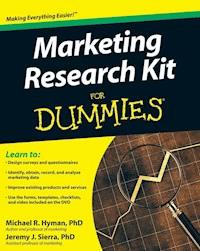
The tools you need to identify, obtain, record, and analyze data Sure, access to data is faster and easier to obtain than ever before, but how do you cut through the clutter of information to find what's most useful and organize it to suit your purposes? Marketing Research Kit For Dummies supplies a brimming box of tools that help you mine mountains of data, find the sources you need, and focus your marketing plan. Whether you're an entrepreneur, a small business owner, or a marketer in a large organization, this powerful resource and companion CD provide you with hands-on tools you need to identify, obtain, record, and analyze secondary, data-electronic and print-for developing or revising a marketing plan, launching a new product or service, or implementing long-term strategic planning. It also offers clear, in-depth instructions and customizable forms for conducting your own primary research. * Includes complete instructions for writing a research plan, conducting depth interviews, and focus groups * Fully explains the process of sampling, analyzing data, and reporting results * Features tips on developing questionnaires for face-to-face, Internet, and postal surveys * Helps you keep an eye on your competition and analyze their results When money is tight and everything is on the line, you need to make sure you've done your homework. You need Marketing Research Kit For Dummies. Note: CD-ROM/DVD and other supplementary materials are not included as part of eBook file.
Sie lesen das E-Book in den Legimi-Apps auf:
Seitenzahl: 563
Veröffentlichungsjahr: 2010
Ähnliche



















Marketing Research Kit For Dummies®
Table of Contents
Introduction
About This Book
Conventions Used in This Book
What You’re Not to Read
Foolish Assumptions
How This Book Is Organized
Part I: Marketing Research: Learn It, Live It, Love It
Part II: Surveys: A Great Way to Research
Part III: More Methods to Meet Your Needs
Part IV: Collecting, Analyzing, and Reporting Your Data
Part V: The Part of Tens
Icons Used in This Book
Where to Go from Here
Part I: Marketing Research: Learn It, Live It, Love It
Chapter 1: Seeing What Marketing Research Can Do for You
What Is Marketing Research?
Comparing Marketing Research to Marketing Information Systems
Using Research for Problem Identification and Problem Solving
Looking at problem-identification research
Becoming familiar with problem-solving research
The Most Appropriate Research at Each Stage of the Product Life Cycle
Making the Big Decision to Do (Or Not to Do) Marketing Research
When you should do marketing research
When you shouldn’t do marketing research
Chapter 2: Following the Stages of the Marketing Research Process
Working Your Way through the Stages of Research
Stage 1: Identifying the problem
Stage 2: Designing the study
Stage 3: Selecting a sample
Stage 4: Gathering the data
Stage 5: Analyzing the results
Stage 6: Communicating the findings and their implications
Anticipating Outcomes
Chapter 3: Surveying the Types of Research You May Do
Recognizing the Difference between Basic and Applied Research
Basic: The research you probably don’t care about
Applied: The research you want to do
Exploratory, Descriptive, and Causal Research: Picking Your Approach
Getting started: Exploratory research
Describing your market environment: Descriptive research
Identifying relationships: Causal research
Comparing Longitudinal Research and Cross-Sectional Research
Chapter 4: Believing In Marketing Research Ethics
A Solid, To-the-Point Ethics Checklist
Keeping in Mind a Researcher’s Obligation to Respondents
Obtaining informed consent
Avoiding deception
Respecting respondent privacy
Avoiding Abuse of Research Clients
Making sure proprietary stuff stays proprietary
Conducting unnecessary research
Performing wrong or irrelevant research
Ignoring errors in ongoing studies
Using unwarranted shortcuts
Recognizing Clients’ Obligations to Researchers
Remembering Clients’ Obligations to Respondents
Recalling that Respondents Have Obligations, Too!
Chapter 5: Working with Independent Marketing Researchers
Making the Choice to Solicit Outside Expertise
Sources of Inexpensive Research Help
College and university students
College and university research centers
College and university faculty
Small local firms
Qualities to Look for in a Researcher
Helpful throughout the process
Proper communication and analytical skills
A focus on partnership
High professional standards
Part II: Surveys: A Great Way to Research
Chapter 6: Different Types of Surveys You May Use
Conducting Face-to-Face Interviews
Examining the general face-to-face setup
Performing intercept interviews
Conducting Telephone Surveys
Reviewing the contemporary methods for conducting phone interviews
Reviewing the pros and cons
Noting the problems with telephone directories
Categorizing Self-Administered, Paper-and-Pencil Surveys
Mail surveys
Administered surveys
Publication inserts and fax surveys
Opting for Self-Administered, Electronic Surveys
Browser-based surveys
E-mail-based surveys
Interactive kiosks
Internet samples
Logging Behaviors with Diary Panels
Strengths and weaknesses of diary panels
Questions answerable with diary panel data
A sample diary page
Factors to Consider When Choosing a Data-Collection Method
Understanding the Problems with Commercial Lists
Chapter 7: Recognizing Errors in Survey Research
Respondent-Centric Survey Errors: Reviewing the Components
Random sampling error
Systematic error
Understanding why respondents provide inaccurate information
Tackling Nonresponse Error
Understanding the reasons people become nonrespondents
Encouraging respondent cooperation
Minimizing error by boosting your response rates
Managing Administrative Error
Interviewer cheating
Data processing errors
Looking at Reliability, Validity, Generalizability, and Sensitivity
Recognizing the difference between reliability and validity
Determining reliability and validity
Minimizing variation in responses
Testing for reliability and validity
Valuing study generalizability
Valuing measurement sensitivity
Chapter 8: Asking People about Their Attitudes
What’s an Attitude?
Recognizing and Using the Three Attitude Components
Reviewing the Classic Hierarchy-of-Effects Model
Developing Sound Attitude Measures
Understanding the importance of theory in measuring attitudes
Identifying your conceptual and operational definitions
Becoming Familiar with the Attitude Measurement Process
Strongly Recommended: The Popular Likert Scale
Constructing Likert scales
Structuring Likert-type scales
Semantic Differential (SD) Scales
Reviewing the limitations of SD scales
Limitations of profile analysis
Chapter 9: Writing Good Questions
Comparing Open-Ended and Close-Ended Questions
Looking at open-ended questions
Explaining close-ended questions
Writing Good Questions
Only write questions that address your research problem
Write clear and precise questions
Include only mutually exclusive and exhaustive responses
Use natural and familiar language
Avoid leading questions
Ask one question at a time
Soften the impact of potentially objectionable questions
Generating Reliable and Valid Answers
Consider memory effects
Don’t ask respondents to make unnecessary calculations
Steer clear of impossibly specific questions
Control for order bias
Always provide equal comparisons
State both sides of an attitude scale in question stems (lead lines)
Ask questions as complete sentences
Distinguish undecided responses from neutral ones
Formatting a Purchase Intent Scale
Designing Effective Graphic Rating Scales
Working with Comparative Scales
Ranking scales
Paired-comparison scales
Constant-sum scales
Q-sort
Dollar-metric scale
Chapter 10: Designing Good Questionnaires
What’s in a Good Questionnaire?
Finding qualified respondents with screeners and filter questions
Familiarizing yourself with skip patterns
Organizing your questions
Providing clear instructions
Creating an effective layout
Formatting consistently to guide respondents through your questionnaire
Choosing simple answer formats
Reviewing Guidelines for Cover Letters
Using Browser-Based Questionnaires
Understanding the advantages of browser-based questionnaires
Visualizing browser-based questionnaires
Reviewing some common on-screen display options
Creating an Internet survey
Pretesting: Ensuring Your Questionnaire Is a Good One
Chapter 11: Deciding on a Sample Type
Introducing Basic Sampling Terms
Getting Familiar with Nonprobability and Probability Samples
Examining the different types of nonprobability samples
Describing the different types of probability samples
Balancing probability samples
Selecting a Sample: The Eight Steps
Choosing either a probability or nonprobability sample
Defining your target population
Selecting your sample frame
Identifying sample units
Planning the procedure for selecting sample units
Collecting Samples for Online Research
Chapter 12: Selecting a Sample Size
Examining the Relationship between Sample Size and Random Sampling Error
Practical Criteria for Determining the Size of a Probability Sample
Approaches for Determining Sample Size
Using Sample Size Formulas and Calculators
Part III: More Methods to Meet Your Needs
Chapter 13: Secondary Data: What Is It and How Do You Use It?
Understanding Uses for Secondary Data
Using secondary data for fact-finding
Regression-type model building
Recognizing Internal Secondary Data
Looking at the advantages
Noticing the disadvantages
Improving Efficiency with External Secondary Data
Examining sources
Noting the advantages
Staying mindful of the disadvantages
Evaluating External Secondary Data
Asking the right questions
Assessing Web sites
Being leery of non-U.S. secondary data
Taking care with percentages and index numbers
Chapter 14: Using In-Depth Interviews and Focus Groups
Seeing How Qualitative Methods Can Help You
Conducting In-Depth Interviews
Describing two types of in-depth interviews
Seeing how in-depth interviews should be conducted
Carrying Out Focus Group Interviews
Characterizing focus group interviews
Reviewing the advantages of focus groups over in-depth interviews
Knowing what to include in a recruitment screener
Acting as a focus group moderator
Planning and executing your focus group
Classifying online focus groups
Chapter 15: Projective Techniques and Obser vational Methods
Putting Projective Techniques to Work
Exploring the thematic apperception test
Using word association
Understanding attitudes with sentence completion
Assessing participants’ ideas with third-person role-playing
Scrutinizing Behavior with Observational Methods
Classifying observation research
Weighing the pros and cons of observation
Explaining the types of observation
Chapter 16: Conducting Experiments and Test Marketing
Discovering a Proper Approach to Experiment Basics
Establishing causal relationships
Understanding design fundamentals
Controlling for extraneous variation
Understanding the differences between laboratory and field experiments
Examining internal validity and its threats
Simple Experiments for You to Consider
Entrepreneur examples
Professional examples
Retailer examples
Restaurateur examples
Getting a Handle on Test Marketing
Traditional test markets
Simulated test markets
Controlled test markets
Virtual test markets
Part IV: Collecting, Analyzing, and Reporting Your Data
Chapter 17: Collecting and Preparing Your Data
Determining Who Conducts Fieldwork
Using professional fieldworkers
Monitoring in-house fieldwork
Taking Care of Data Preparation and Entry
Knowing the basic terms
Beginning with pre-entry preparation
Coding your responses
Creating and cleaning data files
Controlling missing responses
Chapter 18: Tools for Analyzing Your Data
Working with Descriptive Analysis
Summarizing data with tabulation
Measuring central tendency
Increasing understanding with measures of dispersion
Computing deviation scores
Making Your Data More Useable
Converting with data transformation
Knowing when to recode your data
Considering More Than One Variable: Cross-Tabulation and Banner Tables
Examining the basics of cross-tabulation
Interpreting cross-tabulation tables
Running a chi-square (X2) test on a cross-tabulation table
Exploring the effect of moderator variables
Avoiding banner tables
Becoming Familiar with Correlation
Understanding the difference betweencorrelation and causation
Associating between measures with the correlation coefficient (rxy)
Setting up a correlation matrix
Chapter 19: Creating Effective Research Reports
Understanding the Objectives of a Research Report
Crafting Your Research Report
Introducing your research with the prefatory parts
Using the main body to explain your research
Presenting supplemental information in appendixes
Exploring the Writing Process
Steps to a winning report
Do’s and don’ts of report writing
Preparing Your Presentation
Charts and Graphs: Depicting Your Data
Cutting your info into slices: Pie charts
Showing changes in variables with bar charts
Comparing relationships over time: Multi-line graphs
Plotting many data points with scatterplots
Applying area graphs when bar charts aren’t enough
Depicting data with box and whisker plots
Part V: The Part of Tens
Chapter 20: Ten Useful Research Tips for Business Operators
Look to University Help First
Take a Statistics or Research Class
View Research as an Ongoing Process
Avoid Research Method Myopia
Start Researching Only After You Know What You Want to Know
Don’t Ignore Opportunity Costs
Pretest Everything
Study Your Customers Thoroughly
Make Incentives a Part of Your Research
Share Research Results with Employees
Chapter 21: Ten Statistical Methods that You (or Your Research Consultant) May Use
Independent Samples T-Test
Paired Samples T-Test
One-Way Analysis of Variance (ANOVA)
Linear Multiple Regression (LMR)
Conjoint Analysis
Exploratory Factor Analysis (EFA)
Multidimensional Scaling (MDS)
Cluster Analysis
Discriminant Analysis
Logistic Regression
Appendix: About the DVD
Cost-and-benefit analysis for marketing research
Marketing research ethics
Sample telephone screener questionnaire
Sample telephone questionnaires
Sample self-administered questionnaires
Focus groups
Data analysis
Sample research reports
Miscellaneous resources
Chapter figure documents
Marketing Research Kit For Dummies®
by Michael R. Hyman, PhD and Jeremy J. Sierra, PhD
Marketing Research Kit For Dummies®
Published byWiley Publishing, Inc.111 River St.Hoboken, NJ 07030-5774www.wiley.com
Copyright © 2010 by Wiley Publishing, Inc., Indianapolis, Indiana
Published simultaneously in Canada
No part of this publication may be reproduced, stored in a retrieval system, or transmitted in any form or by any means, electronic, mechanical, photocopying, recording, scanning, or otherwise, except as permitted under Sections 107 or 108 of the 1976 United States Copyright Act, without either the prior written permission of the Publisher, or authorization through payment of the appropriate per-copy fee to the Copyright Clearance Center, 222 Rosewood Drive, Danvers, MA 01923, 978-750-8400, fax 978-646-8600. Requests to the Publisher for permission should be addressed to the Permissions Department, John Wiley & Sons, Inc., 111 River Street, Hoboken, NJ 07030, (201) 748-6011, fax (201) 748-6008, or online at http://www.wiley.com/go/permissions.
Trademarks: Wiley, the Wiley Publishing logo, For Dummies, the Dummies Man logo, A Reference for the Rest of Us!, The Dummies Way, Dummies Daily, The Fun and Easy Way, Dummies.com, Making Everything Easier!, and related trade dress are trademarks or registered trademarks of John Wiley & Sons, Inc. and/or its affiliates in the United States and other countries, and may not be used without written permission. All other trademarks are the property of their respective owners. Wiley Publishing, Inc., is not associated with any product or vendor mentioned in this book.
Limit of Liability/Disclaimer of Warranty: The contents of this work are intended to further general scientific research, understanding, and discussion only and are not intended and should not be relied upon as recommending or promoting a specific method, diagnosis, or treatment by physicians for any particular patient. The publisher and the author make no representations or warranties with respect to the accuracy or completeness of the contents of this work and specifically disclaim all warranties, including without limitation any implied warranties of fitness for a particular purpose. In view of ongoing research, equipment modifications, changes in governmental regulations, and the constant flow of information relating to the use of medicines, equipment, and devices, the reader is urged to review and evaluate the information provided in the package insert or instructions for each medicine, equipment, or device for, among other things, any changes in the instructions or indication of usage and for added warnings and precautions. Readers should consult with a specialist where appropriate. The fact that an organization or Website is referred to in this work as a citation and/or a potential source of further information does not mean that the author or the publisher endorses the information the organization or Website may provide or recommendations it may make. Further, readers should be aware that Internet Websites listed in this work may have changed or disappeared between when this work was written and when it is read. No warranty may be created or extended by any promotional statements for this work. Neither the publisher nor the author shall be liable for any damages arising herefrom.
For general information on our other products and services, please contact our Customer Care Department within the U.S. at 877-762-2974, outside the U.S. at 317-572-3993, or fax 317-572-4002.
For technical support, please visit www.wiley.com/techsupport.
Wiley also publishes its books in a variety of electronic formats. Some content that appears in print may not be available in electronic books.
Library of Congress Control Number: 2010922048
ISBN: 978-0-470-52068-0
Manufactured in the United States of America
10 9 8 7 6 5 4 3 2 1
About the Authors
Michael R. Hyman, PhD, is the Stan Fulton Chair of Marketing at New Mexico State University in Las Cruces, New Mexico. He earned his undergraduate degree at the University of Maryland and his master’s and doctoral degrees at Purdue University. Back in the day, he fancied himself a Texan — he was a faculty member at the University of Houston and then later at the University of North Texas — but he has since become a loyal green-chile-eating, motorcycle-riding, non-tie-wearing New Mexican.
Mike has taught marketing research at the undergraduate, masters, and doctoral levels for more years than he cares to admit (30 and counting). Although they occasionally suggest that his exams are overly challenging, students never complain that his research courses are poorly structured or lack sufficient rigor.
Roughly 20 years ago, Mike toyed with the idea of leaving academia for full-time consulting. For almost three years, he consulted extensively with major hospitality industry clients. After straddling the university-consulting fence during this period, he decided — with the help of several perpetually annoying colleagues — that he was best suited to university life. Although he still accepts the occasional consulting gig, he has never regretted that decision. Nonetheless, he learned more about “real world” marketing research during those three years than during all his years of schooling.
Golfing and fishing are Mike’s only “Type B” activities. When not teaching, spending time with his family, playing poker, or following the exploits of his beloved New York Yankees (a remnant of his misspent youth), he’s usually preoccupied with some writing project. His roughly 70 academic journal articles, 45 conference papers (10 which won a “best paper” award), 2 books, 15 other academic works, and 20 nonacademic works attest to this writing compulsion. He’s also a sucker for professional service requests; among other activities, he’s been talked into serving on 13 journal editorial boards, reviewing an excessive number of manuscripts and books each year, serving as a journal editor, and coordinating two different doctoral programs.
Jeremy J. Sierra, PhD, is an Assistant Professor of Marketing at Texas State University — San Marcos. He teaches a wide array of marketing courses, including Marketing Research, which he has taught the past four years. Prior to joining the marketing faculty at Texas State, he taught at Northern Arizona University. He earned his MBA. and PhD from New Mexico State University and his BS in Hotel and Restaurant Management from California State Polytechnic University, Pomona. Before entering academia, Jeremy accumulated ten years of experience in the hospitality industry, where he acquired his knack for cost controls, customer relationship management, and in-store design. His industry experience ranges from entrepreneurial restaurant establishments to high-end resorts (for example, Scottsdale Princess and Scottsdale Plaza Resort) and golf club environments (for example, Frenchman’s Creek Country Club in Palm Beach Gardens, Florida).
Jeremy’s research interests include advertising effects, consumer behavior, marketing ethics, and services marketing. Jeremy’s research is published in the following journals: Journal of Academic Ethics; Journal of Advertising; Journal of Business and Management; Journal of Current Issues & Research in Advertising; Journal of Marketing Education; Journal of Marketing Theory and Practice; and Journal of Services Marketing. Jeremy has presented numerous conference proceedings, including two “best paper” awards, and has received a research grant from the Research Enhancement Program at Texas State. He is an avid golfer and an ardent Nebraska football fan, and he also is hopeful that this book will make you a better marketing researcher.
Authors' Acknowledgments
Mike: To read about every person who ever inspired me, and as a result this book, would be at best a mind-numbing experience. That said, certain people were more directly and indirectly influential in its creation and therefore especially deserving of acknowledgment.
My wife, Stacey, and sons, Aaron, Derek, and Evan, should be commended for their tolerance with my oft-uttered “Daddy would love to spend time with you now, but he’s got to work on his book.” Of course, the boys’ college funds will benefit from their patience, so I prefer to rationalize their considerateness as “enlightened self–interest.” Regardless, they are my primary motivation for awakening each morning. (Translation: They arise at 6 a.m. and make enough noise to wake the dead.)
My parents, Aaron and Selma, reinforced my genetic predisposition toward workaholism with a perpetual Get-Out-of-Jail-Free card. They always forgave any personal transgression — such as forgetting to call on their anniversary — when I could attribute it to my preoccupation with a school or work-related project. In essence, they encouraged the type of self-absorption requisite to a large writing project like this book.
Robin Peterson, a partner in crime and the best golfing buddy on the planet — when he doesn’t almost flip our cart — effectively discouraged me from dwelling on his many non-lucrative book-authoring efforts. Sadly, he often failed to convince me that I would benefit more from an afternoon of golf than an afternoon of writing. Now that this book is finished, he will ensure that I renew my support of the golf ball industry.
Unlike the drama junkies who inflict discord and dysfunction on many academic departments, my colleagues at New Mexico State University are truly wonderful people. No one could find better co-workers and friends than Pookie Sautter, Jerry Hampton, Kelly Tian, Kevin Boberg, Bruce Huhmann, Michelle Jasso, Collin Payne, Mihai Niculescu, Pat Gavin, and Virginia Espinosa. By making my life so easy, they allowed me the time and energy needed to write this book.
I would be remiss if I failed to thank the many students throughout the years who enrolled in my marketing research course. They taught me more about teaching than all other sources combined and had an enormous influence on the quality of this book.
Finally, I also would be remiss if I failed to thank my Wiley editorial teammates for their trust and patience. When I initially panicked over the magnitude of this project, Mike Baker repeatedly reassured me that Jeremy and I could complete it. Natalie Harris, Jessica Smith, and Christy Pingleton ensured that the text never drifted into obtuse esoteric academese (like the last phrase). Thanks also to Jenny Swisher and the Media Development team for their help in setting up the DVD.
Jeremy: For brevity, I would like to acknowledge a few essential people (although there are a host of others) that have helped me along the way. For her love, companionship, and support, I would like to thank my wife, Dian; she is the best co-pilot a guy could ask for. To my Mom who showed me persistence growing up, although I never asked her what it was. To my Dad who would hit countless fly balls to me and throw hours of batting practice; these were his ways of communicating that in life, your toughest competitor is yourself. To my Grandma, for her love and support throughout my life, especially during my 11-year, 3-degree process. I also would like to acknowledge and thank my mentors, colleagues, students, and former professors for their insight about marketing. Finally, to the underdog, which I usually side with unless they’re playing Nebraska: You inspire and make the world a better place. Keep the upsets coming.
Dedication
Mike: To Aaron, father and son.
Jeremy: To my wife and family, the underdog, and the loving memory of my Mom.
Publisher’s Acknowledgments
We’re proud of this book; please send us your comments through our online registration form located at http://dummies.custhelp.com. For other comments, please contact our Customer Care Department within the U.S. at 877-762-2974, outside the U.S. at 317-572-3993, or fax 317-572-4002.
Some of the people who helped bring this book to market include the following:
Acquisitions, Editorial, and Media Development
Project Editor: Natalie Faye Harris
Acquisitions Editor: Mike Baker
Copy Editors: Jessica Smith, Christy Pingleton
Editorial Program Coordinator: Joe Niesen
Technical Reviewer: John Hall
Media Development Producer: Jennifer Swisher
Editorial Manager: Christine Meloy Beck
Editorial Assistants: Jennette ElNaggar, David Lutton
Art Coordinator: Alicia B. South
Cover Photos: © Chris Thomaidis/Stone/Getty
Cartoons: Rich Tennant (www.the5thwave.com)
Composition Services
Project Coordinator: Kristie Rees
Layout and Graphics: Carl Byers, Ashley Chamberlain, Yovonne Grego, Mark Pinto, Christine Williams
Proofreaders: John Greenough, Toni Settle
Indexer: Potomac Indexing LLC
Publishing and Editorial for Consumer Dummies
Diane Graves Steele, Vice President and Publisher, Consumer Dummies
Kristin Ferguson-Wagstaffe, Product Development Director, Consumer Dummies
Ensley Eikenburg, Associate Publisher, Travel
Kelly Regan, Editorial Director, Travel
Publishing for Technology Dummies
Andy Cummings, Vice President and Publisher, Dummies Technology/General User
Composition Services
Debbie Stailey, Director of Composition Services
Introduction
If you’re reading these words, it’s unlikely that you’re thinking “Marketing research . . . I’d rather watch paint dry than read about, let alone conduct, marketing research. What could be duller?” Perhaps we’re a bit biased, but we believe that marketing research is exciting because it’s an important source of information that can help you make better business decisions. It touches every aspect of marketing practice.
Many undergraduate students believe that successful marketing practitioners merely need to learn a few broad principles and to apply their common sense. Although we generally disagree with that assessment, it’s particularly false for marketing research. A marketing study is only as good as the quality of its weakest of many components. In other words, the devil is in the details — and we’re your friendly neighborhood demons.
About This Book
Among others, our main goals for this book are to make you an informed consumer of marketing research and to prepare you to conduct a basic survey — most likely a customer satisfaction survey — for yourself or your organization. To accomplish these goals, we must show you what is and isn’t proper for good marketing research. That way, you’ll know what should be done and what should be avoided (like slivovitz, haggis, tripe, and overeating on Thanksgiving).
If we achieve these goals, the probability that you’ll perform and acquire useful marketing research is far higher. You may conduct research yourself, or you may hire someone to conduct research on your behalf. Either way, it’s a waste of time, effort, and money to conduct a study and then discover that it was carried out incorrectly and is worthless for making better marketing decisions.
In this book, we discuss the many skills associated with conducting a successful marketing research study, such as the following:
Identifying a research problem
Developing a series of research questions related to that problem
Writing good questions and designing a good questionnaire that will explore those research questions
Fielding a survey and avoiding common survey research errors
Designing a qualitative study — like a focus group — that will explore your research questions
Collecting respondents’ data, entering it into a computer spreadsheet, analyzing it, and interpreting the results
Writing a report that can help your organization or encourage a loan officer to lend you (and perhaps your associates) money for a business venture
Conventions Used in This Book
Here are some conventions that we use in this book:
Whenever we introduce a word or phrase that may not be familiar to you, we put that word in italics. You can bet that there’s a nearby definition, explanation, or vivid example.
We use bold for key words in bulleted lists and the action part of numbered steps.
On occasion, we include URLs for Web sites that we think may interest you. Those Web addresses appear in monofont, which distinguishes them from the rest of the text.
When this book was printed, some Web addresses may have needed to break across two lines of text. If that happened, rest assured that we haven’t put in any extra characters (such as hyphens) to indicate the break. So, when using one of these Web addresses, just type in exactly what you see in this book, pretending as though the line break doesn’t exist.
What You’re Not to Read
We wrote this book to help you easily find and understand what you need to know about marketing research. Because you may be too busy to read every word, we’ve designed the book so it’s easy to recognize less critical text. Unless you’re super-compulsive or short on reading material, you can skip the following:
Text in sidebars: The shaded boxes that appear occasionally are called sidebars. They include asides and additional but noncritical detail.
Text associated with the Technical Stuff icon: Skipping this interesting but advanced text should be okay if your goal is to conduct a basic customer satisfaction survey.
Foolish Assumptions
This book presents such a broad range of information that we can’t presume we know exactly why you’re reading it. Here are some good — and perhaps not so good — guesses:
You’re thinking about starting a business and you need credible market analyses — of customers, competitors, and the business environment — to convince investors or a loan officer that this business is likely to succeed.
You already own (or co-own) a business and you want marketing research that can help you decide how to grow (or at least maintain) that business.
You want to know the ways that marketing research can improve marketing-related decisions.
You want to improve your financial or nonfinancial success. For example, you want to boost your market share, improve consumers’ responses to your brand, or increase your gross margin percent.
You don’t know your targeted customers or competition as much as you’d like to know them.
You’re a student enrolled in a marketing research course and you want a readable and affordable text without 10,000 footnotes.
You’re not a math, statistics, or econometrics whiz.
You’d rather read this book than our academic journal articles.
We also hope we’re safe in assuming that you know your PC’s DVD tray isn’t a cup holder. Seriously, we assume you know how to use a word processor (to create questionnaires and write reports) and spreadsheet software (to analyze the data you collect).
How This Book Is Organized
We’ve grouped the chapters in this book into five parts, each one focusing on a particular aspect of marketing research. The following sections provide an overview of the content in each part.
Part I: Marketing Research: Learn It, Live It, Love It
This part begins by introducing marketing research and the approaches used to create a research plan. We summarize the research process and the basic types of research you may conduct: exploratory, descriptive, and causal. We then discuss the ethical do’s and don’ts for research doers and research consumers. The part concludes with how to choose, work with, and assess the efforts of marketing researchers you may hire.
Part II: Surveys: A Great Way to Research
This part begins with an overview of the different types of surveys and the relative strengths and weaknesses of each type. Next, we discuss strategies you can use to boost the reliability and validity of respondents’ answers as well as to increase response rates and control research-related costs. We then introduce attitude research, including information about question forms such as Likert and semantic differential scales. We also explain guidelines for question and questionnaire do’s and don’ts, including a brief overview of formatting issues and constant sum, ranking, and purchase-intention scales. We round out the part with chapters on sample type and sample size.
Part III: More Methods to Meet Your Needs
This part discusses the types of secondary data and how to use them; we emphasize important online sources and sites with links to multiple sources. Also, we discuss qualitative and observational research, with an emphasis on in-depth interviews and focus groups. Finally, we introduce experiments, including multiple examples of experiments you may run (for example, identifying effective price points, promotional efforts, and shelf/floor space organization).
Part IV: Collecting, Analyzing, and Reporting Your Data
In this part, we begin by discussing strategies for increasing respondent involvement, avoiding respondent bias, and inputting data. We then discuss how to analyze survey and internal (for existing businesses) data using Microsoft Excel or a comparable spreadsheet program. We conclude with the art of creating research reports.
Part V: The Part of Tens
Our two Part of Tens chapters provide quick and useful insights about critical marketing research do’s and don’ts. Chapter 20 offers ten essential tips for business operators. Such readers may find it useful to peruse this chapter first. Chapter 21 describes ten statistical methods that a marketing research supplier may use to analyze data. Because it focuses on uses, examples, and potential misuses for each method, the chapter is meant more for research consumers than research doers.
Also included in this part is an appendix that discusses the DVD. This appendix shows computer hardware and software requirements for accessing the DVD. It also provides a list of the DVD’s content.
Icons Used in This Book
In the margins of this book, you find the following icons — mini-graphics that denote paragraphs containing certain types of information. Here’s a list of icons we use and what they mean:
This icon highlights information that’s so important you’ll definitely want to read it (and perhaps return to it later).
Although interesting, this information isn’t critical to using or conducting marketing research. Of course, we find it fascinating — and you may too!
Based on our experience and knowledge of marketing research literature, we believe this information may prove especially helpful. These tidbits may save you time or money, or may just be nuggets of insider information.
Our warnings are meant to save you from defective studies and practices that mislead you into costly marketing mistakes.
This icon denotes information that can be accessed on the DVD.
Where to Go from Here
We designed this book with four sets of readers in mind. You may consider the following reading game plan if one of these groups describes you:
Research doers: If you’re a research doer, you may want to read this book in the following sequence: Part I, Part III, Part II, and Part IV. Without understanding the big picture (Part I), you can’t put any of our remaining discussion in the proper context. Although survey research is popular, and you’re likely to conduct a customer survey eventually, you’ll benefit from considering the alternatives first (Part III). After you decide to field a survey, you’ll benefit from discovering how to write a good questionnaire (Part II) and how to analyze the data you collect from it (Part IV). Of course, if you ultimately decide that you should find and hire a low-cost marketing research supplier, you can return to Chapter 5.
Research consumers: Other than Chapter 5, you should focus on the remaining four chapters of Part I — which provide an extensive overview of marketing research — and the two Part of Tens chapters. We meant those last two chapters predominantly for research consumers. Also, Chapter 19 indicates what you should expect from any report summarizing the results of a marketing study. Obviously, being an informed consumer requires extensive knowledge about product features, so you’ll benefit from reading additional text as it pertains to a study you’re considering.
Students: Sadly, there’s no shortcut for students, because much of our text addresses topics included in most marketing research courses. In essence, we suggest that students read our book from beginning to end. Look on the bright side: If you buy this book — rather than borrow it from a library — you’ll get your money’s worth!
Need a customer survey yesterday: If you have an immediate need to field a survey, analyze its data, and make a marketing-related decision, you’ll want to focus on Parts II and IV of this book. (That said, you should at least skim Chapter 11 to avoid a totally useless respondent pool.) You always can return to the remaining text at a later date.
Part I
Marketing Research: Learn It, Live It, Love It
In this part . . .
This part introduces you to marketing research and tells you how to begin the process of creating a research plan. In Chapters 1 through 3, we summarize the research process and the basic types of research you may conduct. In Chapter 4, we discuss the ethical do’s and don’ts for research doers and research consumers. Chapter 5 shows you how to choose, work with, and assess the efforts of marketing researchers you may hire.
Chapter 1
Seeing What Marketing Research Can Do for You
In This Chapter
Defining marketing research
Examining marketing information systems in context of marketing research
Reviewing problem-identification research and problem-solving research
Relating the product life cycle to your research needs
Identifying when it’s wise to conduct and avoid marketing research
Marketing research is more than those annoying people who call you during dinner to ask you a series of questions. It’s also more than those oddly cheerful people at the mall — with clipboard and pencil in hand — who want to ask you seemingly innumerable questions rather than let you shop.
Lesen Sie weiter in der vollständigen Ausgabe!
Lesen Sie weiter in der vollständigen Ausgabe!
Lesen Sie weiter in der vollständigen Ausgabe!
Lesen Sie weiter in der vollständigen Ausgabe!
Lesen Sie weiter in der vollständigen Ausgabe!
Lesen Sie weiter in der vollständigen Ausgabe!
Lesen Sie weiter in der vollständigen Ausgabe!
Lesen Sie weiter in der vollständigen Ausgabe!
Lesen Sie weiter in der vollständigen Ausgabe!
Lesen Sie weiter in der vollständigen Ausgabe!
Lesen Sie weiter in der vollständigen Ausgabe!
Lesen Sie weiter in der vollständigen Ausgabe!
Lesen Sie weiter in der vollständigen Ausgabe!
Lesen Sie weiter in der vollständigen Ausgabe!
Lesen Sie weiter in der vollständigen Ausgabe!
Lesen Sie weiter in der vollständigen Ausgabe!
Lesen Sie weiter in der vollständigen Ausgabe!
Lesen Sie weiter in der vollständigen Ausgabe!
Lesen Sie weiter in der vollständigen Ausgabe!
Lesen Sie weiter in der vollständigen Ausgabe!
Lesen Sie weiter in der vollständigen Ausgabe!
Lesen Sie weiter in der vollständigen Ausgabe!
Lesen Sie weiter in der vollständigen Ausgabe!
Lesen Sie weiter in der vollständigen Ausgabe!
Lesen Sie weiter in der vollständigen Ausgabe!




