


Erhalten Sie Zugang zu diesem und mehr als 300000 Büchern ab EUR 5,99 monatlich.
- Herausgeber: Atlantic Books
- Kategorie: Geisteswissenschaft
- Serie: BOOKS THAT SHOOK THE WORLD
- Sprache: Englisch
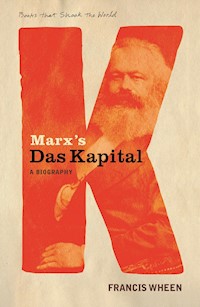
'The philosophers have only interpreted the world, in various ways; the point is to change it,' wrote Karl Marx in 1845. This is the essence of Das Kapital, a blazing expose of the new capitalist world of the Victorian era, whose ideas would affect the lives of millions, and alter the course of world history. In vivid detail, Francis Wheen tells the story of Marx's twenty-year fight to complete his unfinished masterpiece. Das Kapital was born in a two-room flat in Soho amid political squabbles and personal tragedy. The first volume was published in 1867, to muted praise, but, after Marx's death, went on to influence thinkers, writers and revolutionaries, from George Bernard Shaw to Lenin. Wheen's brilliant and accessible book shows that, far from being a dry economic treatise, Das Kapital is like a vast Gothic novel, whose heroes are enslaved by the monster they created: capitalism. Furthermore, Wheen argues, as long as capitalism endures, Das Kapital demands to be read and understood.
Sie lesen das E-Book in den Legimi-Apps auf:
Seitenzahl: 169
Veröffentlichungsjahr: 2013
Das E-Book (TTS) können Sie hören im Abo „Legimi Premium” in Legimi-Apps auf:
Ähnliche




















Marx’s Das Kapital
A Biography
Francis Wheen is the author of The Soul of Indiscretion, a life of Tom Driberg; Karl Marx; The Irresistible Con; Hoo Hahs and Passing Frenzies, which won the Orwell Prize in 2003; and the best-selling How Mumbo Jumbo Conquered the World: A Short History of Modern Delusions.
Other titles in the Books That Shook the World series:Available now:
Plato’s Republic by Simon Blackburn
Darwin’s Origin of Species by Janet Browne
Thomas Paine’s Rights of Man by Christopher Hitchens
The Qur’an by Bruce Lawrence
Adam Smith’s On the Wealth of Nations by P. J. O’Rourke
Forthcoming:
The Bible by Karen Armstrong
Machiavelli’s The Prince by Philip Bobbitt
Homer’s The Iliad and the Odyssey by Alberto Manguel
Carl von Clausewitz’s On War by Hew Strachan
CONTENTS
A Note on Translations
Introduction: The Unknown Masterpiece
1Gestation
2Birth
3Afterlife
Index
Copyright
A NOTE ON TRANSLATIONS
If you wish to read Marx’s masterpiece for yourself, the least intimidating option is Capital: A New Abridgement, edited by David McLellan (OUP World’s Classics), a one-volume collection of the most important chapters. Its extracts from Volume I are in the original English translation of 1887; the translations from Volume II are by McLellan himself; the material for Volume III comes from the anonymous Moscow translation published in 1971.
If you want to plunge straight into a full, unabridged version, I recommend the Penguin Classics edition in three volumes, translated by Ben Fowkes and with an introduction (which you may decide to skip) by Ernest Mandel.
Since no single translation is perfect, I have used various sources for the passages from Das Kapital cited in this book. Some of the quotations are from the Penguin text, some from the World’s Classics, some from the Marx & Engels Collected Works (50 vols, Lawrence & Wishart) – and some are my own.
INTRODUCTION
The Unknown Masterpiece
In February 1867, shortly before delivering the first volume of Das Kapital to the printers, Karl Marx urged Friedrich Engels to read The Unknown Masterpiece by Honoré de Balzac. The story was itself a little masterpiece, he said, ‘full of the most delightful irony’.
We don’t know whether Engels heeded the advice. If he did, he would certainly have spotted the irony but might have been surprised that his old friend could take any delight in it. The Unknown Masterpiece is the tale of Frenhofer, a great painter who spends ten years working and reworking a portrait which will revolutionize art by providing ‘the most complete representation of reality’. When at last his fellow artists Poussin and Porbus are allowed to inspect the finished canvas, they are horrified to see a blizzard of random forms and colours piled one upon another in confusion. ‘Ah!’ Frenhofer cries, misinterpreting their wide-eyed amazement. ‘You did not anticipate such perfection!’ But then he overhears Poussin telling Porbus that eventually Frenhofer must discover the truth – the portrait has been overpainted so many times that nothing remains.
‘Nothing on my canvas!’ exclaimed Frenhofer, glancing alternately at the two painters and his picture.
‘What have you done?’ said Porbus in an undertone to Poussin.
The old man seized the young man’s arm roughly, and said to him: ‘You see nothing there, clown! varlet! miscreant! hound! Why, what brought you here, then? – My good Porbus,’ he continued, turning to the older painter, ‘can it be that you, you too, are mocking at me? Answer me! I am your friend; tell me, have I spoiled my picture?’
Porbus hesitated, he dared not speak; but the anxiety depicted on the old man’s white face was so heart-rending that he pointed to the canvas saying: ‘Look!’
Frenhofer gazed at his picture for a moment and staggered.
‘Nothing! Nothing! And I have worked ten years!’
He fell upon a chair and wept.
After banishing the two men from his studio, Frenhofer burns all his paintings and kills himself.
According to Marx’s son-in-law Paul Lafargue, Balzac’s tale ‘made a great impression on him because it was in part a description of his own feelings’. Marx had toiled for many years on his own unseen masterpiece, and throughout this long gestation his customary reply to those who asked for a glimpse of the work-in-progress was identical to that of Frenhofer: ‘No, no! I have still to put some finishing touches to it. Yesterday, towards evening, I thought that it was done… This morning, by daylight, I realized my error.’ As early as 1846, when the book was already overdue, Marx wrote to his German publisher: ‘I shall not have it published without revising it yet again, both as regards matter and style. It goes without saying that a writer who works continuously cannot, at the end of six months, publish word for word what he wrote six months earlier.’ Twelve years later, still no nearer completion, he explained that ‘the thing is proceeding very slowly because no sooner does one set about finally disposing of subjects to which one has devoted years of study than they start revealing new aspects and demand to be thought out further.’ An obsessive perfectionist, he was forever seeking out new hues for his palette – studying mathematics, learning about the movement of celestial spheres, teaching himself Russian so he could read books on the country’s land system. Or, to quote Frenhofer again: ‘Alas! I thought for a moment that my work was finished; but I have certainly gone wrong in some details, and my mind will not be at rest until I have cleared away my doubts. I have decided to travel, and visit Turkey, Greece and Asia in search of models, in order to compare my picture with Nature in different forms.’
Why did Marx recall Balzac’s tale at the very moment when he was preparing to unveil his greatest work to public scrutiny? Did he fear that he too might have laboured in vain, that his ‘complete representation of reality’ would prove unintelligible? He certainly had some such apprehensions – Marx’s character was a curious hybrid of ferocious self-confidence and anguished self-doubt – and he tried to forestall criticism by warning in the preface that ‘I assume, of course, a reader who is willing to learn something new and therefore to think for himself.’ But what ought to strike us most forcibly about his identification with the creator of the unknown masterpiece is that Frenhofer is an artist – not a political economist, nor yet a philosopher or historian or polemicist. The most ‘delightful irony’ of all in The Unknown Masterpiece, noted by the American writer Marshall Berman, is that Balzac’s account of the picture is a perfect description of a twentieth-century abstract painting – and the fact that he couldn’t have known this merely deepens the resonance. ‘The point is that where one age sees only chaos and incoherence, a later or more modern age may discover meaning and beauty,’ Berman writes. ‘Thus the very open-endedness of Marx’s later work can make contact with our time in ways that more “finished” nineteenth-century work cannot: Das Kapital reaches beyond the well-made works of Marx’s century into the discontinuous modernism of our own.’ Like Frenhofer, Marx was a modernist avant la lettre. His famous account of dislocation in the Communist Manifesto – ‘all that is solid melts into air’ – prefigures the hollow men and the unreal city depicted by T. S. Eliot, or Yeats’s ‘Things fall apart; the centre cannot hold’. By the time he wrote Das Kapital, he was pushing out beyond conventional prose into radical literary collage – juxtaposing voices and quotations from mythology and literature, from factory inspectors’ reports and fairy tales, in the manner of Ezra Pound’s Cantos or Eliot’s The Waste Land. Das Kapital is as discordant as Schoenberg, as nightmarish as Kafka.
Karl Marx saw himself as a creative artist, a poet of dialectic. ‘Now, regarding my work, I will tell you the plain truth about it,’ he wrote to Engels in July 1865. ‘Whatever shortcomings they may have, the advantage of my writings is that they are an artistic whole.’ It was to poets and novelists, far more than to philosophers or political essayists, that he looked for insights into people’s material motives and interests: in a letter of December 1868 he copied out a passage from another work by Balzac, The Village Priest, and asked if Engels could confirm the picture from his own knowledge of practical economics. (The conservative, royalist Balzac may seem an unlikely hero, but Marx always held that great writers have insights into social reality that transcend their personal prejudices.) Had he wished to write a conventional economic treatise he would have done so, but his ambition was far more audacious. Berman describes the author of Das Kapital as ‘one of the great tormented giants of the nineteenth century – alongside Beethoven, Goya, Tolstoy, Dostoevsky, Ibsen, Nietzsche, Van Gogh – who drive us crazy, as they drove themselves, but whose agony generated so much of the spiritual capital on which we still live’.
Yet how many people would think of including Karl Marx in a list of great writers and artists? Even in our post-modern era, the fractured narrative and radical discontinuity of Das Kapital are mistaken by many potential readers for formlessness and incomprehensibility. The main purpose of my own book is to persuade at least some of these readers to look again: anyone willing to grapple with Beethoven, Goya or Tolstoy should be able to ‘learn something new’ from a reading of Das Kapital – not least because its subject still governs our lives. As Marshall Berman asks: how can Das Kapital end while capital lives on?
It is deeply fitting that Marx never finished his masterpiece. The first volume was the only one to appear in his lifetime, and the subsequent volumes were assembled by others after his death, based on notes and drafts found in his study. Marx’s work is as open-ended – and thus as resilient – as the capitalist system itself. He was indeed one of the great tormented giants. Before approaching his masterpiece we must seek out the sources of Marx’s torment, and of his inspiration.
CHAPTER 1
Gestation
Although Das Kapital is usually categorized as a work of economics, Karl Marx turned to the study of political economy only after many years of spadework in philosophy and literature. It is these intellectual foundations that underpin the project, and it is his personal experience of alienation that gives such intensity to the analysis of an economic system which estranges people from one another and from the world they inhabit – a world in which humans are enslaved by the monstrous power of inanimate capital and commodities.
Marx himself was an outsider from the moment of his birth, on 5 May 1818 – a Jewish boy in a predominantly Catholic city, Trier, within a Prussian state whose official religion was evangelical Protestantism. Although the Rhineland had been annexed by France during the Napoleonic wars, three years before his birth it was reincorporated into Imperial Prussia and the Jews of Trier thus became subject to an edict banning them from practising in the professions: Karl’s father, Heinrich Marx, had to convert to Lutheranism in order to work as an attorney. No wonder the young Karl Marx began to brood upon alienation. ‘We cannot always attain the position to which we believe we are called,’ he wrote in a schoolboy essay, at the age of seventeen. ‘Our relations in society have to some extent already begun to be established before we are in a position to determine them.’
His father encouraged Karl to read voraciously. The years of annexation had given Heinrich a taste for French flavours in politics, religion, life and art: one of his grandchildren described him as ‘a real eighteenth-century “Frenchman” who knew his Voltaire and his Rousseau by heart’. The boy’s other intellectual mentor was Heinrich’s friend Baron Ludwig von Westphalen, a cultured and liberal government official who introduced Karl to poetry and music (and to his daughter Jenny von Westphalen, the future Mrs Karl Marx). On long walks together the Baron would recite passages from Homer and Shakespeare, which his young companion learned by heart – and later used as the essential seasonings in his own writings. In adult life Marx re-enacted those happy hikes with von Westphalen by declaiming scenes from Shakespeare, Dante and Goethe while leading his own family up to Hampstead Heath for Sunday picnics. As Professor S. S. Prawer has written, anyone in Karl Marx’s household was obliged to live ‘in a perpetual flurry of allusions to English literature’. There was a quotation for every occasion: to flatten a political enemy, enliven a dry text, heighten a joke, authenticate an emotion – or breathe life into an inanimate abstraction, as when capital itself speaks in the voice of Shylock (in Volume I of Das Kapital) to justify the exploitation of child labour in factories.
Workmen and factory inspectors protested on hygienic and moral grounds, but Capital answered:
My deeds upon my head! I crave the law,
The penalty and forfeit of my bond.
To prove that money is a radical leveller, Marx quotes a speech from Timon of Athens on money as the ‘common whore of mankind’, followed by another from Sophocles’ Antigone (‘Money! Money’s the curse of man, none greater!/That’s what wrecks cities, banishes men from home,/Tempts and deludes the most well-meaning soul,/Pointing out the way to infamy and shame…’). Economists with anachronistic models and categories are likened to Don Quixote, who ‘paid the penalty for wrongly imagining that knight-errantry was equally compatible with all economic forms of society’.
Marx’s earliest ambitions were literary. As a law student at the University of Berlin he wrote a book of poetry, a verse drama and even a novel, Scorpion and Felix, which was dashed off in a fit of intoxicated whimsy while under the spell of Laurence Sterne’s Tristram Shandy. After these experiments, he admitted defeat: ‘Suddenly, as if by a magic touch – oh, the touch was at first a shattering blow – I caught sight of the distant realm of true poetry like a distant fairy palace, and all my creations crumbled into nothing… A curtain had fallen, my holy of holies was rent asunder, and new gods had to be installed.’ Suffering some kind of breakdown, he was ordered by his doctor to retreat to the countryside for a long rest – whereupon he at last succumbed to the siren voice of G. W. F. Hegel, the recently deceased professor of philosophy at Berlin, whose legacy was the subject of intense dispute among fellow students and lecturers. In his youth Hegel had been an idealistic supporter of the French Revolution, but by middle age he had become comfortable and complaisant, believing that a truly mature man should recognize ‘the objective necessity and reasonableness of the world as he finds it’. According to Hegel, ‘All that is real is rational,’ and since the Prussian state was undoubtedly real, in the sense that it existed, his conservative supporters argued that it must therefore be rational and above reproach. Those who championed his more subversive early work – the Young Hegelians – preferred to quote the second half of that dictum: ‘All that is rational is real.’ An absolute monarchy, buttressed by censors and secret police, was palpably irrational and therefore unreal, a mirage that would disappear as soon as anyone dared touch it.
At university, Marx ‘adopted the habit of making extracts from all the books I read’ – a habit he never lost. A reading list from this period shows the precocious scope of his intellectual explorations. While writing a paper on the philosophy of law he made a detailed study of Winckelmann’s History of Art, started to teach himself English and Italian, translated Tacitus’s Germania and Aristotle’s Rhetoric, read Francis Bacon and ‘spent a good deal of time on Reimarus, to whose book on the artistic instincts of animals I applied my mind with delight’. This is the same eclectic, omnivorous and often tangential style of research which gave Das Kapital its extraordinary breadth of reference. The description of Democritus in Marx’s doctoral thesis, on ‘The Difference Between Democritean and Epicurean Philosophy’, looks remarkably like a self-portrait: ‘Cicero calls him a vir eruditus. He is competent in physics, ethics, mathematics, in the encyclopaedic disciplines, in every art.’
For a while, Marx seemed uncertain how best to use all that erudition. After gaining his doctorate he thought of becoming a philosophy lecturer, but then decided that daily proximity to professors would be intolerable. ‘Who would want to have to talk always with intellectual skunks, with people who study only for the purpose of finding new dead ends in every corner of the world!’ Besides, since leaving university Marx had been turning his thoughts from idealism to materialism, from the abstract to the actual. ‘Since every true philosophy is the intellectual quintessence of its time,’ he wrote in 1842, ‘the time must come when philosophy not only internally by its content, but also externally through its form, comes into contact and interaction with the real world of its day.’ That spring he began writing for a new liberal newspaper in Cologne, the Rheinische Zeitung; within six months he had been appointed editor.
Marx’s journalism is characterized by a reckless belligerence which explains why he spent most of his adult life in exile and political isolation. His very first article for the Rheinische Zeitung was a lacerating assault on both the intolerance of Prussian absolutism and the feeble-mindedness of its liberal opponents. Not content with making enemies of the government and opposition simultaneously, he turned against his own comrades as well, denouncing the Young Hegelians for ‘rowdiness and blackguardism’. Only two months after Marx’s assumption of editorial responsibility, the provincial governor asked the censorship ministers in Berlin to prosecute him for ‘impudent and disrespectful criticism’. No less a figure than Tsar Nicholas of Russia also begged the Prussian king to suppress the Rheinische Zeitung, having taken umbrage at an anti-Russian diatribe. The paper was duly closed in March 1843: at the age of twenty-four, Marx was already wielding a pen that could terrify and infuriate the crowned heads of Europe. Realizing that he had no future in Prussia, he accepted an invitation to move to Paris as co-editor of a new journal-in-exile for Germans, the Deutsche-Französische Jahrbücher. There was only one caveat: ‘I am engaged to be married and I cannot, must not and will not leave Germany without my fiancée.’
Karl Marx married Jenny von Westphalen in June 1843. For the rest of the summer, while awaiting their summons to Paris, he and his new bride enjoyed an extended honeymoon in the fashionable spa resort of Kreuznach. When not walking by the river he shut himself away in a workroom, reading and writing with furious intensity. Marx always liked to work out his ideas on paper, and a surviving page from the Kreuznach notebooks shows the process in action:
Note. Under Louis XVIII, the constitution by grace of the king (Charter imposed by the king); under Louis Philippe, the king by grace of the constitution (imposed kingship). In general we can note that the conversion of the subject into the predicate, and of the predicate into the subject, the exchange of that which determines for that which is determined, is always the most immediate revolution… The king makes the law (old monarchy), the law makes the king (new monarchy).
This simple grammatical inversion also disclosed the flaw in German philosophy. Hegel had assumed that ‘the Idea of the State’ was the subject, with society as its object, whereas history showed the opposite. Turn Hegel upside down and the problem was solved: religion does not make man, man makes religion; the constitution does not create the people, but the people create the constitution. Although he took the idea from Ludwig Feuerbach, who in a recent book had argued that ‘thought arises from being, not being from thought’, Marx extended its logic from abstract philosophy to the material world. As he wrote in his Theses on Feuerbach, published in 1845, ‘The philosophers have only interpreted the world, in various ways; the point is to change it.’ Here, still in the womb, is the essential thesis of Das Kapital




