


29,99 €
Mehr erfahren.
- Herausgeber: Packt Publishing
- Kategorie: Fachliteratur
- Sprache: Englisch
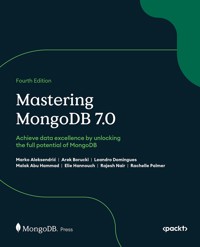
Mastering MongoDB 7.0 explores the latest version of MongoDB, an exceptional NoSQL database solution that aligns with the needs of modern web applications. This book starts with an informative overview of MongoDB’s architecture and developer tools, guiding you through the process of connecting to databases seamlessly.
This MongoDB book explores advanced queries in detail, including aggregation pipelines and multi-document ACID transactions. It delves into the capabilities of the MongoDB Atlas developer data platform and the latest features, such as Atlas Vector Search, and their role in AI applications, enabling developers to build applications with the scalability and performance that today’s organizations need. It also covers the creation of resilient search functionality using MongoDB Atlas Search. Mastering MongoDB 7.0’s deep coverage of advanced techniques encompasses everything from role-based access control (RBAC) to user management, auditing practices, and encryption across data, network, and storage layers.
By the end of this book, you’ll have developed the skills necessary to create efficient, secure, and high-performing applications using MongoDB. You’ll have the confidence to undertake complex queries, integrate robust applications, and ensure data security to overcome modern data challenges.
Das E-Book können Sie in Legimi-Apps oder einer beliebigen App lesen, die das folgende Format unterstützen:
Seitenzahl: 519
Veröffentlichungsjahr: 2024
Ähnliche


















Mastering MongoDB 7.0
Achieve data excellence by unlocking the full potential of MongoDB
Marko Aleksendrić
Arek Borucki
Leandro Domingues
Malak Abu Hammad
Elie Hannouch
Rajesh Nair
Rachelle Palmer
Mastering MongoDB 7.0
Fourth edition
Copyright © 2024 Packt Publishing
All rights reserved. No part of this book may be reproduced, stored in a retrieval system, or transmitted in any form or by any means, without the prior written permission of the publisher, except in the case of brief quotations embedded in critical articles or reviews.
Every effort has been made in the preparation of this book to ensure the accuracy of the information presented. However, the information contained in this book is sold without warranty, either express or implied. Neither the author(s), nor Packt Publishing or its dealers and distributors, will be held liable for any damages caused or alleged to have been caused directly or indirectly by this book.
Packt Publishing has endeavored to provide trademark information about all of the companies and products mentioned in this book by the appropriate use of capitals. However, Packt Publishing cannot guarantee the accuracy of this information.
Acquisition Editor: Sathya Mohan
Lead Development Editor: Siddhant Jain
Development Editors: Afzal Shaikh and Rhea Gangavkar
Content Development Editors: Asma Khan and Saba Umme Salma
Copy Editor: Safis Editing
Project Coordinator: Yash Basil
Proofreader: Safis Editing
Production Designer: Deepak Chavan
Production reference: 1190124
Published by Packt Publishing Ltd.
Grosvenor House, 11 St Paul's Square, Birmingham, B3 1RB, UK.
ISBN 978-1-83546-047-4
www.packtpub.com
Contributors
About the authors
Marko Aleksendrić is an analyst, an ex-scientist, and a freelance self-taught web developer with over 20 years of experience. Marko has authored the book Modern Web Development with the FARM Stack, published by Packt Publishing. With a keen interest in backend and frontend development, he has been an avid MongoDB user for the last 15 years for various web and data analytics-related projects, with Python and JavaScript as his main tools.
Arek Borucki, a recognized MongoDB Champion and certified database administrator, has been working with MongoDB technology since 2016. As a principal SRE database engineer, he works closely with technologies such as MongoDB, Elasticsearch, PostgreSQL, Kafka, Kubernetes, Terraform, AWS, and GCP. His extensive experience includes working with renowned companies such as Amadeus, Deutsche Bank, IBM, Nokia, and Beamery. Arek is also a Certified Kubernetes Administrator and developer, an active speaker at international conferences, and a co-author of questions for the MongoDB Associate DBA Exam.
Leandro Domingues is a MongoDB Community Champion and a Microsoft Data Platform MVP alumnus. Specializing in NoSQL databases, focusing on MongoDB, he has authored several articles and is also a speaker and organizer of events and conferences. In addition to teaching MongoDB, he was a professor at one of the largest universities in Brazil. Leandro is passionate about MongoDB and is a mentor and an inspiration to many developers and administrators. His efforts make MongoDB a more comprehensible tool for everyone.
Malak Abu Hammad is a seasoned software engineering manager at Chain Reaction, with a decade of expertise in MongoDB. She has carved a niche for herself not only in MongoDB but also in essential web app technologies. Along with conducting various online and offline workshops, Malak is a MongoDB Champion and a founding member of the MongoDB Arabic Community. Her vision for MongoDB is a future with an emphasis on Arabic localization, aimed at bridging the gap between technology and regional dialects.
Elie Hannouch is a senior software engineer and digital transformation expert. A driving force in the tech industry, he has a proven track record of delivering robust, scalable, and impactful solutions. As a start-up founder, Elie combines his extensive engineering background with strategic innovation to redefine how enterprises operate in today's digital age. Apart from being a MongoDB Champion, Elie leads the MongoDB, Google, and CNCF communities in Lebanon, and works toward empowering aspiring tech professionals by demystifying complex concepts and inspiring a new generation of tech enthusiasts.
Rajesh Nair is a software professional from Kerala, India, with over 12 years of experience working in various MNCs. He started his career as a database administrator for multiple RDBMS technologies, including Progress OpenEdge and MySQL. Rajesh also managed huge datasets for critical applications running on MongoDB as a MongoDB administrator for several years. He has worked on technologies such as MongoDB, AWS, Java, Kafka, MySQL, Progress OpenEdge, shell scripting, and Linux administration. Rajesh is currently based out of Amsterdam, Netherlands, working as a senior software engineer.
Rachelle Palmer is the Product Leader for Developer Database Experience and Developer Education at MongoDB, overseeing the driver client libraries, documentation, framework integrations, and MongoDB University. She has built sample applications for MongoDB in Java, PHP, Rust, Python, Node.js, and Ruby. Rachelle joined MongoDB in 2013 and was previously the director of the technical services engineering team, creating and managing the team that provided support and CloudOps to MongoDB Atlas.
About the reviewers
Jeff Allen is a technical writer at MongoDB. Based in the New York City area, he mainly focuses on server documentation. Before joining MongoDB, he worked in software development, specifically full-stack web development in C# and .NET. He is passionate about writing documentation that is easy to use and understand. He enjoys the challenge of documenting complex topics. Jeff regularly collaborates with Product and Engineering teams to craft examples that match real-world use cases and has been involved in large-scale improvements to the Indexes and Schema Design documentation.
Alex Bevilacqua is an advocate for open standards, as well as a passionate and enthusiastic open source developer with over 10 years of experience. He is skilled in Ruby, Python, C#, Flash, Flex, JavaScript, and others. He is the author of several Redmine extensions and plugins, two of the most popular being Redmine Knowledgebase and Redmine Dropbox Attachments. He currently works for a leading digital marketing company in Toronto where he handles process automation, data collection, and aggregation initiatives.
Nicholas Cottrell has used MongoDB as the data layer for dozens of software development projects since MongoDB 2.0, long before joining the company as a consulting engineer in 2017. He now helps technical services engineers learn about all aspects of MongoDB to support an ever-growing range of customer use cases. He holds dual Australian and Swedish citizenship and lives in Normandy, France.
Joseph Dougherty is a developer-turned-writer who has been working in tech for over 15 years. He has been a technical writer at MongoDB since 2020, contributing to the documentation of the core server product. Joseph has also worked with financial data models, built web apps, programmed guitar effects pedals, and documented it all along the way. In his spare time, he is an avid cyclist and enjoys working with open source audio production tools.
Kenneth P. J. Dyer is a Senior Technical Writer on the Server Documentation team at MongoDB. He joined MongoDB in 2021 and has 12 years of experience in documenting various content and database management systems and related products. With a background in creative writing and philology, he's passionate about language and literature and technologies that facilitate developments in these areas. He lives in Austin, Texas.
Corry Root is a Senior Technical Writer at MongoDB with 15+ years of experience. She holds an MS in Human Factors in Information Design and is passionate about innovative design and collaboration. Corry specializes in technical documentation for MongoDB's Cloud team. She covers products such as MongoDB Atlas CLI, embracing the Docs as Code approach. She believes in testing documentation for user-friendliness. Corry resides in Princeton, Massachusetts, with her family, and actively engages in the local community as the chair for the Princeton Cultural Council. She also enjoys jazz and ballet classes, her passion since childhood.
John Williams joined MongoDB in 2019 and co-leads the Cloud documentation team. His team documents MongoDB Atlas and other enterprise tools. He has more than a decade of experience in writing developer docs.
Kailie Yuan is a Technical Writer for the Cloud Enterprise team and holds a lot of knowledge regarding MongoDB drivers, Atlas Search, and MongoDB Atlas Charts. Throughout her time at the company, she worked on a handful of features and constantly strives to provide users with a great experience. Kailie loves to educate others and would like to see more people pursue roles in the technology field. She aspires to help more people understand the tech field better, which is why she took on a second job to teach at her alma mater.
Note from Author
When I joined MongoDB, our cloud engineering team was nascent, our server engineering team fit in a single room, and there were only four program managers in the entire company. At the time, I remember thinking whether joining a start-up, even a well-funded one with a big idea, was the right thing to do. Now, after working with MongoDB for almost 10 years, I have helped us grow from a big idea to a billion-dollar business.
It was a bitterly cold morning in December 2013 when I joined MongoDB; I didn't know what to expect. I certainly could not have predicted the features we would build, the IPO that would eventually happen, or that one day in the future, my job would be defining the experience of MongoDB for you—the developers around the world.
Making databases clearer and more user-friendly for developers is a necessity and something I'm constantly racking my brain over. And while there's so much that sets MongoDB apart from other databases, we've always focused on the foundation of our uniqueness—making it easier for you to work with data. Everything I find tedious about working with data, I strive to make simpler and more accessible in MongoDB.
That's the goal. That's the mission. That's the strategy.
In this book, you'll learn all about MongoDB: the major features, the use cases, the best practices, and the new functionalities we've added in MongoDB 7.0. You'll learn the tips and tricks from some of our community champions and most distinguished engineers. Since this is our first book as a company, we wanted to make it not just technically accurate, but also exciting!
I've realized that the best way to learn is by exploring, and transposing theory into practice. Look at the code, and go beyond it; access the GitHub examples, clone them, and build your own practice applications. You can create an account on MongoDB Atlas and host a production app on the free tier. By the end of this book, you will have the skills to build an application that runs at scale.
Thank you for reading, and for using MongoDB.
Rachelle Palmer
Director, Product Management
MongoDB, Inc.
Table of Contents
Preface
1
Introduction to MongoDB
Who uses MongoDB
Why developers love MongoDB
Efficiency of the inherent complexity of MongoDB databases
How is this possible?
Summary
2
The MongoDB Architecture
Replication vs sharding
Replication
Replica set elections
Replica set oplog
Replica set deployment architectures
Write concern
Read preference
Read concern
Replication methods
Sharding
Why do you need sharding?
Key elements of a sharded cluster
Microsharding
Advantages of sharding
Data distribution
Chunks
Chunk administration
Querying sharded data
Sharding methods
New sharded cluster features in MongoDB 7.0
Shard key advisor commands
AutoMerger
Command support without shard keys
Summary
3
Developer Tools
Technical requirements
Introduction to developer tools
Categories of developer tools
MongoDB Shell
Installation
Connecting to a MongoDB deployment using mongosh
mongosh vs legacy shell
Key features of mongosh
Use cases for mongosh
Best practices for using mongosh
MongoDB CLI
Installation
Configuration
Working with MongoDB CLI
mongocli auth
Key features of MongoDB CLI
Use cases for MongoDB CLI
Best practices for MongoDB CLI
MongoDB Compass
Installation
Configuration
Visually explore data using Compass
Key features of MongoDB Compass
Use cases for MongoDB Compass
Best practices for MongoDB Compass
MongoDB for VS Code
Installation
Explore data using Playground
Use Terraform to create an Atlas cluster
Key features
Use cases for the MongoDB for VS Code extension
Best practices for the MongoDB for VS Code extension
Summary
4
Connecting to MongoDB
Connecting methods
Connecting using Ruby
Connecting using Python
Connecting using PHP
Connecting using Node.js
Connecting using TypeScript
Summary
5
CRUD Operations and Basic Queries
Technical requirements
MongoDB CRUD operations
CRUD using mongosh
Scripting for mongosh
Batch inserts using mongosh
Batch operations using mongosh
CRUD using the Ruby driver
Connecting to a database
Creating documents
Reading data
Chaining operations in find()
Nested operations
Batch operations
Mongoid ODM
CRUD using the Python driver
Inserting documents
Finding documents
Updating documents
Deleting documents
Regular expressions
Administration
currentOp() and killOp()
collMod
Secure access to MongoDB
Authentication and authorization
MongoDB Stable API
Summary
6
Schema Design and Data Modeling
Schema design for relational databases
Normal forms
Schema design for MongoDB
Data modeling in MongoDB
Document structure
Embedded data
References
Denormalization
BSON and its data types
Design considerations and best practices for MongoDB modeling
Read-write ratio
Design patterns and schema design
Summary
7
Advanced Querying in MongoDB
Introduction to the aggregation framework
Benefits of aggregation in MongoDB
Aggregation stages
Query Techniques
Logical and comparison operators
Array querying and manipulation
Array field projection techniques
Indexes and query optimization
Benefits of using indexes
Types of index
Geospatial features in MongoDB
GeoJSON objects
Geospatial indexes
Geospatial operators
Summary
8
Aggregation
Technical requirements
MongoDB aggregation framework
Modularity and composability
Stages
Aggregation expressions
Basic aggregation operators
Bitwise operators in aggregation
Array expression operators
The "power" array operators: $map and $reduce
Other types of aggregations
Best practices
Code modularity
Query optimization
Streaming and blocking stages of a pipeline
Sharded cluster considerations
Summary
9
Multi-Document ACID Transactions
Why are transactions useful?
ACID properties
Atomicity
Consistency
Isolation
Durability
MongoDB implementation of ACID
Read and write concerns in transactions
Transaction limitations
Best practices
Summary
10
Index Optimization
Introduction to indexes
Creating an index
Index types
Single-field indexes and indexing embedded documents
Compound indexes
Multikey indexes
Covered queries
Hashed index
Text indexes
Atlas Search Indexes
TTL indexes
Partial indexes
Geospatial indexes
Wildcard indexes
Hidden indexes
Compound wildcard indexes
Best practices for index optimization
Summary
11
MongoDB Atlas: Powering the Future of Developer Data Platforms
Understanding MongoDB Atlas as a database-as-a-service
Hosted database
Secure by default
Monitoring and alerting
Back up, restore, and archive
Automation
Atlas developer data platform
Atlas Vector Search and its role in AI applications
What does vector search entail?
What is Atlas Vector Search?
Semantic search and vectors
KNN, ANN, and vector embeddings
How to use Atlas Vector Search
Atlas Search
Atlas Application Services
What is Atlas Application Services?
Key features
How to use Atlas Application Services
Atlas Data API
Security and authorization
Use cases
How to use the Atlas Data API
Atlas Data Lake
Data storage and optimization
How to use Atlas Data Lake
Atlas Data Federation
Data processing
Key features
How to use Atlas Data Federation
Atlas Stream Processing (preview)
Operational mechanism
Key features
Setting up a stream processor
Atlas SQL Interface
How to use the Atlas SQL Interface
MongoDB Atlas Charts
How to use Atlas Charts
Operational integrations: The Atlas Kubernetes Operator
What is the Atlas Kubernetes Operator?
How to use the Atlas Kubernetes Operator
Atlas CLI
How to use the Atlas CLI
Capabilities of the Atlas CLI
Summary
12
Monitoring and Backup in MongoDB
Monitoring in MongoDB
Monitoring clusters
Why monitor in MongoDB?
What should you monitor?
Page fault
Resident memory
Virtual and mapped memory
Working set
Track free disk space
Monitoring replication
Oplog size
Network monitoring
Cursors and connections
Document metrics
Monitoring memory usage in WiredTiger
Tracking page faults
Tracking B-tree misses
I/O wait
Read and write queues
Working set calculations
Why is the working set crucial?
Estimate the working set size
Importance of indexes in the working set
MongoDB reporting tools overview
Utilities
Commands
Hosted monitoring tools overview
Cluster backups
MongoDB backup methods
Cloud-based backup solutions
On-premises backup solutions
Using filesystem snapshots for MongoDB backups
Consistency requirements
Backups using mongodump
Backing up with cp or rsync
Backup and restore on EC2
Backup with queues
Incremental backups
Common mistakes and pitfalls in MongoDB monitoring and backup
Summary
13
Introduction to Atlas Search
MongoDB Atlas Search
Feature overview
Version requirements for Atlas Search features
Atlas Search architecture
Technical overview of Atlas Search indexes
Index creation and management
Atlas Search queries
Atlas Search query operators and collectors
Query execution in Atlas Search
Relevance scoring in Atlas Search
Atlas Search Nodes
Atlas Search index management
Search query analysis
Troubleshooting Atlas Search errors
Apache Lucene
Apache Software Foundation
Atlas Search and integration with Apache Lucene
Summary
14
Integrating Applications with MongoDB
Technical requirements
Integrating applications in MongoDB
The MongoDB Kubernetes Operator
Installation
Deploy and configure MongoDB using the Kubernetes Operator
The Atlas Kubernetes Operator
The Enterprise Kubernetes Operator
Integrating Terraform with MongoDB
Installation
Configuring a MongoDB cluster on Atlas using Terraform
Using Vercel with MongoDB
Building a web application with Vercel and MongoDB
Configuring MongoDB Atlas with Vercel
Disconnecting the Vercel integration
Integrating Datadog with MongoDB
Configuring Datadog
Integrating MongoDB Atlas with Datadog
Integrating Prometheus with MongoDB
Configuring Prometheus
Integrating MongoDB Atlas with Prometheus
Integrating webhooks with MongoDB
Configuring webhooks with MongoDB
Integrating MongoDB with alerting applications
Atlas integrations for webhooks
Microsoft Teams integration
PagerDuty integration
Slack integration
Splunk On-Call integration
Opsgenie integration
Integrating MongoDB with Confluent
Integrating MongoDB with Postman
Summary
15
Security
Authentication methods
SCRAM
x.509
LDAP
Kerberos
Role-based access control (RBAC)
Knowing about resources, actions, and roles
Role hierarchy
Managing roles
Access restrictions
Summary
16
Auditing
Auditing and logging in MongoDB
Types of auditable events
Enable auditing in MongoDB
Audit filters
Enable auditing in MongoDB Atlas
View and download MongoDB logs
Case study: The role of auditing in compliance
Troubleshoot auditing issues in MongoDB
How to identify and address issues in auditing using MongoDB
Tools for MongoDB audit record analysis
Summary
17
Encryption
Encryption types
Certificates
Encryption in-transit
How it works
Configure TLS for MongoDB
Encryption at rest
Encryption at rest in MongoDB
Configure encryption at rest for MongoDB
Client-side encryption
When is CSFLE used
How it works
Configure MongoDB
Restrictions and considerations
Queryable Encryption
Summary
Index
Why subscribe?
Other Books You May Enjoy
Packt is searching for authors like you
Download a free PDF copy of this book
Preface
Mastering MongoDB 7.0 is a technical guide for developers and database professionals wanting to implement advanced functionalities and master complex database operations in MongoDB. Exploring the latest version of MongoDB, it helps with gaining the skills necessary to create efficient, secure, and high-performing applications using MongoDB.
This book is an excellent collection of real-world examples, practical insights, and invaluable tips. It is a comprehensive guide to equip developers with the skills needed to handle the challenges of modern data management, application integration, and security.
How will this book help you?
This book provides hands-on examples that will help you become proficient in creating efficient, secure, and high-performing applications using MongoDB. You'll gain the confidence to undertake complex queries, integrate robust applications, and ensure data security to overcome modern data challenges.
Who is this book for?
This book is for developers with an intermediate skill level, who aim to become MongoDB experts. This book is not for beginners. Working knowledge of MongoDB is recommended to get the most out of this guide. Ideal for database administrators, app developers, and software engineers, this book will assist you in developing advanced skills to conquer intricate data tasks.
What does this book cover?
Chapter 1, Introduction to MongoDB, provides a quick introduction to MongoDB, the world's most versatile developer data platform, through the lens of the creators. This chapter will build your curiosity around exploring MongoDB and all its new features.
Chapter 2, The MongoDB Architecture, shows how to increase reliability and availability for your applications by implementing various methods in MongoDB, using replication and sharding. It also covers the new sharded cluster features introduced in MongoDB 7.0.
Chapter 3, Developer Tools, explores different MongoDB developer tools and shows how to use them to increase your productivity.
Chapter 4, Connecting to MongoDB, showcases the multi-language facets of MongoDB, providing a walkthrough of the direct driver methods, ODM libraries, and MongoDB integration across Ruby, PHP, Python, and Node.js.
Chapter 5, CRUD Operations and Basic Queries, demonstrates CRUD operations and basic queries in action. It provides hands-on examples of using the MongoDB Shell for database administration operations.
Chapter 6, Schema Design and Data Modeling, covers MongoDB schema design principles and techniques for effective data representation—which are essential for optimizing performance and scalability.
Chapter 7, Advanced Querying in MongoDB, offers a more profound exploration of MongoDB's capabilities, including the aggregation framework, indexing techniques, and optimization.
Chapter 8, Aggregation, delves into the aggregation framework and explores numerous stages and expression operators suitable for the most diverse problems.
Chapter 9, Multi-Document ACID Transactions, shows how MongoDB handles multi-document ACID transactions and what significance this concept has in sectors with strict requirements, such as finance, fintech, and mission-critical applications.
Chapter 10, Index Optimization, discusses and shows how MongoDB supports a plethora of indexes—from single-field to compound indexes, from geospatial to hashed and partial, as well as some recently introduced indexing types.
Chapter 11, MongoDB Atlas: Powering the Future of Developer Data Platforms, provides an in-depth walk-through of MongoDB Atlas—the most advanced cloud database service on the market.
Chapter 12, Monitoring and Backup in MongoDB, focuses on the essential aspects of monitoring the health and performance of the system, along with strategies and tools for effective data backup and recovery.
Chapter 13, Introduction to Atlas Search, shares insights on the capabilities integrated into MongoDB Atlas. It shows how to use sophisticated search functionalities for your data.
Chapter 14, Integrating Applications with MongoDB, delves into the various methods of integrating applications with MongoDB—both the native and cloud versions of MongoDB Atlas.
Chapter 15, Security, discusses the critical role of security in MongoDB, delving into robust authentication and authorization methods such as SCRAM, x.509, LDAP, and Kerberos.
Chapter 16, Auditing, provides an in-depth look at the features, benefits, and challenges of auditing in MongoDB, with an understanding of and practical guidelines for its effective implementation.
Chapter 17, Encryption, summarizes the different types of encryption and shows the practical implementation of each type in your database.
To get the most out of this book
You will require the following software:
Software/hardware covered in the book
Operating system requirements
Resources for installation steps
MongoDB version 4.4 or newer
Windows, macOS, or Linux
https://www.mongodb.com/docs/manual/installation/
MongoDB Atlas Search
Windows, macOS, or Linux
https://www.mongodb.com/docs/atlas/getting-started/
MongoDB Shell
Windows, macOS, or Linux
https://www.mongodb.com/docs/manual/administration/install-community/
MongoDB Compass
Windows, macOS, or Linux
https://www.mongodb.com/docs/compass/current/install/
After reading this book, we encourage you to check out some of the other resources available athttps://www.mongodb.com/developeror https://learn.mongodb.com/.
If you're using the digital version of this book, we advise you to type the code yourself or access the code from the book's GitHub repository (a link is available in the next section). Doing so will help you avoid any potential errors related to the copying and pasting of code.
Download the example code files
You can download the example code files for this book from GitHub at https://github.com/PacktPublishing/Mastering-MongoDB-7.0. If there's an update to the code, it will be updated in the GitHub repository.
We also have other code bundles from our rich catalog of books and videos available at https://github.com/PacktPublishing/. Check them out!
Conventions used
There are a number of text conventions used throughout this book.
Code in text: Indicates code words in text, database collection names, folder names, filenames, file extensions, pathnames, dummy URLs, user input, and Twitter handles. Here's an example: "The mongoid gem can be added to your application by modifying the Gemfile."
A block of code is set as follows:
class Shape include Mongoid::Document field: x, type: Integer field: y, type: Integer embedded_in: canvas endBold: Indicates a new term, an important word, or words that you see onscreen. For instance, words in menus or dialog boxes appear in bold. Here's an example: "Click on the Schema tab to check the schema distribution of the collection."
Tips or important notes
Appear like this.
Get in touch
Feedback from our readers is always welcome.
General feedback: If you have questions about any aspect of this book, email us at [email protected] and mention the book title in the subject of your message.
Errata: Although we have taken every care to ensure the accuracy of our content, mistakes do happen. If you have found a mistake in this book, we would be grateful if you would report this to us. Please visit www.packtpub.com/support/errata and fill in the form.
Piracy: If you come across any illegal copies of our works in any form on the internet, we would be grateful if you would provide us with the location address or website name. Please contact us at [email protected] with a link to the material.
If you are interested in becoming an author: If there's a topic that you have expertise in and you're interested in either writing or contributing to a book, please visit authors.packtpub.com.
Download a free PDF copy of this book
Thanks for purchasing this book!
Do you like to read on the go but are unable to carry your print books everywhere?
Is your e-book purchase not compatible with the device of your choice?
Don't worry, now with every Packt book you get a DRM-free PDF version of that book at no cost.
Read anywhere, any place, on any device. Search, copy, and paste code from your favorite technical books directly into your application.
The perks don't stop there, you can get exclusive access to discounts, newsletters, and great free content in your inbox daily
Follow these simple steps to get the benefits:
Scan the QR code or visit the link belowhttps://packt.link/free-ebook/9781835460474
Submit your proof of purchaseThat's it! We'll send your free PDF and other benefits to your email directly




