


64,99 €
Mehr erfahren.
- Herausgeber: John Wiley & Sons
- Kategorie: Fachliteratur
- Sprache: Englisch
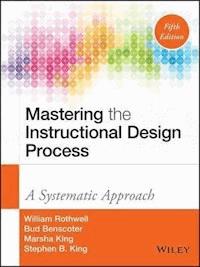
A comprehensive framework for effective real-world instructional design Mastering the Instructional Design Process provides step-by-step guidance on the design and development of an engaging, effective training program. The focus on core competencies of instructional system design helps you develop your skills in a way that's immediately applicable to real-world settings, and this newly updated fifth edition has been revised to reflect the new IBSTPI Competencies and Standards for Instructional Design. With a solid foundation of researched and validated standards, this invaluable guide provides useful insight and a flexible framework for approaching instructional design from a practical perspective. Coverage includes the full range of design considerations concerning the learners, objectives, setting, and more, and ancillaries include design templates, PowerPoint slides, lecture notes, and a test bank help you bring these competencies to the classroom. Instructional design is always evolving, and new trends are emerging to meet the ever-changing needs of learners and exploit the newest tools at our disposal. This book brings together the latest developments and the most effective best practices to give you a foolproof framework for successfully managing instructional design projects. * Detect and solve human performance problems * Analyze needs, learners, work settings, and work * Establish performance objectives and measurements * Deliver effective instruction in a variety of scenarios Effective training programs don't just happen. Instructional design is a complex field, and practitioners must be skilled in very specific areas to deliver a training program that engages learners and makes the learning 'stick.' Mastering the Instructional Design Process is a comprehensive handbook for developing the skillset that facilitates positive training outcomes.
Sie lesen das E-Book in den Legimi-Apps auf:
Seitenzahl: 642
Veröffentlichungsjahr: 2015
Ähnliche


















Table of Contents
Title Page
Copyright
Dedication
Preface to the Fifth Edition
Acknowledgments
About the International Board of Standards for Training, Performance, and Instruction
Advance Organizer
The Advance Organizer
Scoring and Interpreting the Advance Organizer
About This Book
Why Is This Topic Important?
What Can You Achieve with This Book?
How Is This Book Organized?
How Is the Fifth Edition Different from the Fourth Edition?
Part One: Overview
Chapter One: An Overview of Instructional Design
Instructional Design: An Emerging Profession
Instructional Design: Focused on Establishing and Maintaining Efficient and Effective Human Performance
Instructional Design: Guided by a Model of Human Performance
Instructional Design: Carried Out Systematically
Instructional Design: Based on Open Systems Theory
Instructional Design: Oriented to Finding and Applying the Most Cost-Effective Solutions to Human Performance Problems
Criticisms of Traditional Instructional Approaches
Part Two: Planning and Analyzing for Instructional Design
Chapter Two: Conducting a Needs Assessment
Defining Terms
Steps in Developing Needs Assessment
Developing a Needs Assessment Plan: A Case Study
Solving Problems in Conducting Needs Assessments
Identifying Instructional Problems
Ethical Issues in Needs Assessment
Chapter Three: Collecting and Analyzing Data for Instructional Design Projects
The Nature of Data
The Data Collection Process
Data Analysis
Chapter Four: Identifying the Target Population and Environmental Characteristics
Selecting Learner Characteristics for Assessments
Selecting Learner Characteristics: A Case Study Example
When Should Learner Characteristics Be Assessed?
Chapter Five: Using Analytical Techniques to Determine Instructional Content
Identify Content Aligned with Needs Assessment Findings
Elicit, Synthesize, and Validate Content from Subject Matter Experts
Analyze Instructional Products to Determine the Adequacy of Content, Instructions, and Learning to Determine Content Coverage
Determine Subordinate and Prerequisite Skills and Knowledge
Analyze Content
Chapter Six: Analyzing the Potential Use of Existing and Emerging Technologies
E-Learning
The Effectiveness of Today's Instructional Technology
Part Three: Designing and Developing for Instructional Design
Chapter Seven: Using an Instructional Design Process Appropriate for a Project
Selecting or Creating an Instructional Design Process Based on the Project
Modifying the Instructional Design Process as Project Parameters Change
Describing a Rationale for the Selected, Created, or Modified Instructional Design Process
Chapter Eight: Organizing Instructional Programs and/or Products
Determine the Overall Scope of Instructional Programs
Specify and Sequence the Anticipated Learning and Performance Outcomes
Chapter 9: Designing Instructional Interventions
Identifying Instructional Strategies Aligned with Instructional Goals and Anticipated Learning Outcomes
Choosing an Appropriate Instructional Strategy
Choosing Media and Delivery Methods
Selecting Delivery Modes
Appreciating the Learner's Perspective: A Brief Overview of Cognitive Strategies
Using Appropriate Message, Visual, and Motivational Design Principles
Accommodating Social, Cultural, Political, and Other Individual Factors Influencing Learning
Chapter Ten: Planning Noninstructional Interventions
Identifying Appropriate Noninstructional Interventions
Feedback Options
Job Performance Aids
Reward Systems
Employee Selection Practices
Organizational Redesign
Justifying Appropriate Noninstructional Interventions
Creating Design Specifications for Noninstructional Interventions
Chapter Eleven: Selecting or Modifying Existing Instructional Materials
Selecting, Developing, or Modifying Instructional Materials
Conducting Cost-Benefit Analyses to Decide Whether to Use or Modify Existing Materials
Validating Selection or Modification of Existing Instruction
Chapter Twelve: Developing Instructional Materials
Developing Media Specifications
Producing Instructional Materials in Various Delivery Formats
Developing Materials Aligned with Content Analysis, Proposed Technologies, Delivery Methods, and Instructional Strategies
Collaborating with Production Specialists
Chapter Thirteen: Designing Learning Assessments
Introduction
An Overview of Steps in Preparing Instruments
Constructing Reliable and Valid Methods of Assessing Learning and Performance
Ensuring the Assessment Is Aligned with Instructional Goals, Anticipated Learning Outcomes, and Instructional Strategies
Part Four: Evaluating and Implementing Instructional Design
Chapter Fourteen: Evaluating Instructional and Noninstructional Interventions
Purpose and Definitions of Evaluation
Formative Evaluation
Developing a Formative Evaluation Plan
Four Major Approaches to Conducting Formative Evaluation
Summative Evaluations
Reporting Evaluation Results
Creating the Report
Disseminating the Report
Chapter Fifteen: Revising Instructional and Noninstructional Solutions Based on Data
Types of Revisions
Gaining Stakeholder Support for Revisions
Implementing Revisions to Delivery of Products/Programs
Chapter Sixteen: Implementing Instructional and Noninstructional Interventions
Creating a Vision for Change
Planning for the Implementation and Dissemination of the Intervention
Planning for Diffusion of the Intervention
Encouraging and Achieving Adoption and Buy-In
Compliance versus Gaining Commitment
Monitoring Implementation, Dissemination, and Diffusion to Identify Potential Adjustments
Taking Action on Deviations or Problems Surfaced through Monitoring
Part Five: Managing Instructional Design
Chapter Seventeen: Applying Business Skills to Managing the Instructional Design Function
Where Instructional Design Fits into the Larger Organization
Contributing to the Organizational Purpose and Strategy
Implementing Standards
Leveraging Internal and External Resources to Accomplish Project Goals and Objectives
Managing Instructional Design Talent
Marketing and Communicating about Instructional Design
Navigating Organizational Culture, Structure, Politics, and Processes
Chapter Eighteen: Managing Partnerships and Collaborative Relationships
Identifying and Engaging Stakeholders
Building Relations between Instructional Designers and Individuals or Group Members
Managing Cross-Functional Teams
Securing Commitment
Conducting Project Reviews
Chapter Nineteen: Planning and Managing Instructional Design Projects
Unique Challenges Posed by Project Management
Allocating Resources to Support the Project Plan
Part Six: Predicting the Future of Instructional Design
Chapter Twenty: Predicting the Future of Learning and Instructional Design
Technological Advances to Improve Delivery and Design
The Impact of Neuroscience Research on Instructional Systems Design
A Final Word
About the Authors
References
Index
End User License Agreement
Pages
v
xiii
xiv
xv
xvi
xvii
xix
xxi
xxiii
xxiv
xxv
xxvii
xxviii
1
3
4
5
6
7
8
9
10
11
12
13
14
15
16
17
19
20
21
22
23
24
25
26
27
28
29
30
31
32
33
34
35
36
37
38
39
40
41
42
43
44
45
46
47
48
49
50
51
52
53
54
55
56
57
58
59
60
61
62
63
64
65
66
67
68
69
70
71
72
73
74
75
76
77
78
79
80
81
82
83
84
85
86
87
88
89
90
91
92
93
94
95
96
97
98
99
100
101
102
103
104
105
106
107
108
109
110
111
112
113
114
115
117
119
120
121
122
123
124
125
126
127
128
129
130
131
132
133
134
135
136
137
138
139
140
141
142
143
144
145
146
147
148
149
150
151
152
153
154
155
156
157
158
159
160
161
162
163
164
165
166
167
168
169
170
171
172
173
174
175
176
177
178
179
180
181
182
183
184
185
186
187
188
189
190
191
192
193
194
195
196
197
198
199
200
201
202
203
204
205
206
207
208
209
210
211
212
213
214
215
216
217
218
219
220
221
222
223
224
225
226
227
228
229
230
231
233
234
235
236
237
238
239
240
241
242
243
244
245
246
247
248
249
250
251
252
253
254
255
256
257
258
259
260
261
262
263
264
265
266
267
268
269
270
271
272
273
274
275
276
277
278
279
280
281
282
283
284
285
286
287
288
289
291
292
293
294
295
296
297
298
299
300
301
302
303
304
305
306
307
308
309
310
311
312
313
314
315
316
317
318
319
320
321
322
323
324
325
326
327
328
329
330
331
332
333
334
335
336
337
338
339
340
341
343
344
345
346
347
348
349
350
351
352
353
354
355
356
357
358
359
360
361
362
363
364
365
366
367
368
369
370
371
372
373
374
375
376
377
378
379
380
381
383
384
385
386
387
388
389
390
391
392
393
394
395
396
397
Guide
Cover
Table of Contents
Begin Reading
List of Illustrations
Preface to the Fifth Edition
Figure Exhibit P.1 AN INSTRUCTIONAL DESIGN MODEL
Chapter One: An Overview of Instructional Design
Figure 1.1 A Comprehensive Model of Human Performance in Organizations
Figure 1.2 A Situation-specific Model of Human Performance
Figure 1.3 The Basic Components of an organization as an Open System
Chapter Two: Conducting a Needs Assessment
Figure 2.1 A Model of Steps in the Instructional Design Process
Chapter Six: Analyzing the Potential Use of Existing and Emerging Technologies
Figure 6.1 Technology-based Learning Timeline
Chapter Seven: Using an Instructional Design Process Appropriate for a Project
Figure 7.1 Instructional Design Models: How Often do You Use the Following Models?
Chapter Eight: Organizing Instructional Programs and/or Products
Figure 8.1 Steps for Converting Results of Task or Content Analysis Into Performance Objectives
Figure 8.2 Levels of Objectives in the Cognitive Domain
Figure 8.3 Levels of Objectives in the Affective Domain
Figure 8.4 Levels of Objectives in the Psychomotor Domain
Figure 8.5 Rules for Sequence Performance Objectives: A Flowchart
Chapter 9: Designing Instructional Interventions
Figure 9.1 Algorithm for Selection of Instructional Mode
Chapter Sixteen: Implementing Instructional and Noninstructional Interventions
Figure 16.1 Vertical Alignment
Chapter Twenty: Predicting the Future of Learning and Instructional Design
Figure 20.1 Gartner's Hype Cycle
Figure 20.2 Time to Learning
List of Tables
Chapter One: An Overview of Instructional Design
Table 1.1 Factors Affecting Performance
Chapter Two: Conducting a Needs Assessment
Table 2.1 Myths and Cures
Table 2.2 Questions for Developing a Situation-Specific Needs Assessment Plan
Chapter Three: Collecting and Analyzing Data for Instructional Design Projects
Table 3.1 Comparing Quantitative and Qualitative Methods
Table 3.2 Quantitative versus Qualitative Methods: Myths and Reality
Table 3.3 Strengths and Weaknesses of Selected Data Collection Methods
Chapter Four: Identifying the Target Population and Environmental Characteristics
Table 4.1 Summary of Stages in the Classic Dalton, Thompson, and Price Model
Table 4.2 Important Cultural Questions
Table 4.3 Assessing Developmental Characteristics
Chapter Six: Analyzing the Potential Use of Existing and Emerging Technologies
Table 6.1 Authoring Tools
Table 6.2 Blended Learning Tools
Chapter 9: Designing Instructional Interventions
Table 9.1 Instructional Strategies and Tactics
Table 9.2 Instructional Events and the Conditions of Learning They Imply for the Five Types of Learned Capabilities
Chapter Thirteen: Designing Learning Assessments
Table 13.1 Behaviors Specified in Instructional Objectives and Corresponding Test Items
Chapter Fourteen: Evaluating Instructional and Noninstructional Interventions
Table 14.1 Interest in Evaluation by Stakeholder
Chapter Sixteen: Implementing Instructional and Noninstructional Interventions
Table 16.1 People-Resources Needed during the Instructional Design Process
Chapter Eighteen: Managing Partnerships and Collaborative Relationships
Table 18.1 A Model for Selecting Techniques to Establish and Maintain Rapport in Instructional Design Projects
Chapter Twenty: Predicting the Future of Learning and Instructional Design
Table 20.1 Implications of Neuroscience Research for ISD
Fifth Edition
Mastering the Instructional Design Process
A Systematic Approach
A REVISED EDITION BASED ON AN ADAPTATION OF INSTRUCTIONAL DESIGN COMPETENCIES: THE STANDARDS (4TH ED.)
William J. Rothwell
G.M. (Bud) Benscoter
Marsha King
Stephen B. King
This book is printed on acid-free paper. ∞
Copyright © 2016 by Rothwell, Benscoter, King, & King. All rights reserved
The material on pages 4, 19, 20, 61, 77, 90, 119, 145, 171, 189, 196, 216, 228, 234, 263, 271, 272, 291, 317, 318, 334, 335 are printed with permissions from IAP – Information Age Publishing, Inc. All rights are reserved.
Published by John Wiley & Sons, Inc., Hoboken, New Jersey
Published simultaneously in Canada
No part of this publication may be reproduced, stored in a retrieval system, or transmitted in any form or by any means, electronic, mechanical, photocopying, recording, scanning, or otherwise, except as permitted under Section 107 or 108 of the 1976 United States Copyright Act, without either the prior written permission of the Publisher, or authorization through payment of the appropriate per-copy fee to the Copyright Clearance Center, 222 Rosewood Drive, Danvers, MA 01923, (978) 750-8400, fax (978) 646-8600, or on the web at www.copyright.com. Requests to the Publisher for permission should be addressed to the Permissions Department, John Wiley & Sons, Inc., 111 River Street, Hoboken, NJ 07030, (201) 748-6011, fax (201) 748-6008, or online at www.wiley.com/go/permissions.
Limit of Liability/Disclaimer of Warranty: While the publisher and author have used their best efforts in preparing this book, they make no representations or warranties with respect to the accuracy or completeness of the contents of this book and specifically disclaim any implied warranties of merchantability or fitness for a particular purpose. No warranty may be created or extended by sales representatives or written sales materials. The advice and strategies contained herein may not be suitable for your situation. You should consult with a professional where appropriate. Neither the publisher nor the author shall be liable for damages arising herefrom.
For general information about our other products and services, please contact our Customer Care Department within the United States at (800) 762-2974, outside the United States at (317) 572-3993 or fax (317) 572-4002.
Wiley publishes in a variety of print and electronic formats and by print-on-demand. Some material included with standard print versions of this book may not be included in e-books or in print-on-demand. If this book refers to media such as a CD or DVD that is not included in the version you purchased, you may download this material at http://booksupport.wiley.com. For more information about Wiley products, visit www.wiley.com.
Library of Congress Cataloging-in-Publication Data
Names: Rothwell, William J., 1951– author.
Title: Mastering the instructional design process : a systematic approach /
William J. Rothwell, G.M. (Bud) Benscoter, Marsha King, Stephen B. King.
Description: Fifth edition. | Hoboken, New Jersey : John Wiley & Sons, Inc., 2016 | Includes bibliographical references and index.
Identifiers: LCCN 2015036837 | ISBN 9781118947135 (cloth); ISBN 9781118947159 (ePDF); ISBN 9781118947142 (ePub)
Subjects: LCSH: Employees— Training of. | Instructional systems— Design.
Classification: LCC HF5549.5.T7 R659 2016 | DDC 658.3/12404— dc23 LC record available at http://lccn.loc.gov/2015036837
Cover Design: Wiley
Cover Image: © iStock.com/aleksandarvelasevic
William J. Rothwell: I dedicate this book to my wife, Marcelina V. Rothwell. She is the wind beneath my wings.
Bud Benscoter: I dedicate this book to the inspiring and inspired professors, colleagues, and students who influenced my commitment to the field of instructional systems design.
Marsha and Steve King: We dedicate this book to our son, John, who inspires us every day.
Preface to the Fifth Edition
Instructional design has changed dramatically since the fourth edition of this book was published in 2008. Those changes were just as dramatic as what happened between the first edition of this book in 1992, its second edition in 1998, and its third edition in 2004.
Managers are trying harder than ever to improve human performance. In some respects, this pursuit of productivity improvement remains the modern business world's equivalent of the medieval quest for the Holy Grail. There are good reasons for improving performance. The competitive environment has never been more fierce. The outsourcing of products and services—including instructional design work—is taken for granted in many settings. And there is increasing willingness to outsource or offshore services and manufacturing. Blended learning has grown popular, and it has led many instructional designers to feel like they need to relearn their profession from scratch. Then it, too, has undergone dramatic reformation, transformed into unique learning blends that include social media and m-(mobile-) learning. But one thing has not changed: the long-term success of organizations continues to hinge on improved human performance. That is important to remember even as new forms of technology are used, and experimented with, in design and delivery. Media use remains only the means to the end of improved performance, and instructional designers are still subject to the pointed complaint by managers that they are too obsessed with media and not interested enough in achieving learning results that align with achieving their business strategies.
For some, efforts to improve human performance have led to headlong plunges into flashy fads and quick fixes—modern-day snake-oil remedies. Others, however, are meeting the challenges they face by taking a more thoughtful approach: supporting and participating in the systematic analysis of human performance problems, identifying the root causes of those problems, finding and leveraging organizational and individual strengths, considering various improvement strategies, and carrying out the strategies in ways designed to reduce the unintended consequences of action. The desire is keen to accelerate this process through new models and approaches to instructional design, but many people have grown wiser (and more wary) about what it takes to make change happen, even as they have tried to do things faster.
Instructional designers are often the standard-bearers of these calculated efforts to improve human performance. They continue to work under the guise of many job titles. They are sometimes called talent developers, performance technologists, performance consultants, trainers, training and development specialists, workplace learning and performance professionals, learning and performance professionals, instructional developers, staff development specialists, performance consultants, or instructional designers. A 2015 study revealed that over 30 percent of respondents to a global survey felt that the job title “instructional design” did not adequately reflect what they do—and one respondent felt that a better title was “jack of all trades” (Rothwell, Zaballero, Asino, Briskin, Swaggerty, and Bienert 2015). Whatever their titles, instructional designers share a common goal of improving human performance. Perhaps training remains as the best-known performance improvement strategy, although many people are experimenting with approaches that integrate planned learning, unplanned on-the-job learning, and social learning. Management solutions that do not include training range from using job aids, redesigning organizational structures and reporting relationships, redesigning work and jobs, refocusing employee selection methods, re-engineering work-related feedback methods, and designing and implementing employee reward systems. Thousands of ways exist to improve human performance, and the sheer choice of strategies is as daunting as discovering root causes or building on strengths.
The examples and references incorporated in this book grow out of our own experiences in instructional design. Since our experiences have not been universal, we have attempted to focus on what we know. Our goal is to make this book a practical tool for instructional designers to develop their own skills and build their competencies in down-to-earth ways.
But one theme should be stressed from the outset: instructional systems design (ISD) is not about the mindless application of step-by-step schemes or new technology. Improving human performance is hard work. Both an art and a science, instructional design requires a blend of intuitive and analytical thinking. And it requires a willingness to meet needs to solve organizational problems, which (in turn) may demand that instructional designers skip steps in traditional instructional design models, multitask to do several steps at once, rearrange steps, add steps (such as translation), or even reinvent design models to meet the unique needs of unique clients in unique situations. The growing desire for accelerated approaches that align with the fast-paced demands of new technology has prompted new interest in diverse models to guide instructional design.
The Foundation of the Book
In the past, books on instructional design have often reflected the personal opinions of the authors and have not been based on an underlying foundation of solid research. However, Mastering the Instructional Design Process: A Systematic Approach, Fifth Edition, is based on Koszalka, Russ-Eft, and Reiser's Instructional Design Competencies: The Standards (4th ed.) (2013). The fourth edition of this work is abbreviated throughout this book as The Standards. Prepared through the cooperation of highly respected professionals in the instructional design field, The Standards was sponsored by the International Board of Standards for Training, Performance, and Instruction (IBSTPI).
The fifth edition of Mastering the Instructional Design Process: A Systematic Approach begins where The Standards leaves off. While The Standards focuses on what instructional designers do, this book focuses on how to demonstrate instructional design competencies. Its purpose is to point the way toward building and applying instructional design competencies.
The Audience for the Book
This book is for instructional design professionals and professionals in the making, whatever their formal job titles. It is intended as a desk aid to help professionals carry out their work and as a text for students. A list of references appears at the end of the book. We suggest that readers use it to pursue subjects of interest to them.
Mastering the Instructional Design Process: A Systematic Approach, Fifth Edition, should also interest others, such as human resource professionals and operating managers, who have reason to analyze human performance problems systematically, pinpoint the root causes of those problems, identify strengths, consider various solutions to the problems or methods of building on strengths, and carry out the performance improvement efforts in ways designed to reduce the unintended side effects of action.
Overview of the Contents
This book is adapted from The Standards. The chapters do not exactly follow the sequence of competencies in The Standards. That is necessary because print media is linear. Some may want to follow a step-by-step approach. But others, more wisely, will know to adapt their project approach to meet client and learner demands and project constraints. See a graphic illustrating the book's organizational scheme in Exhibit P.1.
Exhibit P.1 AN INSTRUCTIONAL DESIGN MODEL
The book opens with an Advance Organizer. The advance organizer helps readers assess their own grasp of instructional systems design.
Part One comprises only one chapter. Chapter 1 provides a conceptual foundation for the book. Its focus is on summarizing the instructional design field. This chapter sets the stage for the remainder of the book by defining instructional design, describing instructional design as an emerging profession, and summarizing key issues affecting human performance in organizations. It also addresses several important critiques of traditional instructional design approaches.
Part Two is entitled “Planning and Analyzing for Instructional Design.” It comprises Chapters 2 through 6. Chapter 2 is about conducting a needs assessment, Chapter 3 is about collecting and analyzing data about instructional design projects, Chapter 4 is about identifying the target population and environmental characteristics for instruction, Chapter 5 is on using analytical techniques to determine instructional content, and Chapter 6 is entitled “Analyzing the Potential Use of Existing and Emerging Technologies.”
Part Three is called “Designing and Developing for Instructional Design.” Chapter 7 examines how to use an instructional design process appropriate for a project, Chapter 8 discusses ways to organize instructional programs and/or products, Chapter 9 reviews how to design instructional interventions, Chapter 10 reviews ways to plan noninstructional interventions, Chapter 11 advises on ways to select or modify existing instructional materials, Chapter 12 offers suggestions on developing instructional materials, and Chapter 13 focuses on how to design learning assessments.
Part Four is called “Evaluating and Implementing Instructional Design.” It includes Chapters 14 through 16. Chapter 14 suggests ways to evaluate instructional and noninstructional interventions, Chapter 15 examines ways to revise instructional and noninstructional solutions, and Chapter 16 gives advice on implementing instructional and noninstructional interventions.
Part Five is “Managing Instructional Design.” Chapter 17 explains how to apply business skills to managing the instructional design function, Chapter 18 offers tips on managing partnerships and collaborative relationships, and Chapter 19 suggests how to plan and manage instructional design projects.
Part Six is “Predicting the Future of Instructional Design.” It comprises Chapter 20, which concludes the book. It lists some trends that will shape the future of instructional design.
Acknowledgments
We wish to thank members of the International Board of Standards for Training, Performance and Instruction (IBSTPI) for their encouragement of this project and their permission to use The Standards as the foundation for this book. (A description of IBSTPI appears on the next page for those who are curious about what the board is and what it stands for.) While any mistakes in this book are entirely our responsibility and not that of the International Board, we are indebted to the board members for their support.
William J. Rothwell also thanks his graduate research assistant Jae Young Lee for her assistance in helping to secure, and repeatedly follow up on, necessary copyright permissions.
William J. RothwellUniversity Park, PennsylvaniaG.M. (Bud) BenscoterRaleigh, North CarolinaMarsha KingGlenview, IllinoisSteve KingGlenview, Illinois
About the International Board of Standards for Training, Performance, and Instruction
For more than three decades, The International Board of Standards for Training, Performance, and Instruction (IBSTPI®) has been developing and validating the standards for professionals in the fields of training and performance.
IBSTPI's standards come about as a result of a rigorous research process, development, international validation, and publication.
IBSTPI leads the way in developing standards for the training and performance professions.
Worldwide, aspiring and active professionals, educational institutions, and organizations in a wide variety of sectors, including private industry, academia, military, and government, use IBSTPI's standards to establish professional benchmarks, improve individual performance and organizational results, and to further extend the research about and around the competencies.
Source: Taken from www.linkedin.com/company/ibstpi. Used by permission of IBTSPI.
Lesen Sie weiter in der vollständigen Ausgabe!
Lesen Sie weiter in der vollständigen Ausgabe!
Lesen Sie weiter in der vollständigen Ausgabe!
Lesen Sie weiter in der vollständigen Ausgabe!
Lesen Sie weiter in der vollständigen Ausgabe!
Lesen Sie weiter in der vollständigen Ausgabe!
Lesen Sie weiter in der vollständigen Ausgabe!
Lesen Sie weiter in der vollständigen Ausgabe!
Lesen Sie weiter in der vollständigen Ausgabe!
Lesen Sie weiter in der vollständigen Ausgabe!
Lesen Sie weiter in der vollständigen Ausgabe!
Lesen Sie weiter in der vollständigen Ausgabe!
Lesen Sie weiter in der vollständigen Ausgabe!
Lesen Sie weiter in der vollständigen Ausgabe!
Lesen Sie weiter in der vollständigen Ausgabe!
Lesen Sie weiter in der vollständigen Ausgabe!
Lesen Sie weiter in der vollständigen Ausgabe!
Lesen Sie weiter in der vollständigen Ausgabe!
Lesen Sie weiter in der vollständigen Ausgabe!
Lesen Sie weiter in der vollständigen Ausgabe!
Lesen Sie weiter in der vollständigen Ausgabe!
Lesen Sie weiter in der vollständigen Ausgabe!
Lesen Sie weiter in der vollständigen Ausgabe!
Lesen Sie weiter in der vollständigen Ausgabe!
Lesen Sie weiter in der vollständigen Ausgabe!
Lesen Sie weiter in der vollständigen Ausgabe!
Lesen Sie weiter in der vollständigen Ausgabe!
Lesen Sie weiter in der vollständigen Ausgabe!
Lesen Sie weiter in der vollständigen Ausgabe!
Lesen Sie weiter in der vollständigen Ausgabe!
Lesen Sie weiter in der vollständigen Ausgabe!




