


29,99 €
Mehr erfahren.
- Herausgeber: Packt Publishing
- Kategorie: Fachliteratur
- Sprache: Englisch
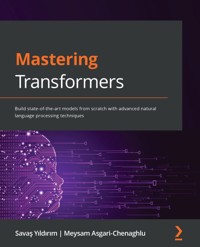
Transformer-based language models have dominated natural language processing (NLP) studies and have now become a new paradigm. With this book, you'll learn how to build various transformer-based NLP applications using the Python Transformers library.
The book gives you an introduction to Transformers by showing you how to write your first hello-world program. You'll then learn how a tokenizer works and how to train your own tokenizer. As you advance, you'll explore the architecture of autoencoding models, such as BERT, and autoregressive models, such as GPT. You'll see how to train and fine-tune models for a variety of natural language understanding (NLU) and natural language generation (NLG) problems, including text classification, token classification, and text representation. This book also helps you to learn efficient models for challenging problems, such as long-context NLP tasks with limited computational capacity. You'll also work with multilingual and cross-lingual problems, optimize models by monitoring their performance, and discover how to deconstruct these models for interpretability and explainability. Finally, you'll be able to deploy your transformer models in a production environment.
By the end of this NLP book, you'll have learned how to use Transformers to solve advanced NLP problems using advanced models.
Das E-Book können Sie in Legimi-Apps oder einer beliebigen App lesen, die das folgende Format unterstützen:
Seitenzahl: 360
Veröffentlichungsjahr: 2021
Ähnliche


















Mastering Transformers
Build state-of-the-art models from scratch with advanced natural language processing techniques
Savaş Yıldırım
Meysam Asgari-Chenaghlu
BIRMINGHAM—MUMBAI
Mastering Transformers
Copyright © 2021 Packt Publishing
All rights reserved. No part of this book may be reproduced, stored in a retrieval system, or transmitted in any form or by any means, without the prior written permission of the publisher, except in the case of brief quotations embedded in critical articles or reviews.
Every effort has been made in the preparation of this book to ensure the accuracy of the information presented. However, the information contained in this book is sold without warranty, either express or implied. Neither the authors, nor Packt Publishing or its dealers and distributors, will be held liable for any damages caused or alleged to have been caused directly or indirectly by this book.
Packt Publishing has endeavored to provide trademark information about all of the companies and products mentioned in this book by the appropriate use of capitals. However, Packt Publishing cannot guarantee the accuracy of this information.
Publishing Product Manager: Aditi Gour
Senior Editor: David Sugarman
Content Development Editor: Nathanya Dias
Technical Editor: Arjun Varma
Copy Editor: Safis Editing
Project Coordinator: Aparna Ravikumar Nair
Proofreader: Safis Editing
Indexer: Tejal Daruwale Soni
Production Designer: Alishon Mendonca
First published: September 2021
Production reference: 1290721
Published by Packt Publishing Ltd.
Livery Place
35 Livery Street
Birmingham
B3 2PB, UK.
ISBN 978-1-80107-765-1
www.packt.com
Contributors
About the authors
Savaş Yıldırım graduated from the Istanbul Technical University Department of Computer Engineering and holds a Ph.D. degree in Natural Language Processing (NLP). Currently, he is an associate professor at the Istanbul Bilgi University, Turkey, and is a visiting researcher at the Ryerson University, Canada. He is a proactive lecturer and researcher with more than 20 years of experience teaching courses on machine learning, deep learning, and NLP. He has significantly contributed to the Turkish NLP community by developing a lot of open source software and resources. He also provides comprehensive consultancy to AI companies on their R&D projects. In his spare time, he writes and directs short films, and enjoys practicing yoga.
First of all, I would like to thank my dear partner, Aylin Oktay, for her continuous support, patience, and encouragement throughout the long process of writing this book. I would also like to thank my colleagues at the Istanbul Bilgi University, Department of Computer Engineering, for their support.
Meysam Asgari-Chenaghlu is an AI manager at Carbon Consulting and is also a Ph.D. candidate at the University of Tabriz. He has been a consultant for Turkey's leading telecommunication and banking companies. He has also worked on various projects, including natural language understanding and semantic search.
First and foremost, I would like to thank my loving and patient wife, Narjes Nikzad-Khasmakhi, for her support and understanding. I would also like to thank my father for his support; may his soul rest in peace. Many thanks to Carbon Consulting and my co-workers.
About the reviewer
Alexander Afanasyev is a software engineer with about 14 years of experience in a variety of different domains and roles. Currently, Alexander is an independent contractor who pursues ideas in the space of computer vision, NLP, and building advanced data collection systems in the cyber threat intelligence domain. Previously, Alexander helped review the Selenium Testing Cookbook book by Packt. Outside of daily work, he is an active contributor to Stack Overflow and GitHub.
I would like to thank the authors of this book for their hard work and for providing innovative content; the wonderful team of editors and coordinators with excellent communication skills; and my family, who was and always is supportive of my ideas and my work.
Table of Contents
Preface
Section 1: Introduction – Recent Developments in the Field, Installations, and Hello World Applications
Chapter 1: From Bag-of-Words to the Transformer
Technical requirements
Evolution of NLP toward Transformers
Understanding distributional semantics
BoW implementation
Overcoming the dimensionality problem
Language modeling and generation
Leveraging DL
Learning word embeddings
A brief overview of RNNs
LSTMs and gated recurrent units
A brief overview of CNNs
Overview of the Transformer architecture
Attention mechanism
Multi-head attention mechanisms
Using TL with Transformers
Summary
References
Chapter 2: A Hands-On Introduction to the Subject
Technical requirements
Installing Transformer with Anaconda
Installation on Linux
Installation on Windows
Installation on macOS
Installing TensorFlow, PyTorch, and Transformer
Installing using Google Colab
Working with language models and tokenizers
Working with community-provided models
Working with benchmarks and datasets
Important benchmarks
Accessing the datasets with an Application Programming Interface
Benchmarking for speed and memory
Summary
Section 2: Transformer Models – From Autoencoding to Autoregressive Models
Chapter 3: Autoencoding Language Models
Technical requirements
BERT – one of the autoencoding language models
BERT language model pretraining tasks
A deeper look into the BERT language model
Autoencoding language model training for any language
Sharing models with the community
Understanding other autoencoding models
Introducing ALBERT
RoBERTa
ELECTRA
Working with tokenization algorithms
Byte pair encoding
WordPiece tokenization
Sentence piece tokenization
The tokenizers library
Summary
Chapter 4: Autoregressive and Other Language Models
Technical requirements
Working with AR language models
Introduction and training models with GPT
Transformer-XL
XLNet
Working with Seq2Seq models
T5
Introducing BART
AR language model training
NLG using AR models
Summarization and MT fine-tuning using simpletransformers
Summary
References
Chapter 5: Fine-Tuning Language Models for Text Classification
Technical requirements
Introduction to text classification
Fine-tuning a BERT model for single-sentence binary classification
Training a classification model with native PyTorch
Fine-tuning BERT for multi-class classification with custom datasets
Fine-tuning the BERT model for sentence-pair regression
Utilizing run_glue.py to fine-tune the models
Summary
Chapter 6: Fine-Tuning Language Models for Token Classification
Technical requirements
Introduction to token classification
Understanding NER
Understanding POS tagging
Understanding QA
Fine-tuning language models for NER
Question answering using token classification
Summary
Chapter 7: Text Representation
Technical requirements
Introduction to sentence embeddings
Cross-encoder versus bi-encoder
Benchmarking sentence similarity models
Using BART for zero-shot learning
Semantic similarity experiment with FLAIR
Average word embeddings
RNN-based document embeddings
Transformer-based BERT embeddings
Sentence-BERT embeddings
Text clustering with Sentence-BERT
Topic modeling with BERTopic
Semantic search with Sentence-BERT
Summary
Further reading
Section 3: Advanced Topics
Chapter 8: Working with Efficient Transformers
Technical requirements
Introduction to efficient, light, and fast transformers
Implementation for model size reduction
Working with DistilBERT for knowledge distillation
Pruning transformers
Quantization
Working with efficient self-attention
Sparse attention with fixed patterns
Learnable patterns
Low-rank factorization, kernel methods, and other approaches
Summary
References
Chapter 9: Cross-Lingual and Multilingual Language Modeling
Technical requirements
Translation language modeling and cross-lingual knowledge sharing
XLM and mBERT
mBERT
XLM
Cross-lingual similarity tasks
Cross-lingual text similarity
Visualizing cross-lingual textual similarity
Cross-lingual classification
Cross-lingual zero-shot learning
Fundamental limitations of multilingual models
Fine-tuning the performance of multilingual models
Summary
References
Chapter 10: Serving Transformer Models
Technical requirements
fastAPI Transformer model serving
Dockerizing APIs
Faster Transformer model serving using TFX
Load testing using Locust
Summary
References
Chapter 11: Attention Visualization and Experiment Tracking
Technical requirements
Interpreting attention heads
Visualizing attention heads with exBERT
Multiscale visualization of attention heads with BertViz
Understanding the inner parts of BERT with probing classifiers
Tracking model metrics
Tracking model training with TensorBoard
Tracking model training live with W&B
Summary
References
Why subscribe?
Other Books You May Enjoy
Section 1: Introduction – Recent Developments in the Field, Installations, and Hello World Applications
In this section, you will learn about all aspects of Transformers at an introductory level. You will write your first hello-world program with Transformers by loading community-provided pre-trained language models and running the related code with or without a GPU. Installing and utilizing the tensorflow, pytorch, conda, transformers, and sentenceTransformers libraries will also be explained in detail in this section.
This section comprises the following chapters:
Chapter 1, From Bag-of-Words to the TransformersChapter 2, A Hands-On Introduction to the Subject




