


103,99 €
Mehr erfahren.
- Herausgeber: John Wiley & Sons
- Kategorie: Fachliteratur
- Serie: Frank J. Fabozzi Series
- Sprache: Englisch
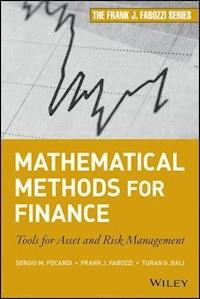
The mathematical and statistical tools needed in the rapidly growing quantitative finance field With the rapid growth in quantitative finance, practitioners must achieve a high level of proficiency in math and statistics. Mathematical Methods and Statistical Tools for Finance, part of the Frank J. Fabozzi Series, has been created with this in mind. Designed to provide the tools needed to apply finance theory to real world financial markets, this book offers a wealth of insights and guidance in practical applications. It contains applications that are broader in scope from what is covered in a typical book on mathematical techniques. Most books focus almost exclusively on derivatives pricing, the applications in this book cover not only derivatives and asset pricing but also risk management--including credit risk management--and portfolio management. * Includes an overview of the essential math and statistical skills required to succeed in quantitative finance * Offers the basic mathematical concepts that apply to the field of quantitative finance, from sets and distances to functions and variables * The book also includes information on calculus, matrix algebra, differential equations, stochastic integrals, and much more * Written by Sergio Focardi, one of the world's leading authors in high-level finance Drawing on the author's perspectives as a practitioner and academic, each chapter of this book offers a solid foundation in the mathematical tools and techniques need to succeed in today's dynamic world of finance.
Sie lesen das E-Book in den Legimi-Apps auf:
Seitenzahl: 405
Veröffentlichungsjahr: 2013
Ähnliche



















Contents
Cover
Series Page
Title Page
Copyright Page
Dedication
Preface
About the Authors
Chapter 1: Basic Concepts
INTRODUCTION
SETS AND SET OPERATIONS
DISTANCES AND QUANTITIES
FUNCTIONS
VARIABLES
KEY POINTS
Chapter 2: Differential Calculus
INTRODUCTION
LIMITS
CONTINUITY
TOTAL VARIATION
THE NOTION OF DIFFERENTIATION
COMMONLY USED RULES FOR COMPUTING DERIVATIVES
HIGHER-ORDER DERIVATIVES
TAYLOR SERIES EXPANSION
CALCULUS IN MORE THAN ONE VARIABLE
KEY POINTS
Chapter 3: Integral Calculus
INTRODUCTION
RIEMANN INTEGRALS
LEBESGUE-STIELTJES INTEGRALS
INDEFINITE AND IMPROPER INTEGRALS
THE FUNDAMENTAL THEOREM OF CALCULUS
INTEGRAL TRANSFORMS
CALCULUS IN MORE THAN ONE VARIABLE
KEY POINTS
Chapter 4: Matrix Algebra
INTRODUCTION
VECTORS AND MATRICES DEFINED
SQUARE MATRICES
DETERMINANTS
SYSTEMS OF LINEAR EQUATIONS
LINEAR INDEPENDENCE AND RANK
HANKEL MATRIX
VECTOR AND MATRIX OPERATIONS
FINANCE APPLICATION
EIGENVALUES AND EIGENVECTORS
DIAGONALIZATION AND SIMILARITY
SINGULAR VALUE DECOMPOSITION
KEY POINTS
Chapter 5: Probability
INTRODUCTION
REPRESENTING UNCERTAINTY WITH MATHEMATICS
PROBABILITY IN A NUTSHELL
OUTCOMES AND EVENTS
PROBABILITY
MEASURE
RANDOM VARIABLES
INTEGRALS
DISTRIBUTIONS AND DISTRIBUTION FUNCTIONS
RANDOM VECTORS
STOCHASTIC PROCESSES
PROBABILISTIC REPRESENTATION OF FINANCIAL MARKETS
INFORMATION STRUCTURES
FILTRATION
KEY POINTS
Chapter 6: Probability
INTRODUCTION
CONDITIONAL PROBABILITY AND CONDITIONAL EXPECTATION
MOMENTS AND CORRELATION
COPULA FUNCTIONS
SEQUENCES OF RANDOM VARIABLES
INDEPENDENT AND IDENTICALLY DISTRIBUTED SEQUENCES
SUM OF VARIABLES
GAUSSIAN VARIABLES
APPPROXIMATING THE TAILS OF A PROBABILITY DISTRIBUTION: CORNISH-FISHER EXPANSION AND HERMITE POLYNOMIALS
THE REGRESSION FUNCTION
FAT TAILS AND STABLE LAWS
KEY POINTS
Chapter 7: Optimization
INTRODUCTION
MAXIMA AND MINIMA
LAGRANGE MULTIPLIERS
NUMERICAL ALGORITHMS
CALCULUS OF VARIATIONS AND OPTIMAL CONTROL THEORY
STOCHASTIC PROGRAMMING
APPLICATION TO BOND PORTFOLIO: LIABILITY-FUNDING STRATEGIES
KEY POINTS
Chapter 8: Difference Equations
INTRODUCTION
THE LAG OPERATOR L
HOMOGENEOUS DIFFERENCE EQUATIONS
RECURSIVE CALCULATION OF VALUES OF DIFFERENCE EQUATIONS
NONHOMOGENEOUS DIFFERENCE EQUATIONS
SYSTEMS OF LINEAR DIFFERENCE EQUATIONS
SYSTEMS OF HOMOGENEOUS LINEAR DIFFERENCE EQUATIONS
KEY POINTS
Chapter 9: Differential Equations
INTRODUCTION
DIFFERENTIAL EQUATIONS DEFINED
ORDINARY DIFFERENTIAL EQUATIONS
SYSTEMS OF ORDINARY DIFFERENTIAL EQUATIONS
CLOSED-FORM SOLUTIONS OF ORDINARY DIFFERENTIAL EQUATIONS
NUMERICAL SOLUTIONS OF ORDINARY DIFFERENTIAL EQUATIONS
NONLINEAR DYNAMICS AND CHAOS
PARTIAL DIFFERENTIAL EQUATIONS
KEY POINTS
Chapter 10: Stochastic Integrals
INTRODUCTION
THE INTUITION BEHIND STOCHASTIC INTEGRALS
BROWNIAN MOTION DEFINED
PROPERTIES OF BROWNIAN MOTION
STOCHASTIC INTEGRALS DEFINED
SOME PROPERTIES OF ITÔ STOCHASTIC INTEGRALS
MARTINGALE MEASURES AND THE GIRSANOV THEOREM
KEY POINTS
Chapter 11: Stochastic Differential Equations
INTRODUCTION
THE INTUITION BEHIND STOCHASTIC DIFFERENTIAL EQUATIONS
ITÔ PROCESSES
STOCHASTIC DIFFERENTIAL EQUATIONS
GENERALIZATION TO SEVERAL DIMENSIONS
SOLUTION OF STOCHASTIC DIFFERENTIAL EQUATIONS
DERIVATION OF ITÔ’S LEMMA
DERIVATION OF THE BLACK-SCHOLES OPTION PRICING FORMULA
KEY POINTS
Index
The Frank J. Fabozzi Series
Fixed Income Securities, Second Edition by Frank J. Fabozzi
Focus on Value: A Corporate and Investor Guide to Wealth Creation by James L. Grant and James A. Abate
Handbook of Global Fixed Income Calculations by Dragomir Krgin
Managing a Corporate Bond Portfolio by Leland E. Crabbe and Frank J. Fabozzi
Real Options and Option-Embedded Securities by William T. Moore
Capital Budgeting: Theory and Practice by Pamela P. Peterson and Frank J. Fabozzi
The Exchange-Traded Funds Manual by Gary L. Gastineau
Professional Perspectives on Fixed Income Portfolio Management, Volume 3 edited by Frank J. Fabozzi
Investing in Emerging Fixed Income Markets edited by Frank J. Fabozzi and Efstathia Pilarinu
Handbook of Alternative Assets by Mark J. P. Anson
The Global Money Markets by Frank J. Fabozzi, Steven V. Mann, and Moorad Choudhry
The Handbook of Financial Instruments edited by Frank J. Fabozzi
Interest Rate, Term Structure, and Valuation Modeling edited by Frank J. Fabozzi
Investment Performance Measurement by Bruce J. Feibel
The Handbook of Equity Style Management edited by T. Daniel Coggin and Frank J. Fabozzi
The Theory and Practice of Investment Management edited by Frank J. Fabozzi and Harry M. Markowitz
Foundations of Economic Value Added, Second Edition by James L. Grant
Financial Management and Analysis, Second Edition by Frank J. Fabozzi and Pamela P. Peterson
Measuring and Controlling Interest Rate and Credit Risk, Second Edition by Frank J. Fabozzi, Steven V. Mann, and Moorad Choudhry
Professional Perspectives on Fixed Income Portfolio Management, Volume 4 edited by Frank J. Fabozzi
The Handbook of European Fixed Income Securities edited by Frank J. Fabozzi and Moorad Choudhry
The Handbook of European Structured Financial Products edited by Frank J. Fabozzi and Moorad Choudhry
The Mathematics of Financial Modeling and Investment Management by Sergio M. Focardi and Frank J. Fabozzi
Short Selling: Strategies, Risks, and Rewards edited by Frank J. Fabozzi
The Real Estate Investment Handbook by G. Timothy Haight and Daniel Singer
Market Neutral Strategies edited by Bruce I. Jacobs and Kenneth N. Levy
Securities Finance: Securities Lending and Repurchase Agreements edited by Frank J. Fabozzi and Steven V. Mann
Fat-Tailed and Skewed Asset Return Distributions by Svetlozar T. Rachev, Christian Menn, and Frank J. Fabozzi
Financial Modeling of the Equity Market: From CAPM to Cointegration by Frank J. Fabozzi, Sergio M. Focardi, and Petter N. Kolm
Advanced Bond Portfolio Management: Best Practices in Modeling and Strategies edited by Frank J. Fabozzi, Lionel Martellini, and Philippe Priaulet
Analysis of Financial Statements, Second Edition by Pamela P. Peterson and Frank J. Fabozzi
Collateralized Debt Obligations: Structures and Analysis, Second Edition by Douglas J. Lucas, Laurie S. Goodman, and Frank J. Fabozzi
Handbook of Alternative Assets, Second Edition by Mark J. P. Anson
Introduction to Structured Finance by Frank J. Fabozzi, Henry A. Davis, and Moorad Choudhry
Financial Econometrics by Svetlozar T. Rachev, Stefan Mittnik, Frank J. Fabozzi, Sergio M. Focardi, and Teo Jasic
Developments in Collateralized Debt Obligations: New Products and Insights by Douglas J. Lucas, Laurie S. Goodman, Frank J. Fabozzi, and Rebecca J. Manning
Robust Portfolio Optimization and Management by Frank J. Fabozzi, Peter N. Kolm, Dessislava A. Pachamanova, and Sergio M. Focardi
Advanced Stochastic Models, Risk Assessment, and Portfolio Optimizations by Svetlozar T. Rachev, Stogan V. Stoyanov, and Frank J. Fabozzi
How to Select Investment Managers and Evaluate Performance by G. Timothy Haight, Stephen O. Morrell, and Glenn E. Ross
Bayesian Methods in Finance by Svetlozar T. Rachev, John S. J. Hsu, Biliana S. Bagasheva, and Frank J. Fabozzi
The Handbook of Municipal Bonds edited by Sylvan G. Feldstein and Frank J. Fabozzi
Subprime Mortgage Credit Derivatives by Laurie S. Goodman, Shumin Li, Douglas J. Lucas, Thomas A Zimmerman, and Frank J. Fabozzi
Introduction to Securitization by Frank J. Fabozzi and Vinod Kothari
Structured Products and Related Credit Derivatives edited by Brian P. Lancaster, Glenn M. Schultz, and Frank J. Fabozzi
Handbook of Finance: Volume I: Financial Markets and Instruments edited by Frank J. Fabozzi
Handbook of Finance: Volume II: Financial Management and Asset Management edited by Frank J. Fabozzi
Handbook of Finance: Volume III: Valuation, Financial Modeling, and Quantitative Tools edited by Frank J. Fabozzi
Finance: Capital Markets, Financial Management, and Investment Management by Frank J. Fabozzi and Pamela Peterson-Drake
Active Private Equity Real Estate Strategy edited by David J. Lynn
Foundations and Applications of the Time Value of Money by Pamela Peterson-Drake and Frank J. Fabozzi
Leveraged Finance: Concepts, Methods, and Trading of High-Yield Bonds, Loans, and Derivatives by Stephen Antczak, Douglas Lucas, and Frank J. Fabozzi
Modern Financial Systems: Theory and Applications by Edwin Neave
Institutional Investment Management: Equity and Bond Portfolio Strategies and Applications by Frank J. Fabozzi
Cover image: © Brownstock / Alamy Cover design: Wiley
Copyright © 2013 by John Wiley & Sons, Inc. All rights reserved.
Published by John Wiley & Sons, Inc., Hoboken, New Jersey. Published simultaneously in Canada.
No part of this publication may be reproduced, stored in a retrieval system, or transmitted in any form or by any means, electronic, mechanical, photocopying, recording, scanning, or otherwise, except as permitted under Section 107 or 108 of the 1976 United States Copyright Act, without either the prior written permission of the Publisher, or authorization through payment of the appropriate per-copy fee to the Copyright Clearance Center, Inc., 222 Rosewood Drive, Danvers, MA 01923, (978) 750-8400, fax (978) 646-8600, or on the Web at www.copyright.com. Requests to the Publisher for permission should be addressed to the Permissions Department, John Wiley & Sons, Inc., 111 River Street, Hoboken, NJ 07030, (201) 748-6011, fax (201) 748-6008, or online at http://www.wiley.com/go/permissions.
Limit of Liability/Disclaimer of Warranty: While the publisher and author have used their best efforts in preparing this book, they make no representations or warranties with respect to the accuracy or completeness of the contents of this book and specifically disclaim any implied warranties of merchantability or fitness for a particular purpose. No warranty may be created or extended by sales representatives or written sales materials. The advice and strategies contained herein may not be suitable for your situation. You should consult with a professional where appropriate. Neither the publisher nor author shall be liable for any loss of profit or any other commercial damages, including but not limited to special, incidental, consequential, or other damages.
For general information on our other products and services or for technical support, please contact our Customer Care Department within the United States at (800) 762-2974, outside the United States at (317) 572-3993 or fax (317) 572-4002.
Wiley publishes in a variety of print and electronic formats and by print-on-demand. Some material included with standard print versions of this book may not be included in e-books or in print-on-demand. If this book refers to media such as a CD or DVD that is not included in the version you purchased, you may download this material at http://booksupport.wiley.com. For more information about Wiley products, visit www.wiley.com.
ISBN 978-1-118-31263-6 (Hardcover) ISBN 978-1-118-42008-9 (ePDF) ISBN 978-1-118-42149-9 (ePub)
To the memory of my parents SMF
To my wife, Donna, and my children, Patricia, Karly, and Francesco FJF
To my wife, Mehtap, and my son, Kaan TGB
Preface
Since the pioneering work of Harry Markowitz in the 1950s, mathematical tools drawing from the fields of standard and stochastic calculus, set theory, probability theory, stochastic processes, matrix algebra, optimization theory, and differential equations have increasingly made their way into finance. Some of these tools have been used in the development of financial theory, such as asset pricing theory and option pricing theory, as well as like theories in the practice of asset management, risk management, and financial modeling.
Different areas of finance call for different mathematics. For example, asset management, also referred to as investment management and money management, is primarily concerned with understanding hard facts about financial processes. Ultimately, the performance of an asset manager is linked to an understanding of risk and return. This implies the ability to extract information from time series data that are highly noisy and appear nearly random. Mathematical models must be simple, but with a deep economic meaning. In other areas, the complexity of instruments is the key driver behind the growing use of sophisticated mathematics in finance. There is the need to understand how relatively simple assumptions on the probabilistic behavior of basic quantities translate into the potentially very complex probabilistic behavior of financial products. Examples of such products include option-type financial derivatives (such as options, swaptions, caps, and floors), credit derivatives, bonds with embedded option-like payoffs (such as callable bonds and convertible bonds), structured notes, and mortgage-backed securities.
One might question whether all this mathematics is justified in finance. The field of finance is generally considered much less accurate and viable than the physical sciences. Sophisticated mathematical models of financial markets and market agents have been developed but their accuracy is questionable to the point that the recent global financial crisis is often blamed on unwarranted faith on faulty mathematical models. However, we believe that the mathematical handling of finance is reasonably successful and models are not to be blamed for this crisis. Finance does not study laws of nature but complex human artifacts—the financial markets—that are designed to be largely uncertain. We could make financial markets less uncertain and, thereby, mathematical models more faithful by introducing more rules and collecting more data. Collectively, we have decided not to do so and, therefore, models can only be moderately accurate. Still, they offer a valuable design tool to engineer our financial systems. Nevertheless, the mathematics of finance cannot be that of physics. It is the mathematics of learning and complexity, similar to the mathematics used in studying biological and ecological systems.
In 1960, the physicist Eugene Wigner, recipient of the 1962 Nobel Prize in Physics, wrote his now famous paper “The Unreasonable Effectiveness of Mathematics in the Natural Sciences.” Wigner argued that the success of mathematics in describing natural phenomena is so extraordinary that it is in itself a phenomenon that needs explanation.1 Mathematics in finance is reasonably effective and the reasons why it is reasonably effective deserve an explanation. Recently, the world went through the worst financial and economic crisis since the Great Depression. Many have pointed their fingers at the growing use of mathematics in finance and the resulting mathematical models. We would argue that mathematics does not have much to do with that crisis. In a nutshell, we believe that mathematics is reasonably effective in finance because we apply it to study large engineered artifacts—financial markets—that have been designed to have a lot of freedom. Modern financial systems are designed to be relatively unpredictable and uncontrolled in order to leave possibilities of changes and innovations. The level of unpredictability and control is different in different systems. Some systems are prone to crises. Mathematics does a reasonably good job to describe these systems. But the mathematics involved is not the same as that of physics. It is the mathematics of learning and complexity. Mathematics can be perceived as ineffective in finance only if we insist on comparing it with physics.
There are differences between finance and the physical sciences. In the three centuries following the publication of Newton’s Principia in 1687, physics has developed into an axiomatic theory. Physical theories are axiomatic in the sense that that the entire theory can be derived through mathematical deduction from a small number of fundamental laws. Physics is not yet completely unified but the different disciplines that make the body of physics are axiomatic. Even more striking is the fact that physical phenomena can be approximately represented by computational structures, so that physical reality can be mimicked by a computer program.
Though it is clear that finance has made progress and will make additional progress only by adopting the scientific method of empirical science, it should be clear that there are significant differences between finance and physics. We can identify, albeit with some level of arbitrariness, four major differences between finance and the physical sciences:
None of the above four points is in itself an objection to the scientific study of finance as a mathematical science. However, it should be clear that the methods of scientific investigations and the findings of finance might be conceptually different from those of the physical sciences. It would probably be a mistake to expect in finance the same type of generalized axiomatic laws that we find in physics.
One of the major sources of the progress made by physics is due to the ability to isolate elementary subsystems, to come out with laws that apply to these subsystems, and then to recover macroscopic laws by a mathematical process. For example, the study of mechanics was greatly simplified by the study of the material point, a subsystem without structure identified by a small number of continuous variables. After identifying the laws that govern the motion of a material point, the motion of any physical body can be recovered by a process of mathematical integration. Simplifications of this type allow one to both simplify the mathematics and to perform empirical tests in a simplified environment.
In financial economics, however, we cannot study idealized subsystems because we cannot identify subsystems with a simplified behavior. This is not to say that attempts have not been made. Drawing on the principles of microeconomics, financial economics attempts to study the behavior of individuals as the elementary units of the financial system. The real problem, however, is that the study of individuals as economic “atoms” cannot produce simple laws because it is the study of a human financial decision-making process, which is very complex in itself. In addition, we cannot perform experiments. Instead, we have to rely on how the only financial system we know develops in itself.
Note that the possibility to study elementary subsystems does not coincide with the existence of fundamental laws. For example, consider the Schrödinger equation of quantum mechanics formulated in 1926 by the physicist Erwin Schrödinger. The equation is a partial differential equation describing how in some physical system a quantum state evolves over time. Although the Schrödinger equation is indeed a fundamental law, it applies to any system and not only to microscopic entities. Fundamental laws are not necessarily microscopic laws. We might be able to find fundamental laws of finance even if we are unable to isolate elementary subsystems.
There is a strong connection between fundamental laws and the ability to make experiments. By their nature, fundamental laws are very general and can be applied, albeit after difficult mathematical manipulations, to any phenomena. Therefore, after discovering a fundamental law it is generally possible to design experiments specific to test that same law. In many instances in the history of physics, crucial experiments have suggested rejection of a theory in favor of a new competing theory. However, in finance the ability to conduct experiments is limited though important research in this field has been carried on. In the 1970s, Daniel Kahneman and Amos Tversky performed groundbreaking research on cognitive biases in decision making. Vernon Smith studied different types of market organization, in particular auctions. This type of research has changed the perspective of finance as an empirical science. Still, we cannot make a close parallel between experimental finance and experimental physics where we can design experiments to decide between theories.
Perhaps the deepest difference between finance and physics is the fact that finance studies a human artifact which is subject to change in function of human decisions. Physics aims at discovering fundamental physical laws while finance determines laws that apply to a specific artifact. The level of generality of finance is intrinsically lower than that of physics. In addition, financial systems tend to change in function of the knowledge accumulated so that the object of inquiry is not stable.
As a result of all the above, it is unlikely that the kind of mathematics used in physics is appropriate to the study of financial theories. For example, we cannot expect to find any simple law that might be expressed with a closed formula. Hence, empirical testing cannot be done by comparing the results of closed-form solutions with experiments but more likely by comparing the results of long calculations. Thus the mathematical description of financial systems was delayed until researchers in finance had high-performance computers to perform the requisite large number of calculations. Nor can we expect a great level of accuracy in our descriptions of financial phenomena. If we want to compare finance to the natural sciences, we have to compare our knowledge of finance with our knowledge of the laws that govern macrosystems. While physicists have been able to determine extremely precise laws that govern subsystems such as atoms, their ability to predict macroscopic phenomena such as earthquakes or weather remains quite limited. Parallels between finance and the natural sciences are to be found more in the theory of complex systems than in fundamental physics.
In this book, special emphasis has been put on describing concepts and mathematical techniques, leaving aside lengthy demonstrations, which, while the substance of mathematics, are of limited interest to the practitioner and student of financial economics. From the practitioner’s point of view, what is important is to have a firm grasp of the concepts and techniques so as to understand the appropriate application. There is no prerequisite mathematical knowledge for reading this book: all mathematical concepts used in the book are explained, starting from ordinary calculus and matrix algebra. It is, however, a demanding book given the breadth and depth of concepts covered. Each chapter begins with a brief description of how the tool it covers is used in finance, which is then followed by the learning objectives for the chapter. Each chapter concludes with its key points.
In writing this book, special attention was given to bridging the gap between the intuition of the practitioner and academic mathematical analysis. Often there are simple compelling reasons for adopting sophisticated concepts and techniques that are obscured by mathematical details. That said, whenever possible, we tried to give the reader an understanding of the reasoning behind these concepts. The book has many examples of how quantitative analysis is used in the practice of asset management.
SERGIO M. FOCARDI FRANK J. FABOZZI TURAN G. BALI
1. E. Wigner, “The Unreasonable Effectiveness of Mathematics in the Natural Sciences, ” Communications in Pure and Applied Mathematics 13 (1960): 1–14.
About the Authors
Sergio M. Focardi is a Visiting Professor at Stony Brook University, SUNY, where he holds a joint appointment in the College of Business and the Department of Applied Mathematics and Statistics. Prior to that, he was a Professor of Finance at the EDHEC Business School in Nice. Professor Focardi is a founding partner of the Paris-based consulting firm The Intertek Group. A member of the editorial board of the Journal of Portfolio Management, he has authored numerous articles and books on financial modeling and risk management including the following Wiley books: Probability and Statistics for Finance (2010), Quantitative Equity Investing: Techniques and Strategies (2010), Robust Portfolio Optimization and Management (2007), Financial Econometrics (2007), Financial Modeling of the Equity Market (2006), The Mathematics of Financial Modeling and Investment Management (2004), Risk Management: Framework, Methods and Practice (1998), and Modeling the Markets: New Theories and Techniques (1997). He also coauthored three monographs published by the Research Foundation of the CFA Institute: Challenges in Quantitative Equity Management (2008), The Impact of the Financial Crisis on the Asset Management Industry (2010), Trends in Quantitative Finance (2006). His research interests include the econometrics of large equity portfolios and the modeling of regime changes. Professor Focardi holds a degree in Electronic Engineering from the University of Genoa and a PhD in Mathematical Finance and Financial Econometrics from the University of Karlsruhe.
Frank J. Fabozzi is Professor of Finance at EDHEC Business School and a member of the EDHEC Risk Institute. He has held various professorial positions at Yale and MIT. In 2013–2014 he will hold the position of James Wei Visiting Professor in Entrepreneurship at Princeton University. Since the 2011–2012 academic year, he has been a Visiting Fellow in the Department of Operations Research and Financial Engineering at Princeton University. A trustee for the BlackRock family of closed-end funds, Professor Fabozzi has authored and edited many books in asset management and quantitative finance. In addition to his position as editor of the Journal of Portfolio Management and editorial board member of Quantitative Finance, he serves on the advisory board of The Wharton School’s Jacobs Levy Equity Management Center for Quantitative Financial Research, the Q Group Selection Committee, and from 2003 to 2011 on the Council for the Department of Operations Research and Financial Engineering at Princeton University. He is a Fellow of of the International Center for Finance at Yale University. He is the CFA Institute’s 2007 recipient of the C. Stewart Sheppard Award and an inductee into the Fixed Income Analysts Society Hall of Fame. Professor Fabozzi earned a PhD in Economics in September 1972 from the City University of New York and holds the professional designations of Chartered Financial Analyst (1977) and Certified Public Accountant (1982). In 1994, he was awarded an Honorary Doctorate of Humane Letter from Nova Southeastern University.
Turan G. Bali is the Robert S. Parker Chair Professor of Finance at the McDonough School of Business at Georgetown University. Before joining Georgetown University, Professor Bali was the David Krell Chair Professor of Finance at Baruch College and the Graduate School and University Center of the City University of New York. He also held visiting faculty positions at New York University and Princeton University. Professor Bali specializes in asset pricing, risk management, fixed income securities, and financial derivatives. A founding member of the Society for Financial Econometrics, he has worked on consulting projects sponsored by major financial institutions and government organizations in the United States and other countries. In addition, he currently serves as an Associate Editor for the following journals: Journal of Banking and Finance, Journal of Futures Markets, Journal of Portfolio Management, Review of Financial Economics, and Journal of Risk. He served on the review committee of several research foundations such as the National Science Foundation, Research Grants Council of Hong Kong, Scientific and Technological Research Council of Turkey, and Social Sciences and Humanities Research Council of Canada. With more than 50 published articles in economics and finance journals, Professor Bali’s work has appeared in the Journal of Finance, Journal of Financial Economics, Review of Financial Studies, Journal of Monetary Economics, Management Science, Review of Economics and Statistics, Journal of Business, and Journal of Financial and Quantitative Analysis.
CHAPTER 1
Basic Concepts
Sets, Functions, and Variables
Lesen Sie weiter in der vollständigen Ausgabe!
Lesen Sie weiter in der vollständigen Ausgabe!
Lesen Sie weiter in der vollständigen Ausgabe!
Lesen Sie weiter in der vollständigen Ausgabe!
Lesen Sie weiter in der vollständigen Ausgabe!
Lesen Sie weiter in der vollständigen Ausgabe!
Lesen Sie weiter in der vollständigen Ausgabe!
Lesen Sie weiter in der vollständigen Ausgabe!
Lesen Sie weiter in der vollständigen Ausgabe!
Lesen Sie weiter in der vollständigen Ausgabe!
Lesen Sie weiter in der vollständigen Ausgabe!




