


Erhalten Sie Zugang zu diesem und mehr als 300000 Büchern ab EUR 5,99 monatlich.
- Herausgeber: Luath Press
- Kategorie: Geisteswissenschaft
- Sprache: Englisch
The Nordic countries have a veritable smörgåsbord of relationships with the European Union, from in to out to somewhere in between. So, what does that mean for Scotland? Well, somewhere in this incredible diversity of relationships with Europe is an arrangement that's likely to be good for Scotland too – strangely enough, maybe more than one. Inside or outside the UK, Scotland wants to keep trade and cultural links with Europe – that much is clear. But is the EU really the best club in town for an independent Scotland? Or would Scots benefit from 'doing a Norway' – joining the halfway house of the EEA and keeping the Single Market but losing the troublesome Common Fisheries and Agriculture Policies? Would an independent Scotland need the support and shelter of another union – or could the nation stand alone like the tiny Faroes or Iceland? These tough questions have already been faced and resolved by five Nordic nations and their autonomous territories within the last 40 years. Perhaps there's something for Scotland to learn? The unique combination of personal experience and experts' insights give this book its hands-on character: pragmatic and thought-provoking, challenging and instructive, full of amazing stories and useful comparisons, enriching the debates about Scotland's post-Brexit future as a Nordic neighbour. Scotland's response to Britain's divided Brexit vote has been positively Nordic – Scots expect diversity and empowerment to be entirely possible – whilst Westminster's reaction has been decidedly British. One singer – one song. One deal for everyone – end of. Lesley Riddoch Of course, the majority of Nordic nations are eu members. But perhaps the eea is a closer fit for Scotland? Perhaps, too, a viable halfway house option would boost support for Scottish independence? Especially since Holyrood may not automatically retrieve powers from Europe post Brexit. Paddy Bort
Sie lesen das E-Book in den Legimi-Apps auf:
Seitenzahl: 216
Veröffentlichungsjahr: 2017
Das E-Book (TTS) können Sie hören im Abo „Legimi Premium” in Legimi-Apps auf:
Ähnliche















Scotland’s response to Britain’s divided Brexit vote has been positively Nordic – Scots expect diversity and empowerment to be entirely possible – whilst Westminster’s reaction has been decidedly British. One singer – one song. One deal for everyone – end of.
LESLEY RIDDOCH
Of course, the majority of Nordic nations are EU members. But perhaps the EEA is a closer fit for Scotland? Perhaps, too, a viable halfway house option would boost support for Scottish independence? Especially since Holyrood may not automatically retrieve powers from Europe post Brexit.
PADDY BORT
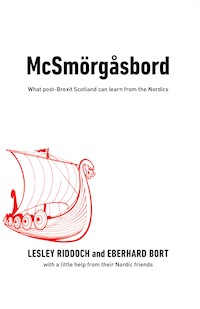
McSmörgåsbord
What post-Brexit Scotland can learn from the Nordics
LESLEY RIDDOCH AND PADDY BORT
Luath Press Limited
EDINBURGH
www.luath.co.uk
First published 2017
eISBN: 978-1-910324-91-2
The authors’ right to be identified as author of this work under the Copyright, Designs and Patents Act 1988 has been asserted.
Text © The Contributors 2017
Maps © OpenStreetMap contributors from data available under the Open Database License (openstreetmap.org and opendatacommons.org)
Dedicated to Eberhard Bort
born 1 December 1954 died 17 February 2017
EBERHARD (PADDY) BORT was the backbone of the Edinburgh Traditional Music scene and a lynchpin of Nordic Horizons. Although he came from Germany and spent time in Ireland, I think the Nordic nations perfectly and unselfconsciously acted out the ‘small is beautiful’ mantra at the heart of Paddy’s politics. Paddy was a born-again European – someone who revelled in the fabulous spectacle of cultural difference without worry, disapproval or xenophobia and maybe that’s why he was so determined we should produce this book, exploring the vast array of different relationships between Europe and the Nordic nations – a palette from which Scotland might soon pick its own post Brexit relationship. Paddy breathed life into this wee book from the start and finished all major corrections the day before he died. It is now dedicated to him and to the small peaceful Nordic nations he so admired.
Lesley Riddoch
The demographic and economic statistics used in the country boxes in this book were sourced from the following locations:
gov.scot; Scottish Government
mfa.is; Ministry for Foreign Affairs
nrscotland.gov.uk; National Records Scotland
scb.se; Statistics Sweden
ssb.no; Statistics Norway
stat.gl; Grønlands Statistik (Statistics Greenland)
statbank.dk; Statistics Denmark
statbank.hagstova.fo; Statistics Faroe Islands
statice.is; Statistics Iceland
tilastokeskus.fi, pxnet2.stat.fi; Statistics Finland
cia.gov; CIA World Factbook
data.worldbank.org; World Bank
Eur-lex.Europa.Eu; EUR-Lex Access to European Union Law
Europa.Eu; European Union Official Site
imf.org; International Monetary Fund
and the following publications:
Bache, Ian and Stephen George (2006) Politics in the European Union, Oxford University Press. p.540–542
Havemann, Joel (4 June 1992). ‘EC Leaders at Sea Over Danish Rejection : Europe: Vote against Maastricht Treaty blocks the march to unity. Expansion plans may also be in jeopardy.’ LA Times.
Lang, Arabella (14 January 2013). ‘Norway’s relationship with the Eu’. House Of Commons Library.
Contents
Preface
The Trading Clubs of Europe, their rules and origins
Glossary
Timeline
CHAPTER ONE: Sampling the Smörgåsbord of Nordic Relations with Europe
Lesley Riddoch and Paddy Bort
CHAPTER TWO: Norden – an intertwined history
Mary Hilson
CHAPTER THREE: Lessons from Iceland
Jón Baldvin Hannibalsson
CHAPTER FOUR: A Reverse Greenland?
Ulrik Pram Gad
CHAPTER FIVE: The Faroe Islands – All about Fish
Bjørt Samuelsen
CHAPTER SIX: Fishing, Forestry and Agriculture: Sustainability and the ‘Norwegian Model’
Duncan Halley
CHAPTER SEVEN: No Signs of Swexit – Sweden and the European Union
Eberhard Bort
CHAPTER EIGHT: Finland – Totally in and helping to write the EU rulebook
Tuomas Iso-Markku
CHAPTER NINE: Options for Scotland
Lesley Riddoch
Appendix: Nordic Country Profiles
Preface
IN STARK CONTRAST to the UK Government’s insistence on a ‘one singer, one song’ approach to Brexit, Nordic experience with the European Union varies dramatically – even within individual Nordic states. The palette ranges from full membership in the case of Finland (in Euro and Schengen) to Sweden (in the EU but outside the Euro), to Denmark (in the EU but outside the Euro, and with the autonomous Faroes and Greenland outside the EU), to Norway (outside the EU but inside the Single Market, and in Schengen) and to Iceland (outside the EU, having dallied with the idea of joining after the banking crash) – and all the Nordic nations square these very varied relationships with Europe with a similar and unchanging membership of the Nordic Council.
This book emerged from an event on 29 October 2016 in Edinburgh, organised by the policy group Nordic Horizons, together with Edinburgh University’s Academy of Government, financed by a Scottish Government grant which covered the speakers’ travel and accommodation costs. Contributors from the Nordic countries explored their ‘Smörgåsbord’ of relationships with the EU – and whether Scotland post-Brexit might learn any lessons from their experience. Three hundred people attended, including the Cabinet Secretary for Cultural and External Relations, Fiona Hyslop. It rapidly became clear that Britain is not the only North Atlantic State with mixed views about the EU.
It was good to see Scottish Government ministers meeting the Nordic Horizons speakers – a real Nordic meeting of minds. These small nations have experienced almost every conceivable situation that might befall Scotland – except of course being dragged out of the EU against their will.
We are grateful to Lily Greenan for transcribing the speakers’ presentations and to the speakers themselves for their participation and contribution, and thank them for their easy cooperation on this book. We would also like to thank Cabinet Secretary Fiona Hyslop for opening the conference, and the Academy of Government for making it happen at Edinburgh University. Without the grant from the Scottish Government, neither the event nor the book would have been possible. Last, but certainly not least, thanks to Gavin MacDougall and his team at Luath Press.
Nordic Horizons, founded by Nordic policy enthusiast Dan Wynn and journalist, broadcaster and author Lesley Riddoch in 2009, is an informal group of Scottish professionals who want to raise the standard of knowledge and debate about life and policy in the Nordic nations. The Scottish Government has funded Nordic Horizons to bring Nordic experts to Scotland to engage with government officials and other policymakers and influencers. This has led to the development of a Nordic Policy Network within the Scottish Government, where civil servants share information and experiences in order to inform policy.
Lesley Riddoch and Paddy Bort
31 January 2017
The Trading Clubs of Europe, their rules and origins
DEFINITIONS ARE a dull way to start a book. But unless the differences between the EU, EFTA, and EEA are clear from the outset, readers may fail to properly savour the subtle differences in Nordic relations with Europe described in this book. Basically, the EEA is the mechanism that extends the Internal Market of the EU to the three participating states of the European Free Trade Association. EFTA is an alternative trading bloc to the EU created in 1960 with no ambitions for further political integration. Iceland, Liechtenstein and Norway are EFTA members who are also in the EEA (and thus have access to the EU’s 500 million consumers.) EFTA’s fourth member Switzerland has opted not to join the EEA.
So currently the EEA comprises the 28 EU Member States and the three EEA EFTA States. Simple.
Here’s how EFTA deals with Frequently Asked Questions:1
WHY WAS EFTA CREATED AND HOW IS IT DIFFERENT FROM THE EU?
The European Free Trade Association is an intergovernmental organisation, established in 1960 by the EFTA Convention for the promotion of free trade and economic integration between its member states (today Iceland, Liechtenstein, Norway and Switzerland). EFTA doesn’t envisage political integration, it doesn’t issue legislation, nor does it establish a customs union.
EFTA’s first objective was to liberalise trade between its member states. In 1972, each EFTA State negotiated bilateral free trade agreements (FTAs) with the EEC. Currently, the EFTA States have 26 FTAs in force or awaiting ratification covering 36 partner countries worldwide.
EFTA States are not obliged by the EFTA Convention to conclude preferential trade agreements as a group. They maintain the full right to enter into bilateral third-country arrangements.
WHAT IS THE EuROPEAN ECONOMIC AREA?
The European Economic Area (EEA) was established by the EEA Agreement in 1994. Its objective is to extend the Internal Market of the EU to the three participating EFTA States, creating a homogeneous European Economic Area. Currently, the EEA comprises the 28 EU Member States and the three EEA EFTA States – Iceland, Liechtenstein and Norway.
Under the present wording of the EEA Agreement, it’s impossible to be a party to the EEA Agreement without being a member of either the EU or EFTA.
The EEA Council takes political decisions leading to the amendment of the EEA Agreement, including possible enlargement. Decisions by the EEA Council are taken by consensus between the EU on the one hand and the three EEA EFTA States – Iceland, Liechtenstein and Norway – on the other.
WHAT IS COVERED BY THE EEA AGREEMENT?
All relevant Internal Market legislation is integrated into the EEA Agreement so that it applies throughout the whole of the EEA. The core of these rules relate to the free movement of goods, capital, services and persons. In addition, the EEA Agreement covers areas such as social policy, consumer protection, environment, company law and statistics. In order to ensure equal conditions of competition throughout the EEA, the EEA Agreement mirrors the competition and state aid rules of the EU Treaties. It also provides for participation in EU programmes such as those for research and education.
WHAT IS NOT COVERED BY THE EEA AGREEMENT?
The EEA Agreement does not cover EU common agriculture and fisheries policies, although it contains provisions on farming and fishing trade. The EEA does not have a customs union, common trade policy, common foreign and security policy, justice and home affairs, harmonised taxation or economic and monetary union.
Schengen is not a part of the EEA Agreement. However, all of the four EFTA States participate in Schengen and Dublin through bilateral agreements and they all apply the provisions of the relevant Acquis.
HOW DO THE EEA EFTA STATES CONTRIBUTE FINANCIALLY TO THE EU?
First, the EEA EFTA States contribute towards reducing economic and social disparities in the EEA through the EEA Grants. Currently the beneficiary states include Bulgaria, Croatia, Cyprus, Czech Republic, Estonia, Greece, Hungary, Latvia, Lithuania, Malta, Poland, Portugal, Romania, Slovakia and Slovenia. In addition to the EEA Grants, Norway has funded a parallel scheme since 2004 – the Norway Grants. The funding period covering 2014–2021 has a total financial envelope of approximately €400 million per year. These contributions are not managed by the EU, but by the EFTA Financial Mechanism Office in collaboration with the beneficiary countries.
Second, the EEA EFTA States contribute towards the EU programmes and agencies that they participate in through the EEA Agreement. These contributions are added to the EU budget, increasing the total financial envelopes of the programmes and agencies in question. For the current 2014–2020 EU multiannual budget period, the total EEA EFTA contribution to EU programmes and agencies is approximately €460 million per year.
1http://www.EFTA.int/faq
Glossary
EEC: European Economic Community, created by the Treaty of Rome, 1957. After the Maastricht Treaty which came into force in 1993, it became the
EC: European Community – one of the three communities (alongside the
ECSC: European Coal and Steel Community of 1951 and
EURATOM: the European Atomic Energy Community of 1957) which were subsumed into the
EU: European Union through the Maastricht Treaty in 1993.
EFTA: European Free Trade Association, an intergovernmental organisation established in 1960 by seven European countries to promote free trade and economic integration to the benefit of its Member States. All original signatories except Norway and Switzerland withdrew from EFTA upon joining what is now the European Union, as did Finland which had become an associate member in 1961 and full member in 1986. As Iceland joined in 1970 and Liechtenstein in 1991 EFTA currently has four Member States: Iceland, Norway, Liechtenstein and Switzerland.
EEA: European Economic Area consists of the 28 Member States of the European Union and three EFTA countries: Iceland, Liechtenstein and Norway, but not Switzerland. The Agreement on the EEA entered into force on 1 January 1994. It seeks to strengthen trade and economic relations between the contracting parties and is principally concerned with the four fundamental pillars of the internal market, namely: the free movement of goods, people, services and capital.
CUSTOMS UNION: A type of trade bloc in which a group of member countries share a single external trade policy and tariff, though sometimes different import quotas are used. The purpose of a Customs Union is usually to foster increased economic efficiency and closer cultural and political ties between member states. The European Union Customs Union, for example, consists of all EU member countries, as well as Monaco and some UK territories which are not EU members.
SCHENGEN: A group of twenty-six European countries, named for the Schengen Agreement of 1985, which have abolished any type of border or passport control at their shared borders. For the purposes of international travel, the Schengen area functions as a single country with a shared visa policy. Conversely, borders shared with adjacent non Schengen member countries are proportionally stronger.
BREXIT: A portmanteau of ‘Britain’ and ‘Exit’, the result of a 2016 referendum to determine whether the UK would leave the European Union. 52% of votes were cast in favor of leaving, with Article 50, the clause in European Law that allows member states to withdraw from the Union, set to be triggered in March of 2017.
Timeline
1949
NATO (North Atlantic Treaty Organisation)
Defence Treaty signed initially by 12 countries: by the US and Canada, Belgium, Denmark, France, Iceland, Italy, Luxembourg, the Netherlands, Norway, Portugal, and the United Kingdom. Since then, another 16 states have joined: Greece and Turkey (1952), West Germany (1955), Spain (1982) [East Germany, with German unification in 1990], Hungary, the Czech Republic and Poland (1999), Bulgaria, Estonia, Latvia, Lithuania, Romania, Slovakia and Slovenia (2004), and Albania and Croatia (2009) – so that NATO now comprises 28 states.
1951
European Coal and Steel Community
Treaty of Paris signed by six countries: Belgium, The Netherlands, Luxembourg, France, Germany and Italy.
1957
European Economic Community
The six members of the ECSC sign the Treaty of Rome setting up the EEC and EURATOM, aiming at the creation of a common market, a customs union, plus free movement of capital and labour. EURATOM’s goal was the jointly develop nuclear energy.
1960
EFTA
As an alternative to the EEC, the European Free Trade Association emerges, with Austria, Denmark, Norway, Portugal, Sweden, Switzerland and the UK. Like the EEC, EFTA aims to establish free trade, but it opposes uniform external tariffs and sees no need for supranational institutions.
1963
The UK’s application to join the EEC is vetoed in 1963, and again in 1967 by Charles de Gaulle.
1968
The EEC’s Customs Union is completed.
1972
Norway rejects joining European Community (EEC, ECSC, EURATOM).
1973
The UK, the Republic of Ireland and Denmark join the European Community.
1975
UK votes in a referendum by a margin of two-to-one in favour of staying in the EC.
1979
The European Monetary System (EMS) introduces the European Currency Unit (ECU) and the exchange rate mechanism (ERM). All EC members join except the UK.
1981
Greece becomes the EC’s tenth member.
1985
Schengen Agreement signed, aiming at a border-free Europe.
1986
Portugal and Spain join the EC, and the European flag is unveiled.
Single European Act (SEA) signed, aiming to complete the formation of a common market.
1992
Maastricht Treaty signed.
1993
Maastricht comes into force, creating the European Union (EU). It paves the way for monetary union and includes a chapter on social policy. The UK negotiates an opt-out on both. The treaty also introduces European citizenship, giving Europeans the right to live and vote in elections in any EU country, and launches European cooperation in foreign affairs, security, asylum and immigration. Denmark had rejected it in a referendum in 1992, but accepted it in 1993 in a second referendum after negotiating an opt-out on monetary union.
1995
Austria, Finland and Sweden join the EU, taking membership to 15. Norway would have joined if voters had not rejected the move in a second referendum in 1994.
Schengen implemented: France, Germany, Portugal, Spain and the Benelux countries are the first to drop border controls except on the EUs external borders – followed later by Austria, Italy, Denmark, Finland, Sweden and Greece, but not the UK or Ireland.
1997
The Amsterdam Treaty is signed, readying the EU for its eastward expansion. More national vetoes are abolished. Laws on employment and discrimination are strengthened, and the social chapter of the Maastricht treaty becomes an official part of EU law. The Schengen agreement also becomes law, though Ireland and the UK maintain their opt-outs.
2002
Single European Currency, the Euro, is introduced. It had been created in 1999 as the official currency of the then 11 EU countries. Greece adopted the currency two years later, but Sweden, Denmark and the UK stayed out. On 1 January 2002 Euro notes and coins were introduced in the 12 participating states and over the next few months their national currencies were phased out.
2004
Ten countries join the EU: Cyprus, the Czech Republic, Estonia, Hungary, Latvia, Lithuania, Malta, Poland, Slovakia and Slovenia.
New EU Constitution is signed.
2005
Voters in referendums in both France and the Netherlands reject their governments’ plans to ratify the EU Constitution. The EU continues on the basis of existing treaties.
2007
Romania and Bulgaria become EU member states.
2009
The Lisbon Treaty, replacing the failed Constitution, extends qualified majority voting, gives more powers to the European Parliament, and provides, for the first time, the possibility of leaving the EU (Article 50).
2013
Accession of Croatia to the EU.
2016
UK referendum on EU membership produces 52: 48 per cent majority for Leave; Scotland votes 62: 38 to Remain.
Scottish Government publishes Scotland’s Place in Europe setting out proposals for anticipating the impact on Scotland of the UK’s exit from the EU.
2017
UK Government publishes The United Kingdom’s exit from, and new partnership with, the European Union White Paper.
Article 50 to be triggered by UK in March 2017 – to begin the two-year negotiation period with EU.
1
Sampling the Smörgåsbord of Nordic Relations with Europe
LESLEY RIDDOCH AND PADDY BORT
THE NORDIC NATIONS co-exist quite happily despite having thrashed out every conceivable variation of relationship with the Eu. Some are in (Finland, Sweden, Denmark) some are out (Iceland and Norway) and the smallest players have managed to shake it all about (The Faroes and Greenland are out while their ‘Mother Ship’ Denmark is in). These two tiny Nordic players have a few formal agreements with the Eu, whilst Norway pays to retain access to the single market. Denmark is in but its people rejected Euro membership in a referendum, whilst the Finns are all in – members of the EU and the Euro. Surely, among all this kaleidoscopic variation there are lessons for Scotland to learn – as a devolved government within the UK or possibly a small northern independent state sometime in the future.
Another way to characterise this diversity of European relationships is to look at it from west (where fishing limits matter hugely and most Nordic states are outside the EU) to east (where the frontier with Russia /USSR has concentrated minds about the need for European solidarity for decades).
For Greenland, Iceland and the Faroe Islands, fisheries are not just important, they are the defining feature of their economies. Greenland and the Faroe Islands, self-governing parts of EU member Denmark, are outside of the EU because they did not want to become subject to the Common Fisheries Policy. With fishing accounting for 90 per cent of exports from the Faroe Islands, these concerns remain in place. The Faroese used their devolved powers to decide not to follow Denmark into the EEC in 1973; Greenland, which had become a member of the EU when Denmark joined, followed the Faroes after home rule was introduced, with a referendum in 1982 in which 53 per cent voted to leave the EEC – again one of the biggest deciding factors was the Common Fisheries Policy.
For Iceland, too, the EU has been a contentious issue for years. A member of the EEA and EFTA, the barrier to EU membership has been the Common Fisheries Policy – fishing, of course, represents a vital part of the Icelandic economy.
Norway, with its population of just over five million, is in the European Economic Area (EEA) and a member of the European Free Trade Association (EFTA). More than 80 per cent of Norway’s exports go to the EU, and more than 60 per cent of imports come from EU countries. Norway decided not to join the European Community in 1972 (in a referendum, 53.5 per cent voted against), and reaffirmed that vote in a second referendum in 1994 (this time, EU membership was rejected by 52.2 per cent). But Norway participates in the Single Market and in Schengen, paying an estimated €9bn as an annual contribution to the EU. Crucially though, it is not part of the common fisheries and common agricultural policies.
Moving east, Denmark, Sweden and Finland, are all less economically dependent on fish and joined the EU to safeguard economic growth within the Single Market, and to promote stability with the EU peace-keeping bloc. The Cold War experience and its long shadow – the presence of the Soviet/Russian frontier loomed larger here – influenced attitudes towards the European Union.
But there are still differences. Denmark is widely regarded as one of the EU’s most reluctant players and has voted against EU treaties several times and negotiated four opt-outs. Thus, Denmark is not participating in the common currency and remains exempt from parts of the EU’s criminal justice and home affairs system – something it negotiated in 1993. Like Denmark, Sweden has stayed outside the Euro. Only Finland is fully committed to all aspects of EU membership, having been in the Euro from the start.
Reviewing this smörgåsbord of European relationships, where does a post-Brexit Scotland fit in? As we consider our post Brexit options, might we be eyeing up the wrong European prize? Might the halfway house of the European Economic Area (EEA) suit Scotland better than full EU membership? These questions were all posed at the ‘Scotland after Brexit’ conference in October 2016 when speakers from five Nordic nations explained their very varied outlooks on the same question facing Scotland – is EU membership desirable, oversold or essential? It rapidly became clear that Britain and Scotland were not the only nations with mixed views about the EU.
The Norwegian environmentalist Duncan Halley explained that in 1992 Norway joined the EEA (essentially the EU’s Single Market mechanism) as a precursor to full membership after a referendum in 1994. But fierce debate produced a no vote and the halfway house of the EEA became Norway’s permanent home.
Iceland’s EEA entry the same year had a slightly different genesis. According to the former Social Democrat leader Jón Baldvin Hannibalsson who masterminded EEA membership, access to the European single market looked like a good way to liberalise a 1960s economy ‘more rigid than the Soviet Union.’ But because of Iceland’s reliance on fishing and relatively recent independence from Denmark, a complete transfer of sovereignty to the EU was not on the cards. ‘People said: “We’ve had 600 years of European colonialism – no more.”’ It took five years to negotiate the EEA agreement, but it was finally signed, according to Hannibalsson, because an interim solution was mutually beneficial for the EU and small countries like Iceland. The original EFTA – members (The Nordic 4 and the Alpine 3, Austria, Switzerland and Lichtenstein) then conducted more trade with the EU than the USA and Japan combined.
From Iceland’s point of view, the combination of EFTA (a rival European trading group) and EEA membership has proved more useful than the full EU deal. EEA members are in the EU’s internal market but can opt out of the Common Fisheries or Agriculture Policies, Maastricht, the customs union and the Euro. They can opt in to areas like justice and home affairs and they have free movement in Europe and useful educational and research funds in exchange for a financial contribution.
So might Brexiting Britain aim to join the EEA? Hannibalsson thinks not: ‘One, Britain is too big for the EEA; two, its government isn’t keen and, three, EU members would have to approve Britain joining the EEA and they are not best pleased with Britain right now.’
It would be a different story for an independent Scotland, he thinks, and maybe – with negotiations and the possibility of a second independence referendum ahead – more feasible.
Opting out of the Common Fisheries Policy (CFP) would not just please Scotland’s fishing communities, it could help ensure Scotland’s portion of the North Sea becomes as productive and well protected as Norway’s portion of the North Atlantic.
Duncan Halley says the Common Fisheries Policy has a terrible record protecting fish stocks in EU waters. Presently 30 per cent of stocks in the North Sea are outside safe biological limits and 93 per cent of cod are fished before they can breed. Meanwhile, according to the OECD, ‘stocks in Norway are good,’ and 73 per cent of caught fish come from sustainably managed stocks – the highest proportion in the world.




