


Erhalten Sie Zugang zu diesem und mehr als 300000 Büchern ab EUR 5,99 monatlich.
- Herausgeber: Luath Press
- Kategorie: Geisteswissenschaft
- Serie: Viewpoints
- Sprache: Englisch
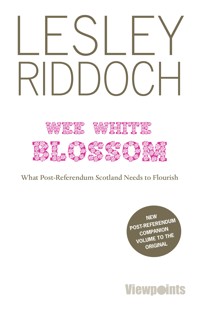
So stands Scotland where it did? Not on your nelly. The professional classes in Scotland may be busy with Commissions, vows, deals, submissions and General Election planning but the wider Yes Movement is busy with huge spontaneous meetings involving hundreds, even thousands of people - gatherings like birds flocking before winter or starlings swooping to throw shapes into darkening skies. Because they can. Wee White Blossom is a post-indyref, poppadom-sized version of Blossom for folk who've already sampled the full bhuna. It updates Blossom with a new chapter on Scotland's Year of Living Dangerously. Lesley Riddoch shares her thoughts on the Smith Commission, the departure of Gordon Brown, the return of Alex Salmond and the latest developments in land reform and local control. She considers the future of the SNP, the Radical Independence Campaign, Common Weal, Women for Independence and Scottish Labour in the aftermath of the referendum. This is a plain-speaking, incisive call to restore equality and control to local communities and let Scotland flourish. Wee White Blossom is the ideal companion volume to Blossom, whether you want an update on the first edition or an appetiser before delving into the pages of the original. The most influential, passionate and constructive book to appear during the referendum campaign. Blossom seized readers because it argued for independence as means to an end - restoring control over their own lives to Scottish communities so disempowered by top-down authority that they had no real experience of democracy. NEAL ASCHERSON A brilliant, moving, well written, informative, important and valuable piece of work. ELAINE C SMITH Not so much an intervention in the independence debate as a heartfelt manifesto for a better democracy. ESTHER BREITENBACH, Scotsman
Sie lesen das E-Book in den Legimi-Apps auf:
Seitenzahl: 146
Veröffentlichungsjahr: 2014
Das E-Book (TTS) können Sie hören im Abo „Legimi Premium” in Legimi-Apps auf:
Ähnliche
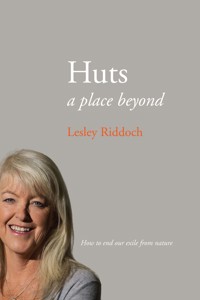
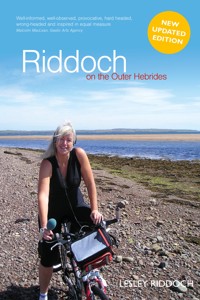















LESLEY RIDDOCHis an award-winning broadcaster, writer and jour-nalist. She writes weekly columns forThe Scotsman, The NationalandSunday Postand is a regular contributor toThe Guardian,bbcQuestion Time, Scotland TonightandAny Questions. She is founder and Director of Nordic Horizons, a policy group that brings Nordic experts to the Scottish Parliament and produces a popular weekly podcast. Lesley presentedYou and YoursonBBCRadio 4,The Midnight HouronBBC2 andThe People’s ParliamentandPowerhouseon Channel 4. She founded the Scottish feminist magazineHarpies and Quines, won two Sony awards for her daily Radio Scotland show and editedThe Scotswoman– a 1995 edition ofThe Scotsmanwritten and edited by its female staff. She lives in Fife and is married to an Englishman who grew up in Canada.
Luath Press is an independently owned and managed book publishing company based in Scotland and is not aligned to any political party or grouping. Viewpoints is an occasional series exploring issues of current and future relevance.
Reading Lesley Riddoch’sBlossomis like inhaling fjord air after being trapped in a sweaty backroom. Just brilliant.
PAT KANE, singer and columnist
Inspiring, galvanising analysis of the untapped potential of Scottish people power.
KARINE POLWART, singer/songwriter
Blossomconfirms Lesley Riddoch’s reputation as one of our top campaigning journalists.
PAUL HUTCHEON, The Herald
Cracking. A hopeful antidote to so much empty nastiness in politics. Read!
ALYN SMITH MEP
It’s brilliant – every politician in the land should be made to read the chapter on inequality. I love the human stories in the book, but it’s rich with evidence too. The most engaging social policy book I’ve read in ages(ever?).
JENNY KEMP,Zero Tolerance Campaign
I’m readingBlossomright now and every paragraph crystallises the nebulous sensations of deep divideinequality and snobbery I have experienced my whole life.
DES DILLON, writer
Blossomis something we should all be reading. This is the book William Power and Edwin Muir should have written … a fine work.
ELSPETH KING, Director, Stirling Smith Art Gallery and Museum
To all progressives – just to everyone… read Lesley Riddoch’sBlossom. She just gets it.
DAVID GREIG, playwright
Blossomreveals a Scotland full of promise, whose richest resource – her people – remains untapped. Riddoch’s belief in Scotland’s countrymen and women is the lifeblood ofBlossom.
NEWSNET SCOTLAND
A hard-hitting tour-de-force and a characteristically feisty contribution to(and beyond)the present constitutional debate.
PADDY BORT, Product Magazine
Wee WhiteBlossom
What Post-Referendum Scotland Needs To Flourish
LESLEY RIDDOCH
LuathPress Limited
EDINBURGH
www.luath.co.uk
First published 2015
ISBN: 978-1-908373-99-1
ISBN (EBK): 978-1-910324-48-6
The author’s right to be identified as author of this work under the Copyright, Designs and Patents Act 1988 has been asserted.
© Lesley Riddoch
To Rosie and Jenny, joyful young companions on the journey
Contents
Acknowledgements
Introduction
CHAPTER ONE 2014: Scotland’s Year of Living Dangerously
CHAPTER TWO Radical Scotland meets the Smith Commission
CHAPTER THREE Blossom
CHAPTER FOUR Land, Land Everywhere… and Soon a Drop for Sale
CHAPTER FIVE Supersized Councils – Disempowered Communities
CHAPTER SIX Women – The Real Indyref Winners
CHAPTER SEVEN What’s Next – The 2015 General Election
CONCLUSION What Scotland Needs to Blossom
Acknowledgements
Muriel Alcorn
Bella Caledonia
Øivind Bratberg
Paddy Bort
Robin Callander
Hannah Derbyshire
Development Trusts Association Scotland
Professor Tom Devine
Foster Evans
Maggie Fyffe
Jim Harvey
Mary Hepburn
Luath Press, Kirsten Graham and Louise Hutcheson
Cathy McCormack
Professor David McCrone
Professor Catriona MacDonald
Rosemarie MacEachen
Cailean MacLean
Robin McAlpine
Annie Macsween
Professor Charles McKean
Mark Perryman
Perspectivesmagazine, especially Davie Laing
Tommy Riley
Mona Røhne
The Scotsman
The Sunday Herald
Newsnet Scotland
The National
Tore Tanum
Ann Soutar
Phil Welsh
Andy Wightman
Raymond Young
All the above have saved me from errors in fields where they are expert and the faults or misjudgements that survive their amendments are mine alone.
Introduction
Wee White Blossomis a post-referendum update for folk who have already read the main book. Parts of the original are included to give context and make this diminutive version readable. Doubtless by the time you read this, though, some thoughts will be out-dated, slightly off-beam or even plain wrong. Events in Scotland after the referendum are moving that fast. Unfortunately some of the mainBlossomchapters, like the one about Tommy Riley and the Drumchapel Men’s Health project, cannot now change. Tommy died prematurely ofCOPDjust beforeBlossomwas first published in 2013. Consultant obstetrician Mary Hepburn has now (partly) retired to her beloved Shetland. The lives of the drug-using mothers she treated in Possil and North Glasgow are still grim. The bold housing pioneers of West Whitlawburn have gone from strength to strength despite the sad death of co-founder Phil Welsh. They are currently installing a district heating system to save energy and cut bills – meanwhile much of council-run East Whitlawburn looks set to be demolished.
But of course there has been even bigger change in Scotland since 2013. 45 per cent of Scots voted Yes in the independence referendum – more than anyone could dream of when this book was first published but not enough to win the day. Since that vote, with its record-breaking 85 per cent turnout, pro-independence movements like Women for Independence, Radical Independence, National Collective and Common Weal have flourished and party membership has surged amongst Yes supporting parties like the Greens,SSPand above all theSNP– likely to have 100,000 members by Burns Night 2015. Nicola Sturgeon was elected unopposed as the newSNPleader and has already made history three times – she is the first femaleSNPleader, the first female First Minister and leads the first gender equal cabinet. Not bad going for one week. The Scottish Government’s new legislative programme contains a long overdue Land Reform Bill, plans for more affordable childcare and quotas for women on public boards. Meanwhile Alex Salmond has announced he will contest the 2015 Westminster elections as a candidate for the Gordon constituency, breathing yet more life into the hyper-oxygenatedSNP.
Of course there is some anxiety about keeping new members engaged, a dearth of independent candidates willing to stand ‘under theSNPbanner’ and disappointment amongst time-served members about the number of recently-joined folk competiting for 2015 nominations. But in the former Yes camp, the air is full of possibility.
By contrast, the main victors of the No campaign, the Labour Party, have been tearing themselves apart – or retiring. Johann Lamont resigned unexpectedly in the wake of the No vote. She described Westminster LabourMPs as dinosaurs and accused the London leadership of treating the Scottish party like a branch office. Alistair Darling and Gordon Brown led the No camp to victory – then each (separately) announced his intention to leave politics in 2015, giving the appearance that No leaders had cut and run before ‘substantial new powers’ were wrestled from Westminster – whilst the bloodied but unbowed Salmond was preparing to soldier on.
Of course hardcore Labour supporters will not see the Brown/ Darling retirement announcements that way at all. But a perception of constancy could help theSNPwin the all-important battle over the narrative of the 2015 campaign. General Elections have hitherto been perceived by Scots as a two-horse race in which England votes (largely) Tory so Scotland must vote (largely) Labour. But the next election looks set to produce another hung parliament in which neither party alone has a working majority. That opens up the prospect of a different dynamic – a four-horse race asUKIPtake seats south of the border while theSNPis elected in large numbers north of it. In this scenario, anSNPvote doesn’t contribute to a Tory victory (Nicola Sturgeon has said she will ‘never, ever support a Conservative government’) but could make a Labour government withSNPbacking more likely. Of course a sizeableSNPbloc will try to extract full Home Rule for Scotland and the cancellation of Trident’s renewal – and that might be a political price too high for Ed Miliband without losing even more support in Middle England. Still, such a scenario might serve to reinforce theSNP’s role as guarantor of Scottish interests at Westminster. As Salmond said on theBBC’sSunday Politics, ‘The only circumstances in which people will trust Labour to deliver for Scotland is when theSNPare at their heels.’
With five months to go, that rhetoric may resonate strongly with disgruntled Scottish voters.
Far more certain though, is that Salmond already resonates with theUKmedia. Having spent the election campaign virtually ignoring his very able deputy Nicola Sturgeon, the British press has built Salmond into a powerfulUKphenomenon which culminated in a LiverpoolQuestion Timeprogramme where the audience applauded Salmond’s suggestion they could ‘come with Scotland next time’ and laughed as presenter David Dimbleby was left guessing about Salmond’s intentions for 2015. The former First Minister also bagged the 2014 Spectator’s Politician of the Year award, suggesting absence from the miserable London scene has only made right-wing hearts grow fonder of a man who boldly disrupted Nigel Lawson’s budget in 1988 and has gone on to disrupt British life.
But Salmond’s candidacy could have a more important and immediate impact, ending any chance that General ElectionTVdebates can reasonably exclude theSNP, Greens and Plaid Cymru. Of course, Salmond is no longerSNPleader and the controversial decision to exclude ‘small’ parties exceptUKIP‘fits broadcast guidelines’. But it’s hard to see how theBBCcan support a deal that places performance above fairness when Mr Box Office himself is in town using every available opportunity to raise the scandal of theSNP’s exclusion, when its party membership would exceed a million inUKterms. A state broadcaster already facing accusations of referendum bias could find its credibility seriously damaged by a constant, Salmond-led chorus of ‘we wuz muzzled’.
That’s also because Salmond has enjoyed renewed status since his dignified exit the day after referendum defeat. Many agree that nothing became him like the manner of his going. My hairdresser – a traditional Labour voter – was moved to tears by his resignation speech and Salmond’s emotional farewell at theSNPconference was followed by an equally affectionateBBCScotland tribute programme. Perhaps like Sherlock Holmes – whose reincarnation after a highly acclaimedTV‘death’ was watched by millions – Alex Salmond is a colourful character the public just don’t want to lose.
And yet there are dangers.
Angus Robertson will remain theSNP’s official Westminster leader. How easy will that be if the media is constantly seeking out opinions from his erstwhile leader? It could be a canny move if Salmond is allowed to roam theTVand radio studios as Charles Kennedy has done for decades, while someone else makes sure Commons business gets done.
But if theSNPwins 30 or 40 Scottish seats, as polls currently predict, and formally supports Labour, newMPs will be expected to break the habit of 30 years and vote on English matters. That could rankle with some. On the other hand, if an enlargedSNPcontingent has no new role in government, party discipline could become an even bigger issue. Some ‘non-traditional’ candidates are bound to be selected and sent south. And whilst no independent candidate has publicly accepted the offer to stand ‘under theSNPbanner’ (a contradiction in terms for many thrawn, non-party oriented folk like myself), ‘newbies’ are bound to get restless sitting on the sidelines if they feel Scotland’s fate is being determined elsewhere.
Will Alex Salmond’s candidacy be a gamechanger for theSNPin 2015 or will the pendulum swing back towards Labour once they have a new Scottish leader?
One thing’s certain, though – David Cameron certainly infuriated erstwhile Better Together partners by constantly linking greater powers for Scotland with English votes for English laws.1UKIPhas won two recent by-elections and England looks set to vote for anEUexit in the forthcoming referendum, pulling a reluctant Scotland along with her. All of this seems to have refocused Scots’ minds. One opinion poll just after the vote, suggested a majority of Scots would now vote Yes if the referendum was re-run. It’s fair to discount some of that enthusiasm since the proposition is currently theoretical – but such polls leave Scots uncertain that the balance of opinion still wholeheartedly backs the Union. Meanwhile, two other polls – one straight after 18 September and another two months later – found a consistent two-thirds of Scots backing Home Rule, where Holyrood controls all taxation, spending and welfare and sends payment south to Westminster for defence and foreign affairs. Clearly, that 66 per cent contains many folk who voted No to independence. So will this larger and more ‘settled will’ wrestle Home Rule out of Westminster? Not easily. And certainly not without another massive and co-ordinated demonstration of political will at the 2015 general election. Given the heady levels of activism over the past two years, that is entirely possible.
FOOTNOTE:
1 The Vow was published on the front page of theDaily Recorddays before the referendum vote and apparently signed by Messrs Cameron, Miliband and Clegg. The three unionist party leaders vowed to agree ‘substantial new powers’ for the Scottish Parliament before the 2015 general election and delivery by whichever party formed a government. English Votes for English Laws (EVEL) is an attempt to stopMPs with devolved control over taxation from voting on such English matters in the Commons. In fact theSNPhas not done that for 30 years. But such a convention or new law would remove the once sizeable contingent of ScottishMPs from the Labour party total – impeding the chances of a future Labour government achieving a working majority for its budget and for new English legislation.
CHAPTER ONE
2014 – Scotland’s Year ofLiving Dangerously
THE INDEPENDENCEcampaign began in earnest for me in September 2013. That monthBlossomwas first published, I began a book and speaking tour that eventually took in 190 venues and started a course of chemotherapy for an auto immune condition called vasculitis. Mercifully I had a fairly mild version of it, with tiny blood vessels going wrong only in my kidneys – it can occur in other organs.
The bad news is that it still can. The good news is that it seems to be contained. So when I said on Question Time that 2014 was the best year of my life, I really meant it. Despite weekly blood tests, three-hour chemotherapy sessions every fortnight until February 2014 and joint problems that left me hurpling for months, 2014 was a topper.
I say this not for sympathy (though if you’re thinking of flowers, my favourites are still lupins). Many folk struggle with illness, and I am much better.
I say this because Scotland, lit up by the possibility of real, profound political change, helped me through. The generosity, humour and courage of folk on the referendum trail was quietly inspirational and the luminous beauty of the landscape was breathtaking – in every season.
It was a strange bit of synchronicity. In 2013, I published a book arguing Scots had the capacity to heal their country and themselves. In 2014, I was experiencing the truth of that dynamic myself, at first hand.
Very few people realised anything was wrong – early kidney problems have no symptoms apart from tiredness – so I know what I witnessed was the real deal. In 2014, while animosity reigned in the public arena, kindness was the currency in the local, grassroots and private domains where the Yes campaign flourished.
Folk in far flung places slept on sofas so I got the spare bed. I stayed in the snug Stromness home of a fisherman’s mum while she was ‘aff sooth.’ I shared fresh Hebridean salmon at the home of a retired Free Church Minister in Stornoway, a riotously funny evening with kirk elders in Aberdeen, an eye-opening weekend with the troubled tenant farmers of Islay and a long simmer dim day with musicians on Shetland.
Two young snowboarders from Aviemore took the day off work to organise a mini bike tour – and wait for me without complaint at the top of every hill. I sat in some spectacular locations to write newspaper columns fed with home-made and often home-grown food. After one event in Stewarton, I was presented with two blocks of delicious local cheese and a bottle of ‘The Optimist’ wine. Folk in the poorest communities were always the ones who had a thoughtful whip round to reimburse train fares or petrol costs and non-professional groups seemed to demonstrate the strongest ability to get organised and self-start.
It wasBlossomin action. Heartening, gratifying and life-affirming. The enthusiasm and frenzied activity was as infectious and self-reinforcing as the previous long decades of forelock-tugging disempowerment. Unexpectedly, and as the by-product of an independence campaign backed by only a minority of voters, the whole of Scotland seemed to be switched on.
One cold Lochinver evening, 40 crofters packed into a tiny side room of the village hall, sitting on each other’s laps and standing in door-wells for aBlossom




