


9,95 €
Mehr erfahren.
- Herausgeber: Susan Omondi
- Kategorie: Fachliteratur
- Sprache: Deutsch
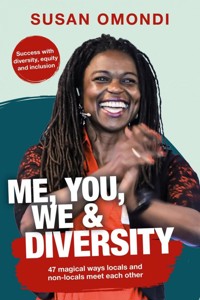
We fear what we don't know. No matter what country or culture we come from or what color our skin is, we all have this primal fear of the unknown. This diffuse fear that we share is also the thing that separates us from one another. Hardly any other topic is as charged with such controversy, polarization, doubt and inhibitions as the topic of integration. With her book, 47 magical ways locals and non-locals meet each other, Susan Omondi sets out to overcome the rifts that divide us. Profound, touching and always humorous, the Kenyan-born author tells stories from her everyday life, raises awareness of racism and sheds light on the perspectives of both immigrants or "non-locals" and locals. As an author, keynote speaker, moderator and trainer, Omondi's main focus is on diversity in the workplace and the great professional and human opportunities that come with overcoming our fears and prejudices. She lives out the motto: "When we engage with one another, magic happens".
Das E-Book können Sie in Legimi-Apps oder einer beliebigen App lesen, die das folgende Format unterstützen:
Seitenzahl: 359
Veröffentlichungsjahr: 2024
Ähnliche


















Contents
About this book
Foreword by Obera Bergmann
Part 1: Welcome to Germany. Welcome to a Germany full of foreigners.
#1 Fake it, till you make it
#2 The others and us
#3 The vicious cycle, the causes
#4 Development aid prevents true integration
#5 Integration takes place through the stomach
#6 Your migratory background and you
Part 2: Your get-to-know rounds
#7 The way to study is only through appointments
#8 The chicken or the egg question
#9 There are no stupid questions
#10 Your uniqueness, your being different
#11 They all look the same
#12 The Professor, who knew better
Part 3: Authorities:Tested and approved
#13 The thing about names
#14 I solemnly swear
#15 Never ask for permission
#16 If you know the law, you will be rewarded
#17 Political correctness only barks
#18 You want to get married in Germany
Part 4: The economy Social or antisocial?
#19 Our customers will not accept you
#20 When your colleagues keep silent
#21 Diversity needs a stage
#22 Already trusted, and yet this fear
#23 Money: It is (NOT) evident on your face
#24 Love or hate through misunderstandings
#25 Technology and diversity
Part 5: Are you a good neighbor, tenant, or landlord?
#26 Disturbance and integration
#27 When the landlord fears letting you rent
#28 Your neighbors and you
#29 Celebrating diversity made by children
Part 6: Media, statistics, and integration
#30 Media and diversity
#31 You do have problems, man
#32 We need an update
#33 The somewhat different statistics
#34 Pandemic and diversity
#35 The other side Changing your point of view
Part 7: On the road
#36 There are non-natives and the better non-natives
#37 Car, vroom vroom: Voluntary linguistic mistakes
#38 The weather and diversity
#39 If you don't complain, you don't really belong
#40 „Hier not fahren!“ - the unofficial police officers
#41 Caution: thinking non-natives
Part 8: This is how it works with the (non)locals
#42 Do it with care
#43 Love it, change it, or leave it
#44 Unleash the magic and diversity within you
#45 Be more local than the locals
#46 Everyday tests
#47 Now it is clear - When you suddenly wear socks and sandals
Closing words
In memory of Prof. Dr. Bernd Richter
Where would I be without you? Thank you!
About the Author
Imprint
English-language first edition January 2024
Copyright © 2024 Susan Omondi
All rights reserved.
Reprinting, even in extracts, is not permitted.
This work, including its parts, is protected by copyright.
Any utilisation is not permitted without the consent of the publisher and the author. This applies especially to electronic or other reproduction, translation, distribution, and public accessibility.
Susan Omondi
Silcherstrasse 10, 78224 Singen
Cover design and typesetting: Wolkenart - Marie-Katharina Becker, www.wolkenart.com
First Editor: Ruth Omondi - JAN Explore Publishers, Nairobi
Final Editor: Michelle K. Gilluly-Beham - www.targetlanguage.at Production and publishing: Sinaveria – www.sinaveria.de
1st edition
For our incredible twins, Amora and Obera, who are my enthusiastic and steadfast supporters and always by my side while presenting.
For Thomas, Sammy and my family in Germany, Kenya, Finland, Tanzania, the US, Uganda, Qatar, the UK.
For my remarkable nephew Hawi Jayden, who touched my heart by sharing the original German version with his friends, despite not speaking the language. What a powerful gesture that still moves me to tears. I just had to translate this book.
About this book
US and THEM? Or ME and YOU to WE?
Germany is a country of immigration. The number of immigrants living in Germany in the year 2022 was 2.7 million (rising from 1.32 million in 2021) as reported by Statistista. From a worldview regarding immigration, 281 million people were reported to be living outside their country of birth in 2020 (see https://worldmigrationreport.iom.int/wmr-2022-interactive/), making cultural diversity a hot topic.
I personally observe people identifying with the country of their origin. Furthermore, there are many people who identify with both their new homeland and the country of their roots or origin.
All those involved benefit from this. Nevertheless, an intriguing phenomenon can be observed: there is a willingness to provide development aid or donations and, at the same time, there is reluctance to do so when it comes to housing or jobs.
I am convinced that great things only come about when we trust everyone more in their uniqueness and are willing to change our perspective. In other words, this is a leadership task. But how can we succeed in this, with all these everyday challenges and the "non-natives"? How do we manage to engage with each other? Who should take the first step? How do we succeed in a true encounter between the natives and the non-natives? Is it enough for us to rely on laws and political correctness? Are quotas enough for us?
Don't let the first impression fool you. It's people like you and me who make this magical encounter. I am convinced that a positive attitude toward diversity, as well as dealing constructively with the challenges it brings, begins with oneself and at home, and not when we discover in companies that people are systematically treated worse because of their gender or otherness. Each of us can take the first step. Personal experiences play a magical role in this.
It is time that we approach diversity in a more positive and effective way. It is time to use every opportunity to shape the land of diversity ourselves - from WE versus THE OTHERS to ME and YOU and thus to WE. This book accompanies you on this path. With true stories and selected anecdotes from everyday life, it summarizes for you 47 simple and magical ways to integrate - consciously as a native or a non-native, in whichever country you are.
Every person is diverse. You are diverse in your personality and talents. As you get to know yourself better and better and identify what is limiting you, you pave a wonderful path for magical encounters. This book shows you how to unleash that magic and diversity within you.
Experiencing true diversity starts with little things and chance encounters in everyday life - with surprisingly big effects - whether at home, at work, or on the road. It is my desire to accompany you with selected anecdotes.
So why should you read this book?
Because you are curious! Curiosity is the magical first step to joint success. An entertaining book with many surprising insights awaits you; it is educating, humorous and at the same time includes clear messages that will further develop you.
What you can take with you:
You learn to discover and use magical moments in everyday life, not only within the context of being an immigrant/nonimmigrant, but as a family member, a partner, a leader, an employee, etc.Nothing is what it seems. You can also take the first step by questioning yourself and approaching people empathetically. This is often easier than you think.We are connected by more than we initially perceive. Dialogues and questions open up new paths.It takes both natives and non-natives to make our society and environment what we want it to be for our children. It also takes every individual, in every setting – be it at work, at home, or in public places – to responsibly and consciously engage in ways that will promote more positivity in diversity.
It starts with ME and YOU, then together WE will find a better way for living in DIVERSITY for a better society. I can only expect from you what I am willing to give myself. I have to acknowledge the diversity and magic in me first so that I can acknowledge the same in others. Moreover, I can give and receive appreciation and allow for magical encounters when I am open to them.
Only through conscious diversity and integration are we successful together. Therefore, the title is deliberately: ME, YOU, WE & DIVERSITY - whether you have already found your home in your chosen country or not, or whether you are working on your personal growth, nurturing a relationship at home or at work. In every context, experiencing diversity remains a process.
While this book’s setting is in Germany, every reader who is curious to learn about magical encounters beyond cultural differences can benefit from these 47 lessons.
This book is therefore applicable to your chosen country of residence as well. Just adapt the lessons for your area and shine.
Thank you so much for getting involved.
Welcome to Germany: a love at second sight.
People talk about love at first sight. But maybe the love for your chosen country has to develop.
Foreword by Obera Bergmann
For at least 4 years, my mother posted every Sunday short blogs about diversity. I remember that she was inspired by simple phrases and endeavored to write about them.
One day, she finally came to me with the idea that she wanted to write a book - a book to help you unleash the magic and diversity within you. And so, she picked one chapter every morning, based on one of her posts, and developed each of them further to create five pages per chapter in this book. I wouldn't have thought that so much great content and humor could fit into these short chapters.
Her initial motive was to inspire people to settle in a foreign country (in their country of choice) and to better understand other people and cultures. "For natives and non-natives" was her favorite phrase, which she always included in her sentences whenever she talked about her book. However, the messages go beyond immigration and culture and can be applied to daily interactions and activities, anywhere, everywhere for a better version of the reader.
I am also confident that this book will accompany you, so that new paths will open up for you. Not only as a "native and or non-native" but also for every individual, in every part of the world.
Obera Bergmann, 2024
If you remind yourself every day that every person, native or non-native, or who is in any other way different from you, has the same
biological needs, you will have no inhibitions in terms of encounters. Should
you – influenced by your environment–think that others are superior or inferior to you, then imagine you were together in a forgotten forest, lost and even more so without clothes.
In this scenario, you would be totally dependent on each other,
wouldn’t you?
#1 Fake it, till you make it
"What do I wear?"
Isn't it wonderful that we always ask ourselves this question, whether we have a lot of money or not, whether we are natives or not?
In my talks, I always tell a story based in Kenya, about the project of a lifetime, where this one important question - "What do I wear?" - almost stopped me from doing it entirely.
Since I didn't have anything appealing to me to wear, I asked my neighbors back in Homabay, Kenya for help and they saved this important project by lending me great shoes and a nice skirt to wear. At this point, I always wonder what it would be like today, to ask my neighbors here in Germany for a dress or outfit. I find the idea of throwing them a curveball or unhinging them amusing. Likewise, if they had to do the asking, this would also throw them off.
Years ago, I participated in many running events, one of them being in the town where my husband’s aunt and uncle live. Before the event, we were received each time as guests at their house for a joint warm-up and celebration. The host, an excellent runner himself by the way, and very humorous, asked us the day before one race, "And the most important question is: what are we going to wear?" Because this question was valid, we laughed heartily about it. For my part, I had brought some sportswear with me and decided at the last minute on one outfit. You have no idea what the most difficult decision can be for me. No, not spending money or wrapping up a project, but rather deciding on what to wear. Shallow? Not at all for me; the right clothes determine my performance and even my safety, especially in the dark.
What does this have to do with diversity? Recognizing that we all have the same basic needs, the same issues, albeit in different contexts, takes the pressure off when we interact with others. Because if you remind yourself every day that everyone, native or non-native, has the same biological needs, then you will have no inhibitions about encounters. Should you–influenced by your environment–think that others are superior or inferior to you, then imagine you were together in a forgotten forest, stark naked to boot and lost. In this scenario, you would be totally dependent on each other, wouldn't you?
I remember very clearly how some people said to me, "Susan, you are doing human development work here." Among other things, my choice of colors and courage to wear them were mentioned as reasons. I strongly assume that the colors of my clothes were meant here, and not my skin color. People around me know by now that I reject development aid (more about this in Chapter 4). However, sentences like these show me that it is also necessary here to accompany people in the so-called “developed countries” in their further development. After all, we also talk about personnel development, which has a positive connotation.
Everyone has challenges. The first encounters in a foreign country or with strangers under different circumstances show you that people have fears of contact in this respect. As a non-native, you bring at least one strength from your country with you. One of my strengths in particular is building bridges through engaging easily with people, hence taking away their fear. The same applies to you as an individual, a leader, a student or a parent. Acknowledge and use your strength and reach people with it. Sometimes you figure it out yourself. Sometimes it becomes clear to you through outside feedback, which shows you what people admire you for. Use these skills exactly where others are not so strong, even if that just means being outgoing. Many people who are not, will be happy about it, secretly at first and then gradually opening up to you at some point.
Surely, you've heard of this phrase: "Fake it till you make it." This book is not about faking outer values; it is about inner values and how you view others, combined with your strengths that are not necessarily apparent on your resume. It is convincing yourself through your thoughts and mindset that you will blend in and that you are capable of interacting with the locals. It is about being open and seeing value in being different. Just imagine you are there already. How does it feel?
Ask yourself: How do you want to be treated? How do you want to treat others? Do you want to feel like a victim of being left out or rather take personal responsibility? I encourage you to define your values in dealing with yourself and in dealing with others through the lens of diversity.
I decided years ago not to limit myself and others, despite unpleasant experiences. This conscious decision helps me work towards accepting myself first. And it works better and better over time. Reflect carefully: perhaps you reject someone because they are different; you prefer others because they are like you; you develop products that exclude others. Under various circumstances, you feel victimized, and then your actions become self-fulfilling prophecies, or maybe you tend to generalize because of a negative experience. These are all signs that you are limiting yourself or others.
The idea is not that you become one hundred percent prejudice-free, because prejudices are partially useful. For instance, positive prejudices can will help you gain orientation easily for a sense of belonging. However, it is important to avoid toxic prejudices, for instance assuming (all) locals will not understand you or that (all) non-locals are not capable of leading your team.
Making a conscious choice and aligning each of your actions and decisions with your values, gives you a direction for magical encounters. In my speeches, I emphasize that diversity and its associated challenges don't start, for instance, when we women realize our salaries are lower than our male counterparts or when we arrive in our chosen countries as non-natives. Diversity and its associated challenges start at home. If you are a non-native, be honest with yourself. Where do you come from? What have you had to struggle with? And what has given you courage?
Here is my short story:
I barely survived my birth because I was my mother's sixth girl, because my grandma, the only “midwife” nearby, could not take in girls anymore. I was the sixth girl in a row. Where I grew up, my mother was called "the mother of girls." At first, I thought that was a compliment. But it wasn't, because at this time, boys were valued more than girls, with the thought that they would remain with their parents as adults, unlike girls who would be married off.
As a child, spending several days in a row without anything to eat was not uncommon. Yet, not everyone in my neighborhood had these experiences. We pretended to be doing well so we wouldn't be pitied. We groomed ourselves so that no one would notice what we were actually going through. To each other we said, "Work hard so your kids don't watch television at the neighbor’s houses." This meant, striving to be fully financially independent to cater for your children.
What may sound like a negative belief system to you right now, gave us courage and allowed us to dream. As you can see, I grew up in a big family and we did not have TV, yet this dream motivated us to take action. We ignored hunger and ran back to school after lunch time without eating. Nobody noticed. Fortunately, other children did not ask us such impertinent questions as, "What did you eat?"
We moved forward. Graceful. Present. Hopeful. I know how important it is to be aware of what you tell yourself. We faked it till we became.
You see many obstacles already start in your parents' house and in your home country. In our diverse neighborhood, poverty was a true challenge. Within our big family, being oneself amidst poverty was a challenge too. Individuality was a rare good. At the same time, being looked down upon because most of us were girls was more than limiting. So be open and make the best of your situation. Of course, you can and should be sad in/after negative experiences. Accept the situation, yes, but please do not stay there too long. You have this choice in your hands.
For you as a native: dare to give a job to a non-native or let him have your apartment. I don't mean the kind of jobs that are now only done by non-natives because our society in Germany or in a “developed country” is much too good to do them. I mean exactly the job that is reserved for the native and their skillset. You are allowed to take risks and act based on values. What not-so-brave colleagues say about this is irrelevant.
"Susan, your message is more relevant than ever," a colleague, also born in Kenya, wrote to me after one of my talks. "These things are still happening, and many of us don't know how to deal with them," he added. It is therefore essential that we talk about our experiences and learnings. The more you talk about it–with whom you may choose–the faster you will learn and gain valuable insights that will help you move forward. Remember, you can't change other people or situations. You can, however, change your view of things and how you deal with them. You can fake it until you make it. In doing so, you do not have:
to work harder than the locals here in Germany, Switzerland, England, Finland, US or in your chosen country to prove your ability.to follow rules, written or oral, if they seem pointless. Question them.Do it differently, it will work. If you want to accept others and not be a victim, then act like someone who has already achieved this. Actively challenge a ME and YOU encounter in order to create the WE feeling. You will start getting closer and closer to this value. Your charisma reflects your decision. Measuring your choices against your values helps you become better and more accepting of yourself and others.
So remember, Way #1: Fake it till you make it. Imagine you're in a forgotten forest together, stark naked and lost. It doesn't hurt, I promise. It works magic and breaks down unnecessary walls.
Live as if there is no wall between us.
Someday you'll be right.
#2 The others and us
"This workshop is for citizens only."
It wasn't long ago that citizen workshops on great topics were organized in my city. We were invited to actively participate and thus help shape the city.
One Saturday, I happily went. I was about to show my ID when I was greeted with the words, "This workshop is for citizens only."
I just asked, "Then why am I on the list?"
I was very surprised and of course a little offended, no, very offended.
I often forget the color of my skin. With this, I do not mean that I never look in the mirror. Rather, I don’t think of getting excluded because of my color. Until someone, like that day, think he/she has to protect me and others. How could this person have recognized, without questioning me or allowing me to show my ID, whether I am a citizen? (I am.) How could this person judge my citizenship based on just looking at me? As if there were no black Germans.
A friend listened to me sympathetically while I narrated how I finally joined the workshop. I also shared how it went, including giving presentations. Some of the participants were very surprised at the presentation of the results: "Wow, where did you learn to present?" Again, my non-native-ness does not predicate my skill set nor my ability to integrate in the community.
Yes, we will always encounter such statements. I accept this. So how do we move forward, beyond them? I continue to show myself, to go out with my message, to exercise my responsibility and my rights, and to vote. But what I really wondered after processing this case was: why was the workshop only for the citizens? Who is the city being designed for? I assume for all residents - native and non-native. Don't we all pay taxes?
I think we can learn from the tax office on this point. For them, skin color doesn't matter. They never forget me; they even approach me voluntarily so that I don't feel forgotten. They treat me just like everyone else.
So, what should citizens look like? Will we need stamps in the future - ones that must be visible even on a darker complexion, of course? Why must there be the "us" and "them”? Or “we” and the “others”? In general, “we” is often perceived as the “better ones.”
In another context, I remember when a colleague was inline skating. He took great pleasure in riding the lovely path along the lake from Radolfzell to Konstanz in the summertime, along with many other cyclists, inline skaters, and pedestrians.
Once, a stranger shouted at him, "This is our street! We pay for it with our tax money!"
The first thing we - a group of Kenyans - asked ourselves was: Then, where are our roads? Because we also pay taxes. And furthermore,where does this bitterness come from?
More awareness and clarifications would help here, but let's face it: if we non-natives weren't affected (meaning if we did not have such negative encounters), we would also think such things don't happen. So, my encouragement: Help out by asking questions about locals and non-locals; get the conversation started.
No matter how different the origins, at the end of the day, each of us wants well-maintained roads, clean cities, and good schools for our children. So why is there this war of US and THEM that is killing us on the inside?
Would you like to hear another anecdote?
"They speak German here," a stranger told me briskly when I was walking in town with my twins and we were speaking Luo, my mother tongue, with each other.
I kept silent, because once again I was very surprised at how someone could think he was so important. He was right. People speak German here. What he forgot, however, is that some people can speak several languages. Who says that we have to “forget” other languages to be good at German? How long do we want to run parallel: US vs. THEM? There is enough room in Germany for thousands of languages. There is enough room for diversity. You don't have to be afraid of losing something just because you leave room for diversity.
In other encounters (just to show how differently people react to something like this), strangers are thrilled when they learn that I pass this language on to my children. Meanwhile, my children only respond in German, but that doesn't matter. A piece of Luo always accompanies us, and that is wonderful.
By the way, my sister-in-law's husband encouraged me to keep up with Luo when I was unsure about it a few months after the birth of my children. He and my sister-in-law are locals who appreciate diversity without fear of losing anything in the process.
So, I encourage you as a non-native person: you don't have to forget your roots to be accepted here. Accept yourself first. Be brave, otherwise you will be unhappy. When you accept yourself truly and with your uniqueness, you create a WE feeling, because this is what you radiate. Your energy will be contagious. People will feel connected to you.
Here are three ways that can help you, starting today (read more in Chapter 10):
Accept the differences and your otherness.There's nothing you can do about it. Nor can you change the fact that someone “attacks” you with rude words because you are different, whether it's in front of a discotheque or on the street. It is fear that drives them. It's not what others think that matters, but what you think about yourself.
What others say has to do with their fears or ignorance. As children, we told ourselves (a famous saying, most likely from Mark Twain), "Never argue with a fool. People might not see the difference [between you and him/her].”
Find your way and take your time.What always works for me is to remember to take time between the stimulus and reaction in order to consciously choose my response. I very much wish I were more quick-witted. However, quick-witted answers often don't occur to me until much later. That's why I talk about these situations with my husband or family. This helps me to gain other perspectives and this strengthens me.
Share your story and laugh about it from time to time.Don't just share it with your own family. Share your story with those affected so that they know they are not alone. Hence, we can work together to raise awareness.
If you are a speaker, share your story and message on stage. It is important that you do not present yourself as a victim, but rather share your learnings and moments of clarity. In the end, there is not WE and THE OTHERS, but only WE - from a healthy ME and YOU encounter. Only together can we overcome challenges like environmental issues, education, or integration. If we continue to struggle with petty issues, I don't want to imagine Germany or the country you are in, in fifty years.
If you're a native: It might also help if you internalize that citizens can now be as black as I am. And if you are unsure, ask directly instead of just assuming.
Also look critically at news and media reports. Do not support the use of sad images of children, mostly from Africa or Asia, for fundraisers, because they create distance. These images prevent eye-to-eye encounters. Would you be ok if your child’s picture were used for fundraising under similar circumstances?
Out of my experience, I feel like with our "Europe helps Africa” or “the West helps Africa” attitude or with blind donations, we rob people of courage and breed systematic divisions instead of a WE feeling. What is your big goal when you talk about helping others in Africa as an example? What can you do instead of donating money? Give people who come to your country a chance in your business. And please don't do it because they are "cheaper." These people are also experts in their fields. They are not "needy."
Your way #2 is: Get rid of the separation between "us" and "the others". Maintain active contacts with the "others" to create a new WE. Let non-natives be part of the "citizen workshops." Don't jump on media divisiveness. The non-natives are also citizens and residents. We are all citizens and residents whose children go to school together. Internalize this today in order to break the vicious cycle of misleading perceptions.
There is no other name that is so abused as that of the devil.
That's how easy we make it for ourselves: We have a culprit for all bad things, and that lets us off the hook.
A vicious cycle.
#3 The vicious cycle, the causes
"That looks quite normal," a colleague told me years ago. I had been in Kenya that summer and, of course, I came back with photos. My colleague was curious. Curious people are great for encounters. I'm sure you've noticed that by now, too.
Among the photos I was sharing with my colleague, was one from my friend's house in Nairobi. We had visited her during our stay. The photo showed the interior part of the house. What I intended to show was, of course, my friend and the gathering in her house. My colleague, however, did not miss the western furnishings, and thus for him a "familiar" interior.
A lovingly spread carpet on the floor, beautiful lamps, fancy curtains, furniture like at the Queen's - okay, maybe a bit exaggerated -, a couch and dining table made of shiny wood, a TV (oh yes, a thoroughly western invention) and then my friend, who was not wrapped in a traditional cloak, rather was dressed in more modern, western clothes. Furthermore, she is lighter skinned than I am.
And his conclusion was, "Well, that looks normal." Stop: Let's first define normal.
I understood him, but I did not respond. Years later, when I was grappling with why it is so difficult to create an eye-to-eye encounter, his comment came back to me.
Normal means accustomed, usual, familiar. Normal means: We have more in common with countries like Kenya than we thought. It could also mean: Africans are not as primitive as the media portrays them to be.
My colleague was certainly not the only one with such views. My non-native colleagues and I often hear many such comments – said generally without bad intentions:
Is there television? (The fact is, I grew up without it, but there was/is television in my area.)Do you sleep in trees among monkeys?Do you encounter wild animals on the road?Do you have lions as pets?You have to know that I am a quality manager by profession, among other things. Therefore, it was obvious that I would look for the root causes step by step and no longer want to fight the symptoms. In the process, I came across this vicious cycle.
For one thing: The categorization of countries and thus people into first and third world or industrialized and developing countries creates a toxic dependency and a superiority/inferiority feeling that makes it difficult to meet at eye level. In Africa, for example, we give the impression that in Europe it is raining money, and that those is more industrialized countries are allowed to determine the lives of others - thanks to wealth. Even in the first years after the arrival of non-natives or workers from abroad, this is still in the newcomers’ minds, until reality shows people otherwise: It is the hard work that pays off.
Locals do something for their money. You will have already noticed that a poor local in Western Europe or in similarly “developed” countries is someone who does not go on vacation, but rather puts in some elbow grease.
That is, the middle class goes on vacation. With our behavior in the vacation destination country like when Germans visit Kenya, or when non-natives go back to their countries of birth, we confirm this way of thinking - consciously or unconsciously. Since you saved a lot in your country of residence in order to be able to treat yourself, you will afford the best and tip the most, - which in turn makes others envious. "If I could fly to Germany, I would come back rich," people in the vacation country then think. Non-natives or working people in Germany who return to their families for their vacations also unconsciously brag. Vacationers have saved a lot to treat themselves to something. The weird thing is that locals of the vacation destination can't get the image out of their heads. Here in Europe, it's raining money. Period. And it is the same with other western countries. Your attempts at explanation will often fail. It's about what you do and unconsciously show - namely:
"I am superior to you" and not about what you declare.
With these first categories of causes, we have created a perfect breeding ground for rejection based on the assumed risks when it comes to renting out apartments or buying houses, job offers, or working together - at work and at college. And as soon as the rejection happens, we form groups with others in the same boat and sink into self-pity: If only these Germans wouldn't reject us; they don't like us. This is the phase of generalization, of course. Since in our imagination every native rejects every non-native, we become frustrated. Unconsciously, a game of blame and automatic distancing begins on both sides.
The non-natives also discriminate – and, in general, we all harm ourselves with these thoughts and this attitude.
In addition, the laws make it difficult for open-minded people who want to give non-natives a chance to do so. One example is the question: Who is allowed to work and for how long? I’m glad however that the new bill (as published by Deutsche Welle) intends to give skilled immigrants a direct chance to work in Germany. This will enhance integration over time. See also an update on “the new skilled Immigration Act” https://www.make-it-in-germany.com/en/visa-residence/skilled-immigration-act
Moreover, if energetic non-natives are welcome in the country, yet are for the time being, denied meaningful jobs, where then can they be found? At the train stations, for example, where they hang out and are seen as a nuisance. Train stations in Europe are convenient meeting places for many people. Admittedly, there was a time when I, like many locals, thought these people should do something useful until I understood that not all foreigners had the opportunities to study or gain work experience. Not all foreigners are allowed to work. The non-natives grew up with the belief that they always have to work hard, and even harder to be seen. But who says that we women or non-natives have to work even harder than men or than non-natives to succeed?
The reasons for non-natives hanging out and not working are very complex and it is easy for people to jump to conclusions without attempting to understand the other side of the story.
To test my thesis, I asked a group of leaders during one of my speeches if they would really treat someone who they perceive as coming from the Third World, possibly receiving aid, and only working "black"/under the table (okay, some of us will always work black, the color just won't come off, believe me) the way the leaders listening might want to and whether it could be an authentic, truthful encounter. The answer was clearly NO. Both sides can be blinded towards the full story or background of the others. And, the whole chain of expectations and interaction becomes a self-fulfilling prophecy, a vicious cycle that is difficult to break.
How is it possible that we are more than willing to provide development aid and at the same time hold back when it comes to housing or job allocation? Isn't it a leadership task to value everyone in their uniqueness? But how can we succeed with all these challenges in everyday life with "the others" when the surrounding conditions are so difficult?
How do we break this vicious cycle? Who should take the first step?
You and me, of course. It doesn't take much to break the vicious cycle, neither do we need to wait for powerful organizations to initiate. Just be honest with yourself and deal with everything that narrows your view. You don't have to have caused it yourself. Are you ready to go beyond this "defined" limit?
Understanding where your fear or the fear of your counterpart comes from will help you find solutions.
Therefore, remember path #3: Find the causes of your fears, rejections, or misleading thoughts. Don't fight symptoms. Break the vicious cycle of systematic prejudice.
Be curious and patiently engage in conversations that will prove valuable by engaging with your empathy for both sides. But please do not provide development aid before you have questioned the impact of your help. From my point of view, the supposedly "needy" lose even more if you do so, than they would if you did not get involved.
I rob you the space to develop yourself and your treasures, as it suits me. After that I will inform you about how I help you in further development
and thus, stand there as God. Because of this, we do not meet on an equal playing field.
You are a fund receiver, after all.
That's pretty much how it feels to me when it comes to development aid. Branded.
Forever.
#4 Development aid prevents true integration
"Susan, they will survive without you," a friend told me once, awakening me from my ingrained thought patterns.
When I came to Germany, I neglected myself and worked hard alongside my studies so that I could provide for my family in Kenya. "Urgent" news (and needs) from Kenya controlled me for twenty years. Maybe you are also familiar with this. I assumed that there is only one cause and one solution to a problem. The expectation and the opinion that prevailed made me feel like a slave to my extended family. "You have been lucky. Now keep working hard and help your family," many said to me, making it their truth and mine. Because the major cause of problems "at home" from my point of view was money. I was the "chosen one", but I had forgotten that I had worked for it all, or rather that I had taken advantage of the opportunity to study in Germany, for example, and at the same time had looked for jobs to meet my and my family’s financial needs.
This may sound harmless, but this burden that I shouldered (along with many other non-natives) bears enormous consequences…
Many of my relatives, including children, had the mindset of "Susan is there anyway, she will automatically take care of our needs." I wanted to raise my mother's standard of living by any means possible. When growing up, I watched her sacrifice and work hard to make ends meet. For a period of time, I watched her wash the only one dress she had every evening, hang it to dry, and put it on the next day. My mother gave me the reason to work hard. Of course, she deserved my money. What I forgot was that neighbors, relatives, and friends also were observing this and asked my mother for help, claiming that she did not have a reason to say no because "Your daughter is in Germany."
With time, I became weary and discussed this one day with a friend. She said to me, causing a turning point in my life, "Susan, they will survive without you". Of course, they will.
This was wrong of me. I had given them the impression that it is "raining money" here, and that they couldn’t do anything without me. That's how it is for many non-natives or their families. Maybe you have experienced this as well, where families depend so much on a few people for all their needs, even though they could also provide for themselves. What I learned from this was:
The realization that "I am not a savior" is liberating.Wanting to be a savior robs others of something valuable: the opportunity to grow themselves. This also applies to us in the professional context.My main takeaway since then is: Blind action breeds toxic dependency. And so, I researched and found many voices, including voices from the so-called developing countries, criticizing these kinds of actions.
Helping people to help themselves is not much better because here in Germany, for example, we assume that others are dependent on us, in a way that we decide what kind of help they get. Is it not arrogant to think that the others are only waiting for our help to survive?
True aid does not make people small. If you agree with me, how can it be that smart people travel around the world to give development aid without thinking of the effects? Labor migration is one thing; the real reason for aid is another. Of course, you can find excuses: If politics weren't like this, if big non-profits organizations weren't paving these ways, if African leaders weren't corrupt…
None of this helps if you don't start with yourself. If you are donating or working for on such programs, please ask yourself: Have you clarified the purpose? Why are you doing what you are doing? What message are you sending? Then redefine your program to achieve a positive impact. This could be for example trading, investment or education concepts which truly empower people, enable them to act with self-efficacy and to change their life situations in ways that they want to.
Here's another little story:




