


26,99 €
Mehr erfahren.
- Herausgeber: John Wiley & Sons
- Kategorie: Fachliteratur
- Sprache: Englisch
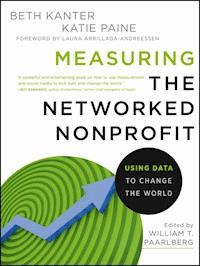
The tools nonprofits need to measure the impact of their social media Having a social media measurement plan and approach can no longer be an after-thought. It is a requirement of success. As nonprofits refine their social media practice, their boards are expecting reports showing results. As funders provide dollars to support programs that include social media, they too want to see results. This book offers the tools and strategies needed for nonprofits that need reliable and measurable data from their social media efforts. Using these tools will not only improve a nonprofit?s decision making process but will produce results-driven metrics for staff and stakeholders. * A hands-on resource for nonprofit professionals who must be able to accurately measure the results of their social media ventures * Written by popular nonprofit blogger Beth Kanter and measurement expert Katie Delahaye Paine * Filled with tools, strategies, and illustrative examples that are highly accessible for nonprofit professionals This important resource will give savvy nonprofit professionals the information needed to produce measurable results for their social media.
Sie lesen das E-Book in den Legimi-Apps auf:
Seitenzahl: 437
Veröffentlichungsjahr: 2012
Ähnliche

















CONTENTS
Figures and Tables
Foreword
Preface: The Queen of Nonprofits Meets the Goddess of Measurement
Acknowledgments
The Authors
Part One: Introduction of Concepts
Chapter One: The Secret Sauce for Nonprofits
The Keys to Nonprofit Success: Networking and Measurement
Momsrising: A Superstar of Networked Nonprofits Knows The Joys of Measurement
Conclusion
Chapter Two: The Rise of the Networked Nonprofit
What is A Networked Nonprofit?
Seven Vital Characteristics of Networked Nonprofits
How Momsrising Generated 100,000 Letters to Congress
Becoming A Networked Nonprofit: The Crawl, Walk, Run, Fly Model
Conclusion
Part Two: Basic Measurement Principles, How-Tos, and Best Practices
Chapter Three: Creating a Data-Informed Culture
Data Informed, Not Data Driven
“Data Informed” Means More Than KPIs and Measurement
Creating Dosomething.org’s Data-Informed Culture
The Stages of Becoming Data Informed: Crawl, Walk, Run, Fly
Becoming Data Informed: Change is Easy With Baby Steps
Conclusion
Chapter Four: Measurement Is Power
Measurement Makes Your Organization Powerful
Katie Paine’s Seven Basic Measurement Steps Remixed for Networked Nonprofits
Getting Alignment: The Hardest Part of Measurement
How to Get Your Organization Started in Measurement
Conclusion
Chapter Five: Don’t Confuse Activity with Results
Our Daily Bread Gets A Rise Out of Facebook
Connecting Your Social Media Program to What Matters to Your Organization
Understanding How to Use ROI
How to Think Strategically About The Value of Social Media for Your Organization
Networked Nonprofits Ask, “What’s The Social Impact?”
A Theory of Change Can Demonstrate The Value of Social Media
Conclusion
Chapter Six: The Ladder of Engagement
The Nonprofit World’s Ladder of Engagement
From Tweet Huggers to Embracing The Habit of Sustainable Living
The Ladder of Engagement, One Step at A Time
Best Friends Moves People From Awareness of Invisible Dogs to Adopting Real Ones
Developing Your Own Ladder: Low, Medium, and High Engagement
Six Steps to Building Your Ladder of Engagement
Conclusion
Chapter Seven: How to Turn Your Stakeholders into Fundraisers
New Tools and Techniques Drive Social Fundraising
Charity: Water Makes A Splash By Turning Friends Into Fundraisers
Autism Speaks Uses Social Fundraising in A Multichannel Campaign: Light It Up Blue
Social Fundraising As Part of Multichannel Integrated Campaigns
Measuring Social Fundraising
Katie’s Kat Shelter Measures A Capital Campaign
Conclusion
Chapter Eight: Measurement Tools
The Indispensable Spreadsheet
The Right Tool for The Job
Tools to Determine What Your Marketplace is Thinking: A Very Brief Guide to Surveys
Conducting Surveys
Seven Steps to Conduct A Survey
A Tool to Measure What People Are Saying About You: Media Content Analysis
Tools to Determine What Your Marketplace is Doing: Web and Social Analytics and Behavioral Metrics
Going Mobile and Measuring It
What Does Measurement Really Cost?
If You Don’t Have An Analytics Guru On Staff: The Analysis Exchange
Educate Yourself About Measurement Tools
Conclusion
Chapter Nine: Measurement and the Aha! Moment
Your Aha! Moments, and How to Get More of Them
How The Smithsonian Shares Departmental Dashboards and Reports
The Power of Sharing Dashboards
The Kat’s Meow: Katie Presents Her Results to The Board of Trustees
Conclusion
Part Three: Advanced Measurement Concepts and Practices for Networked Nonprofits
Chapter Ten: Measuring What Really Matters
The Benefits of Friends: Good Relationships Prove Their Value
Measuring Relationships: The Grunig Research and Relationship Survey
How to Measure The Components of Relationships
How to Measure Relationships in Eight Steps
Conclusion
Chapter Eleven: Understanding, Visualizing, and Improving Networks
The Story of Stuff: Why The Network is The Hero
Social Network Basics
Social Network Analysis: Visualize Your Network to Improve It
Measuring The Value of Networks
Social Network Mapping Tools: How to Visualize Your Networks
Conclusion
Chapter Twelve: Influence Measurement
Influence Redefined (NOT)
How Free Agents Help Networked Nonprofits Change The World
Measuring Who Influences Stakeholders: The Blue Key Campaign
Measurement of Influence
The Leadership Learning Community
Conclusion
Chapter Thirteen: How to Be Naked and Measure It
Greatnonprofits, A Radical Experiment in True Transparency
What Exactly is Transparency?
Learning in Public
The Benefits of Transparency
Measuring Transparency
Katie’s Kat Shelter Measures and Improves its Transparency
Conclusion
Chapter Fourteen: Measuring the Impact of the Crowd
100,000 Cheeks: The Power of Harnessing The Crowd
The Power of Crowdsourcing
Measuring The Advantages of The Crowd
Kitty Kat Krowdsourcing
Conclusion
Epilogue: With Measurement and Learning, Networked Nonprofits Can Change the World
Appendix A: Measuring Relationships and Relationship Research
Appendix B: Crawl, Walk, Run, Fly Assessment Tool for Networked Nonprofits
Appendix C: Social Media Measurement Checklist
Appendix D: A Checklist for Monitoring Services
Glossary
Resources for Tools, Tutorials, and Assistance
Index
MORE PRAISE FOR MEASURING THE NETWORKED NONPROFIT
“Kanter and Paine use their wit and wisdom to make the process of measuring your impact and making change accessible, and even fun!”
—Holly Ross, executive director, NTEN
“Social change organizations just got a yard stick for measuring success and learning from failure.”
—Premal Shah, president, Kiva—Loans That Change Lives
“The book is an invaluable roadmap for moving to data-informed decision-making and producing greater impact for those they serve.”
—Mario Morino, chairman, Venture Philanthropy Partners
“Kanter and Paine share a wealth of insights and practical advice that will enable organizations to truly understand the real impact of their digital and social efforts.”
—Jean Case, CEO and cofounder, Case Foundation
“This book is a gift for those facing the task of measuring nonprofit performance in our complex, interconnected age.”
—Jacob Harold, program officer, William and Flora Hewlett Foundation
“This must-read book for the sector shows how simple yet powerful measurement can help a nonprofit effectively get actionable information to increase impact.”
—Dr. Akhtar Badshah, senior director, Citizenship and Public Affairs, Microsoft
“As nonprofits devote increasing energy to social media, getting measurement right is critical to helping us learn and impact. This book unpacks this daunting subject in a practical and actionable way.”
—Stephen J. Downs, Chief Technology and Information Officer, Robert Wood Johnson Foundation
“Measuring the Networked Nonprofit is more than a ‘how–to,’ it’s a citizen’s owners manual for making change happen.”
—Lucy Bernholz, visiting scholar, Stanford University Center on Philanthropy and Civil Society
“The need to understand how to leverage social networks for measurable impact has never been greater. This pioneering book on the critical topic of measurement will be essential for any nonprofit seeking to be truly effective.”
—Jennifer Aaker, General Atlantic Professor of Marketing, Winnick Family Faculty Fellow for 2011–2012, and Vineet Singal, Stanford alumnus and leader, 100KCheeks campaign
“The combination of nonprofit social media savoire faire and superior measurement discipline in Measuring the Networked Nonprofit makes for an unparalleled discussion about organizational performance.”
—Geoff Livingston, author and marketing strategist
“This book belongs on the shelf of every nonprofit leader. The authors do a great job of clearly laying out practical advice for social media measurement.”
—Ritu Sharma and Darian Rodriguez Heyman, cofounders, Social Media for Nonprofits
“Finally, a user-friendly guide to demystifying measurement, why it matters, and how nonprofits can take it on.”
—Laura L. Efurd, Chief Strategy and Innovation Officer, ZeroDivide
“Data is like fine food: you can enjoy eating it but do you know how to make it? The authors have written the ultimate cookbook!”
—Nancy Lublin,DoSomething.org
“Kanter and Paine present a comprehensive and welcome addition to the social network knowledge base that will serve to awaken the data geek in all of us, tempting us to explore both new tools and networks, while also inspiring us to assess the impact of how these networks are contributing toward our missions and the greater good.”
—Janet Camarena, director, Foundation Center—San Francisco
“Attention everyone who is using social media to do good in the world: This book is your must-have survival guide to measuring what matters.”
—Katya Andresen, COO, Network for Good and author, Robin Hood Marketing
“Hi, I’m Daniel and I’m a recovering measurementaphobic. This book helped me break down walls I had built for forty years.”
—Daniel Ben-Horin, founder and co-CEO, TechSoup Global
“Accelerating external change coupled with new tools for engagement challenges even the most networked nonprofits in making sense of feedback around complex issues. This book is as much about leadership as it is about measuring.”
—Jeff Clarke, interim president and CEO, Council on Foundations
“A timely and valuable contribution to the evaluation, learning, and improvement movement in the social sector.”
—Johanna Morariu, director, Innovation Network
“This book will be a catalyst for nonprofits to power social change because it explains clearly how to use measurement.”
—Wendy Harman, American Red Cross
“Measuring the Networked Nonprofit teaches organizations of all sizes how to be obsessed with impact—for good.”
—Claire Díaz-Ortiz (née Williams), Social Innovation
“If you want to unlock the power of data and measurement to dramatically scale your engagement, fundraising, and impact, this book is your must buy, must read, must apply.”
—Simon Mainwaring, founder, We First and New York Times bestselling author of We First
“If you work in any capacity in the nonprofit sector and think impact measurement is just another burdensome task, this book is for you. It is a guide to finding the joy and inspiration in evaluating the impact of our work.”
—Cheryl Francisconi, director, Institute of International Education, Ethiopia
“Data driven improvements that deliver an emotional punch and improve the bottom-line? Absolutely! Let Katie and Beth show you how it’s done.”
—Avinash Kaushik, author, Web Analytics 2.0 and Web Analytics: An Hour A Day
“Paine and Kanter have created a mind-blowingly useful, practical, valuable guide to making the most of social media for every non-profit interested in getting better at doing good.”
—Jim Sterne, founder, eMetrics Marketing Optimization Summit and chairman, Digital Analytics Association
“This book is a must-read for all nonprofits who care about creating change.”
—Allyson Kapin, partner at Rad Campaign
“This timely and practical book will help networked nonprofits untangle measurement and the big, hairy ‘social media ROI’ question.”
—Steve Bridger, Builder of Bridges
“Nonprofit managers and philanthropists will find practical and insightful recipes and examples for measurement programs that will help their efforts rise above the noise and create real social change.”
—Kami Watson Huyse, CEO, Zoetica
“One of the biggest challenges of leveraging networked approaches to social change is the challenge of measurement. Well, no longer. Thankfully Kanter—the smartest person on this topic—has come to our rescue with a thoughtful, well-informed approach to ‘measuring the networked nonprofit’ that can help us all assess our results, and continuously learn and adapt to increase our impact.”
—Heather McLeod Grant, consultant, The Monitor Institute and author, Forces for Good: The Six Practices of High-Impact Nonprofits
“People always ask me what’s next in social media for social change, and now the answer is simple: Measuring the Networked Nonprofit! This book is exactly what we need, a simple, clear, easy-to-use primer on measuring the use and effect of social media for nonprofits from the two most knowledgeable people on the topic. It’s exactly what we needed when we needed it most.”
—Allison Fine, coauthor, The Networked Nonprofit
“Beth Kanter is widely recognized in the nonprofit sector as the go-to person for understanding both how to use and the implications of social media. With this book, she answers the hardest of our burning questions: ‘But how do I know if my social media strategy is working?’ A must-read for leaders, practitioners, and strategists.”
—Deanna Zandt, author of Share This! How You Will Change the World With Social Networking
Cover design by Jeff Puda
Cover image: © pedrosek/Veer
Copyright © 2012 by John Wiley & Sons, Inc. All rights reserved.
Published by Jossey-Bass A Wiley Imprint One Montgomery Street, Suite 1200, San Francisco, CA 94104-4594–www.josseybass.com
No part of this publication may be reproduced, stored in a retrieval system, or transmitted in any form or by any means, electronic, mechanical, photocopying, recording, scanning, or otherwise, except as permitted under Section 107 or 108 of the 1976 United States Copyright Act, without either the prior written permission of the publisher, or authorization through payment of the appropriate per-copy fee to the Copyright Clearance Center, Inc., 222 Rosewood Drive, Danvers, MA 01923, 978-750-8400, fax 978-646-8600, or on the Web at www.copyright.com. Requests to the publisher for permission should be addressed to the Permissions Department, John Wiley & Sons, Inc., 111 River Street, Hoboken, NJ 07030, 201-748-6011, fax 201-748-6008, or online at www.wiley.com/go/permissions.
Limit of Liability/Disclaimer of Warranty: While the publisher and author have used their best efforts in preparing this book, they make no representations or warranties with respect to the accuracy or completeness of the contents of this book and specifically disclaim any implied warranties of merchantability or fitness for a particular purpose. No warranty may be created or extended by sales representatives or written sales materials. The advice and strategies contained herein may not be suitable for your situation. You should consult with a professional where appropriate. Neither the publisher nor author shall be liable for any loss of profit or any other commercial damages, including but not limited to special, incidental, consequential, or other damages. Readers should be aware that Internet Web sites offered as citations and/or sources for further information may have changed or disappeared between the time this was written and when it is read.
Jossey-Bass books and products are available through most bookstores. To contact Jossey-Bass directly call our Customer Care Department within the U.S. at 800-956-7739, outside the U.S. at 317-572-3986, or fax 317-572-4002.
Wiley also publishes its books in a variety of electronic formats and by print-on-demand. Not all content that is available in standard print versions of this book may appear or be packaged in all book formats. If you have purchased a version of this book that did not include media that is referenced by or accompanies a standard print version, you may request this media by visiting http://booksupport.wiley.com. For more information about Wiley products, visit us www.wiley.com.
Library of Congress Cataloging-in-Publication Data
Kanter, Beth, 1957–
Measuring the networked nonprofit : using data to change the world / by Beth Kanter and Katie Delahaye Paine ; edited by William T. Paarlberg.—First edition.
pages cm
Includes bibliographical references and index.
ISBN 978-1-118-13760-4 (paper), ISBN 978-1-118-26347-1 (ebk.), ISBN 978-1-118-23881-3 (ebk.), ISBN 978-1-118-22541-7 (ebk.)
1. Nonprofit organizations. 2. Social networks. I. Delahaye Paine, Katie, 1952– II. Paarlberg, William T. III. Title.
HD62.6.K358 2012
658.5’036—dc23
2012016809
FIGURES AND TABLES
FIGURES
1.1
Carie Lewis and Bella Celebrate
1.2
The HSUS’s Million Fan Campaign Facebook Page
2.1
Wendy Harman Tweets About the American Red Cross
5.1
The Theory of Change of Grantmakers for Effective Organizations
6.1
Grist’s Ladder of Engagement
6.2
Farming Is the New Hipster Occupation of Choice
6.3
Invisible Dogs Pledge Form
7.1
Autism Speaks’ E-Mail Open Rates
8.1
NTEN Journal Survey
8.2
Feeding America’s: Social Listening Dashboard
8.3
Feeding America’s Facebook Tracking
9.1
A Hospital’s Spider Chart
9.2
The Humane Society’s Infographic to Report Results
9.3
Beth Kanter’s Facebook Insights Dashboard
11.1
Social Network Analysis Map of Tech Soup
11.2
Using Sticky Notes to Map National Wildlife Foundation’s Social Network
12.1
Keywords That the Blue Key Campaign Used to Identify Influencers in Traackr
12.2
Blue Key Campaign Metrics for Tracking Twitter Data
12.3
The Blue Key Team Uses Google Analytics to Analyze Web Traffic
TABLES
4.1
Matching Measurement Tools with Objectives
5.1
Planning the Value of Social Media
8.1
Selecting Measurement Tools to Measure Your Goals
8.2
Comparison of Survey Tools
8.3
Comparison of Manual and Automated Media Content Analysis
B.1
Crawl, Walk, Run, Fly Assessment Tool
FOREWORD
When I think of innovation, three things come to mind: the creation of something new, the renewal of something that already exists, and the emergence of new thinking around existing processes and systems. What’s exciting is that I see all three at work in the nonprofit sector today. It’s a thrilling time. A new culture of innovation is sweeping across the philanthropic landscape, bringing with it dramatically increased potential for social change. Yet the onus is on us—the individuals who work in and support nonprofits—to help that culture establish deep roots. This means building the kind of robust measurement metrics that will empower us to take a hard look at what works and what does not—and then to use that information as the basis for innovation.
• • •
As a philanthropist, social entrepreneur, and academic based in Palo Alto, California, I find myself sitting at the epicenter of innovation: Silicon Valley. I watch enthralled as every day, new technologies, apps, software, and platforms enter our lives, disrupting the old ways and transforming how we work, connect, interact, and give. I see innovation everywhere, and not only among Silicon Valley’s new generation of tech entrepreneurs. It’s also present in the brilliant young minds of the students I teach at Stanford University and its Graduate School of Business, in the approaches to problem solving taken by my partners at SV2 (Silicon Valley Social Venture Fund, the venture philanthropy partnership that I founded), and in the compelling research that informs practice at Stanford PACS (the Center on Philanthropy and Civil Society, which I created and of which I am now chair).
Yet in the world of philanthropy, we often fail to apply innovation to solving social problems. That’s because we rarely find out how our money is being spent, where it’s going to end up, or how it will move the needle on the problems we want to help solve. Innovation is all about finding a better way of doing things. But if you want to find a better way of traveling from where you are now to where you want to be, you need to start by analyzing your current route before you can think about how to improve on it.
The trouble is that our giving tends to be emotionally driven. A 2010 study found that about 65 percent of all individual giving (which makes up more than 80 percent of all American philanthropy) has no research behind it.1 It’s not that we’re not generous—far from it. In 2010 Americans gave more than $290 billion and volunteered over 8 billion hours. More than 1.5 million nonprofits, from large, endowed institutions to small, grassroots organizations, worked tirelessly to make our communities and world a better place. The problem is that we are not maximizing the potential of this generosity.
When donors give without any proof of impact or trying to understand precisely how their gifts bring about change, we put drastic limits on our philanthropic potential. When we give purely based on emotion, we also leave the nonprofits we fund with no incentive to measure or understand that impact. That’s a lose-lose-lose situation: as donors, we lose the chance to improve our giving by making informed decisions; as nonprofit leaders, we lose the chance to make the programs and services we provide more effective; and as citizens of this planet, we lose out on the chance to live in a better world.
There could hardly be a better moment for a book such as this. In her valuable book, The Networked Nonprofit, Beth Kanter and her cowriter, Allison Fine, showed nonprofit leaders across all generations how to use social media for social good.2 Now, in Measuring the Networked Nonprofit, Beth Kanter and Katie Paine have given us a must-read guide for anyone using social media and other tools to improve their work and increase their accountability.
Social change is not about what we hope we achieve but how we are going to achieve it. What is so powerful about Measuring the Networked Nonprofit is that not only does it provide a set of tools for using measurement and data; it also explains how to measure the effectiveness of the different ways of achieving social change.
This book appears at a critical moment. Because of the rapid advance of technology, our world is changing at a pace that’s faster than ever before, and this rate of change is constantly accelerating. Over the past decade, the philanthropic sector has undergone the most profound evolution since modern philanthropy’s invention more than a century ago. And of all the changes we’ve witnessed, perhaps the most radical has emerged in the place where technology, innovation, and philanthropy intersect.
The way we engage in meaningful social change is being fundamentally altered by technology. Technology is increasing access to information and connecting us in ways never before possible. It’s transforming the way we approach problem solving. It’s making it possible to reach billions of people globally through online giving platforms. It’s democratizing our ability to make the world a better place, and social media are among the most powerful technological forces behind this phenomenon.
When it comes to connecting with donors—particularly younger ones and those with modest means—social media can help nonprofits get their message out to hundreds of thousands of individuals, regardless of their location. Nonprofits can use technology not only to solicit thousands of small donations, which can combine to produce extremely large sums, or volunteers; they can also inform and inspire a whole new generation of supporters, who may in turn create social media campaigns among their own networks.
The beauty of social media is that they help us expand our philanthropic potential dramatically. But with it comes a whole new set of challenges, and one of the most pressing is measuring impact. How do we know how many people we are reaching? What types of messages are grabbing people’s attention online and which are falling on deaf ears? How do we assess the effectiveness of a social media campaign?
Measurement entails qualitative and quantitative data, hard and soft metrics. It can be expensive and time-consuming, and it requires deep thought and analysis. Yet without this analysis, we cannot improve our performance. The ability to learn from every gift we give or receive and every program we fund or run is one of the social sector’s greatest areas of untapped potential.
Meanwhile, one of its greatest failures is the incessant reinvention of the wheel. Despite our best intentions, we tend to duplicate efforts that are not successful. The only way to avoid this wasteful, vicious cycle is by learning how to measure our actions and apply our learning to the way we do it the next time. Those who want to make a difference—whether social entrepreneurs; nonprofit staff members, executives, or board members; volunteers; or donors—need to complete an assessment of what they are doing now to inform how they do it in the future.
Of course, many individual donors and nonprofit teams are already practicing data-driven, research-based work and using those data and research to improve their programs and services. These people can serve as inspirations and examples to us all.
And as these individuals would be the first to admit, taking generosity and shared purpose and turning it into social change is far from easy. What I have found, however, is that every time I generate data around a gift I’ve made or understand the impact of a social program I’ve initiated, this measurement shows me that it leads to greater and more meaningful change. The upfront costs of time, intellect, and money are paid back many times over in my increased ability to improve lives and help tackle big problems.
We all need to give in a way that matters more—to shift our giving from reactive to proactive, sympathetic to strategic, isolated to collaborative. We need to become better partners to the organizations that we support, working with them to learn from experience and innovate for the future. Whether we support nonprofits through financial donations, gifts of time or intellectual capital, or the sharing of our networks, we need to give in a way that is far more accountable and measured. Individual lives depend on it, communities depend on it—our world depends on it.
Laura Arrillaga-Andreessen
Stanford Graduate School of Business
Notes
1. Hope Consulting study, “Money for Good,” http://www.hopeconsulting.us/money-for-good.
2. B. Kanter and A. Fine, The Networked Nonprofit (San Francisco: Jossey-Bass, 2010).
PREFACE: THE QUEEN OF NONPROFITS MEETS THE GODDESS OF MEASUREMENT
Beth used to think measurement was the business equivalent of Darth Vader running after her with a radioactive light saber. She had almost flunked math back in eighth grade, and she never lost the sense that anything with data and numbers in it was beyond her ability to learn. She didn’t know her way around a spreadsheet and figured that whatever measurement involved, it was going to be a lot of extra work in any case.
Lesen Sie weiter in der vollständigen Ausgabe!
Lesen Sie weiter in der vollständigen Ausgabe!
Lesen Sie weiter in der vollständigen Ausgabe!
Lesen Sie weiter in der vollständigen Ausgabe!
Lesen Sie weiter in der vollständigen Ausgabe!
Lesen Sie weiter in der vollständigen Ausgabe!
Lesen Sie weiter in der vollständigen Ausgabe!
Lesen Sie weiter in der vollständigen Ausgabe!
Lesen Sie weiter in der vollständigen Ausgabe!
Lesen Sie weiter in der vollständigen Ausgabe!
Lesen Sie weiter in der vollständigen Ausgabe!
Lesen Sie weiter in der vollständigen Ausgabe!
Lesen Sie weiter in der vollständigen Ausgabe!
Lesen Sie weiter in der vollständigen Ausgabe!
Lesen Sie weiter in der vollständigen Ausgabe!
Lesen Sie weiter in der vollständigen Ausgabe!
Lesen Sie weiter in der vollständigen Ausgabe!
Lesen Sie weiter in der vollständigen Ausgabe!
Lesen Sie weiter in der vollständigen Ausgabe!
Lesen Sie weiter in der vollständigen Ausgabe!
Lesen Sie weiter in der vollständigen Ausgabe!
Lesen Sie weiter in der vollständigen Ausgabe!
Lesen Sie weiter in der vollständigen Ausgabe!
Lesen Sie weiter in der vollständigen Ausgabe!
Lesen Sie weiter in der vollständigen Ausgabe!
Lesen Sie weiter in der vollständigen Ausgabe!
Lesen Sie weiter in der vollständigen Ausgabe!
Lesen Sie weiter in der vollständigen Ausgabe!




